Strasbourg, France is a compact, walkable island city on the Franco-German border, with its cathedral and Petite France on one UNESCO-listed island and the Alsace wine country at the door. Most first trips give it two days, or three with an Alsace day trip.
Visitors from North America, the UK or Australia usually reach it through Paris or another major hub, so Strasbourg tends to be one stop on a wider France trip. This guide covers the decisions in the order you make them: whether to go, how long to stay, which season, where to base yourself, how to arrive and what it costs.
Quick Answer
Strasbourg is worth a trip: a compact UNESCO-listed island centre, Franco-German food and architecture, and Alsace on the doorstep. Give the city two days, or three with an Alsace day trip. Market season, from late November until Christmas, changes the trip. It suits first-timers and couples who want a walkable city with a wine region attached.
How We Checked This Guide
This page plans a first visit to Strasbourg at the level of big decisions — trip length, season, where to base yourself, arrival and broad cost — and leaves sight-by-sight lists, hotel picks, day-by-day plans and fare tables to the linked guides.
Alex Perrut, working in tourism since 2015, went over the cathedral and clock rules, the airport rail link and the market season for the Tripstou editorial team; the page itself was written with AI assistance. How that works is set out in our editorial process.
Official sources consulted: Strasbourg Cathedral astronomical clock, Strasbourg Cathedral, Strasbourg-Entzheim Airport, City of Strasbourg Christmas market.
In This Guide
Strasbourg Is Worth Visiting Well Beyond the Christmas Market
Strasbourg is worth visiting in any season. Its island centre is crossed on foot in an afternoon, its table mixes French and German cooking in a way no other French city does, and the Alsace wine villages sit within reach. The Christmas market is the city’s peak, but it is not the reason the city works.
What Strasbourg does best for a first-timer is density. The cathedral, the half-timbered lanes of Petite France, the canals and the grand squares all sit on one island, so a short stay feels full without any transport planning. That same compactness is the limit: past two days, the city starts repeating itself, and the trip needs Alsace to keep moving.
Food is where the border shows most. Winstubs — the small wood-panelled Alsatian taverns — serve choucroute, tarte flambée and baeckeoffe next to Riesling and Gewurztraminer from the region’s own vineyards. Our guide to French regional food places Alsatian cooking among the country’s other kitchens. If you would like someone to walk you through the winstub classics on a first evening, you can reserve a food walk through the old centre.
Plenty of travelers book Strasbourg for the market and leave having liked the city better in the quiet hours after it.
What Strasbourg, France Is Known For: Cathedral, Grande Île, Petite France
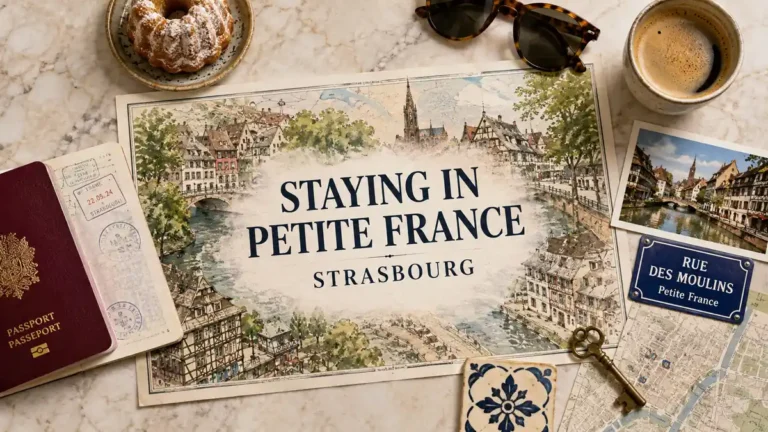
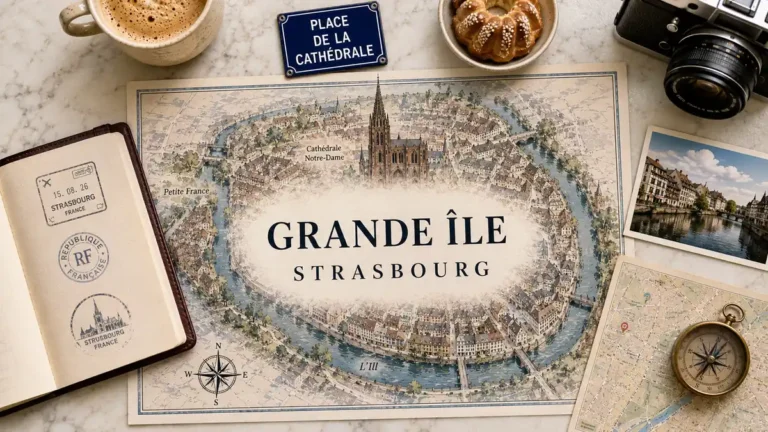
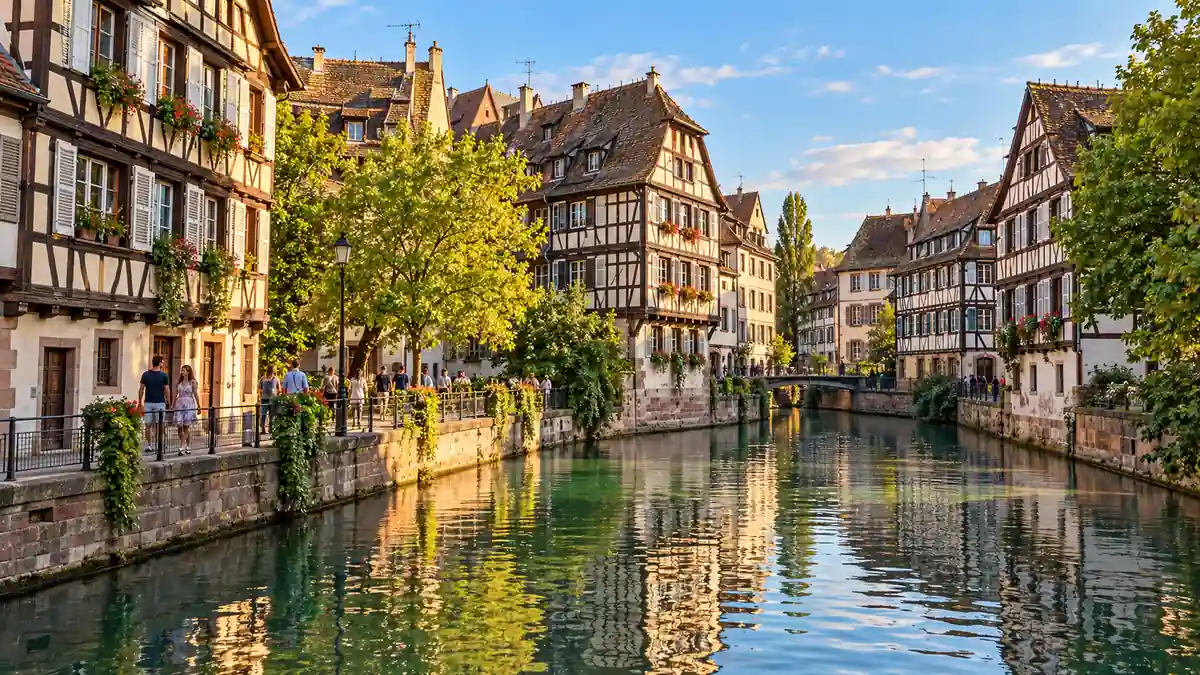
Strasbourg is known for its Gothic Cathedral Notre-Dame and astronomical clock on Place de la Cathédrale, for the Grande Île — the island centre, UNESCO World Heritage-listed together with the Neustadt — and for Petite France, the canal quarter of half-timbered houses, the Ponts Couverts and the Barrage Vauban. The European Quarter, home to EU institutions, is the city’s modern, institutional face.
On the map, these sit close together. The cathedral rises near the eastern side of the Grande Île, with Place Kléber, the main square, a short walk west of it. Petite France fills the island’s south-western tip, where the river splits into canals around the Ponts Couverts and the Barrage Vauban. The train station lies just west of the island, an easy walk in.
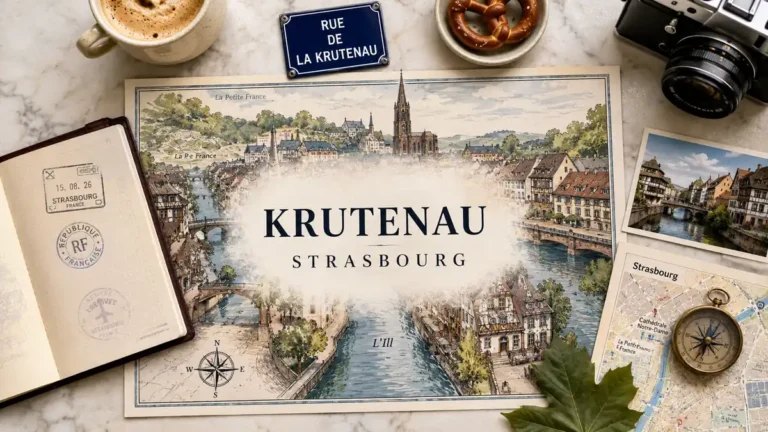
Two areas border the island. The Neustadt, the planned German-era district to the north-east, carries the second half of the UNESCO listing with its broad avenues and monumental buildings. Krutenau, south-east across the water, is the student and bar quarter. The European Quarter lies further out to the north-east, beyond the Neustadt.
The cathedral platform climb starts from Place du Château, on the right side of the cathedral. For the full selection of sights, museums and boat rides, see our guide to things to do in Strasbourg. A guided walk ties the cathedral and Petite France together in one loop, and you can book a guided walk if you prefer the story told on site.
Do you need to book the cathedral or the astronomical clock?
No booking is needed for the cathedral: entry is free, there is no reservation, bags are checked at the entrance, and visitors go in through the south portal. The astronomical clock works differently. Its full automata show runs daily at 12:30, and tickets are sold on the day only, never in advance.
The show is not held on Sundays or feast days that have an 11:00 mass, and it does not run during the Christmas market. Plan the morning around the cathedral if the clock matters to you, because it is the one thing in Strasbourg you cannot secure ahead from home.
Tours and activities
Book skip-the-line tickets, day trips and local tours with free cancellation on most activities.
You can also browse everything on getyourguide.com.
Tripstou may earn a commission if you book through this link, at no extra cost to you.
How Many Days Do You Need in Strasbourg?
Two days is the right length for Strasbourg itself. One day covers the cathedral and Petite France at a rush, and three days lets you add an Alsace day trip without cutting the city short.
The centre is small enough that two days see it properly, with time for a museum, a canal-side lunch and a slow evening in a winstub.
| Trip length | What fits | Who it suits |
|---|---|---|
| 1 day | Cathedral, Petite France and a walk across the Grande Île | Rail travelers stopping between Paris and Germany or Switzerland |
| 2 days | The island at an easy pace, the Neustadt, a museum and the evenings | Most first-timers and couples |
| 3 days | Two city days plus one Alsace day trip to Colmar or the wine villages | Food and wine travelers, anyone using Strasbourg as a regional base |
A third day pays off more outside Strasbourg than inside it: the island runs out of new streets long before Alsace runs out of villages. Our two-day Strasbourg itinerary paces the city visit, and the three-day Strasbourg itinerary shows where the Alsace day slots in.
When to Visit Strasbourg: Two Seasons, Two Different Trips
Spring and early autumn are the best time to visit Strasbourg for a calm city at ordinary prices, and summer gives the longest evenings on the canals. Market season, from late November until Christmas, is a different trip altogether: rooms reprice to a multiple of the ordinary rate, the centre is crowded, and the astronomical clock show is paused.
Spring and early autumn suit first-timers who want to walk the island and see the wine country without queues. Summer is for travelers who like outdoor terraces and late light, and who do not mind more visitors on the squares. Winter outside the market weeks is quiet, cold and good value.
What changes in market season:
- Rooms: prices climb to a multiple of the ordinary rate, so book several months ahead.
- Crowds: the island fills, especially at weekends and in the evenings.
- The clock show: the astronomical clock’s automata show does not run.
The paused clock show is the detail most market visitors discover only once they reach the cathedral. For what the market itself offers, see our Strasbourg Christmas market guide, and compare it with other towns in our guide to Christmas markets in France. For how Strasbourg’s seasons fit a wider route, read the best time to visit France.
Where to Stay in Strasbourg: Grande Île, Krutenau or Near the Station?
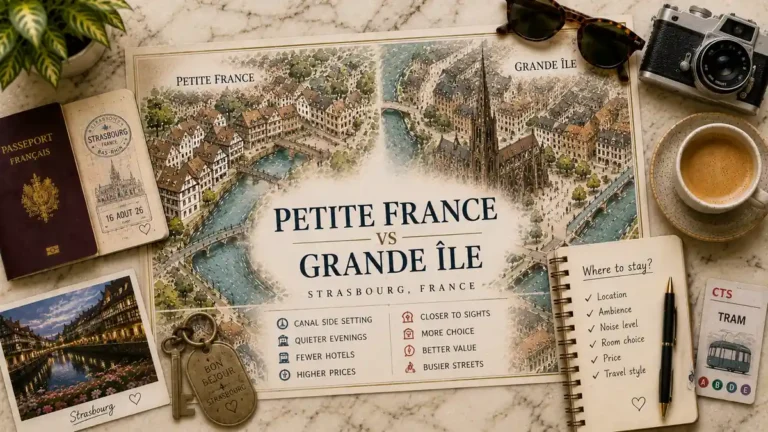
First-timers should stay on or beside the Grande Île: the Petite France side for atmosphere, the cathedral side for having everything on foot. Krutenau suits travelers who want livelier evenings and better value, and the station area only makes sense when the trip is built around day trips by train.
Your area choice follows how you travel:
- First visit: the Grande Île puts the cathedral, Petite France and the evening restaurants within a short walk; our guide to where first-time visitors should stay in Strasbourg narrows it down.
- Couples: the canal-side lanes around Petite France are the quietest after dark; see where couples should stay in Strasbourg.
- Families: flat streets and short distances favour the island and its edges; compare areas in where families should stay in Strasbourg and hotels in our best family hotels in Strasbourg.
- Tight budget: the station side and Krutenau trade a few minutes of walking for lower rates; our budget stay guide for Strasbourg covers both.
- Luxury: heritage and design hotels cluster on the Grande Île; see where to stay in Strasbourg for luxury.
- Nightlife: Krutenau has the student bars and late kitchens; our Strasbourg nightlife stay guide explains which streets.
The Neustadt is a calmer option just north-east of the island, handy for repeat visitors. For the full area-by-area comparison, read our guide to where to stay in Strasbourg.
Hotels and places to stay
Compare hotels, apartments and stays for your dates in one search.
Search hotels and stays on hotels.com →
Tripstou may earn a commission if you book through this link, at no extra cost to you.
How to Get to Strasbourg, France (and From the Airport Into Town)
Most long-haul visitors reach Strasbourg by direct high-speed train from Paris, arriving at Strasbourg station on the edge of the centre. The city’s own airport, Strasbourg-Entzheim (SXB), connects to that station by a shuttle train that takes 8 minutes, with up to 5 trains an hour and a covered walkway from the terminal to the platform.
The Paris rail route is the natural choice for anyone building Strasbourg into a wider France trip, since the station drops you a walk or a short tram ride from the Grande Île. SXB makes sense for a regional flight connection. Frankfurt and Basel are other hubs with rail links to Strasbourg, useful when your long-haul flight lands there.
For fares, the bus and taxi options from SXB and how they compare, see our Strasbourg airport transport guide. If Strasbourg is one stop on a rail tour, our France train itinerary shows how it links with other cities.
Check the entry rules that apply to your passport before booking.
Getting Around Strasbourg: Walk the Island, Tram for the Rest
Walking covers the Grande Île from end to end. The tram is for the station, the European Quarter and the hop across the Rhine to Kehl in Germany, and bikes suit the flat streets along the canals.
Most first-timers ride the tram only a few times. It earns a ticket on arrival day with luggage, for a visit to the European Quarter, or for an afternoon in Kehl; inside the island, walking is quicker than waiting at a stop. Cycling works well here because the city is flat and has dedicated lanes, though the busiest lanes of Petite France are easier on foot.
Our Strasbourg transport guide covers tickets, passes and the City Card. Strasbourg is a calm, orderly city to move around; our practical Strasbourg advice covers local habits and etiquette.
Is Strasbourg Expensive?
Strasbourg is moderately priced in ordinary season: cheaper than Paris and in the middle of French city costs. Market season is the exception, when accommodation reprices to a multiple of the ordinary rate.
| Spend style | Daily band | What it buys here |
|---|---|---|
| Budget | Roughly €60–100 per person per day, ordinary season, excluding travel to Strasbourg | Hostel or simple room off the island, bakery lunches, one winstub meal, walking |
| Mid-range | Roughly €150–200 per person per day, ordinary season | Central hotel, sit-down meals with Alsace wine, a museum, the odd tram |
| High-end | No daily figure | Heritage or design hotels, tasting menus, Grand Cru wine lists, at a ceiling lower than Paris |
The calendar sets a Strasbourg budget more than spend style does: in market weeks, the same room can cost a multiple of its ordinary rate, so book several months ahead. Our Strasbourg trip cost guide breaks the daily bands down, and the France trip cost guide shows how Strasbourg compares with the rest of the country.
Which Day Trips From Strasbourg Are Really Day Trips?
The easiest day trips from Strasbourg lie on the rail lines running south towards Colmar: Obernai and Sélestat are the closest, then Colmar. The Wine Route villages and Haut-Koenigsbourg need a connection, a tour or a car, while the German side and Basel are possible but longer and not first-trip picks.
Ranked from easiest to most demanding:
- Obernai and Sélestat: the closest by train, small and walkable, a relaxed half-day or full day.
- Colmar: a straightforward train day, and the most rewarding single town in Alsace after Strasbourg.
- Haut-Koenigsbourg with Riquewihr and Kaysersberg: the classic guided Alsace day. The hilltop castle and the two wine villages are hard to link by public transport in one day, so a tour or a car does it best.
- A Wine Route tasting day: the wineries need a driver who is not drinking, which makes a guided tasting trip the practical choice.
- Kehl, Baden-Baden and the Black Forest: Kehl is a tram hop across the Rhine; Baden-Baden and the Black Forest take longer and suit a second visit.
- Basel: doable, but a long day that belongs on a route, not a first Strasbourg stay.
Wine Route tastings leave from Strasbourg with the driving handled, so if you want the cellars without the car, you can book a tasting day with transport included.
What to see in each village sits in our Alsace travel guide. Wine travelers will find the region’s grapes and styles in our guide to France’s wine regions, and drivers can plan the Wine Route itself with our France road trip guide.
Who Strasbourg Suits Best (and Who Will Want More Than the City)
Strasbourg suits first-timers, couples and food travelers best on its own. Christmas-market seekers need to plan around the season, families do well in the flat walkable centre, and anyone who wants more than two days should build Alsace into the trip.
First-timers get a European city that is easy to read in a weekend, with nothing to master before arriving. Couples find the canals, the winstubs and the evening light in Petite France hard to beat. Food travelers come for a cuisine that is neither fully French nor fully German, with the vineyards close enough to visit.
Families benefit from short distances and car-free streets, though small children tire of cathedral interiors fast. Market seekers get the atmosphere at its peak, in exchange for the crowds and room prices that come with it. Travelers wanting cities, nightlife or museums for a week will find Strasbourg small and should pair it with Alsace or another French city.
Solo travelers find Strasbourg relaxed and easy to navigate; women travelling alone can read our France solo female safety guide. Our Strasbourg safety guide covers the city in detail, and the guide to common scams in France lists what to watch for in busy tourist spots.
What to Remember When You Book
- Give Strasbourg two days for the city and add a third only for an Alsace day trip, because the island runs out of new streets before the region runs out of villages.
- Market season, from late November until Christmas, reprices rooms to a multiple of the ordinary rate, so book accommodation several months ahead if you want the market.
- The astronomical clock’s 12:30 show cannot be booked from home: tickets are sold on the day only, and the show does not run during the Christmas market.
- A base on or beside the Grande Île gives first-timers the cathedral and Petite France on foot, while Krutenau trades a short walk for livelier evenings and better value.
- Long-haul visitors usually arrive by direct high-speed train from Paris, and Strasbourg-Entzheim airport is 8 minutes from the city’s station by shuttle train.
- Obernai, Sélestat and Colmar are the easy train day trips, while Haut-Koenigsbourg and the Wine Route villages work best with a tour or a car.
Strasbourg Questions First-Timers Ask
Is Strasbourg in France or Germany?
Strasbourg is in France. It is the largest city in Alsace and sits on the Rhine, which forms the border with Germany; the German town of Kehl lies directly across the river. The city changed hands between France and Germany more than once, which is why its architecture and its food mix the two.
Do you need to speak French in Strasbourg?
No. Hotels, museum desks and most restaurants on the tourist circuit can usually manage English, and German is widely understood this close to the border. A few words of French — bonjour when you walk into a shop, merci when you leave — still go a long way in winstubs and small shops.
Can you pay by card in Strasbourg?
Yes. Cards, including contactless payment, are accepted in most hotels, restaurants and shops. Keep a little cash for small purchases at market stalls and for the occasional small café or winstub that prefers it.
Where to Go Next in Alsace and France
- Alsace travel guide: the region Strasbourg opens, from Colmar to the wine villages.
- France travel guide: the country-level planner for a first trip.
- France itinerary planner: how to build a route around Strasbourg and other regions.
- 7-day France itinerary: a one-week route for a first visit.
- 10-day France itinerary: room for Paris, Alsace and one more region.
- 14-day France itinerary: two weeks across several regions.
- Best places to visit in France: where Alsace sits among the country’s highlights.
- Best time to visit France: seasons across the country, region by region.
- France packing list: what to bring, including for a cold market-season trip.
- Best beaches in France: if you are pairing Alsace with the coast on a longer France trip.
Did this guide save you time or money? Tripstou is independent and reader-funded — if you'd like to give something back, you can support the site with a crypto contribution of any size.