The hard part of a first Portugal trip is rarely finding things to do. The decisions that take the time are how long to go for, which regions to pick, and how to move between them without spending half the trip in transit. The country is small enough to tempt you into covering all of it, and varied enough that trying is a mistake.
This guide resolves that sequence in the order the decisions actually arrive: whether Portugal suits the trip you have in mind, how many days it needs, where to go first, when to go, whether you need a car, roughly what it costs, and what catches first-timers out. Each of those decisions has a dedicated guide on this site, and this page hands you off at the point where the detail starts to matter.
Portugal is an easy first European trip. It is compact, it pays in euros, it sits inside the Schengen area, and English goes a long way in the places most first trips visit.
Quick Answer
Pair Lisbon with one other region — Porto and the north, or the Algarve — not the whole country. A week buys one pairing properly; ten days to two weeks adds a third region or an island group. Lisbon plus Porto by direct train is the strongest first-time shape; Madeira and the Azores are a separate trip.
Trust Layer
Tripstou country guide for travelers planning a trip across a whole country. Covers route direction, trip length, season, budget, bases, and transport tradeoffs.
Produced with AI assistance and reviewed by Alex Perrut, working in tourism since 2015, for the Tripstou editorial team. See our editorial process for details.
Last factual review: September 17, 2026.
Official sources consulted: Visit Portugal, Turismo de Portugal.
Key Takeaways
- Pair Lisbon with one other region on a first trip; two regions done properly beat five rushed ones.
- About a week buys one pairing, ten days adds both big cities, and two weeks allows a third region.
- Start in Lisbon if the trip is short, and add Porto once you have a full week to spend.
- Skip the car for Lisbon, Porto and the train between them; hire one for the Douro, Alentejo or Algarve interior.
- Spring and autumn suit a first trip best; summer belongs to the beaches, and winter to the cities and Madeira.
- Daily costs sit below most of western Europe, though central Lisbon and the summer Algarve close that gap fast.
Table of Contents
Is Portugal Worth Visiting, and What Is It Known For?
Portugal is worth visiting because it packs cities, wine country, Atlantic coast and islands into one compact country. It suits first-time Europe travelers, anyone who wants a mixed city-and-coast trip, and slower travelers who prefer two regions done properly to five done fast. Two of those regions fit comfortably into a week.
What Portugal is known for is specific, not generic. Lisbon’s hills and river light. Porto and the terraced Douro valley behind it. The Algarve’s ochre cliffs and cove beaches, Sintra’s palaces in the hills, the Alentejo’s slow cork-and-wheat interior, Madeira’s levada walks along mountain irrigation channels, and the Azores’ volcanic crater lakes.
Food carries the other half of the reputation. Grilled fish and shellfish, pastéis de nata, the long-cooked stews of the interior and vinho verde in the north define the country more reliably than any monument, with fado and azulejo tilework holding up the cultural side. The Portugal food guide covers eating properly, things to do in Portugal handles experiences, and hidden gems in Portugal picks up the places that never make a shortlist. One convention to expect at the table: the bread and olives that arrive unasked — the couvert — are charged if you eat them.
Set expectations on three things before booking. The sea is Atlantic — cold for most of the year, with real currents and lifeguard flags that mean what they say. The cities are steep and paved in polished calçada, so walking days cost more effort here than their distances suggest. The interior is genuinely quiet, which is the whole point for some travelers and a problem for others.
Portugal suits you less if you want warm swimming water everywhere, or want the entire country in five days. Neither is on offer.
How Many Days You Need in Portugal
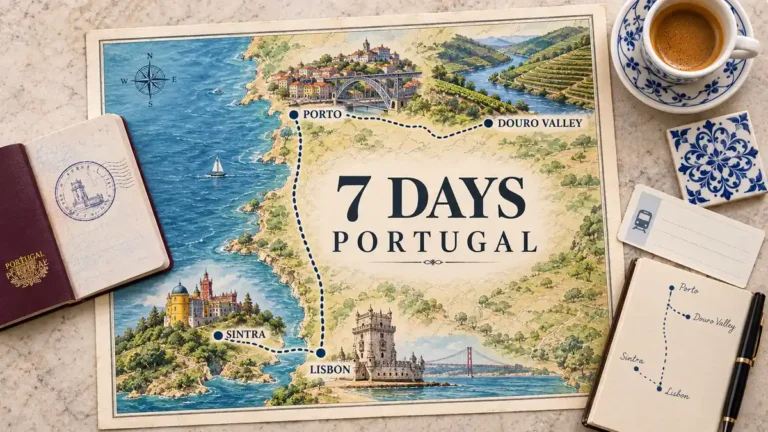
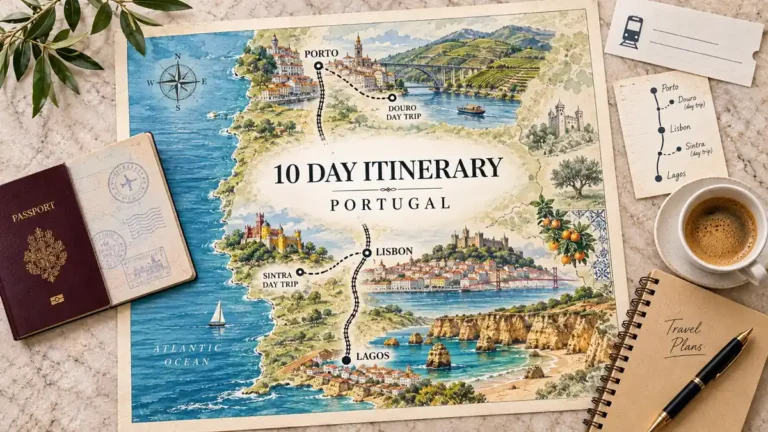
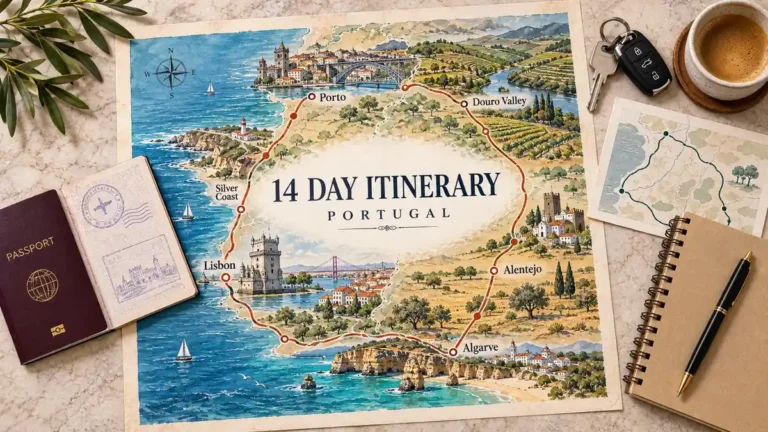
A week covers Lisbon and one more region; ten to fourteen days adds the north or the Algarve without rushing. About a week is the realistic floor for a first trip that still feels unhurried. Two weeks or more is where a third region, or one island group, stops being a stretch.
- About a week — the Lisbon region plus one of either Porto and the Douro or the Algarve. Suits a first visit where one main city, one day-trip zone and a single change of base is the whole plan.
- About ten days — Lisbon, Porto and the Douro, plus one coastal or interior add-on such as the Silver Coast or Évora. Suits travelers who want both big cities without cutting either short.
- Two weeks or more — north to south with the Alentejo in the middle, or the mainland plus one island group. Suits a slow first trip, or a return visit filling in what a week left out.
The standard mistake is fitting Lisbon, Porto and the Algarve into a single week. It works on paper and costs two full travel days plus most of the depth, so pick two of the three and let the third wait. This is the pacing decision the rest of the trip is built on.
The distances are short; the transitions are not. Portugal reads as a small country on a map, and it is — but Porto and the Algarve sit at opposite ends of it, and almost everything worth stopping for in between is inland, away from the fast line. If you want the day-by-day version of any of these shapes, the Portugal itinerary guide lays out the routes.
Where to Go First: Cities, Coast or Islands
Go to Lisbon and Porto on a first trip; add the Algarve for beaches or the Alentejo for the interior. Madeira and the Azores are worth going for on their own terms, as a separate trip. Two regions done properly beat five skimmed, whatever the map suggests.
Porto and the North — a compact city built into a gorge above the Douro, with the terraced wine valley an easy move upriver and the green Minho and Braga further north. The draw is the river: port lodges in Gaia, then vineyards falling to the water. Best for: travelers who want a city and wine country within reach of each other.
Centro — Coimbra’s university city, the surf towns of the Silver Coast and the mountains of the Serra da Estrela. It is the stretch of mainland Portugal most first trips drive straight through, and the reason to stop is the monastery towns and a coastline with far fewer people on it. Best for: breaking the run between Lisbon and Porto.
Lisbon region — a capital spread over hills above the Tejo, with Sintra’s palace-covered ridge, the Cascais and Estoril coast and the surf beaches of Caparica all reachable as days out. It is the country’s best-connected arrival point. Best for: a first trip that needs one base and several different kinds of day.
Alentejo — the slow interior of cork oaks, wheat plains and whitewashed hill towns such as Évora and Monsaraz, plus a wild and barely developed coast. Nothing here rewards hurry, and most of it needs a car. Best for: travelers who want wine, quiet and space between stops.
Algarve — the southern coast, with ochre cliffs and cove beaches in the west around Lagos, long sandbar beaches in the east near Tavira, and the calmest sea in the country. It is also the busiest region in summer by a wide margin. Best for: a beach-led stretch at the end of a trip.
Madeira — a subtropical volcanic island reached by air, built around levada walks, high mountain ridges and a mild climate year-round. Swimming happens in sea pools and a short list of beaches. Best for: walkers who want warmth outside the summer months.
Azores — a mid-Atlantic archipelago reached by air, made of crater lakes, hot springs, whale watching and green volcanic landscape across nine islands, of which São Miguel is the usual first. The weather changes constantly and fast. Best for: travelers who prioritise landscape and wildlife over cities and beaches.
| Region | First-trip role | Trip length it needs | Car needed? |
|---|---|---|---|
| Lisbon region | Default first base and usual arrival point | Works as the core of any trip length | No, for the city and its day trips |
| Porto and the North | Second city, with wine country attached | Earns its place from about a week | Only beyond the Douro river towns |
| Algarve | Beach stretch, usually closing the trip | Needs several unhurried days to pay off | Yes, outside the main coastal towns |
| Alentejo and Centro | Slow interior between the two cities | Best added at ten days or more | Yes, for practically everything inland |
| Madeira and Azores | A trip of their own, reached by air | Deserves a week to itself | Yes, once you leave the main towns |
Portugal’s regions are not evenly served by the rail network, and that quietly decides the shortlist: Lisbon and Porto are the only pair you can combine without driving, so every other combination adds a hire car to the plan and the budget.
Pick the region first, then the places inside it. The best places to visit in Portugal handles the choosing at town and sight level, Portugal’s islands sets Madeira against the Azores properly, and the best beaches in Portugal sorts which coast matches the kind of swimming you have in mind.
Tours and activities
Book skip-the-line tickets, day trips and local tours with free cancellation on most activities.
You can also browse everything on getyourguide.com.
Tripstou may earn a commission if you book through this link, at no extra cost to you.
Lisbon or Porto for a First Visit?
Start in Lisbon on a first trip under a week, and add Porto as soon as you have seven days. Lisbon has the flight connections, the widest spread of day trips and the most to see. One condition flips it: a Douro-led or slower, smaller-city trip should start in Porto.
- Choose Lisbon if your trip is short, you are flying in from outside Europe, or you want variety from a single base — the city itself, Sintra, the Cascais coast and the Caparica beaches all work as days out. The tradeoff is scale: it is bigger, busier and steeper than most people picture.
- Choose Porto if you want a city you can cross on foot, the Douro valley on the doorstep, and a quieter, more domestic feel. The tradeoff is reach: fewer long-haul flights land here, and the day-trip menu is narrower unless you head up the river.
With seven days or more, do both. The two sit on the same direct rail line, which makes the pair the easiest two-base trip in the country: no car, no internal flight, one train. A third base only earns its place at ten days and above, and it should change the register of the trip — the Algarve for the coast, the Alentejo for the interior, never a third city of the same kind.
The honest split is this. Lisbon can absorb an entire trip on its own; Porto rarely needs more than a few days before it starts repeating itself. That asymmetry is exactly why the pair works so well at a week, and why the short trip starts in the capital. Which mode makes sense between them is the next decision.
How to Get Around Portugal: Train, Car or Bus
You don’t need a car for Lisbon, Porto and the train between them. You do need one for the Douro, the Alentejo and the Algarve beyond the coastal towns. Trains link the main cities, buses fill the gaps, and a car unlocks everything inland and off the rail line.
- Train — best for city-to-city travel along the Lisbon–Porto corridor and down into the Algarve, and for anyone who does not want to drive in a Portuguese city. Tradeoff: coverage thins away from those two lines, and the towns the network misses are often the ones worth stopping in.
- Car — best for the Douro, the Alentejo, the Algarve interior and the mountain roads of the Centro, where the driving is part of the point. Tradeoffs: steep, narrow city streets and awkward parking, plus electronic-toll-only motorways that have no booths and take no cash, so a rental needs an activated payment method before you use them.
- Bus — best for reaching towns the railway skips and for keeping inter-region travel cheap. Tradeoff: slower than the train on the main corridor, with thinner departures once you leave it.
A car stops being optional once the plan includes any of these:
- the Douro valley beyond the river towns the train reaches
- the Alentejo’s hill towns and the Costa Vicentina
- the Algarve’s western capes and the beaches between the resorts
- the Serra da Estrela and the interior of the Centro
Most first trips end up hybrid: train between the cities, then a hire car collected for the one region that needs it and dropped before the next city. Paying for a car that sits parked for three days is the commonest quiet waste on a Portugal budget.
Match the mode to the trip shape before booking anything. A Portugal train itinerary shows what a rail-only trip can realistically reach, and the Portugal road trip guide covers the routes and the toll mechanics — which payment method to set up, and how — in the detail this page deliberately leaves out.
How do you get from Lisbon to Porto?
The direct train is the default for a first trip. It links the two cities without a car, a transfer or an internal flight, which makes it the simplest leg of the whole trip. Drive only if the Douro or the Silver Coast is on your route. The bus is the budget fallback.
When to Go to Portugal
Spring and autumn are the best all-round seasons for a first Portugal trip. Summer is for the beach and the islands, and it is the busiest and hottest stretch, especially inland and in the Algarve. Winter suits the cities and Madeira, with short days and Atlantic rain in the north.
Let the shape of the trip decide the season. A city-led trip through Lisbon and Porto works at any time of year and is at its most comfortable in spring and autumn, when the walking is pleasant and the queues are short. A beach-led trip needs summer or its edges, because the Atlantic stays cold and the resort towns run on a season. An island trip inverts the rule: Madeira is a genuine winter destination, while the Azores are steadiest in the warmer half of the year. For the month-level view, including which shoulder weeks actually hold up, see the best time to visit Portugal.
How Much a Trip to Portugal Costs
Portugal is one of western Europe’s less expensive countries, with Lisbon and the summer Algarve as the exceptions. Food, wine, transport and entry fees run below the western European average almost everywhere. Accommodation is where the gap narrows, and in the islands and peak-season Algarve it closes entirely.
- Budget — hostel dorms and simple guesthouses, lunch at the daily-menu places locals use, trains and buses between regions. Portugal is unusually kind at this level, because eating well cheaply is still normal here in a way it has stopped being across much of western Europe.
- Mid-range — small hotels and apartments, a mix of casual and sit-down dinners, an occasional hire car for the region that needs one. Most first trips land here, and this is where the city gap shows up hardest: the same standard costs noticeably more in central Lisbon than in Porto or the Alentejo.
- High-end — design hotels, converted pousadas and quintas, tasting menus, private Douro and wine experiences. Portugal is punishing in one specific way at this level: supply is thin outside Lisbon, the Algarve and Madeira, so the top end books out early and prices hard in season.
As a rough frame only, budget travel works out at roughly €40–€70 per person per day, mid-range at roughly €100–€160, and the high end well above both. Treat these as ranges for sanity-checking a plan and verify current prices before booking. Some municipalities also add a small nightly tourist tax, collected by your accommodation and usually not shown in the headline booking price.
Timing moves this budget more than travel style does. The same Algarve room in high summer and in spring is effectively two different products at two different prices, and no amount of economising elsewhere closes that gap. The real breakdown — what accommodation, food, transport and activities actually absorb across a trip — sits in the Portugal trip cost guide. Non-EU travelers buying anything substantial should also read the Portugal VAT refund guide before leaving the shop, because the paperwork starts at the till.
What You Need Before You Travel to Portugal
Portugal is in the Schengen area and pays in euros. What you need to enter therefore depends on your nationality, not on Portugal: most short-stay visitors travel on a passport, with a Schengen visa or nothing further. Non-EU arrivals are now registered biometrically at the border instead of stamped. Visa-exempt visitors should confirm whether the ETIAS travel authorisation applies to their trip before booking.
- Entry detail — passport validity, how short-stay time is counted, and where the ETIAS authorisation will fit once it starts are covered in Portugal visa requirements.
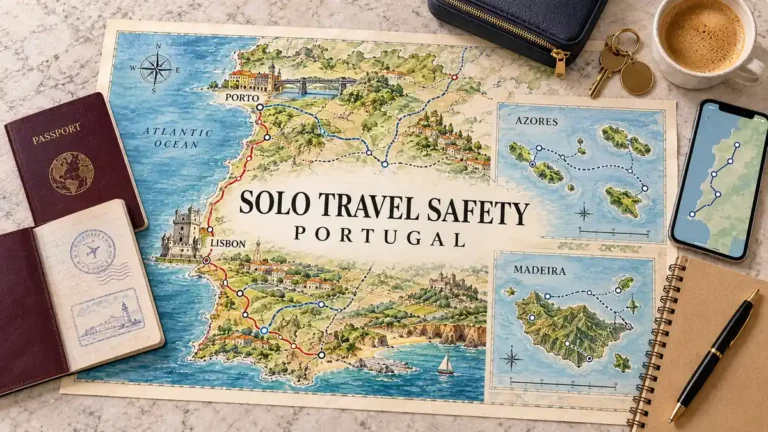
- Safety — Portugal is a low-risk country for travelers, and the real issues are pickpocketing in tourist zones and Atlantic currents at unguarded beaches, handled in detail in Portugal safety.
- Insurance — what is worth covering, and whether a European health card does the job on its own, is set out in Portugal travel insurance.
- Connectivity — compare a local plan in Portugal SIM cards with the install-before-you-fly route in the best eSIM for Portugal.
- Longer stays — anyone thinking past a holiday, including remote workers, should start with Portugal for digital nomads.
What First-Timers Get Wrong in Portugal
Most first-trip mistakes come from expecting a Mediterranean country and packing the itinerary like one. The recurring ones are the whole-country sweep, the cold Atlantic, the hills and polished pavement underfoot, and arriving without the practical set-up sorted. None of them are surprises; they are the things generic guides smooth over.
- The whole-country sweep. Covered above: pick two regions and let the rest wait for a second trip.
- The sea is Atlantic. Water temperatures stay bracing on the west coast even at the height of summer, and beach flags and currents are taken seriously for good reason. The eastern Algarve gives you the warmest water in the country, and it is still an ocean.
- The hills and the calçada. Lisbon and Porto are built on slopes and paved in polished limestone cobbles that turn slick in rain. Grippy shoes matter more here than in most European cities, and the Portugal packing list covers what actually earns space in the bag.
- The dining rhythm. Dinner starts later than northern Europeans expect, the couvert on the table is charged if you eat it, and smaller towns go genuinely quiet on Sundays.
- The practical set-up. Tolls on a rental car and air conditioning that may simply not be there both catch people out late. Each is worth checking before you commit.
Portugal is one of the easiest countries in western Europe to arrive in and one of the most tiring to walk around once you have. Budget for the effort; the paperwork is the easy part. The Portugal travel tips guide collects the ground rules in one place, from etiquette to the small practical habits that make the country easier to travel.
Frequently Asked Questions
Do people speak English in Portugal?
Yes, English is widely spoken in Lisbon, Porto, the Algarve and most tourist areas, especially by younger people and anyone working in hospitality. Portuguese is the official language, and English thins out in the interior and in smaller towns, so a few basic phrases go a long way.
Can you pay by card everywhere in Portugal?
Cards work almost everywhere in cities, hotels, restaurants and tourist areas, and contactless payment is standard. Carry some cash anyway. Small rural cafés, market stalls, a few guesthouses and some parking machines still prefer it, and cash is useful once you leave the main towns.
Do you tip in Portugal?
Tipping is optional in Portugal and nothing like the obligation it is in North America. Rounding up the bill or leaving small change for good service in a restaurant is normal and appreciated. Service staff are paid a wage, so nobody expects a set amount.
What plug adapter do you need in Portugal?
Portugal uses the continental European two-round-pin sockets, Types C and F, shared with Spain, France and Germany, at European mains voltage. Travelers from the UK, Ireland, North America and Australia need an adapter, and North American devices also need to be dual-voltage or run through a converter.
Is tap water safe to drink in Portugal?
Yes, tap water is safe to drink across mainland Portugal and on both island groups. It is treated to European standards and locals drink it. Some travelers find the taste changes from region to region and buy bottled water for that reason, which is a matter of taste, not safety.
Do you pay tolls in a rental car in Portugal?
Yes. Several Portuguese motorways are electronic-toll-only, with no booths and no cash accepted, so a rental car needs an activated payment method before you drive them. Rental companies offer a toll transponder or a card linked to the number plate; arrange it at pickup, because there is no roadside alternative.
Are shops open on Sundays in Portugal?
Many independent shops close on Sundays, particularly in smaller towns, where the whole high street can feel shut. Shopping centres, supermarkets and shops in tourist areas generally stay open. Some smaller businesses also close for a long lunch break during the week, so plan errands around the middle of the day.
Do hotels in Portugal have air conditioning?
Not reliably. Larger and newer hotels usually have it, but guesthouses, apartments and converted historic buildings often rely on thick walls, shutters and cross-ventilation instead. Inland summers get genuinely hot, so check the listing before booking if you are travelling in the hottest months and need cooling.
Related Guides
- Portugal itinerary — day-by-day routes for a week, ten days and two weeks.
- Best places to visit in Portugal — choosing towns and sights inside the region you picked.
- Portugal trip cost — the full breakdown behind the spend styles above.
- Best time to visit Portugal — the month-level view of weather, crowds and prices.
- Portugal road trip — routes, driving conditions and how the toll system works.
- Portugal travel tips — the ground rules for eating, tipping, etiquette and daily practicalities.
Did this guide save you time or money? Tripstou is independent and reader-funded — if you'd like to give something back, you can support the site with a crypto contribution of any size.