France has four coastlines with almost nothing in common, and “best beach” means something different on each one. A Corsican cove, a Riviera club beach, a Basque surf break and a granite headland in Brittany are all honest answers to the same question — for four completely different travelers. Ranked lists of twenty beaches hide that, because they line up places that were never competing for the same trip.
This guide does the opposite. It gives you a short, named shortlist grouped by coast, and the selection logic to choose a coast before you choose a beach. Every pick carries the condition that makes it the right call, so you can leave with two or three coasts on your list and one obvious place to plan from.
Quick Answer
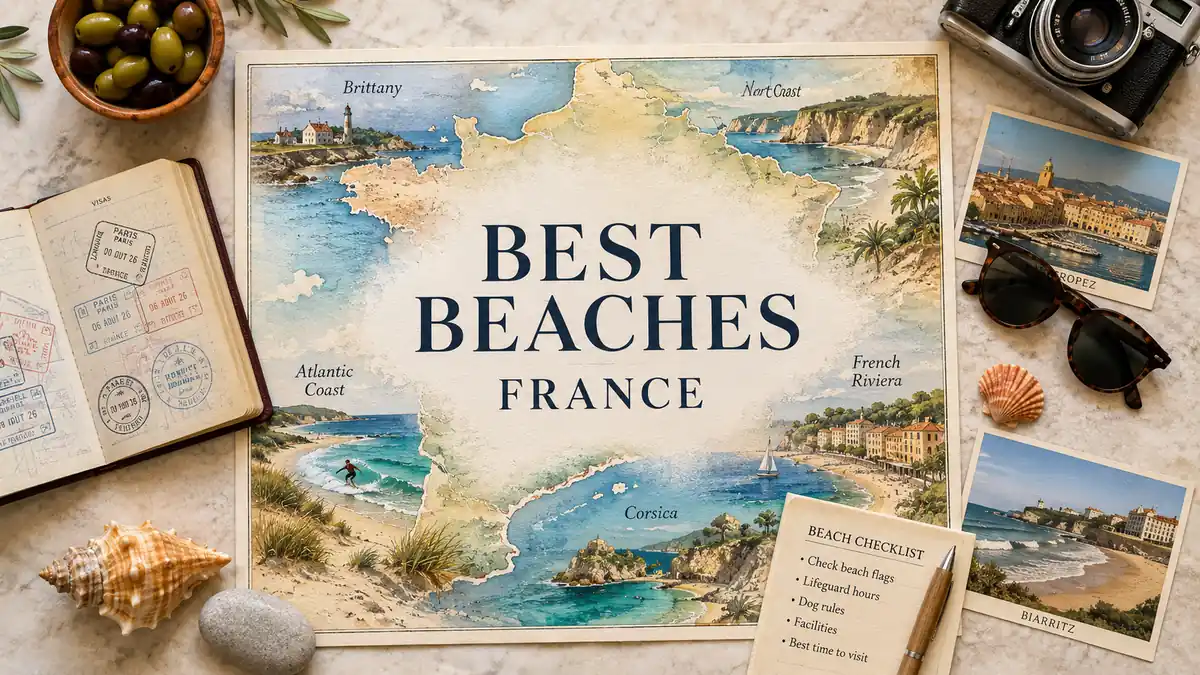
France’s best beaches span four coasts: Palombaggia in Corsica, Pampelonne near Saint-Tropez, and Biarritz’s Côte des Basques. The real choice is coast character: warm calm Mediterranean water, Atlantic surf and space, or the wild scenery of the north. Head south for warmth and glamour, west for surf and dunes, north for drama and fewer crowds.
Trust Layer
Tripstou selection guide for travelers choosing between multiple places. Covers selection criteria, traveler fit, and trip value.
Produced with AI assistance and reviewed by Alex Perrut, working in tourism since 2015, for the Tripstou editorial team. See our editorial process for details.
Last factual review: August 4, 2026.
Official sources consulted: France.fr, Atout France.
Key Takeaways
- France has no single best beach; the coast you choose decides far more than the beach name you pick.
- The Mediterranean gives the warmest, calmest water and the heaviest crowds, and it is the one coast where renting a lounger is normal.
- Choose the Atlantic southwest for real surf, kilometre-long beaches and space, accepting cooler water and stronger currents in return.
- Brittany and the north trade swimming for scenery: pink granite, chalk cliffs and empty sand even in peak summer weeks.
- Corsica outclasses the mainland for sand and water, and the price of entry is a ferry or a flight.
- French sand is public and free everywhere, though a few headline coves now require a free timed reservation in peak summer.
Table of Contents
Which French Coast Has the Best Beaches for You?
The Mediterranean, the Atlantic southwest, the northern coast and Corsica each suit a different kind of trip. Water warmth, surf, crowd pressure and scenery are the four variables that decide. Pick the coast first, then the beach — choosing a famous name before the coast is what wrecks beach trips in France.
Water temperature is the cleanest split. In a typical summer the Mediterranean sits at roughly 22–27°C, warm enough that swimming is the default activity and stays comfortable into the evening. The Atlantic runs cooler over the same months, roughly 18–22°C, which most people still swim in happily but few describe as bath-like. The Channel and Breton coasts are colder again. Treat all of these as ranges shaped by the year and the exact stretch of coast, not as fixed numbers.
Crowd pressure follows the same geography. July and August compress most of France’s own holidays into the same weeks and the same southern coastline, which is a structural condition of French beach travel rather than a bad-luck event. The Mediterranean absorbs the most of it, the Atlantic spreads visitors across far more sand, and the north stays comparatively empty even in peak weeks.
Traveler fit then routes you into one of the groups below. Families who want calm, shallow, warm water lean Mediterranean, with Corsica’s sheltered bays and the family resorts of the Vendée as the two strongest versions of that. Surfers have exactly one answer in France, and it is the Atlantic southwest. Scenery-led travelers who care more about coastline than swimming belong in Brittany and the north. Car-free travelers should stay urban, because Nice, Biarritz and the Marseille-side trailheads work on public transport while the best remote coves do not.
| Coast | Water in summer | Crowd and cost pressure | Who it suits |
|---|---|---|---|
| Mediterranean: Riviera and Calanques | Warmest and calmest, roughly 22–27°C | Highest, and paid loungers are normal | Swimmers, families, glamour and scene seekers |
| Atlantic southwest | Cooler and lively, roughly 18–22°C | Moderate, spread across enormous beaches | Surfers, dune walkers, space seekers |
| Brittany and the north coast | Coldest water, strong tides and swell | Lowest, even during peak summer weeks | Scenery walkers and coastal photographers |
| Corsica | Warm, clear and unusually sheltered | Concentrated on a few headline bays | Travelers wanting the postcard beach itself |
If the coast decision is still open, the wider planning frame for the country sits in the France travel guide, which handles routing, timing and everything outside the beach question.
Warm water only earns its premium if you actually swim. The Mediterranean’s temperature advantage is worth the crowds for travelers who plan to spend hours in the sea. Travelers who mostly walk the shore, photograph it and eat well nearby get a better week out of the north for the same effort.
French Riviera Beaches: Warm Water and Glamour
The French Riviera delivers France’s warmest sea and its most sociable beach scene. It also carries the country’s heaviest summer crowds, and it is the only coast where paying for a lounger is routine. Its best beaches are specific places, and the difference between them is bigger than the postcards suggest.
Two things separate the Riviera from every other coast here. Swimming season stretches longest, and the beach is never the whole day: seafront towns, promenades and restaurants carry the hours you are not in the water. That is why it suits travelers who want a coast with a social life attached. It is also why anyone chasing solitude should skip to Brittany or Corsica. Coastline stretches, towns and how the Côte d’Azur fits together are covered in the French Riviera travel guide.
Pampelonne (Saint-Tropez)
Pampelonne is the Riviera’s signature beach and the one that invented the beach-club format. It is a long sweep of sand south of Saint-Tropez, lined with concessions that rent loungers and serve lunch at prices that match the address. What most visitors do not realize is that free public sand exists along the same beach, alongside the paid sections, so the club is optional. Naturist sections exist here too and are signposted where they apply. Come for the scene, not for peace: this is the busiest, most watched stretch of sand in France, and that is precisely the point.
Pick this if: you want the Riviera’s beach-club culture and are happy to be part of the show.
Plage des Ponchettes (Nice)
Ponchettes is the Riviera’s urban pick, sitting directly below Nice’s Promenade des Anglais. It is a pebble beach, which surprises people expecting sand, but the water is clear, the drop-off is quick and the whole thing is a short walk from the old town. Its real advantage is car-free access: you can arrive in Nice by train or plane, never rent a car, and still swim daily. That makes it the strongest choice for a beach fix inside a city trip. Districts, transport and the city’s other stretches of shore belong in the Nice travel guide.
Pick this if: you are traveling without a car and want the sea within walking distance of dinner.
On the Riviera the free sand usually sits right beside the paid sand. The club buys shade, service and a held spot; the sea in front of it is the same sea. Deciding whether that comfort is worth it is a much smaller decision than choosing the coast, and travelers routinely get it backwards.
Provence and the Calanques: France’s Wildest Swim Spots
The Calanques are white-limestone coves between Marseille and Cassis holding the clearest water on the mainland Mediterranean. They are the scenery-first answer on the Mediterranean, and access is the constraint here, not cost. Most involve a walk, a boat or a booking before you reach the sand.
This is a national park, not a resort coast, which changes what a beach day looks like. There are no promenades, no rows of loungers and little shade. What you get instead is limestone cliffs dropping into turquoise water, reached on foot through pine and scrub. Provence’s inland villages, timing and wider structure sit in the Provence travel guide, and the city that functions as the practical gateway is covered in the Marseille travel guide.
Calanques de Cassis
The Cassis calanques are the classic version: Port-Miou, Port-Pin and En-Vau — strung west of the town, reachable on foot or by boat. En-Vau is the one people photograph, a narrow inlet walled by white cliffs with a small beach at the end, and it asks for a proper walk in return. Port-Pin is the gentler compromise. The honest caution is capacity, not price. Coves fill by mid-morning in summer, the walking is hot and rocky, and access is the real limiting factor on a July day.
Pick this if: you will trade sand comfort and easy parking for the most dramatic swim spot in mainland France.
Calanque de Sugiton
Sugiton is the Marseille-side calanque, and it now runs on a booking system in peak summer. A free timed reservation is required on the busiest summer dates and should be secured a few days ahead of your visit, so this is not a cove you can decide on over breakfast. Check the current requirement before you go, since access rules on protected coves are reviewed regularly. The reward for the admin is a quieter, more controlled cove than the free-for-all coastal beaches, reached by a steep walk down from the plateau above.
Pick this if: you plan a few days ahead and want a headline cove without the peak-season scrum.
Cassis coves reward whoever starts before breakfast. By mid-morning in summer the water is still perfect and the problem has moved entirely to logistics: where you left the car and how far you now have to walk in full sun.
Tours and activities
Book skip-the-line tickets, day trips and local tours with free cancellation on most activities.
You can also browse everything on getyourguide.com.
Tripstou may earn a commission if you book through this link, at no extra cost to you.
Atlantic Coast Beaches: Surf, Dunes and Space
Surfers and travelers who want room should choose France’s Atlantic southwest. This coast holds the country’s biggest beaches, its real surf and its lowest crowd pressure per kilometre of sand. The tradeoff is cooler water and an ocean with genuine current. Waves set the tone here.
The scale is what visitors underestimate. Instead of coves you get straight sand running for kilometres behind dune and pine forest, which means even a busy August day feels dispersed. Swimming is a different proposition too, since surf and rip currents make supervised zones matter more here than on the Med. Bordeaux is the natural gateway to the whole stretch: the city itself is covered in the Bordeaux travel guide, and the coastline, bay and vineyards around it in the Bordeaux region guide.
Côte des Basques and Grande Plage (Biarritz)
Biarritz is where European surfing started, and it still has France’s best surf-town atmosphere. The Côte des Basques is the longboard beach, a wide sweep under a cliff that is the classic learner and cruiser wave. Grande Plage is the town beach, framed by Belle Époque architecture and busy with beginners and bathers. Between the two you get a coastline that works whether you surf or just want to watch surfing with a coffee. It is also unusually car-free friendly, with beaches walkable from the town centre.
Pick this if: you surf, want to learn, or want the surf-town evening as much as the wave.
Dune du Pilat and Arcachon Bay
The Dune du Pilat is Europe’s tallest sand dune and the landmark of this coast. Climbing it gives you ocean on one side and pine forest on the other, which is a view nothing else in France repeats. The beach below is open Atlantic with real waves. Arcachon Bay next door is the opposite: sheltered, calm, tidal, with oyster villages around its edge. That pairing of a wild ocean beach and a protected bay within a short drive is what makes the area work for mixed groups.
Pick this if: you want one landmark that outranks the beach itself, with calm bay water nearby.
Les Sables-d’Olonne (Vendée)
Les Sables-d’Olonne is the Atlantic’s family answer. Its main beach is a long, gently sloping crescent tucked into a bay, which softens the ocean enough for children while keeping the space and the sea air. The town behind it is a working seaside resort with a fishing port, a promenade and the infrastructure family trips actually need. Compared with the Basque coast it trades surf credentials for calmer water and easier logistics, and compared with the Riviera it trades warmth for room to spread out.
Pick this if: you are traveling with young children and want ocean without ocean-sized waves.
Atlantic beach days are shaped by the tide, not by the clock. A bay that looks enormous at low tide can lose most of its sand by late afternoon, and the surf beaches change character entirely between tides. Locals check the tide table before deciding where to put the towel. Visitors almost never do.
Brittany and the North Coast: Dramatic Shores, Cooler Seas
Choose Brittany and the north for cliffs, rock formations and empty sand, not for warm swims. This is France’s most dramatic coastline and its coldest water, and the two arrive together. Beaches here are for walking, tide-watching and short brave dips more than for lounging.
The compensation is scenery and space. Granite, chalk and enormous tidal ranges give this coast a scale of landscape the Mediterranean cannot match, and even in high summer you can find sand with nobody on it. Regional depth for the Breton coast lives in the Brittany travel guide, while the Channel shore closest to Paris is covered in the Normandy travel guide.
Côte de Granit Rose
The Côte de Granit Rose is northern Brittany’s signature stretch and the most distinctive coastline in France. Huge pink granite boulders, weathered into rounded shapes, sit directly on white sand and in shallow turquoise water, which is a combination that exists almost nowhere else in Europe. The walking path between Perros-Guirec and Ploumanac’h is the way to see it properly. Swimming is possible and brisk, but the reason to come is what the coast looks like, especially in low evening light when the granite turns properly pink.
Pick this if: you want France’s strangest-looking coast and a shoreline walk you will photograph constantly.
Côte Sauvage
The Côte Sauvage is Brittany’s wild edge, exposed directly to Atlantic swell along the Quiberon peninsula and the western capes. Cliffs, blowholes, dunes and pounding surf make it the most cinematic coast walk in the region. It is also the one where the flag system matters most: swimming is often prohibited outright on these exposed stretches, and where a beach is unsupervised there is nobody to tell you the sea has changed. Treat it as a walking coast with occasional swimming, and check the flags before you enter the water anywhere along it.
Pick this if: you want exposed Atlantic swell and cliff walking, and will accept that swimming is often banned outright.
Cap Blanc-Nez (Pas-de-Calais)
Cap Blanc-Nez is the surprise on this list, a white chalk headland on the Channel coast with wide sand below and England visible across the water on clear days. Nothing about it fits the French beach cliché, and that is its appeal. It is the most dramatic coast within easy reach of Paris and Lille, which makes it the practical answer for northern-based travelers who want real coastline without crossing the country. Wind is constant, the water is cold, and the walking along the cliff tops is excellent.
Pick this if: you are based in northern France and want the nearest genuinely dramatic coast.
The north rewards planning a beach day around the tide and the light instead of the temperature. The best hours here are the ones photographers want, early and late, when granite and chalk change color and the parking problem disappears. Nobody comes to this coast for a tan.
Corsica Has France’s Most Beautiful Beaches
Corsica’s sand and water outclass anything on the French mainland. Granite coves, pale sand and water that turns turquoise without any help make the island France’s best pure beach destination. The tradeoff is the crossing: every Corsican beach costs a ferry or a flight before you reach it.
The island also concentrates its best beaches on the south and northwest, so where you base matters more than on the mainland. Distances look small and drive slowly, since roads follow the coast and the mountains. Anyone weighing Corsica against a mainland coast should start with the Corsica travel guide, which handles regions, bases and how the island fits into a wider France trip.
Palombaggia and Santa Giulia
Palombaggia and Santa Giulia, both near Porto-Vecchio in the south, are the beaches Corsica is famous for. Palombaggia is the postcard: red granite outcrops, umbrella pines leaning over pale sand, and shallow water in improbable blues. Santa Giulia is the calmer neighbour, a near-enclosed bay with shallow, warm, sheltered water that suits families better than any other beach here. Both are busy in peak summer because they are the island’s headline pair, and both still deliver on the photographs, which is not something every famous beach manages.
Pick this if: the postcard beach is the actual reason for the trip and you will plan around it.
Saleccia
Saleccia, on the Agriates desert coast in the north, is the reward for effort. White sand, transparent water and a backdrop of scrub and dunes with no development behind it make it feel like an island beach that has escaped the twenty-first century. That is entirely because getting there is awkward: it is reached by boat from Saint-Florent or over a rough track that punishes ordinary cars. Facilities are minimal, so bring water and shade. The isolation is the product, and it disappears the moment access gets easy.
Pick this if: you will spend half a day getting to a beach in exchange for near-emptiness.
Corsica punishes short visits more than any mainland coast. Once the crossing is paid, the cost of one more beach day is almost nothing, so a week returns far more than a long weekend does. Travelers who bolt two Corsican nights onto a mainland route pay the island’s entry price and collect almost none of the benefit.
Are French Beaches Free — and What Controls Access?
French beaches are public and free; paying only buys private-club comfort. The foreshore is public land nationwide, so a strip of free sand exists even beside the most exclusive concessions. What actually limits you is the season, the flag system and a handful of coves that now control entry.
Four things shape access in practice, and none of them is an entry fee:
- Private concessions. Renting a lounger and umbrella from a beach club is normal on the Riviera and expensive at the top end, but it is always optional and never the only way onto the sand.
- Lifeguard supervision. Supervision covers a marked swim zone during the season, and nothing beyond it. Outside those two conditions the sea is your own risk, however calm the beach looks, and each commune sets its own arrangements.
- Controlled coves. A few headline spots, the Calanques above all, now use free timed reservations in peak summer to manage pressure on fragile sites. Expect this model to spread to other saturated coves.
- Parking and timing. Popular coves fill by mid-morning in summer, and parking, not space on the sand, is the constraint that ends most beach days before they start.
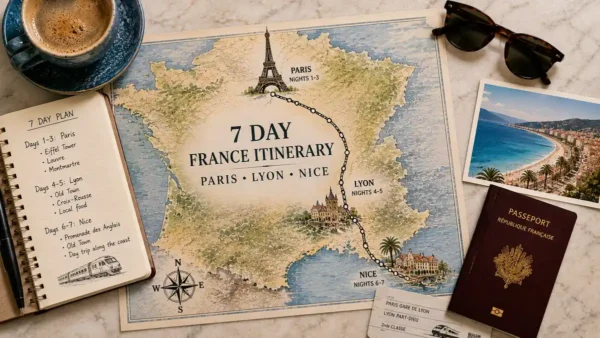
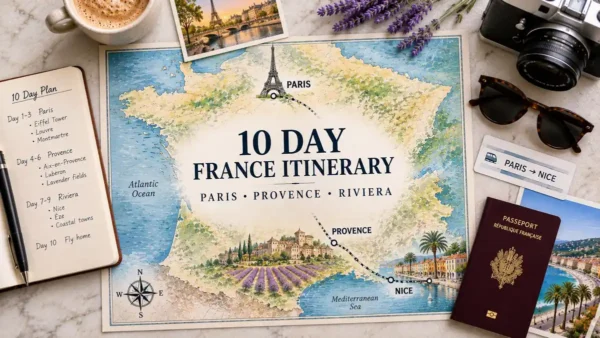
How many beach days a trip can absorb is a routing question, and it is easier to answer against a real route: the 7-day France itinerary shows what a single coast costs a short trip, the 10-day France itinerary is where a coast plus a region starts to work, and the 14-day France itinerary is the length that makes Corsica or a full Atlantic stretch defensible. What to bring for a mixed coast-and-city trip is handled in the France packing list.
The rules that matter on a French beach are local ones. The sand is free everywhere, but each commune sets its own supervision hours and access arrangements, which is why two beaches an hour apart can operate under visibly different rules on the same August afternoon.
Frequently Asked Questions
What do the coloured flags on French beaches mean?
Green means supervised bathing is allowed, orange means bathing is dangerous, and red means bathing is forbidden. Two blue flags mark the edges of the supervised swim zone. Check the flag on arrival and stay inside the marked zone whenever one is set, since the colour reflects the sea on the day, not the beach’s reputation.
When are French beaches supervised by lifeguards?
Core supervision runs through the July and August school holidays, when supervised swim zones are most widely staffed. Busier resort beaches can extend from around April to the end of September, typically between roughly 10am and 7pm. Supervision is set by each commune, so hours and dates vary beach to beach.
Can you take dogs onto French beaches?
Usually not in high summer. The large majority of French public beaches ban dogs during the peak season, and the minority that accept them require a leash. Rules are set commune by commune and often loosen outside summer, so check the signs posted at the beach access before you go.
Are French beaches topless or naturist?
Neither by default. Ordinary French beaches are conventional, though toplessness is unremarkable and entirely a personal choice. Full naturism is confined to designated zones and resorts that are clearly signposted, Cap d’Agde being the best-known, alongside marked sections of a few large southern beaches. Outside those zones, normal swimwear applies.
Do you need a reservation to visit the Calanques?
Not for the park itself, and not for most coves. One cove, Sugiton near Marseille, requires a free timed reservation on peak summer dates, booked a few days ahead of your visit. The rest of the Calanques stays open access on foot. Check the park’s current rules before you go, since access arrangements are reviewed regularly.
How do you reach the best French beaches without a car?
Stay in a coastal town and the problem disappears. Nice, Biarritz and Marseille all put sand or a calanque trailhead within reach of public transport, so a car-free beach week works. Remote picks are the opposite: Saleccia in Corsica and the quieter coves need a vehicle or a boat, and no amount of planning gets around that.
Are there any beaches near Paris?
No sea beach is close to Paris. The capital is inland, and the nearest real coast is the Channel shore of Normandy and the Opal Coast beyond it. Both are reachable as a long day trip by train or car, but neither makes Paris a beach base for a summer holiday.
Related Guides
If your France trip is not built around the coast, these guides cover the inland half of the country — cities, wine regions, mountains and châteaux — and none of them are beach destinations.
- Paris travel guide — the capital itself, for trips that start or end away from the sea.
- Paris region travel guide — what sits within reach of the capital, from palaces to river towns.
- Lyon travel guide — France’s food capital and the natural stop between north and south.
- Lyon region travel guide — vineyards, gorges and day trips around the city.
- Alsace travel guide — half-timbered villages and the wine road on the German border.
- Strasbourg travel guide — the region’s cathedral city and easiest base.
- French Alps travel guide — high mountains and glacial lakes, for trips built around altitude.
- Loire Valley travel guide — château country between Paris and the Atlantic.
Did this guide save you time or money? Tripstou is independent and reader-funded — if you'd like to give something back, you can support the site with a crypto contribution of any size.