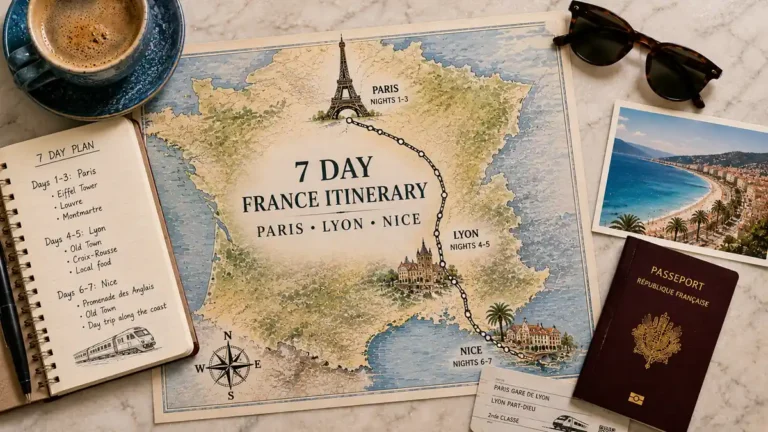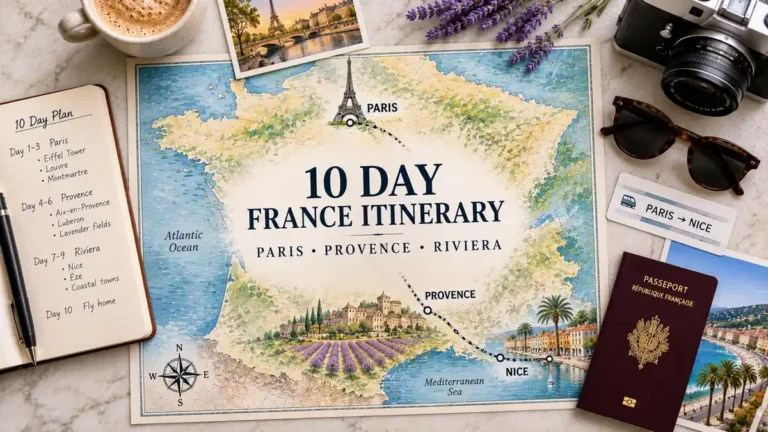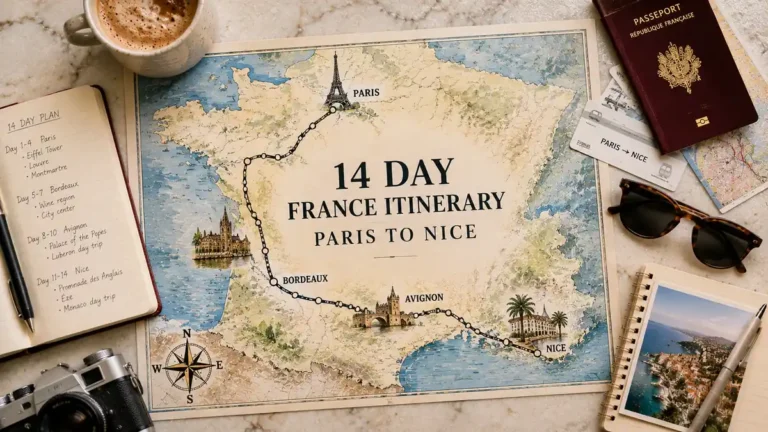
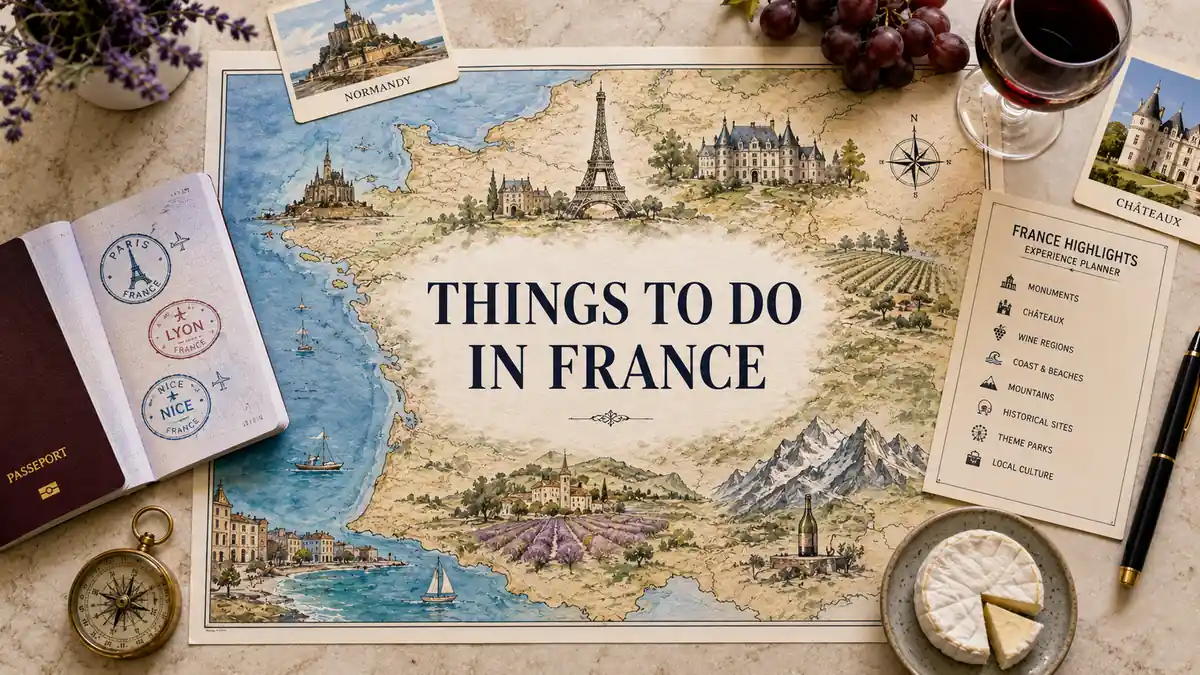
Most France articles show you the same five Paris photographs and then hand you a list of fifty things, ranked by nothing and judged by no one. That is not a plan — it is homework. This guide does the opposite. It covers eight experience families that define a French trip, and each one arrives with a verdict: whether it earns the hours, who it actually suits, and what you give up by choosing it. You will also find the honest skip layer — the famous experiences plenty of travelers should drop, and what to do instead — plus the version question that decides how a day feels: timed slot or walk-up, guided or on your own, second floor or summit. This page answers what to do in France. Which corner of the country to do it in is a separate decision, and a separate page.
Quick Answer
The best things to do in France are experience families — monuments, châteaux, wine, coast, mountains — not a checklist. Season and traveler type decide which families make your trip; most trips support three or four, not all of them. France’s marquee sights close on different weekdays, so check each one’s closing day before fixing plans.
Trust Layer
Tripstou attraction guide for travelers deciding whether an experience is worth doing and how to do it well. Covers value, booking versions, timing, access, and traveler fit.
Produced with AI assistance and reviewed by Alex Perrut, working in tourism since 2015, for the Tripstou editorial team. See our editorial process for details.
Last factual review: August 21, 2026.
Official sources consulted: France.fr, Atout France.
Key Takeaways
- France rewards choosing three or four experience families and going deep, not ticking fifty attractions off a national checklist.
- First trips work best with one marquee monument day plus at least one family that has nothing to do with monuments.
- Timed-slot booking is recommended at France’s big museums, not required — the real decision is which version, not whether.
- Skipping is a fit question: the Eiffel summit, the Mont-Saint-Michel day trip and Disneyland Paris each have a better swap.
- Season locks decide first: lavender, Alpine skiing, the Versailles fountain shows and Christmas markets each exist in one window only.
- France’s marquee sights close on different weekdays — the Louvre on Tuesdays, Versailles on Mondays — so check before fixing a week.
Table of Contents
The best things to do in France are experiences, not places
The best things to do in France are experiences — climbing, tasting, walking, crossing — not destinations. This guide covers eight experience families and how to judge each one. Most of what defines a French trip happens outside Paris, and the strongest trips mix one capital day with something the capital cannot give you.
Every family below is judged, not listed. Each gets a verdict on whether it earns trip time, the traveler it suits, and the tradeoff you accept by picking it. Eight families is deliberate. A fifty-item inventory tells you what exists in France; it never tells you what to drop when your days run out, which is the only decision that matters once a trip is booked.
First-time visitors should build around one monument day plus at least one family that has nothing to do with monuments. That pairing is what stops a first French trip from becoming a queue diary. The monument day anchors the trip; the second family is what people actually describe when they get home.
France beyond Paris is where most of these experiences live. Châteaux you can sleep in, cellars pouring what was pressed in the next room, cable cars that put non-walkers at glacier level, coastal footpaths ending in swimmable water, and the D-Day sand — none of them are capital experiences, and all of them are only-in-France in practice, not just in marketing. They are also the ones travelers regret skipping, because a monument can be photographed for you and a market morning cannot. This page settles what to do; if you are still deciding where in France to go, settle that first and come back with a region in mind.
France’s marquee monuments are worth the crowds — on the right day
The Eiffel Tower, the Louvre, Versailles and Mont-Saint-Michel earn their queues — on the right day, in the right version. Done badly, they produce the most regretted hours of a French trip: a full day spent shuffling, and a memory of other people’s backs. The day you choose matters more than the ticket you buy.
Climbing the Eiffel Tower beats looking at it. The tower offers three ways up — stairs to the second floor, lift to the second floor, lift to the summit — and they are three different experiences, resolved in the booking section below. Half a day covers the visit comfortably, including the riverside walk you should not skip. The summit is weather-dependent and can be restricted at peak periods, so treat it as a bonus, never as the plan.
The Louvre rewards a short, selfish visit. Pick two or three wings and leave: the museum is not completable, and travelers who try come out beaten, not moved. Three hours makes a good visit; five is endurance. It closes on Tuesdays, which derails more trips than any queue does.
Versailles deserves a full day, and the gardens are the reason. The state apartments are the busiest part of the estate and the least pleasant; the grounds, the Trianons and the hamlet are where the day breathes. The gardens are open year-round, while the musical fountain shows run only in a warm-season window — which changes what a garden afternoon feels like. Versailles closes on Mondays.
Crossing to Mont-Saint-Michel is the experience; the village street is not. The approach across the bay is what people remember, and the abbey at the top is ticketed separately from the village, with booking offered online. The single street through the village is the crush point. Stay in or near the bay and you get the island in the evening, after the coaches have gone — a different place entirely.
Pressed for a single answer to the number one thing to do in France, our editorial pick is a full Versailles day in the fountain-show season: architecture, gardens and spectacle in one place, with no transit between them. That is a judgement, not a ranking — and it is exactly the kind of call the big inventory lists never make.
The monument that ruins a day is rarely the famous one — it is the second monument squeezed in beside it. One marquee sight per day is the whole trick, and it is why the capital needs a full set of choices of its own, not a slot in a country-level list. Those choices live in our guide to everything worth doing in Paris.
Can you visit — or even stay in — a French château?
Yes — French châteaux are open as day visits and bookable as overnight stays, and the two feel completely different. A day visit buys scale and state rooms. A night in a château hotel buys the grounds after closing, when the estate belongs to a handful of guests. Both are worth doing. Few trips have room for both.
The state-room day visit suits first-timers and anyone travelling on limited days. You get the scale — the staircases, the painted ceilings, the formal gardens — in about half a day per château, and two châteaux in one day is one too many. What you give up: you see the building the way a coach tour sees it, at its busiest hours, with the rooms full.
Cycling between châteaux suits travelers who want the landscape as much as the architecture. The river valleys are flat enough for ordinary fitness, and arriving at a gate by bicycle changes the register of the whole visit. You will see fewer châteaux and enjoy them more — that is the trade, and for repeat visitors it is an easy one.
A château-hotel night suits couples, milestone trips, and travelers who would bank one extraordinary evening over three good mornings. It sits in a higher accommodation tier than a town hotel, and rural estates usually assume you have a car. What you get back is the place empty at dusk, which no day ticket sells.
Grandeur photographs well and intimacy does not, which is why most travelers book the day visit and remember the night. If your trip has room for only one château experience, the version you choose matters more than which château you choose. The easiest place to combine both versions is covered in our guide to château experiences in the Loire Valley.
Tasting France: vineyard visits and market mornings
Tasting where things are made — a working cellar, a morning market — is France’s most repeatable great experience. It costs half a day, not a detour, and it works in almost every region you might already be visiting. Treat it as an experience, not a food expedition. The point is the room, the hands, and the person explaining.
Tasting wine where it’s made
A cellar tasting is worth half a day for anyone curious, not only for people who already know wine. The guided version explains what is in the glass and suits first-timers, groups, and anyone who wants structure to the visit. The walk-in tasting room at a small producer suits returning travelers and rewards a little French and a little patience.
Drivers face the obvious limitation, and it is a real one: someone stays clear, or the group takes a visit with transport included. The tradeoff nobody warns you about is pace. One estate visited slowly beats three visited efficiently, because by the third stop the palate has stopped reporting anything useful and you are only collecting stops. Two is the ceiling for a good day. For the version of this with the most producers within reach of a single base, see our guide to wine experiences around Bordeaux.
Starting the day at a French market
A French market morning costs nothing and outperforms most ticketed hours. It suits self-catering travelers, families with restless children, and anyone who wants an hour that feels local without being staged. Markets run on a morning rhythm and set up on fixed days that vary town by town, so ask where you are staying the night before instead of turning up hopefully.
The cost is that a market eats the morning you might have given to a monument — which is precisely the argument for putting it first, before anything with a timed ticket. A market is the one experience that improves when you arrive with no plan and no reservation. It is also the family that travels best: every region has a version, so this is the experience to repeat rather than ration. The market culture with the most gravity, and the food experiences built around it, are covered in our guide to market and food experiences in Lyon.
France’s outdoor side rivals its monuments
France is one of Europe’s great outdoor countries, and most visitors never see that side. Cable-car mountain days, gorge paddling, coastal footpaths that end in swimmable water — these suit travelers of ordinary fitness, not athletes. The effort is small and the reward is the part of a trip nobody photographed for you in advance.
Going high in the Alps
Going high in the Alps is worth a full day, and you do not have to hike to earn it. Cable cars lift non-walkers to glacier-level terraces in minutes, which makes this family unusually kind to mixed-ability groups, older travelers, and anyone whose knees have opinions. In summer the day is a lift, a terrace and as much walking as you feel like; in winter the same valleys hand themselves over to skiing, and the experience becomes season-locked.
Weather is the whole risk here. A cloud ceiling converts a spectacular ascent into an expensive lift ride with a view of grey, so keep the mountain day loose in the plan and go on the clear morning, not the scheduled one. Families should treat the altitude itself as the main event and the walking as optional — most of the payoff lands in the first minutes on the terrace, before anyone has taken a step. The valleys that make this easiest, and the lifts worth building a day around, are covered in our guide to mountain experiences in the French Alps.
Swimming coves and walking coastal paths
Swimming from a cove you had to walk to is the best version of the French coast. The Mediterranean calanques ask for a hot, dusty hour on foot and pay in water no road reaches. Riviera coastal paths string headlands and small beaches into a half-day walk that ends wherever you decide to get in. Brittany and the Atlantic trade warmth for wind, scale and space.
This family suits swimmers more than sunbathers, and it suits anyone who finds a lounger boring after an hour. Summer is the complication: in the hot months the coves you can drive to fill fast while the walk-in ones stay civilised, which is the entire case for walking in. Take water and shoes with grip — calanque paths are rock, not sand, and flip-flops end days early. The coast where footpaths, coves and towns sit closest together is covered in our guide to swimming and coast experiences on the Riviera.
Walking the D-Day beaches deserves a full day of your trip
The D-Day beaches are the most affecting day most travelers spend in France, and they need a full one. The experience is not a beach visit. It is an arc — sand, batteries, museums, cemeteries — and compressing it into a morning turns something serious into a photo stop. Give it the day.
The order changes the day more than the choice of sites does. Beaches first, then a battery or a museum for the mechanics, then a cemetery last: that sequence turns information into something you feel. Run it backwards and the day flattens into a series of car parks.
It suits history readers, families with teenagers, and travelers who want one day of substance in a trip otherwise made of views. It suits small children badly, and it suits a half-day wedged between two other plans worse still. Guided or self-driven is a genuine choice here, and it reshapes the day far more than the choice of museum does.
Access is the practical constraint. The sites are spread along the coast with no walking between them, so this family assumes either a car or a guided day out of a nearby base — it is not a train-and-stroll experience. The cemeteries do work the museums cannot, which is why travelers who plan only museums come home calling the day informative. Nobody uses that word when they get the order right. The full set of sites, bases and versions is covered in our guide to D-Day and Normandy experiences.
Which French attractions are overrated — and what to do instead?
A few of France’s most famous experiences are skippable for most travelers, and each one has a better swap. Skipping is a fit question, not a quality verdict. The test is simple: skip when the queue-time cost exceeds the version of the experience you would actually get on the day.
The Eiffel Tower summit is the most skippable upgrade in France on a first visit. The second floor shows you the city as a city — streets, monuments, the bends of the river — while the summit shows you a map of one. The summit also carries the longest waits and the highest chance of a weather restriction. Swap: take the second floor and spend the saved hour walking the riverbank you were just looking at.
The Mont-Saint-Michel day trip is skippable; Mont-Saint-Michel at night is not. A coach-hours visit delivers a queue on one medieval street and a photograph you have already seen a hundred times. Swap: sleep in or near the bay and take the island at the quiet ends of the day, or trade it entirely for a château night, which delivers the same sensation of standing inside history with none of the crush.
Disneyland Paris is worth it only for the group it was built for: families with children in the theme-park years, and adult fans who know exactly what they are buying. For everyone else it spends a full day of a French trip on an experience available on three continents. Swap: any two families from this page fit in the same day — a market morning and a cellar visit, or a coastal walk and a swim.
Almost every skip in France is really a version choice in disguise. Travelers who say they hated a famous sight usually hated the version they bought: the crowded slot, the upgraded ticket, the rushed hour. Change the version before you cross the experience off.
Do you need to book French attractions in advance?
Mostly no — but France’s timed-entry sights sell their best slots first, and officially a slot is recommended. The Louvre, for example, recommends booking a time slot, including for visitors entering free, without requiring one. The real decision is which version you book, not whether you book. That choice shapes the day more than the queue does.
The general ladder runs three rungs, and most sights offer some form of all three:
- Walk-up entry — suits flexible travelers, quieter seasons, and smaller sights. Tradeoff: you accept whatever queue the day produces, and at timed-entry sights you may not get the hour you wanted at all.
- Timed slot — suits anyone with fixed days, a group to keep happy, or a sight they have travelled specifically to see. Tradeoff: the slot fixes the shape of your day around it, and popular warm-season slots go before quieter ones.
- Guided visit — suits first-timers at dense sights, history-led travelers, and the D-Day coast. Tradeoff: the pace belongs to the guide, and it sits a tier above self-guided entry.
The Eiffel Tower has its own ladder, and it is the clearest version decision in the country:
- Stairs to the second floor — suits reasonably fit travelers who want the climb to be part of the experience. Tradeoff: the summit is not reachable on foot, and the climb is a real one.
- Lift to the second floor — suits most visitors, families, and mixed-ability groups. Tradeoff: lift queues at the base, and you are choosing the view over the height.
- Lift to the summit — suits travelers who want the altitude itself. Tradeoff: the dearest rung, and the summit can be restricted in severe weather or at peak periods.
Time of day is the other half of the decision. The first slot of the day and the last slot are different products: early buys emptier rooms and cold light, late buys thinner crowds and better colour, with the risk that you run out of building before you run out of curiosity. Neither is universally right. Pick by what you want photographs of.
France’s marquee sights do not share a closing day, and that catches out more plans than any queue. The Louvre closes on Tuesdays. Versailles closes on Mondays, along with a short list of public holidays. Travelers assume one “museum day” can absorb both and discover otherwise at the door, so check each sight’s closing day before you fix anything else about the week.
Book the version you would still want if the weather turned. That rules out the summit tier and rules in almost everything else, and it is why the cheaper rung is so often the better trip.
Tours and activities
Book skip-the-line tickets, day trips and local tours with free cancellation on most activities.
You can also browse everything on getyourguide.com.
Tripstou may earn a commission if you book through this link, at no extra cost to you.
Match experiences to the season first — then pick three or four
Some defining French experiences exist in one window only, so check the season lock before anything else. Lavender is a short summer bloom, Alpine skiing is winter, the Versailles fountain shows run in the warm season, and Christmas markets belong to December. Then pick three or four families and stop.
A season lock is not a preference. It is a yes or a no, and no amount of planning moves it. Everything else on this page runs year-round in some form, which means the locked experiences get chosen first and the flexible families are fitted around them — never the reverse.
Christmas markets are worth building an entire trip around, which is rare for a seasonal experience. The verdict rests on atmosphere that cannot be manufactured: timber stalls, hot wine, and old squares doing exactly what they were built to do. They suit couples, families, and travelers who dislike summer crowds but will happily accept cold ones. The honest tradeoff is that the towns doing this best are the towns everyone else has also chosen, so evenings are dense and accommodation fills early. The most concentrated version of it is covered in our guide to Christmas-market experiences in Strasbourg.
Then apply the picking rule. Filter by your season’s locks, take at most one monument day, add one tasting family and one outdoors or memory family, and stop. That is three, or four when the season hands you a lock worth building around. Travelers who add a fifth family are not adding experience, they are adding transit — and the fifth is always the one that gets dropped on the day anyway.
Once the shortlist is set, the remaining question is sequence, which is a different job from this page’s. Take your three or four families to our guide on turning the shortlist into a France itinerary.
Frequently Asked Questions
What is the most visited attraction in France?
Four attractions trade the top spots: the Eiffel Tower, the Louvre, Versailles and Disneyland Paris. The popularity lists disagree about which leads, and the tallies shift depending on whether theme parks are counted at all. Pick by the experience you want, not by a visitor number.
Is the Eiffel Tower worth it?
Yes, but only if you go up. Looking at it from below is a photograph; standing on it is the experience. The second floor is the right rung for most first visits, and the stairs suit anyone who wants the climb to count. The summit is the tier most travelers can drop.
What day is the Louvre closed?
The Louvre is closed on Tuesdays. Versailles closes on Mondays, so a single “museum day” cannot cover both, which is where most first-time plans break. The Louvre also advises booking a time-stamped slot, free-admission visitors included, though it stops short of demanding one. Neither closing day moves, so build the week around them.
Is Mont-Saint-Michel worth the trip?
Worth it for travelers who can give it an overnight; questionable for anyone squeezing it into a single long day. The site sits far from France’s other headline experiences, so the journey is the real cost. A day trip alone buys the crush; an overnight buys the silence.
Is Versailles worth a day trip from Paris?
Yes, but only as a full day. Versailles punishes half-day visits — the estate is large, the grounds outlast the interiors, and a rushed morning reduces it to a queue and a corridor. It closes on Mondays, and the fountain shows run in the warm season only.
Is Disneyland Paris worth it?
The park itself is not the problem — its quality is high and its fans are right about it. The question is whether a full day inside a theme park earns a place on a trip to France. On a short trip it rarely does; with children and days to spare it easily can.
Do you need a guided tour for the D-Day beaches?
No — a car works perfectly well, and it buys the quiet hours a coach schedule cannot reach. Take a guide when you want the events explained while you stand in them, when nobody in the group wants to drive, or when you have one day and no appetite for navigating.
Related Guides
These guides take the shortlist further — the country-level planning hub, and the place-level depth behind the experience families above.
- France travel guide — the planning hub for everything above.
- Things to do in Nice — coastal walks, old-town mornings and day trips along the Riviera.
- Things to do in Marseille — the calanque hikes and boat days in detail.
- Things to do in Provence — lavender season, hilltop villages and market towns.
- Things to do in Alsace — vineyard villages and the winter market circuit.
- Things to do in Brittany — Atlantic coastal paths, tides and seafood towns.
- Things to do in Corsica — mountain hikes meeting swimmable coast.
Did this guide save you time or money? Tripstou is independent and reader-funded — if you'd like to give something back, you can support the site with a crypto contribution of any size.