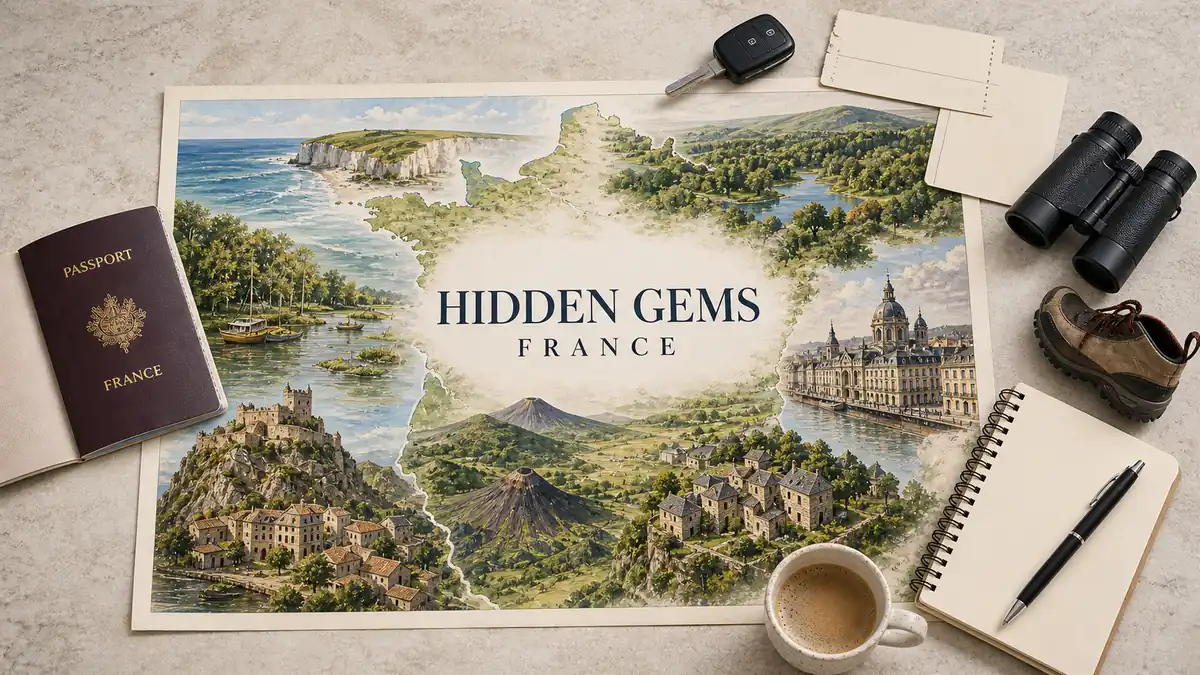
Most hidden-gems lists for France name the same photographed villages, and a surprising number of them name Mont-Saint-Michel. The word “hidden” does the marketing; almost nobody defines it. This guide does two things differently. First, it states a test before naming a single place: a real gem holds an official French heritage designation and draws far fewer visitors than a famous neighbour that absorbs the coach tours. Second, it maps the France those lists never reach — whole under-visited areas and secondary cities, not prettier corners of Provence or Alsace. Those corners are real, but they belong to their own regional guides, and this page routes you to them instead of pretending they are unknown. What follows is a shortlist built on a stated bar: the Jura, the Auvergne, the Gorges du Tarn, Aveyron, Cathar country, the Opal Coast, the Marais Poitevin, and three eastern cities that anglophone travelers still skip.
Quick Answer
France’s real hidden gems are whole quiet areas — the Jura, the Auvergne, Aveyron, the Opal Coast. Qualifying takes an official heritage designation plus far fewer visitors than a famous neighbour, and that second half is the real test. Best for return visitors and crowd-averse travelers; first-timers usually still start with the famous regions.
Trust Layer
Tripstou selection guide for travelers choosing between multiple places. Covers selection criteria, traveler fit, and trip value.
Produced with AI assistance and reviewed by Alex Perrut, working in tourism since 2015, for the Tripstou editorial team. See our editorial process for details.
Last factual review: August 21, 2026.
Official sources consulted: France.fr, Atout France.
Key Takeaways
- A place qualifies only if it holds an official French designation and sits beside a famous neighbour absorbing the crowds.
- Designation alone proves nothing about crowds: the Grand Site label is awarded for managing visitor pressure, not for escaping it.
- For quiet mountains and wild country, the Jura and the Auvergne beat the Alps on emptiness without losing the scenery.
- Nancy, Metz and Besançon deliver a first-rank city break by mainline train, without the crowds the famous cities carry.
- The trade for quiet is real: more driving, shorter seasons, less English, and fewer direct trains than the famous regions.
- If the region you want is already famous, its quiet corners belong to that region’s own gem guide, not here.
Table of Contents
What Actually Counts as a Hidden Gem in France?
A real hidden gem holds an official French heritage designation and draws far fewer visitors than a famous neighbour. Both halves are required. The designation proves the place is worth a detour; the visitation gap proves you will not share it with three coach parties. Lists that skip the second half are just lists of pretty places.
Tier 1: A Designation Proves It’s Worth Visiting
France labels its heritage more systematically than almost any country, which gives Tier 1 a hard edge. Three designations carry most of the weight on a page like this, and each is awarded by a body with published criteria.
- Les Plus Beaux Villages de France — an association label held by more than 180 villages. A candidate must have fewer than 2,000 inhabitants, at least two protected heritage sites, and a council vote to apply, then pass an on-site assessment against around 30 criteria. The label is revocable.
- Grand Site de France — awarded by the environment ministry for a six-year, renewable term to around twenty sites, inside a wider network of roughly fifty places working toward it. Also revocable.
- Monument Historique — state protection for an individual building or structure. It reaches down to the level of a single church, bridge or château, which is why it is the most useful designation for small places.
Tier 1 does one job well: it filters out the merely photogenic. If nobody official has ever protected a place, its claim to be a gem rests on somebody’s holiday photos.
Tier 2: The Visitation Gap Proves It’s Quiet
The Grand Site de France label is awarded for managing visitor pressure — it proves a place is significant and busy, never that it is quiet. That single fact breaks every list treating designation as a synonym for obscurity. The ministry does not label the sites nobody visits. It labels the ones that need a management plan.
So Tier 2 carries this page. The test is not how many people go somewhere; it is which neighbour absorbs the traffic. France is the world’s most-visited country, and its visitors arrive along a small number of fixed corridors — the Paris axis, the Mediterranean coast, the Alpine ski valleys, the Alsace wine route, the Loire châteaux run. A place is quiet when it sits off those corridors and a famous neighbour nearby is soaking up the coaches.
Run that test on the usual suspects and they fail. Gordes holds a Plus Beaux Villages entry and sits squarely on the Luberon circuit every Provence tour already drives. Riquewihr is a stop on the Alsace wine route, which is the corridor. The Dune du Pilat is a Grand Site and a standard Bordeaux day trip. All three clear Tier 1 comfortably. None of them clears Tier 2, and no amount of golden-hour photography changes that.
A label is a quality filter, not a crowd filter, and in France the two frequently point in opposite directions — the state protects hardest exactly where the pressure already is.
The wider distribution helps too. Tourism activity in France is extraordinarily concentrated in and around Île-de-France and along the coasts, and it thins dramatically as you move inland. That is the structural reason the interior stays quiet, and it is why the picks below cluster in the east, the Massif Central and the Occitanie interior.
Here is the practical way to read any hidden-gems list, including this one. Take each name and ask two questions: what is it officially designated as, and which famous place next door is taking the crowd? If the writer cannot answer the second question, the list is inspiration, not selection.
France’s Best Quiet Mountains Aren’t the Alps
For mountains and wild country without Alpine crowds, the Jura, the Auvergne and the Tarn gorges lead France. All three sit outside the Alpine and Pyrenean corridors that international visitors book by default, so the coach traffic funnels past them. Each covers a different landscape type: lake plateau, volcano and limestone gorge.
The Jura
The Jura is a forested limestone range running along the Swiss border, built from high plateaus, lake basins, waterfalls and the cliff-walled dead-end valleys the French call reculées. It is mountain country at a human scale — no glaciers, no permanent snowfields, and a wine region of its own on the western slopes. Walking, cross-country skiing and wine tasting are what people come for.
What makes it distinct on this page is that it is the only pick where mountains and vineyards share a single base. The visitation gap is structural and obvious the moment you look at a map: the Alps lie directly south and take the entire international mountain market, from ski operators to the Mont Blanc circuit. The Jura’s visitors are overwhelmingly French and Swiss, arriving by car for weekends.
Pick this if: you want mountain scenery and a wine region from a single base, and a valley where little English is spoken does not worry you.
Auvergne and the Chaîne des Puys
The Auvergne is volcanic France. The Chaîne des Puys is a line of dozens of extinct cinder cones and lava domes standing above Clermont-Ferrand, and the wider Massif Central adds crater lakes, eroded volcanic summits, spa towns and high summer pasture. Nothing else in western Europe looks like it.
Its distinctiveness is geological, not architectural, which is also why it stays quiet. The Auvergne’s reputation inside France is agricultural and industrial; its regional capital sits on no international leisure circuit; and a chain of volcanoes within sight of a city centre is simply not marketed to anglophone travelers. Lyon to the east and the Dordogne to the west take the traffic, and neither sends anyone this way.
Pick this if: landscape is the entire reason for the trip and you want terrain with no equivalent elsewhere in western Europe.
Gorges du Tarn and the Cévennes
The Tarn cuts a deep limestone canyon between the Causses, the high dry pastoral plateaus of the southern Massif Central, with the schist ridges of the Cévennes and their national park immediately east. Villages sit wedged between the cliff and the river; the plateaus above them are still working sheep country. Canoeing and walking are the two obvious categories, and both are the point.
The gap here is one of the cleanest in France. The A75 motorway carries the summer Mediterranean migration straight across this country, over the Millau Viaduct, at speed — and almost none of that traffic stops. The bridge is the famous neighbour. People photograph it from the viewpoint and drive on.
Pick this if: you want a river-and-cliff trip and are happy to spend days on switchback roads.
Aveyron and Cathar Country Hold France’s Quietest Great Villages
The densest run of protected villages that tourists actually skip is in Aveyron, with Cathar country close behind. Both sit in the Occitanie interior, away from the Provence and Alsace circuits that carry the village-hunting crowd. Aveyron wins on concentration; the Aude wins on history.
Aveyron and the Occitanie Interior
Aveyron holds an unusual density of officially designated villages inside one department: Belcastel, Najac, Estaing, La Couvertoirade and Conques are all Plus Beaux Villages members, and Conques adds a major Romanesque abbey church on the historic pilgrimage route south. Five designated villages, one department, one car hire.
Concentration is what makes Aveyron distinct — most French village clusters make you drive between regions to assemble the same day. The gap is that the southwest’s village-and-castle traffic goes to the Dordogne instead, north-west of it, which has the name recognition, the river cruises and the airport connections. Aveyron has the villages and not the buses.
Pick this if: you want to reach several officially designated villages from one base without a coach park at each.
Cathar Country (Aude)
Cathar country is a belt of ridge-top castle ruins and abbey villages across the Aude, south of the Canal du Midi. Peyrepertuse and Quéribus define it — long, narrow fortresses welded onto limestone crests — and Lagrasse, a Plus Beaux Villages member built around its abbey, is the softer counterweight down in the valley.
This is history-led country, and that separates it from Aveyron: you come for a specific medieval story rather than for a photogenic village centre. The visitation gap is a single name. Carcassonne absorbs almost all of the department’s organised traffic, and the ridge castles south of it sit at the end of minor roads with steep approach walks, which coaches do not do.
Pick this if: a specific medieval story is what pulls you, and steep approach walks do not put you off.
Quiet Beaches and Waterways: The Opal Coast and the Marais Poitevin
France’s quietest good beaches are on the Opal Coast; its quietest waterways thread the Marais Poitevin. Both sit north and west of the Mediterranean shoreline that absorbs the summer crowd. Expect wind, wide horizons and a shorter season instead of the guaranteed heat you are giving up.
The Opal Coast
The Opal Coast is the Channel shoreline of the far north, where two chalk headlands — Cap Blanc-Nez and Cap Gris-Nez — stand above enormous tidal beaches and dune systems, with low-rise seaside towns strung between them. The two capes together hold a Grand Site de France designation, so this is not an unrecognised landscape. It is a protected one that anglophone travelers drive past.
What makes it distinct on this page is scale and light: big-sky, big-tide coast where low water pulls the sea right out and leaves sand running to the horizon. And this is the sharpest gap of any pick here.
More international travelers cross the Opal Coast than almost any other part of France, and virtually none of them visit it — the ferry and tunnel traffic treats it as the corridor to somewhere else.
Pick this if: an empty beach and a headland walk matter more to you than swimming weather.
The Marais Poitevin
The Marais Poitevin is a former sea gulf drained into a vast wetland behind the Atlantic coast, threaded by canals under a canopy of pollarded ash and protected as a regional natural park. Its inner section is known as the Venise Verte, the Green Venice, and the traditional way through it is a flat-bottomed punt. Flat cycle paths do the rest.
Nothing else on this page looks remotely like it — green, level, enclosed water country in a list otherwise made of mountains and coastline. The gap is straightforward: La Rochelle and the Île de Ré, immediately west, take essentially the whole regional visitor load, and the marsh behind them stays a French family destination.
Pick this if: you want your days on flat water and flat cycle paths, with a boat as the main event.
Nancy, Metz and Besançon Are France’s Most Underrated Cities
Nancy, Metz and Besançon deliver first-rank architecture and food with a fraction of the visitors the famous cities carry. None of the three is hidden — all have mainline stations and tourist offices. They are under-marketed to anglophone travelers, which is a different thing and the reason they stay quiet.
Nancy
Nancy is the historic capital of Lorraine, built around Place Stanislas, an eighteenth-century royal square closed by gilded wrought-iron gates and framed by matched classical façades. It is also the home city of the École de Nancy, the movement that produced French Art Nouveau, with a dedicated museum and surviving villas and shopfronts across the centre.
Two first-rank architectural eras in one walkable centre is what separates Nancy from the other cities here. The gap is regional: Strasbourg, further up the same eastern axis, takes almost all the international traffic to this part of France, and Nancy sits in its shadow holding a square that would anchor a tourist economy anywhere else.
Pick this if: architecture is your reason for a city break and you want classicism and Art Nouveau in one walkable centre.
Metz
Metz combines a Gothic cathedral celebrated for the sheer scale of its stained glass, including twentieth-century windows by Chagall, with the Centre Pompidou-Metz, a major contemporary art institution. The old town is built in yellow Jaumont limestone, and a separate Imperial Quarter around the station dates from the German administration.
That combination — cathedral, contemporary art museum and a Germanic imperial district — has no equivalent in another French city of its size. Metz also sits on the mainline from Paris, which makes it the easiest pick on this entire page. It is also the clearest proof that easy access and light visitor traffic coexist happily in France.
Pick this if: you want a major contemporary-art museum without a big-city weekend attached.
Besançon
Besançon sits inside an almost complete loop of the river Doubs, with Vauban’s citadel planted on the narrow neck of land that closes it. The geography does most of the work: the historic centre is effectively an island, ringed by water and overlooked by fortifications. The city is also the historic capital of French watchmaking and Victor Hugo’s birthplace.
Its distinctiveness on this page is dual-purpose. Besançon is the rail gateway to the Jura, so it is the one pick that turns a city break into a mountain trip without a second base. Dijon and Lyon take the region’s visitors. Besançon keeps the citadel.
Pick this if: you want a compact city that doubles as the rail gateway to a mountain range.
If you want the same logic further south, Narbonne is a further underrated option — a Roman-founded city on the Canal de la Robine with a famously unfinished cathedral — though it sits closer to the Mediterranean crowd than the eastern three.
Say the honest version out loud: none of these cities is a discovery. They have tourist offices, signposted heritage trails and trains. What they lack is an English-language marketing machine, and that alone keeps the queues short.
Where Should You Go Instead of France’s Famous Places?
Skip the famous region, keep the trip: the Alps swap for the Jura, the Riviera for the Opal Coast. Every famous name on a France shortlist has a quieter counterpart in the same category of landscape or city. The swap always costs something, and knowing what it costs is the whole decision.
Every counterpart below is a pick from this page; the give-up column stays qualitative by design.
| Famous choice | Quieter counterpart | What you give up |
|---|---|---|
| French Alps | The Jura, along the Swiss border | Fewer direct trains and no resort-scale infrastructure |
| Provence villages | Aveyron and the Occitanie interior | Less English spoken and a shorter restaurant season |
| French Riviera | The Opal Coast, on the Channel | Warm water, reliable sun and a long beach season |
| Paris city break | Nancy or Metz, in Lorraine | Direct flights and the sheer depth of museum choice |
| Loire Valley châteaux | Cathar country’s ridge castles | Furnished interiors, easy access and English-language tours |
Substitution is the crowd-avoidance strategy that actually works, and it is worth understanding why the alternative fails. Most travelers try to solve crowds with timing. They shift the trip to shoulder season, which is genuinely quieter everywhere in France, then discover they are standing in the same village as everyone else who had that idea.
Changing the destination beats changing the dates. Shoulder season thins a queue; a substitution removes it, because the corridor itself has moved. Do both and the effect compounds. A quiet area out of season is about as empty as France gets.
The famous column is not a warning list. Those places earn their reputations, and if you have never been to France, most of them belong on a first itinerary — our guide to the best places to visit in France covers that side of the choice properly. This page exists for the trip after that one.
Hidden Regions vs Hidden Corners: Which Gem Guide Do You Need?
If the region you want is famous, its quiet corners have their own guide. This page covers hidden regions — areas the national lists never reach at all. A hidden corner is different: a quiet village inside Provence or a quiet valley inside the Alps, where the region itself is a headline destination.
The distinction matters because the two need different advice. In a hidden region, the whole area is the answer and your problem is access. In a famous region, the region is already settled and your problem is picking the right corner of it. Each of the eight below has its own guide, and the one-line summary tells you what kind of gem it hides.
- Alsace — half-timbered wine villages beyond the two or three the coaches always stop at: hidden gems in Alsace.
- French Riviera — hill villages and working ports behind the corniche roads: underrated French Riviera.
- Normandy — the Cotentin peninsula and the inland bocage, past the landing beaches: hidden gems in Normandy.
- Provence — perched villages and hill country outside the Luberon circuit: underrated Provence.
- Brittany — the inland Argoat and the smaller islands, away from the headline capes: hidden gems in Brittany.
- Corsica — the mountain interior most visitors never leave the coast road to reach: underrated Corsica.
- French Alps — valleys with no ski brand attached and summer-first villages: underrated French Alps.
- Loire Valley — smaller châteaux and river towns between the headline estates: underrated Loire Valley.
This is also how this page declines those regions honestly. Their gems are real. They are simply somebody else’s section.
Can You Reach These Quiet Regions of France Without a Car?
Yes for Nancy, Metz and Besançon, which are rail cities; the rural picks effectively require a car. France’s rail network is built around mainlines into Paris, so it serves secondary cities well and thin countryside badly. That split decides the shape of the whole trip.
Three access patterns cover everything on this page:
- Rail-only — Nancy, Metz and Besançon. Mainline trains from Paris, with centres you can walk to from the station. Suits travelers who will not drive at all. The trade: you get cities, not landscape.
- Rail plus a short hire — the Jura from Besançon, the Auvergne from Clermont-Ferrand. Reach the regional capital by mainline train, then hire a car for the two or three days you actually need the countryside. Suits travelers who want one quiet area without a full driving holiday.
- Car-first — Aveyron, Cathar country, the Gorges du Tarn and the Cévennes, the Marais Poitevin, and the Opal Coast beyond its resort towns. Rural bus services exist but run on school and market timetables, not visitor ones. The trade: the car is the price of admission.
Car dependence is not a flaw in these areas — it is the mechanism. Places a coach can park at and a train can deliver to do not stay quiet for long, which is why the honest version of this list is mostly a driving list. The three cities are the exception. They are the exception because they are under-marketed, not because they are hard to reach.
Who Should Trade Famous France for the Quiet Version?
Return visitors and crowd-averse travelers gain most from the quiet version of France. A first trip is usually still better spent on the famous set, because those places are famous for reasons that hold up. The strongest pattern is one quiet block inside an otherwise conventional trip.
It suits you if you have already done Paris and one famous region, if you drive happily on rural roads, if you are travelling outside peak weeks, or if landscape and architecture interest you more than marquee sights. It suits slow travelers especially. These areas reward staying put, and they punish checklist pacing badly.
It does not suit you if this is your first trip to France, if you have a week or less, if you need English-language infrastructure, or if you are travelling with people who will resent a long drive to reach a village. Be honest about that last one before booking.
The pairing that works best is simple: one famous anchor, one quiet area, on the same geographic axis, with the longer half of the trip given to the quiet one. Paris with Lorraine. Lyon with the Auvergne. Toulouse or Carcassonne with the Aude and Aveyron. You keep the marquee experiences a fully quiet trip forgoes — the great museums, the headline monuments, the signature things to do in France — and you still get a week where nobody is queuing. For the wider frame around all of it, timing, transport and budget, start from our France travel guide.
Frequently Asked Questions
What is the least visited region in France?
France’s least visited areas are inland and eastern: the Jura, the Auvergne and the Massif Central, plus the Occitanie interior around Aveyron and the Aude. Visitors concentrate on Île-de-France and the coasts, so anywhere far from those corridors and without a headline neighbour stays quiet.
What is a Plus Beau Village de France?
It is a label run by an association, held by more than 180 French villages. A candidate needs fewer than 2,000 inhabitants, at least two protected heritage sites and a supporting council vote, then passes an on-site assessment against around 30 criteria. Membership can be withdrawn.
What is a Grand Site de France?
It is a state label awarded by the French ministry responsible for sites, currently held by around twenty places inside a wider network of roughly fifty. It runs for six years, is renewable and can be revoked. It rewards sustainable management of visitor pressure, so it signals significance, not solitude.
Is Mont-Saint-Michel a hidden gem?
No. Mont-Saint-Michel is one of France’s most visited sites and one of its most photographed, which makes it the clearest example of the test failing. It belongs on a best-of list, not a gem list. Its genuinely quiet neighbours sit inland, and Normandy’s own gem guide covers them.
Which hidden gems can you reach from Paris by train?
Nancy, Metz and Besançon are the three on this list, all reachable by mainline train from Paris and all walkable from their stations. The rural picks are different: the Jura and the Auvergne need a mainline train to the regional capital and then a hire car.
How many days do you need in a quiet French region?
Plan four or five days in one quiet region instead of a circuit across several. These areas are spread out, the roads are slow, and the reward comes from staying put. Three days works if you attach the block to a famous anchor city on the same axis.
Should you skip Paris on a first trip to France?
Usually not. Paris earns its reputation, and a first trip is better spent on the famous set while it is still new to you. Trade one famous block for a quiet region on the return trip instead — that is when an area like the Jura or Aveyron pays off properly.
Related Guides
- France travel guide — the planning frame for a whole trip: timing, regions, transport and how the country fits together.
- Best places to visit in France — the famous set, ranked and explained, and the right starting point for a first trip.
- Things to do in France — the experiences and signature sights, sorted by traveler type instead of by region.
- Underrated Provence — the quiet corners of a famous region, beyond the Luberon circuit.
- Hidden gems in Normandy — the Cotentin, the bocage and the coast past the landing beaches.
- Hidden gems in Alsace — wine villages and valleys away from the standard route stops.
Did this guide save you time or money? Tripstou is independent and reader-funded — if you'd like to give something back, you can support the site with a crypto contribution of any size.