
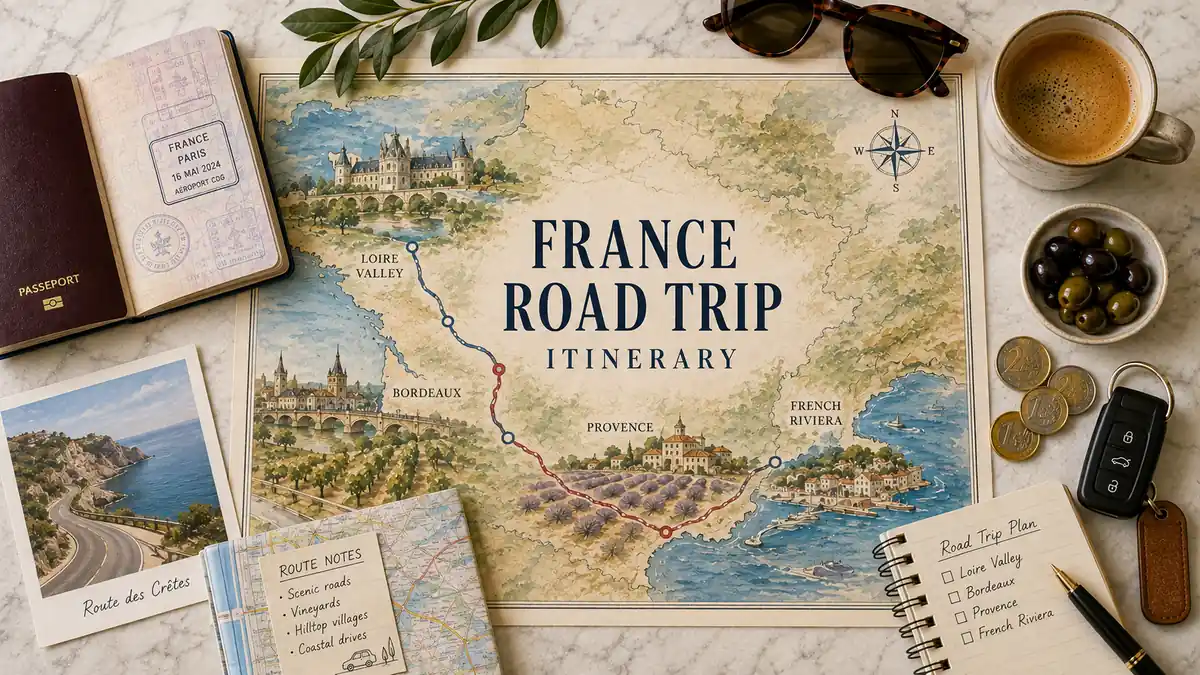
Search for a France road trip and you get menus — fifteen routes, twenty routes, a scenic drive for every mood. Almost none of them answer the questions that actually decide the trip: whether the rental is worth its cost at all, where to collect the car so it does not become a liability, and what driving in France involves once you leave the motorway. This planner does the opposite. It gives one recommended route, laid out as legs so you can see why each region sits where it does, and it qualifies the car decision honestly — including the trips where you should not rent one. It also carries the logistics the route menus skip: how tolls work, what the routes nationales trade away, and the low-emission-zone rules that decide whether you can drive into a French city at all.
Quick Answer
Do Paris car-free, collect the rental leaving the city, then drive Loire, Bordeaux, Provence and the Riviera. Pacing decides the trip: choose few bases with two or three nights each instead of moving every night. A car earns its keep in regional France; skip it for a cities-only trip.
Trust Layer
Tripstou itinerary guide for travelers planning a route. Covers pacing, stop count, stop order, base logic, and trip length.
Produced with AI assistance and reviewed by Alex Perrut, working in tourism since 2015, for the Tripstou editorial team. See our editorial process for details.
Last factual review: August 4, 2026.
Official sources consulted: France.fr, Atout France.
Key Takeaways
- Rent a car for regional France — Provence, the Loire, the Dordogne — and skip it entirely for a cities-only trip.
- See Paris on foot and collect the rental only when you leave, so no rental days are spent parked.
- Drive Loire Valley, Bordeaux, Provence and the Riviera in one direction, finishing at Nice airport with no backtracking.
- Plan three or four bases of two to three nights each; moving every night turns the trip into driving.
- One-way rentals buy the better route but carry a drop-off surcharge; a loop trades route quality for a simpler booking.
- A Crit’Air sticker is required to enter French low-emission zones, including in a rental, and is sold only at certificat-air.gouv.fr.
Table of Contents
Is Renting a Car in France Worth It?
A car is worth renting for regional France and a liability for a cities-only trip. Provence, the Loire Valley, the Dordogne, Normandy, Brittany, Alsace and the Alps all hide their best parts down roads no scheduled service reaches. City centres punish you for arriving in one.
The honest anti-cases are easy to name. A trip built around Paris does not need a car for a single day. Neither does a trip that hops between big city cores — Paris, Lyon, Bordeaux, Marseille — because those cities are linked by fast trains and are all easier to handle without a vehicle to park. A rental in that scenario buys you parking bills, one-way systems and rental days spent stationary.
Where the car changes the trip is the space between the cities. Vineyard roads, hill villages, coastal corniches, château country and mountain valleys are exactly where French public transport thins out, and they are also where the country is at its best. If your shortlist is mostly regions, drive. If it is mostly cities, do not.
A useful test before you book: count the places on your list that have no railway station of their own. Two or more, and the rental pays for itself in days you would otherwise lose to connections. Fewer, and you are paying to store a car. For the wider country picture — regions, planning basics, how the pieces fit together — start with our France travel guide.
Start in Paris, but Don’t Pick Up the Car There
See Paris without a car and collect the rental only when you leave. A car in the capital is pure cost: parking charges, one-way street systems, low-emission-zone exposure and rental days burned while the vehicle sits still. Paris is the best-connected city in France on foot and underground.
This single choice reshapes the whole trip. Rental days are billed from pickup, so a car collected on arrival at Charles de Gaulle and left parked through three Paris days is three days you paid to store a vehicle you could not use. Central parking is expensive and scarce, the traffic is unforgiving to a first-time driver on the wrong side of the road, and the city sits inside a low-emission zone whose rules you gain nothing by being subject to this early. Those city access rules are resolved further down this page. They matter later on the route — just not while you are on foot in the capital.
In practice, “on the way out” means collecting the car on the morning you leave, from an agency on the outer edge of the capital: airport branches and suburban station branches exist for exactly this pattern. You spend your Paris days in our Paris city guide territory with no vehicle at all, then pick up the car and clear the ring road early, before the day builds. If you want a day or two in the wider region — Versailles, Fontainebleau, the Vexin — the Île-de-France region guide is where that fits, and it is the one part of a Paris stay where having the car already makes sense.
The route below returns the favour at the other end. You never bring a car back into the capital at all.
The Recommended France Road Trip Route, Leg by Leg
The route runs Paris car-free, then Loire Valley, Bordeaux and the Southwest, Provence, and the French Riviera, finishing in Nice. It moves in a single direction, links four regions that each reward a car, and ends at an airport with wide European and long-haul connections. No backtracking.
- Loire Valley, 2 nights — easy first miles, château country
- Bordeaux and the Southwest, 2–3 nights — wine country at driving pace
- Provence, 3 nights — the region the car is for
- French Riviera, 2–3 nights — coast finish and Nice drop-off
Leg 1: Loire Valley — Easy First Miles, Château Country
Two nights in the Loire Valley, based in or near Amboise or Blois. It sits first because the run out of the Paris region is short, flat and well signed — the gentlest possible introduction to French roads and the autoroute system before you attempt anything long. The châteaux are the reason to stop: Chambord for sheer scale, Chenonceau for the setting over the river.
Leaving, you point southwest for Bordeaux. This is a long motorway stretch and the first leg where tolls become a visible line item, so it is worth an early start and a planned break. Château selection, stop depth and where to base within the valley belong in our Loire Valley guide.
Leg 2: Bordeaux and the Southwest — Wine Country at Driving Pace
Two to three nights, based either in Bordeaux itself or out among the vineyards. The leg exists because the wine country only opens up with a car: Saint-Émilion’s hillsides and the Médoc estates are strung along small roads with nothing useful running between them. Bordeaux gives you the city evening, the vineyards give you the days, and the split works in either direction.
You leave heading east across the southwest toward Provence. It is the longest single stretch on the route and the one transfer worth breaking with a night in between if your pacing allows it. Region-wide planning lives in the Bordeaux region guide; the city itself is covered in our Bordeaux city guide.
Leg 3: Provence — the Region the Car Is For
Three nights in Provence, based in one town and driving out from it each day — Arles, Saint-Rémy or a Luberon village all work as a base. This is the leg that justifies the entire rental: the hill villages and the back roads connecting them are the part of France least reachable on any sensible schedule without your own vehicle. The Pont du Gard is the one anchor worth building a driving day around.
Marseille works as a day target from here — driven in once, parked once, walked. Our Marseille guide covers what that day should look like, and the Provence region guide handles base selection and the villages themselves. The onward move east to the coast is short, and it is the easiest driving day of the trip.
Leg 4: French Riviera — Coast Finish and the Nice Drop-Off
Two to three nights on the Riviera, based in or near Nice. It closes the route because the drop-off is straightforward and the coast rewards a slow finish. Antibes and the corniche road climbing above Villefranche are the two things here that genuinely reward having the car; almost everything else on this stretch is walkable or reachable along the coast.
Return the car on your last full day and finish the trip on foot. The Riviera is the one leg where a car turns from asset into nuisance — parking is scarce and the coast road crawls in high season — so an early drop-off costs you nothing. Base and neighbourhood detail sits in our Nice city guide, and the wider coast in the French Riviera guide.
Each leg on this route ends in a region you drive around, which is the test a stop has to pass before it earns a place on a driving itinerary. A town you would only walk belongs on a different kind of trip.
Tours and activities
Book skip-the-line tickets, day trips and local tours with free cancellation on most activities.
You can also browse everything on getyourguide.com.
Tripstou may earn a commission if you book through this link, at no extra cost to you.
Should You Drive a Loop or a One-Way Route?
One-way gives you the better route; a loop is usually the cheaper rental because there is no drop-off surcharge. Suppliers charge for returning a car to a different city, and the amount varies by company, distance and season. The route above is one-way for a reason: doubling back wastes days.
The three workable shapes trade the same three things against each other — route quality, rental simplicity, and how much of your time disappears into transfers.
| Route shape | Route quality | Rental consequence | Who it suits |
|---|---|---|---|
| One-way, Paris to Nice | Strongest — no repeated ground, ends on the coast | Supplier drop-off surcharge applies, sometimes a large one | Travelers flying out of a different airport |
| Loop returning to the start | Weaker — the return leg repeats regions you crossed | No drop-off charge, simplest booking of the three | Anyone tied to one arrival and departure city |
| Base-and-spoke from one region | Narrow but deep — one region explored properly | Short rental, often collected mid-trip after arriving | Short trips and travelers who dislike packing daily |
Drop-off fees are a route-shape consequence, not a fixed penalty. They depend on the supplier, on how far apart the two branches are, and on how badly that company needs the car back where it started. Get the quote for both shapes before you commit, because the gap is sometimes trivial and sometimes decisive.
The surcharge is worth paying when it buys you a different region, not just a different city. Paris to Nice changes the entire trip; Bordeaux to Toulouse rarely changes anything, and that is the version of the one-way fee you should refuse.
How Many Stops Can a France Road Trip Handle?
Plan bases, not stops: three or four bases with two to three nights each is the realistic ceiling. Moving every night turns a road trip into a motorway trip, because packing, checking in and hunting for parking eat the hours you wanted for the region. Two nights is the minimum that feels like arriving.
The only length question worth asking on a driving trip is how many of your days go into driving and how many go into being somewhere. A base with two nights buys a full day in its region. A base with one night buys an afternoon and a departure. Four bases separated by three real transfers is a comfortable shape; six bases is a transport schedule with sightseeing attached.
Repetition tires people out on a French road trip far more than distance does. The same driver can happily cover a long autoroute stretch once and still be exhausted by four short hops in four days, because each hop carries the whole overhead of leaving and arriving. Consolidate that overhead and the trip feels twice as long.
The cut that saves a trip is almost always a base and almost never an hour of driving. Dropping a region gives you a whole day back; leaving an hour earlier gives you an hour.
Day-level execution — what you actually do on each of those days, in order — is handled by the day-count guides. Choose by the time you have: the 7-day France itinerary, the 10-day France itinerary or the 14-day France itinerary.
Tolls, Autoroutes and the Routes Nationales Trade-Off
French motorway tolls are charged by distance and vehicle class, so long autoroute legs add up. The free alternative, the routes nationales, costs you time and gives back scenery and villages. On each leg it is a pacing decision first and a cost decision second.
The péage mechanism is simple. You take a ticket or pass a gantry on entry, and you pay on exit for the distance covered in the class of vehicle you were driving. A standard hire car sits in the cheapest passenger class; a van, or a car carrying a roof box that raises its height, can move you up a class. Because the charge scales with distance, tolls are barely noticeable on regional hops and a genuine line item on the long southbound stretches — run a toll calculator for your specific route before you assume either.
Some French motorways no longer have barriers at all. Cameras read the plate and you pay online after the journey, with a penalty following if you forget; the mechanism and its deadline are covered in the FAQ below. Fuel is the other running cost, and drivers from North America consistently underestimate it — on a route this long it matters more than the tolls do.
The routes nationales are the alternative, and the case for them is as much about the drive as the money. They run through villages, past the roadside restaurants the motorway bypasses, and at a speed where you can actually see the country. They also take substantially longer, they carry local traffic through every town, and limits drop in rain and are camera-enforced throughout.
Nationales earn their extra hours on short regional links — the Luberon, the Médoc, the corniches. On the long haul south they simply eat the day you meant to spend in the region you were driving to, which is why this route uses the autoroute for transfers and the small roads once it arrives.
Crit’Air Stickers, ZFEs and Driving Into French Cities
You need a Crit’Air sticker to drive into France’s low-emission zones, including in a rental car. These zones are in force in major cities, foreign-registered vehicles are not exempt, and the sticker is ordered only from the official government site. It costs a few euros.
Order it from certificat-air.gouv.fr, which is the sole authorised issuer. Resellers rank well in search results and charge several times the official price for exactly the same sticker, so going anywhere else is money lost. The sticker is posted, not issued instantly, which is the practical trap: order well ahead of travel, and if you are collecting a rental, check the windscreen at the desk and ask before you drive away.
Paris, Lyon, Marseille and Strasbourg all operate low-emission zones on or near this route. Restrictions differ by city and tighten over time, so confirm the current rule on the official site for each city you intend to drive into.
The sticker is only half the rule. It admits you only if your vehicle’s class is currently permitted in that zone, and modern rental fleets almost always qualify — which is why the missing sticker is what actually catches visitors out.
Parking is the other city variable, and it belongs in your base decision more than in your driving one. In historic centres — Amboise, Saint-Émilion, the Luberon villages — a place with its own parking is usually worth more than a better address without one. The difference between a garage and a pedestrian zone is an hour of your day, twice a day.
How to Adapt This Route With More or Fewer Days
With less time, cut the Bordeaux and Southwest leg first; the route still works as Loire, Provence and the Riviera. With more time, extend the route at one end instead of adding speed. What never gets cut is the multi-night base. Fewer regions, same nights.
Cut first: Bordeaux and the Southwest. It carries the longest transfer on the route, and its appeal — countryside at driving pace, wine at the source — is the closest of the four legs to what Provence already delivers. Remove it and the route still runs cleanly southward with no repeated ground.
Never cut: the nights. Shaving a night off every base to keep all four regions produces exactly the trip this page exists to prevent — a week of motorway with four hotel check-ins attached.
When time grows, add whole regions at the ends of the route:
- A northern start: begin in Normandy and push west into Brittany before dropping to the Loire — the coastline and the small roads there are as car-dependent as Provence.
- An eastern arm: swing through Alsace with a base in Strasbourg, which works best as its own loop out of Paris, since a mid-route detour there costs more than it returns.
- A mid-route pivot: the Lyon region sits naturally between the Southwest and Provence, and Lyon itself justifies a night on food alone.
- A mountain arm: the French Alps reward drivers with time, though high passes close outside the warm months and winter driving in designated mountain areas comes with equipment rules.
- The ambitious one: Corsica is the best driving island in France, but rental suppliers often restrict or surcharge taking a mainland car across, so confirm the policy before you book anything.
Extensions work at the ends of the route. Bolt Alsace into the middle and you spend two driving days to gain one afternoon, which is the arithmetic that quietly ruins otherwise sensible itineraries.
Two driving-season points are worth planning around whatever length you choose: high-Alpine passes are closed for much of the year, and the motorway network is at its worst on the summer weekends when the whole country changes holiday at once. Neither should change your route. Both should change which day you drive it.
Frequently Asked Questions
Do one-way car rentals in France charge a drop-off fee?
Yes. Returning a French rental to a different city almost always triggers a supplier drop-off surcharge, and it can be substantial on long cross-country routes. The amount varies by company, distance and season, so quote the one-way and the loop version of your route before booking either shape.
Do I need an International Driving Permit to drive in France?
Your home licence is usually accepted for a tourist stay, but the answer depends on where it was issued. Licences not in the Roman alphabet need an International Driving Permit, non-EU licences may need an official translation, and individual rental desks can insist on one regardless.
Should I rent a manual or automatic car in France?
Manual is the default in the French rental fleet, so an automatic has to be booked specifically and costs more. Availability is tightest in high summer and on last-minute bookings. If you cannot drive a manual comfortably, reserve the automatic early and treat it as a fixed trip requirement.
How old do you need to be to rent a car in France?
The usual minimum is 21, and larger or premium categories frequently require 25. Suppliers also expect you to have held your licence for a minimum period, and younger drivers typically pay a young-driver surcharge. Check the specific category’s terms before booking; the fleet minimum does not apply to every category.
How do free-flow (flux libre) tolls work in France?
Some French motorways have removed their toll barriers entirely. Cameras read your number plate as you pass a gantry, and you pay online within a few days of the journey; miss the window and a fine follows by post. Rental drivers should check whether the car is already registered to a toll account.
Can you take a rental car to Corsica?
Often, but not always. Many suppliers restrict taking a mainland rental across on the vehicle ferry, and those that allow it usually add a surcharge or extra insurance condition. Confirm the policy in writing before booking either the car or the crossing, because an unauthorised trip can void your cover.
Do you need winter tyres to drive in the French Alps?
In designated mountain communes, yes — winter equipment is legally required during the cold season, meaning winter tyres or carrying snow chains. The obligation applies by commune, not by altitude, and rental cars are not automatically equipped. Ask the supplier what the car carries before taking an Alpine leg.
How do petrol stations in France work?
Most stations are self-service, and many are unstaffed or card-only outside working hours, which catches drivers out on rural evenings. Diesel is gazole and unleaded is sans plomb. Fuel costs noticeably more than in North America, so a card that works reliably at unattended pumps matters more than hunting for a cheap station.
Related Guides
Use these to turn the route above into a bookable trip — day-level execution, packing, and depth on the regions the route passes through.
- 7-day France itinerary — the day-by-day build for a short trip
- 10-day France itinerary — the length this route was designed around
- 14-day France itinerary — the full route with extensions built in
- France packing list — what a driving trip needs beyond the usual list
- France travel guide — regions, planning basics and how the cluster fits together
- Provence region guide — base selection and villages for the route’s central leg
- Renting a car in France — whether to drive, the rules at the counter, and when not to hire at all.
Did this guide save you time or money? Tripstou is independent and reader-funded — if you'd like to give something back, you can support the site with a crypto contribution of any size.