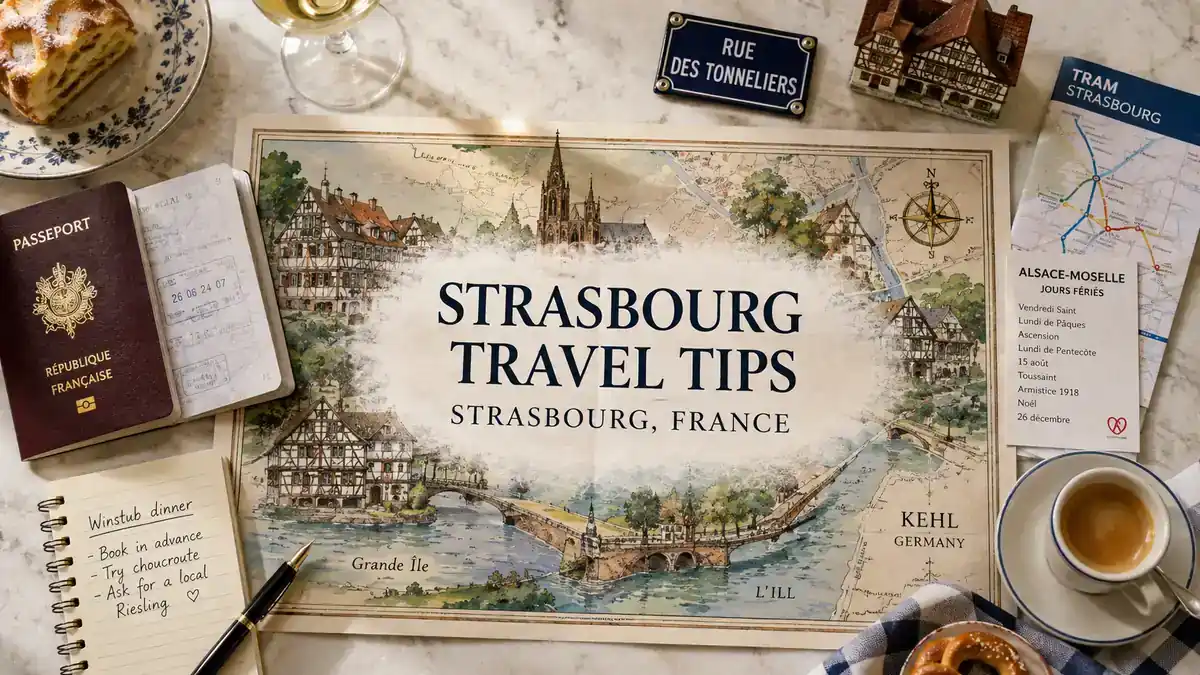
Your Strasbourg trip is booked, and the question now is smaller and more useful: what do you need to know so day one doesn’t get wasted? Most of the answers you’ll find are generic France advice, and generic France advice is exactly what fails here. Strasbourg sits on the French side of the Rhine, opposite Kehl in Germany, and it kept a set of local rules from its German period that the rest of the country never had. That shows up in the calendar, in which days things close, in what the menu says, and in how people greet you. None of it is complicated. All of it is invisible until it costs you an afternoon. This page collects the operating habits — the closing calendar, the language, eating, moving around the island, crossing the border, and the mistakes first-timers make — so you arrive already knowing how this city works.
Quick Answer
Strasbourg runs on its own Franco-German rhythm, with local holidays and closing habits the rest of France doesn’t share. The closing calendar drives your planning: Sundays, the lunchtime gap, two extra Alsace-Moselle public holidays and a shared museum closing day. Plan around closed days, book winstub tables ahead, and walk the island first.
Trust Layer
Tripstou planning guide for travelers resolving one travel decision. Covers the main variable, traveler context, and practical tradeoffs.
Produced with AI assistance and reviewed by Alex Perrut, working in tourism since 2015, for the Tripstou editorial team. See our editorial process for details.
Last factual review: August 15, 2026.
Official sources consulted: France.fr, Atout France.
Key Takeaways
- Strasbourg keeps Alsace-Moselle local law, so its calendar, closing days and food vocabulary differ from the rest of France.
- Alsace observes Good Friday and 26 December as public holidays, so banks, post offices and most shops close.
- Check Sunday closures, the midday gap and the museums’ shared closing day before you commit a day to anything.
- Say “Bonjour” on entering anywhere; French runs the city, English answers visitors, and Alsatian is texture, not a barrier.
- Book the one winstub dinner you care about before you travel; service is included, so rounding up covers tipping.
- Walk the island, stay out of cycle lanes, and carry your passport whenever you cross the Rhine into Kehl.
Table of Contents
Strasbourg Doesn’t Run Like the Rest of France
Strasbourg keeps its own local law, its own calendar and its own food vocabulary. Alsace spent a long stretch under German rule, and the administrative traces never went away. Much of what you know about how France operates is only partly true here — and the gaps are practical ones.
The legal side has a name: droit local, the body of local law that applies in Alsace and Moselle and nowhere else in the country. It is not a curiosity for historians. It is the reason your calendar in Strasbourg has holidays that a Paris calendar doesn’t, and the reason a bank or a post office can be shut on a day the rest of France is working normally. You will never read the statute. You will absolutely walk into its consequences.
The rest of the difference is cultural and just as concrete. The dialect on street signs is Alsatian, a German-rooted language with no relation to French. The menu is built on dishes whose names are German in origin, served in a type of room — the winstub — that has no equivalent in Lyon or Bordeaux. Evenings run earlier. The city is ringed by water, largely pedestrianised, and full of cyclists with real priority.
The split is easier to hold than it sounds: the calendar is local, the etiquette is national. Greetings, tipping, plugs, currency, rail booking and visa rules work here exactly as they do everywhere else in the country, and those are covered in our France travel tips. Everything on this page is the other half — the part that is true because you are in Alsace. If you’re still weighing whether the city earns a trip and how long to give it, that decision sits in our Strasbourg travel guide, not here.
Which Days Do Things Close in Strasbourg?
Sundays close most shops, lunchtime empties many kitchens, and Alsace observes two public holidays the rest of France skips. Museums also share a weekly closing day. None of this is a problem if you know it before you fix your days — it only hurts when you don’t.
Are shops closed on Sundays and over lunch?
Yes, most Strasbourg shops close on Sundays, and many close again in the middle of the day. Cafés, bakeries and restaurants in the tourist core stay open through Sunday, so you will eat and drink perfectly well; what you won’t do is shop, run errands or count on a bank. The midday gap is the one that catches people out, because kitchens in smaller places stop serving between lunch and dinner and don’t restart on request.
Why does Alsace have two extra public holidays?
Alsace-Moselle observes Good Friday and 26 December as public holidays, and the rest of France does not. Both come from droit local, the local legal framework the region kept when it returned to France. On those days, banks, post offices and most shops close in the same way they would on any other national holiday.
The regional holidays are the ones worth checking, because they don’t show up on the French calendar your booking app is using. A day you assumed was ordinary can arrive with half the city shut, and neither Good Friday nor the day after Christmas is flagged anywhere in a standard French holiday list.
What day are the museums closed?
Strasbourg’s municipal museums share a weekly closing day, traditionally Monday — confirm it before you fix a museum day. The city runs its museums as one network, so that closure doesn’t hit a single door; it hits all of them at once. One municipal museum is also shut for a long-term renovation, which means a title appearing on a list is not proof it is currently open.
The practical fix is to check the museum you actually care about on the day you actually intend to go, and to keep the cathedral, the Grande Île and the Petite France quarter as the fallback — none of them close.
Two adjacent decisions get resolved elsewhere. What entry costs and whether the city card earns its place is a budgeting question, answered in our breakdown of Strasbourg trip costs. How to arrange the closures into an actual plan depends on your length of stay: see 2 days in Strasbourg for the tight version, or 3 days in Strasbourg if you have room to absorb a closed day without losing anything.
What Language Do They Speak in Strasbourg?
French is the language of Strasbourg, and English is widely available across the tourist core. Alsatian, a genuine German-rooted dialect, is still spoken, mostly by older residents and out in the villages. German is widely understood too. You will not need any of it beyond a greeting.
The greeting is the one habit worth carrying. Say “Bonjour” as you walk into a shop, a bakery, a pharmacy or a small restaurant, before you say anything else — in English if that’s all you have. It is a French norm rather than a Strasbourg one, but it lands harder in a city where a lot of visitors arrive assuming they are basically in Germany and skip it entirely.
Alsatian is texture, not a barrier. You will see it on street signs alongside French, hear it in the names of dishes, and occasionally catch it in conversation between older locals. Nobody will address you in it. German is understood by many people working in hospitality, given how much of the local trade crosses the river, but French is what the city runs on and English is what visitors get answered in.
How Eating Out Works in Strasbourg
Kitchens here serve in defined windows, the good winstubs fill up, and the menu is Alsatian before it is French. Knowing what the dish names mean is most of the work. Book ahead for dinner, and don’t expect food on demand between services.
A winstub is the characteristic Strasbourg eating room: wood-panelled, close-packed, informal, originally a wine room attached to a producer. It is a format, not a cuisine label, and it is where the regional dishes are at their best. Service is included in the bill, so tipping is a matter of rounding up if the meal was good, and nothing more is expected.
What should you order — and what do the words mean?
Order flammekueche, choucroute or baeckeoffe and you are eating the actual local repertoire. The names look intimidating and describe very simple things:
- Flammekueche — a thin base of dough with cream, onion and bacon, blistered in a hot oven. Do not call it a pizza in front of an Alsatian; it isn’t one, and the comparison misses what it is.
- Choucroute garnie — fermented cabbage cooked in wine and served under an assortment of pork and sausage. It is the dish people mean when they say Alsatian food is heavy, and they are right.
- Baeckeoffe — a slow-baked casserole of meat, potato and onion marinated in white wine, sealed in a terracotta pot. Traditionally cooked overnight, so it is often a limited-run dish.
- Kougelhopf — a ring-shaped yeast cake with almonds and raisins, eaten at breakfast, with coffee, or as dessert. Savoury versions exist as an aperitif snack.
- Bretzel — the Alsatian pretzel, sold in bakeries all day and the most useful thing to eat when the kitchens are between services.
The good winstubs keep short menus, cook one region’s food properly and never hurry a table. That is precisely why those tables are gone by the time most visitors start thinking about dinner.
Do you need to book restaurants in advance?
Book dinner in advance for any winstub you actually want to eat in. The rooms are small, locals use them, and walk-in availability in the centre thins out fast in the evening. Weekends are tighter than weeknights, and the busy market season tightens everything further. Lunch is the easier service to improvise.
If you have one meal you care about on the trip, that is the one to reserve before you travel. Everything else can usually be sorted the same day, especially away from the immediate cathedral surroundings.
How to Move Around the Grande Île
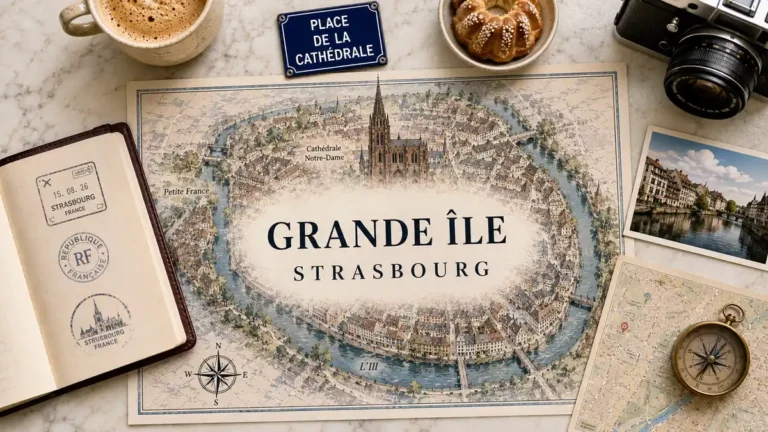
Walk the Grande Île. The historic centre sits on an island ringed by water, and it is compact, largely pedestrianised and cobbled almost everywhere. Bikes have genuine priority here and move fast. The tram fills the gaps out to the wider city, but the core is a walking city and behaves like it.
Walking is not a virtuous choice here; it is the efficient one. The island is small enough to cross on foot without effort, and much of it is closed to cars anyway, so the distance between anything you came to see is short. Cobbles are the real cost — they are uneven, they get slippery in rain, and they punish thin soles and wheeled luggage.
Strasbourg is among France’s leading cycling cities, and that changes how you have to behave on foot. Cycle lanes are traffic, not decoration. Stepping into one to line up a photograph of the cathedral is the most reliable way for a visitor to get shouted at, and the bikes are travelling faster than you expect. Look before you drift sideways. Bike hire is mainstream and easy if you’d like to join them.
The tram network is clean, frequent and genuinely useful for the station, outer districts and the run across the river. Tickets, passes and how the cross-border line actually works are a separate subject, handled in our guide to getting around Strasbourg.
Do You Need a Passport to Cross into Kehl?
Carry your passport or national ID card whenever you cross the Rhine into Kehl, even for an afternoon. You are moving between two countries, and the document that got you into France is the document you should have on you. Leaving it in the hotel safe is a needless risk.
The crossing itself is undramatic. Strasbourg’s tram runs across the river into Kehl on the German side, which is why plenty of visitors end up there almost by accident — a short ride, a walk on the riverside, and back. The casualness of it is exactly what makes people leave their documents behind.
Treat carrying ID as a standing habit for the day, not something you assess each morning. Put it in the bag you are taking out anyway and forget about it.
What Should You Pack and Wear for Strasbourg?
Pack for cobbles and changeable weather: broken-in shoes, layers, and rain cover in any season. Strasbourg’s climate leans continental — cold winters, warm summers, rain possible at any point. The centre is compact enough that you will walk far more than you planned. Nothing here calls for formal dress.
Footwear is the decision that matters. The old centre is cobbled and you will be on those stones for hours, so grip and cushioning beat style, and brand-new shoes are a poor idea. Layers handle the rest, because a bright Alsatian morning and a grey damp afternoon can be the same day. A hooded jacket usually serves better than an umbrella, given how open the riverside stretches are to wind.
Dress is relaxed everywhere, including winstubs and the smarter restaurants. Bring something warm you can add for evenings even in summer, since sitting outside by the water cools off quickly once the light goes. For staying connected, sort your data before departure with an eSIM for France.
The First-Timer Mistakes That Waste a Strasbourg Day
Over-scheduling is the mistake that costs the most here. Strasbourg’s centre is small, and the trip works when you let it be slow. The other classic errors are versions of the same thing: arriving with Paris assumptions, treating the city as a stopover, and ignoring the closing calendar.
- Packing the day like it’s a capital. The island rewards wandering, sitting and doubling back, and a plan with a stop every hour actively removes what people came for. Fewer fixed points, more time between them.
- Arriving with Paris expectations. Evenings start earlier and end earlier, kitchens close between services, and the city gets quiet sooner than a first-timer expects. A late dinner plan is how visitors lose their best meal of the trip.
- Treating Strasbourg as a day trip. The city empties in the evening once the day visitors leave, and the illuminated Grande Île after dark is the version most people never see. Staying the night changes the trip more than any sight does.
- Fixing days before checking closures. Sunday, the midday gap, the museums’ shared closing day and the two regional holidays are all knowable in advance. Every one of them is only a problem for people who found out on the day.
- Underestimating the market season. The core fills up, moves slowly and books out earlier, so accommodation and restaurant tables need securing well ahead. Crossing the island on foot takes noticeably longer than the map suggests.
Where you sleep affects how much of this you feel — a base on or beside the island puts the quiet evening version of the city on your doorstep, and the area-by-area comparison lives in our guide to where to stay in Strasbourg.
The mistakes that actually cost you a day are all timing mistakes, and none of them are about choosing the wrong thing to see. Strasbourg is small enough that you will reach everything; what you can lose is the hour it was open, the table you wanted, or the evening you were already in bed for.
Frequently Asked Questions
Can you drink the tap water in Strasbourg?
Yes, Strasbourg’s tap water is safe to drink, and asking for a carafe of tap water in a restaurant is completely normal. Bringing a refillable bottle is the practical move, since the compact centre means you will be on your feet for hours between stops.
Is Strasbourg in France or Germany?
Strasbourg is in France, in the Bas-Rhin department of Alsace, directly across the Rhine from Kehl in Germany. The German feel is real but historical: the region kept its own local law, dialect and food vocabulary from its German period, which is why it operates unlike the rest of France.
Should you carry cash in Strasbourg?
Carry a small amount of cash, but expect to pay by card almost everywhere. Cards work in restaurants, shops and museums without trouble. Cash still earns its place for market stalls, small bakeries and rounding up a bill in a winstub, where handing over a card feels clumsy.
Is Strasbourg easy to walk with wheeled luggage?
Wheeled luggage is manageable but unpleasant on the Grande Île, where cobbles cover most streets. Small hard wheels catch and rattle, and the noise carries in narrow lanes. Plan a short walk from your drop-off point, and choose a bag you can carry over the worst stretches.
Should you plan around the astronomical clock?
Don’t build a day around the astronomical clock without checking first. The cathedral runs a fixed daily display and the clock is not shown every day, so confirm the current arrangement with the cathedral before you commit. Treat it as a bonus you fit in, not a fixed appointment.
Is Strasbourg very crowded during the market season?
Yes, the Grande Île is at its busiest during the market season, and the lanes near the cathedral move at a shuffle. The useful thing to know is that the crowds don’t suspend the closing calendar: shops still shut on Sunday, and the museums still share their weekly closing day.
Related Guides
These pages resolve the decisions this guide deliberately routes outward.
- Strasbourg travel guide — whether the city earns a trip, and how long to give it.
- 2 days in Strasbourg — what fits into a short first visit.
- 3 days in Strasbourg — the slower version, with room to absorb a closed day.
- Getting around Strasbourg — tram tickets, passes and the cross-border line to Kehl.
- Strasbourg trip costs — what a trip runs to, and whether the city card is worth it.
- Where to stay in Strasbourg — choosing a base by area and trip type.
- France travel tips — the national practicalities that apply everywhere in the country.
Did this guide save you time or money? Tripstou is independent and reader-funded — if you'd like to give something back, you can support the site with a crypto contribution of any size.