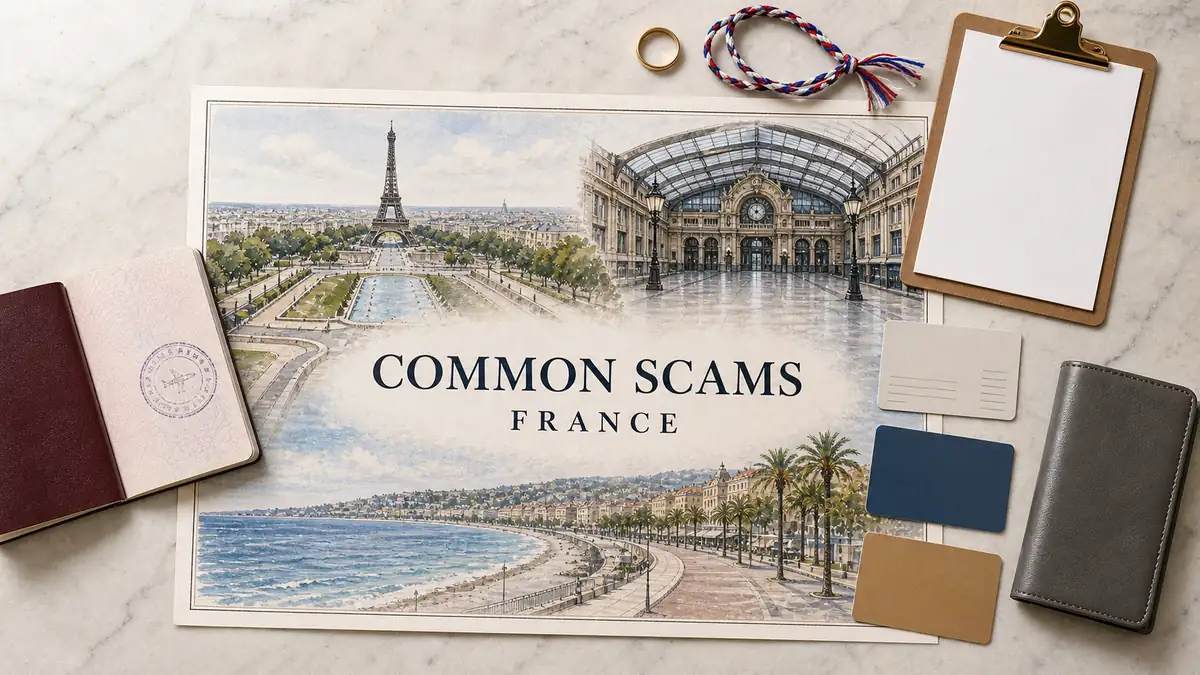
Every street scam in France needs something from you: your hand, your pause, or your conversation. That is the whole mechanism. A stranger creates a small social opening — a ring picked up off the pavement, a string held out toward your wrist, a clipboard pushed under your nose — and the scam only runs if you supply the participation it asks for. Remove that, and almost every version collapses on the spot.
The calibration matters too. These are nuisances that cost a wallet and an afternoon, overwhelmingly non-violent, in a country that is broadly safe to travel. Recognising the opening is worth more than any amount of general caution.
This guide does three things: it names every scam you are realistically likely to meet and gives you its tell, it scripts the refusal that ends an approach cleanly, and it sets out the official route for reporting one after the fact.
Quick Answer
France’s common scams are street approaches — gold ring, friendship bracelet, fake petition, unofficial taxis — that need your participation to work. The tell is always the unsolicited opening: a stranger initiating with an object, a clipboard, or an offer of help. Refuse without stopping. Keep walking, keep your hands occupied, and accept nothing.
Trust Layer
Tripstou safety guide for travelers deciding how safe a destination is and what precautions actually matter. Covers real risk levels, common scams, situational awareness, and protection choices.
Produced with AI assistance and reviewed by Alex Perrut, working in tourism since 2015, for the Tripstou editorial team. See our editorial process for details.
Last factual review: August 21, 2026.
Official sources consulted: France.fr, Atout France.
Key Takeaways
- Every street scam in France dies at the same point: the moment you decline to stop, speak, or hold anything.
- Stepping into a doorway or café to check directions removes you from selection, because scammers read hesitation, not wealth.
- Never let an object into your hand — a ring, a bracelet or a rose turns politeness into a bill.
- Official taxis never solicit passengers, so anyone offering a ride inside a terminal or station hall is not legitimate.
- France runs an official online complaint portal for theft and fraud by an unknown person, and non-residents can file through it.
- Insurance usually covers money stolen from you, not money you handed over, and a filed police report is the hinge either way.
Table of Contents
What Are the Most Common Scams in France?
France’s common scams are a small, stable set of street and transport approaches. They are the gold ring, the friendship bracelet, the fake petition, the shell game, unofficial taxis, ticket-machine “help”, ATM interference, and inflated bar bills. All eight share one mechanic: they need your participation to work.
- The gold ring — a stranger “finds” a gold-coloured ring at your feet, presses it on you, then asks for money.
- The friendship bracelet — someone knots a woven string onto your wrist, then demands payment for it.
- The fake petition — a clipboard, an unnamed charity, and a signature that turns into a donation demand.
- The shell game — street gambling with three cups or cards, run by a crew that includes fake winners.
- Unofficial taxis — a driver soliciting rides inside an airport terminal or a station hall.
- Ticket-machine “help” — an unrequested helper at a metro machine who reaches for your card or your ticket.
- ATM interference — a card that jams, a helpful bystander, and a PIN watched over your shoulder.
- Inflated bar and restaurant bills — a bill that does not match what was ordered or what was posted outside.
One more sits outside the street set entirely: booking fraud, the scam that runs before you land. It is covered with the payment scams below because it needs a different response and a different reporting channel.
These crews work in teams. One person opens the interaction while another works behind you, which is why the approach is rarely the point — the distractor is the job, and the theft or the payment is the second act. Understanding that changes what you watch: the moment you are engaged, your attention is the thing being spent.
This page covers approaches, meaning the scams that come with a social opening you can refuse. Silent pickpocketing has no opening and no conversation, and it sits alongside the national safety verdict and the geography of petty theft in our France safety guide, which is where the broader question of how safe the country is gets answered.
Street Approach Scams: Ring, Bracelet, Petition, Shell Game
These four scams all begin with a stranger’s object or invitation. They run on monument forecourts, basilica steps and station concourses, where visitors slow down and look around. Each one has exactly one tell, and none of them survives a walk-past that never stops.
The gold ring (“found ring”) scam
The gold ring scam converts a staged act of honesty into a payment.
- Opening move: someone bends down beside you, picks up a gold-coloured ring, and asks whether you dropped it.
- The tell: the ring appears at your feet at the exact moment you pass, and the finder refuses to keep it.
- How it ends: you say it is not yours, they insist you take it as a gift or for luck, then ask for money “for a coffee” — and the asking price rises while the ring is in your hand.
- What to do: keep your hands down, say “non” once, keep walking. Never let the ring into your palm.
The friendship bracelet / string trick
The friendship bracelet scam attaches the product to your body before any price is mentioned.
- Opening move: a warm approach with a compliment or an offered handshake, and a woven string looped over your wrist or finger.
- The tell: the bracelet is being knotted on while you are still working out what is happening.
- How it ends: once it is tied, payment is demanded, and the group closes in socially so that refusing feels like a scene.
- What to do: keep your hands pocketed through the approach zone. If a bracelet is already on, slide or cut it off and walk on — nobody can make you pay for something you never bought.
The fake petition clipboard scam
The fake petition uses a signature to occupy both your hands and your attention.
- Opening move: a young person with a clipboard asks “Do you speak English?” and presents a charity or disability petition.
- The tell: the sheet is homemade, the organisation is never named, and a second person is hovering just behind you.
- How it ends: after you sign, a donation is demanded — often pointing at amounts already written on the sheet — while your bag hangs open and your eyes are on the clipboard.
- What to do: do not take the clipboard and do not stop. Answer the opening question with a flat “non” and keep moving.
The shell game (street gambling)
The shell game is not a bet you can lose fairly; it is a performance with no winning move.
- Opening move: a small crowd around a cardboard box, three cups or three cards, and a game that looks easy to follow.
- The tell: someone in the crowd keeps winning easily and encourages you to try, while others watch the street for police.
- How it ends: you win a small round, raise your stake, then lose it all — and the crowd pressed around you includes the people working your pockets.
- What to do: do not stop to watch. Spectators here are marks as often as players are.
All four cluster where visitors arrive and orient themselves — monument forecourts, basilica steps, bridges and river walks, and the concourse of a big station. The setting is not dangerous in itself; it is simply where people stand still with a map or a phone in their hands. Most named French versions of these scams are Paris versions, and our Paris safety guide carries the city-level detail on where they concentrate.
The approach is calibrated to your politeness, not your wealth. The ring and the bracelet both open with a favour or a gift precisely because refusing a gift feels ruder than refusing a sale — that discomfort is the product being sold. Treat the opening as a sales pitch and it ends in one word.
Two lighter variants work the same edges: the rose pressed into a companion’s hand at a restaurant terrace, and the unofficial drink sellers working monument queues. Both are answered in the FAQ below.
Transport and Payment Scams: Taxis, Ticket Machines, ATMs and Bar Bills
These scams open where money or a machine sits between you and a stranger. The arrival hall, the ticket machine, the ATM keypad and the end-of-night bill are the four moments. Each one has a binary test that settles the question before you commit anything.
The fake airport taxi
Official taxis in France do not solicit passengers. Anyone offering you a ride inside a terminal or a station hall is, by that act alone, not a legitimate taxi.
- Opening move: someone approaches you in arrivals — often well dressed, sometimes holding a phone or a printed sign — and offers a car already waiting outside.
- The tell: the approach itself. Licensed taxis wait at the marked rank and never work the hall.
- How it ends: an unmetered ride, a price renegotiated en route or on arrival, and no recourse afterwards because no journey record exists.
- What to do: walk to the official rank and check the car for three markers — an illuminated roof sign, a visible licence number, and a working meter. Any one of them missing means walk away.
A prefectural flat fare applies between the Paris airports and the city, identical by day and by night, so the price is not something to negotiate at the kerb. Confirm the official fare at the rank or with your driver before you set off, and treat any driver who wants to agree a different number as the scam itself.
The metro ticket-machine “help” scam
The ticket-machine scam runs on a helper you did not ask for.
- Opening move: a stranger steps in to “assist” you at a machine you are already using.
- The tell: you did not request help, and the helper reaches for the screen, your card or your ticket.
- How it ends: the ticket you paid for is swapped for a used or invalid one, or your card and PIN pass through someone else’s hands.
- What to do: decline and complete the transaction yourself, or use a staffed counter. Real station staff are in uniform.
The ATM scam
ATM scams need a moment of confusion at the machine, so they manufacture one.
- Opening move: your card jams or the screen stalls, and a bystander appears with advice.
- The tell: anyone standing close enough to read the keypad, or offering to re-enter your PIN “to release the card”.
- How it ends: the PIN is observed, the card is retrieved from the slot after you leave, and withdrawals follow within minutes.
- What to do: cover the keypad with your free hand and refuse all assistance. If the machine keeps your card, block it from your banking app or by phone before you leave the spot.
The restaurant and bar bill scam
A rip-off is a bad price you agreed to; a scam is a price you never agreed to. Overcharging crosses that line when the bill stops matching what was ordered or what was posted outside.
- Opening move: a menu with no prices, a “speciality” recommended verbally, or items appearing at the end. In the night version, a friendly stranger invites you for a drink at a bar they choose.
- The tell: the price stays unstated until the bill lands, and the venue is one you were steered toward instead of one you picked.
- How it ends: a bill far above anything posted, delivered with staff pressure and, in the night version, a companion who has quietly left.
- What to do: read the posted menu before you sit down, then check the bill line by line against it. Ask for the itemised bill in writing, and if it does not match what was posted, say so calmly and ask for the police to be called. Legitimate venues settle it on the spot.
Booking fraud
Booking fraud is the one scam that runs before you land.
- Opening move: a listing or an offer that moves you off the platform — a classified ad, a messaging app, a bank transfer “to hold the dates”.
- The tell: payment is requested outside the booking platform, or the price sits well below everything comparable.
- How it ends: no booking exists when you arrive, and the transfer is gone.
- What to do: pay through the platform and use a card, never a transfer. This scam also has its own reporting channel, covered below.
Bill scams have a geography of their own: seafront terraces and promenade bars, where turnover is high and nobody expects a customer to come back. The Riviera and beachfront version of this is covered in our Nice safety guide, alongside the rest of the coastal context.
The airport rung is the only one on this page you can settle without any judgement at all. The rank exists, solicitation does not belong in the hall, and there is nothing to evaluate. Everywhere else you have to read a situation. Here you only have to walk.
How to Say No to Scammers in France
Say a flat “non” without breaking stride, and keep your hands where nothing can be placed in them. No explanation, no eye contact held, no pause to be polite. Refusing costs nothing socially in France, and it removes the one thing every street scam needs from you.
- Do not stop. Every script needs you standing still. Walking answers it.
- Say one word. “Non”, repeated once if needed, never explained.
- Keep your hands pocketed or occupied. An object in your hand is already the transaction.
- Do not answer the opener. “Do you speak English?” is an audition, not a question.
- Take nothing, ever. A ring, a bracelet, a rose, a flyer, a bottle — each one creates a debt you never agreed to.
- Move toward people and light. Stepping aside with a group is how the group closes in.
The same refusal defeats every rung because every rung buys the same thing from you: a few seconds of participation. The ring needs your open palm. The bracelet needs your wrist. The petition needs your signature. The shell game needs your attention. Take the participation away and there is nothing left for the script to work with.
Politeness is the currency these approaches actually run on, and it is what you are asked to spend before any money changes hands. French street manners are far blunter than most visitors expect. A flat “non” and a continued stride is normal behaviour here, and no one around you will read it as rude.
Crews select marks by behaviour, not by nationality or wealth. The visibly orienting traveler is the preferred target: map open, phone up, luggage in hand, head turning at a junction. Stepping into a doorway or a café to check your directions takes you out of the selection entirely, because a stationary person who is clearly settled is not worth an approach.
Lone travelers are approached more often than pairs, because a companion produces an instant second opinion and no scam script survives one. Women traveling alone meet this targeting mechanic more frequently, and the wider questions it raises — street harassment, walking at night, going out alone — are answered in our solo female travel safety guide for France.
What to Do If You Get Scammed in France
Disengage first, without arguing. Step away toward a busy, staffed space, then check that your wallet, phone and bag are all still yours. These encounters are overwhelmingly non-violent, and the realistic loss is a wallet and an afternoon — so cards come before confrontation.
- Within minutes: move to a staffed location, confirm what is missing, and block any card that was handled, jammed or taken, through your banking app or your bank’s emergency line.
- Within the hour: write down what happened while it is fresh — the time, the exact location, how many people were involved, what was said, and what you handed over.
- The same day: keep or photograph anything physical: the bracelet, the receipt, the bill, the machine, the transfer confirmation.
- Before you move on: file the report. It is the hinge for everything that follows.
The instinct to chase the crew, argue, or film them is the most expensive minute of the whole encounter, because it is the minute your card is still live. Chasing recovers almost nothing. Blocking recovers the rest of your trip.
Report even a small loss. A filed report is what converts an unpleasant afternoon into something a bank or an insurer can act on, and it is what makes a card dispute or a claim possible in the first place. It also takes far less time than the argument you walked away from.
How to Report a Scam to the Police in France
France lets visitors file a complaint online through an official Ministry of the Interior portal. It covers property offences committed by an unknown person, theft and fraud included, and it is open to non-residents, who authenticate with a passport or a national ID card. A police station also takes the complaint in person.
- A street scam or theft by an unknown person → the official online complaint portal at
plainte-en-ligne.masecurite.interieur.gouv.fr, or any police station or gendarmerie in person. - Bank-card fraud → Perceval, the dedicated channel for fraudulent card transactions.
- An online scam where you never met the other party → THESEE, which handles internet fraud such as the booking fraud above. THESEE cannot be used for a street scam: the relationship must have been virtual.
That last boundary matters more than it looks. A gold ring, a bracelet, a shell game or an inflated bill all happened face to face, so they go to the online complaint portal or to a station — never to THESEE. A fake apartment listing you only ever met through messages goes to THESEE. Sending an in-person scam to the online-fraud channel costs you the report and the time it took to write.
Once the complaint is filed, you have the document your bank and your insurer will ask for, and the trip carries on from there. Our France travel guide is the route back to the rest of the planning.
Does Travel Insurance Cover Money Lost to a Scam?
Cover usually responds to money stolen from you, not to money you handed over. That distinction decides most scam claims: theft is an insured event under typical policies, while a voluntary payment, however manipulated, generally is not. A police report is the hinge either way.
Voluntary handover sits outside standard theft cover. A ring bought under pressure, a bracelet paid for, a shell-game stake, an inflated bill settled at the table — in each case you performed the payment yourself, and most policies read that as a purchase you regret. Theft-adjacent losses behave differently. A wallet lifted while a petition occupied your hands, or a card retrieved from an ATM slot and used, are thefts, and thefts are what a policy is built for.
The report is what makes the difference practical. Without a filed complaint, an insurer has your account of events and nothing else; with one, the loss carries an official record and a date. Card losses often move faster through your issuer’s dispute process than through any policy, so run both in parallel and let whichever responds first do the work.
The clause that decides almost every claim on this page is the theft definition, and whether it requires the money to have left you without your knowledge. Read that one before the trip. It tells you more about your cover than any scam list will.
Travel medical insurance
SafetyWing Nomad Insurance provides travel medical coverage designed for travelers and digital nomads, with flexible Monthly and Annual plans.
Check Nomad Insurance coverage and current pricing →
New Nomad Insurance Essential members can get 8 weeks of electronic theft coverage free with reward code TRIPSTOU8.
Apply the reward before creating your SafetyWing account by looking for the pink camera icon on the Nomad Insurance page.
Tripstou may earn a commission if you purchase through this link, at no extra cost to you.
Frequently Asked Questions
What is the rose scam in France?
A stranger presses a rose on you as a gift, then demands payment once you accept it. It runs on restaurant terraces and busy pavements, often aimed at a companion so refusing feels rude. It works exactly like the ring and the bracelet. Take nothing and it ends.
Should you buy water from street sellers at the Eiffel Tower?
No. Unlicensed sellers working monument queues have no accountability for what is in the bottle or where it was filled, and prices are set on the spot. Buy from a shop, a café or a vending machine instead, and carry a refillable bottle for long queue days.
Can scammers force you to pay for a friendship bracelet?
No. The pressure is social, not physical: a group closes in, voices rise, and refusing feels like making a scene. These approaches are overwhelmingly non-violent. Slide or cut the string off, say “non” once, and walk toward a busy, staffed space without arguing or paying.
What should you do if you already signed a fake petition?
Check your bag and pockets first — the signature was only the distraction. The real target was whatever hung open while you wrote. Refuse the donation demand and keep walking; nothing you signed binds you. If a card or wallet is missing, block it before doing anything else.
Is it safe to use ATMs and cards in France?
Yes. Cards are accepted almost everywhere and paying by card is safer than carrying cash. The risk sits at the machine, not the card: use ATMs inside bank branches or staffed buildings where possible, cover the keypad, and refuse help from anyone who appears while you are withdrawing.
Is someone bumping into you or spilling something on you a scam?
Usually yes, if a stranger then offers to help. The contact is the opening and the cleaning-up is the distraction, while a second person works your bag. Step back instead of letting anyone touch you or your clothes, check your pockets straight away, and keep moving.
Related Guides
- Is France safe? The full safety guide — the national verdict, where petty theft concentrates, and the pickpocketing geography this page leaves out.
- Paris safety guide — city-level detail on the landmark-anchored approaches, since most named French scams are Paris scams.
- Nice safety guide — Riviera and beachfront context, including the coastal version of the bill and overcharging problem.
- Solo female travel safety in France — targeting, harassment, night walking and going out alone, treated in full.
- France travel guide — the broad planner for routes, timing and everything beyond safety.
Did this guide save you time or money? Tripstou is independent and reader-funded — if you'd like to give something back, you can support the site with a crypto contribution of any size.