
Most first trips to Europe go wrong on pace, paperwork and small habits, not on the choice of country. Travelers squeeze too many cities into too few days, discover an entry check late, arrive at a famous museum whose slots sold out long before, or haul a heavy case up a staircase with no lift. None of that depends on where you go. This guide groups what to prepare by the decisions a first-timer actually makes: how fast to move, what to check before entering the Schengen area, what to book, how to pay, how to get between countries, what to pack, and how to behave once you are on the ground. Each section gives the habit that works and points to the Tripstou guide that owns the deeper detail. Where to go is a separate question with its own page; this one assumes you have a rough idea and want the trip to run smoothly once it starts.
Quick Answer
Prepare a first Europe trip by fixing the pace: fewer countries, more nights per stop. The number of moves decides how much time goes on transit, and how much paperwork, booking and packing friction you take on. Check the Schengen area’s entry rules early, book famous sights ahead, pay by card and pack light.
Trust Layer
Tripstou planning guide for travelers resolving one travel decision. Covers the main variable, traveler context, and practical tradeoffs.
Produced with AI assistance and reviewed by Alex Perrut, working in tourism since 2015, for the Tripstou editorial team. See our editorial process for details.
Last factual review: October 1, 2026.
Official sources consulted: Your Europe (European Union), European Travel Commission, European Commission (112 emergency number).
Key Takeaways
- Plan two or three bases with at least two nights each, and count a full travel day for every move between them.
- The Schengen stay limit is one shared total across every member country, and Switzerland sits inside Schengen while staying outside the EU.
- Book timed tickets only for the famous sights you would regret missing, and keep to one booked entry per day at most.
- Pay by card, choose the local currency whenever a terminal or ATM asks, and carry a small cash float for cafés and markets.
- Pack one bag you can lift up stairs, and sort mobile data and the right plug adapters before you land.
- Pickpockets target crowded transit and landmarks, so keep phone and wallet out of reach, and call 112 for emergencies across the EU.
Table of Contents
How many countries should you visit on a first trip to Europe?
A first trip to Europe works best with two or three bases and more nights in each. Every move between cities costs most of a day in packing, transit and check-in, so fewer bases buys more time actually seeing places. Longer trips can add a base; short trips should cut one.
Two to three nights per stop is a sensible minimum. One night means arriving tired, seeing a single evening and leaving the next morning; the second and third nights are where a city starts to open up. Count a travel day for each move, even a short one, because checkout, the station, the journey and finding the next room eat the hours in between.
Mix busy and quiet stops. A run of big capitals back to back wears most first-timers down within the second week, while a smaller town or a stretch of coast between them resets the pace. This is not your only trip, either: leaving a country for next time beats seeing it through a train window.
An extra country on a first trip only pays off if it gets at least two full days on the ground; anything shorter trades a sightseeing day for a travel day.
Choosing which countries belong in the route is its own decision, covered in our guide to choosing where to go on a first trip to Europe. Once the countries are settled, sort these before you fix the route:
- Decide the total number of nights first, then divide them between your bases.
- Group stops that sit close together and connect directly.
- Price an open-jaw flight into one city and out of another to avoid backtracking.
- Keep one buffer day for weather, strikes or simple tiredness.
What to check before entering the Schengen area
Confirm your passport validity, whether you need a visa or travel authorisation, and how long you may stay before booking. These three checks decide whether you can board and how long the trip can run. They apply to the Schengen area as one zone, so the stay limit covers every Schengen country you visit, not each one separately.
Short stays are capped at 90 days in any rolling 180-day period across the Schengen area as a whole, not per country. Visa-exempt visitors should confirm whether the ETIAS travel authorisation applies to their trip before booking. Non-EU arrivals are registered biometrically at the border instead of having passports stamped, under the EU Entry/Exit System. If your trip starts in Spain, Italy, France or Portugal, their entry pages carry the current rules: Spain entry requirements, Italy entry requirements, France entry requirements and Portugal entry requirements.
Schengen and the EU are different maps. Switzerland belongs to the Schengen area but not to the EU. Andorra and Monaco sit outside both, so different rules apply there; check them before you cross. The UK and Ireland are outside Schengen too, with their own entry checks.
On a multi-country route the stay limit is one shared total, so adding another Schengen country to the itinerary never adds a day to it.
Should you book attractions in advance in Europe?
Yes for the famous ones: the best-known sights sell out, so book timed tickets ahead and leave the rest flexible. Headline museums, major monuments and timed-entry sites fill their slots first, especially in summer. Smaller museums, churches and neighbourhoods rarely need a booking, which keeps most of each day open to weather and mood.
Book the handful of sights you would regret missing, then build each day around that slot. A timed entry anchors the morning or the afternoon; the rest of the day fills with walking, food and places that need no ticket. Use the sight’s official website where one exists. Missed slots are rarely refunded, so arrive early.
One booked sight per day is the ceiling that works on a first trip; two timed entries in different parts of a city turn the day into a race between them.
Timing changes the pressure. Shoulder season thins the queues and crowds at the same sights, and our guide to the best time to visit Europe sets out how the months compare. Winter has its own draw in many cities, with shorter days and festive stalls in the squares; Christmas markets in Europe covers that season.
Tours and activities
Book skip-the-line tickets, day trips and local tours with free cancellation on most activities.
You can also browse everything on getyourguide.com.
Tripstou may earn a commission if you book through this link, at no extra cost to you.
Pay by card, choose the local currency, carry a little cash
Pay by card where you can, pick the local currency when the terminal asks, and keep a small cash float. Cards are accepted across most of Europe for everyday spending, while cash still covers small cafés, markets, tips and some toilets. That combination keeps fees low without leaving you stuck at a cash-only counter.
The currency prompt matters because paying in your home currency lets the terminal or ATM set the exchange rate, and that rate is usually worse than your card’s. Choose the local currency every time. Several countries on a typical route — Switzerland and the UK among them — keep their own currency, and the same rule applies there.
Tell your bank you are travelling, and carry two cards from different networks stored in separate places. One loss then never stops the trip.
The currency question comes up at almost every till and ATM on a multi-country trip, so one wrong answer repeated across the route costs more than most card fees.
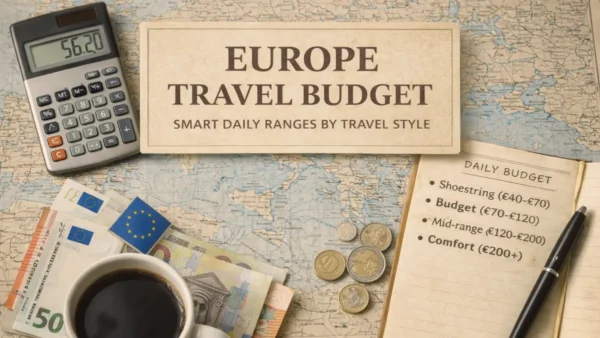
How much to set aside each day is answered in the Europe travel budget guide. Fees, ATM habits and the places where cash still wins are covered in cash vs card in Europe.
How to move between countries without losing days
Pick base cities that connect directly, keep transfers few, and book long legs ahead. A direct train or flight between two bases protects the day; a route with several changes multiplies the chances of a missed connection. Long-distance tickets bought in advance are also easier to secure on the departure you actually want.
Move in the morning. An early departure lands you in the next city with daylight left to check in, eat and walk the first streets, and a delay still leaves room to recover.
Buy and validate tickets before boarding. Many regional trains, buses and city transit systems check for validation, and an unvalidated ticket can earn a fine even when you paid for it.
The route that looks shortest on a map is often the one with the most changes, so count the connections before you compare journey times.
The mode decision itself — train, plane, bus or car, and whether a rail pass pays off — sits in our guide to getting around Europe.
What plug adapter and phone plan do you need for Europe?
Most of continental Europe uses two-round-pin plugs, while the UK and Ireland use three-pin plugs. Sort mobile data before you land, either through your home plan or a travel eSIM, so maps and tickets work from the arrival hall. A route that includes the UK or Ireland needs both adapter types.
Check the label on each charger before plugging it in; it states the voltage the device accepts. A multi-port adapter covers several devices from one socket, which helps in older rooms with few outlets.
Phones need the same planning.
- EU roaming rules apply to EU SIM cards; they do nothing for a phone plan from outside the EU.
- Ask your home provider what its travel option includes, or install a travel eSIM before departure.
- Download offline maps, booking confirmations and train tickets so a weak signal never blocks a gate.
How much luggage should you bring to Europe?
One carry-on-sized bag you can lift up stairs is the right size for a first trip. Old buildings often have no lift, stations have stairs between platforms, and cobbled streets punish wheels. A light bag also makes every move between bases faster, which matters most on a route with several stops.
Plan for laundry. A laundrette or an apartment washing machine halfway through the trip halves what you need to bring. Luggage racks fill quickly on busy trains, and a bag you can lift overhead stays with you instead of at the far end of the carriage. Winter trips and long stays justify a slightly bigger bag; even then, the limit is a case you can carry one-handed up a flight of stairs.
Shoes matter more than anything else in the bag, because most sightseeing in European old towns is done on foot over stone and uneven paving.
Pack this:
- Comfortable walking shoes that are already broken in.
- Layers, including a light waterproof, for weather that changes within a day.
- A scarf or cover-up for churches and other religious sites.
- A small day bag that closes fully.
Skip this:
- More than two pairs of shoes.
- A separate outfit for every evening.
- Full-size toiletries you can buy at any pharmacy.
- Anything you would not want to carry up stairs.
How to avoid pickpockets and scams in Europe
Most losses happen in crowded transit and at landmarks, and a few habits remove nearly all of the risk. Pickpockets work where people are distracted: packed metro carriages, station concourses, queues and viewpoints. Violent crime against visitors is rare; theft of phones and wallets is the problem a first-timer actually needs to plan for.
- Keep phone and wallet out of reach in crowds — front pocket or zipped bag, never a back pocket or a café table edge.
- Split cards between bags so one theft never takes everything.
- Carry only the day’s cash and leave the rest locked away.
- Decline petitions, “free” bracelets and friendship bands; they exist to stop you and bring a hand near your bag.
- At ticket machines, refuse help from strangers and watch for anyone crowding behind you.
A stranger who starts a conversation at a ticket machine or a crowded doorway is usually the setup; the theft is done by a second person you never look at.
Call 112 in an emergency. It is the European emergency number, free from fixed and mobile phones everywhere in the EU, and it also works in Switzerland. Many countries keep their own police and ambulance numbers alongside it. Save both.
Where to eat in Europe without falling into tourist traps
Walk a street or two from any landmark to eat, and ask for the bill when ready. Places facing the main square trade on location; a short walk usually finds better food at local prices. Waiters in most of Europe do not bring the bill unprompted, because rushing a table is considered rude.
Menus with photos and translations into many languages, and staff calling you in from the doorway, mark a place built for passing trade. Look for a short menu in the local language and tables full of locals at lunch.
Lunch is the bargain. Many restaurants offer a set lunch menu on weekdays, often the best-value meal of the day.
Ask explicitly for tap water. It is generally drinkable in most of Europe, though some islands and regions advise checking locally; without asking, many restaurants bring bottled water and charge for it.
A restaurant that needs a host on the pavement to fill its tables is telling you who its customers are: people who will not come back.
A few local phrases go far — hello, please, thank you and the bill. English is common in big cities and tourist areas but not universal, especially in smaller towns. Tipping norms differ from North America and are answered in the FAQ below.
Frequently Asked Questions
Do you tip in Europe?
Yes, but less than in North America, and service is sometimes already included in the bill. Rounding up or leaving a small amount for good table service is common, though norms vary by country. Check the bill for a service line before adding anything. How to tip when paying by card is covered in cash vs card in Europe.
Is tap water safe to drink in Europe?
Tap water is generally safe to drink in most of Europe, including in hotels and apartments. Some islands and regions advise checking locally, and a sign at a tap or fountain marking non-drinking water settles it. Carrying a refillable bottle saves buying bottled water through the day.
Do you have to pay to use public toilets in Europe?
Often yes, especially at railway stations and busy tourist sites, where an attendant or turnstile collects a small fee. Keep a few coins handy, since not every machine accepts cards. Cafés usually reserve their toilets for customers, so buying a coffee is the simplest way in. Museum toilets are usually free once you are inside with a ticket.
Do I need travel insurance for Europe?
Travel insurance is strongly recommended for a first trip to Europe, even on a short stay. A good policy covers medical care abroad, cancelled or missed travel, and lost or stolen bags. Check what your home health plan covers abroad before relying on it. Choose cover for every country on the route, including any outside the EU.
Can you travel around Europe speaking only English?
Yes, a first trip to Europe works in English alone if it stays mostly in cities and tourist areas. Hotels, stations and major sights handle English routinely. Smaller towns, local buses and family-run restaurants are where it thins out, so download an offline translation pack and learn a greeting and a thank-you in each country’s language.
What is an open-jaw flight, and is it worth booking for Europe?
An open-jaw flight lands in one city and flies you home from another. It removes the day spent backtracking to your arrival airport, which suits a route that moves in one direction through several bases. Price it against a standard return before deciding, because the difference depends on the airports and season.
Related Guides
- Europe travel guide — choose which countries and regions belong on a first route.
- Getting around Europe — compare trains, flights, buses and cars, and see when a rail pass pays off.
- Cash vs card in Europe — fees, ATM habits, the currency prompt and tipping by payment method.
- Best time to visit Europe — how the seasons change crowds, weather and booking pressure.
- Europe travel budget — what a day costs and where the money goes.
- Christmas markets in Europe — plan a winter trip around the festive season.
- France entry requirements — the current rules if your trip starts in France.
- Italy entry requirements — the current rules if your trip starts in Italy.
Did this guide save you time or money? Tripstou is independent and reader-funded — if you'd like to give something back, you can support the site with a crypto contribution of any size.