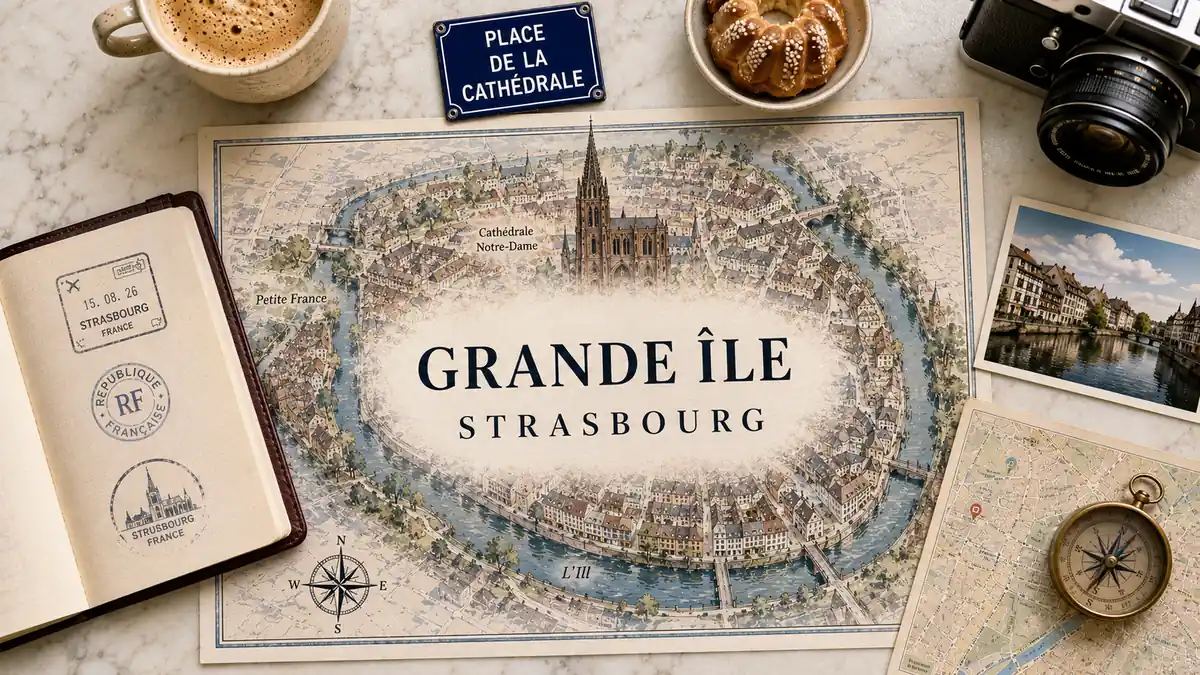
Two questions usually arrive together: what exactly is the Grande Île, and should you book a hotel on it? The first one trips people up more than it should. The Grande Île is not a small quarter tucked between canals — it is the entire historic centre of Strasbourg, the island that holds the cathedral, the main squares, and Petite France inside it. So “staying on the Grande Île” is a much broader choice than most booking sites make it sound.
The second question has a shorter answer. For most first-time visitors on a short, car-free trip, the island is the most convenient base in the city, and it charges for that convenience in three currencies: room rates, night noise, and car hassle. This guide covers the verdict, where on the island to book, what it costs, and when to look elsewhere.
Quick Answer
Yes — the Grande Île is the best base in Strasbourg for a first, car-free, sightseeing-led short stay. Everything worth seeing sits within a walk. You pay a premium for that, and the cathedral core stays loud late. Book the quieter island edges for sleep, or off-island if you are driving.
Trust Layer
Tripstou stay guide for travelers choosing where to base. Covers area atmosphere, budget, convenience, noise, and traveler fit.
Produced with AI assistance and reviewed by Alex Perrut, working in tourism since 2015, for the Tripstou editorial team. See our editorial process for details.
Last factual review: August 15, 2026.
Official sources consulted: France.fr, Atout France.
Key Takeaways
- The Grande Île is Strasbourg’s entire historic island centre, not a small quarter — Petite France sits inside it.
- Book the island if your trip is short, car-free and sightseeing-led; the walk-everywhere advantage pays back most on two or three nights.
- Location is charged for three ways: room rates above the city average, late street noise, and a car that becomes a liability.
- Choose the cathedral core for atmosphere and the quieter canal edges for sleep — the walking gap between them is minutes.
- Arrive by train and stay car-free; large parts of the island are pedestrianised and parking is a standing cost.
- Christmas market weeks push rates to their annual peak and tighten island access, so book far ahead or book elsewhere.
Table of Contents
The Grande Île Is Strasbourg’s Whole Historic Centre — Not a Small Quarter
The Grande Île is the island historic centre of Strasbourg, ringed by the river Ill and the Faux-Rempart canal. It covers the whole old town, and Petite France sits inside it. Booking a hotel on the Grande Île can therefore already mean booking in Petite France, which trips up a lot of first-time planners.
The island was the first entire city centre inscribed on the UNESCO World Heritage list, and the inscription was later extended to take in the Neustadt on the far bank. That listing is the reason the island reads as one continuous historic quarter with no obvious internal borders.
Almost everything a visitor pictures of Strasbourg sits on the island: Notre-Dame cathedral, the Palais Rohan on Place du Château, Place Kléber, and Place Broglie. They are close together. Once you understand the island as a single unit, hotel listings stop being confusing — “old town” and “Grande Île” are describing the same piece of ground.
Practically, that collapses one decision. Petite France is a postcode inside the address you already chose, and this page treats the island as one base. If you are still weighing the two names against each other, our Petite France vs Grande Île comparison resolves that head-to-head.
Is the Grande Île a Good Place to Stay?
Yes, for most short visits. The Grande Île is Strasbourg’s strongest base if you are arriving by train, staying two or three nights, and want the cathedral, the canals, and the restaurants outside your door. The conditions attached are price, night noise, and near-total incompatibility with a car.
The case for the island is mechanical, not romantic. On a two- or three-night trip, the walk between your room and the first coffee of the day is the part of the itinerary you repeat most, and on the island that walk is a few minutes to almost anything. Short stays lose a disproportionate share of their hours to getting places. An island base deletes that line from the schedule.
The case against it is equally concrete. Rates run above the city average, the lanes around the cathedral carry restaurant and bar noise well past dinner, and arriving by car turns the last stretch of the journey into the hardest part of it. None of these are dealbreakers on a short trip. All three grow heavier the longer you stay.
The premium is worth most on the shortest trips and least on the longest. Two nights on the island buy back more usable hours than a week does, because a week has enough slack to absorb a longer walk each morning — which is why extended stays often do better on the mainland side of the canal.
This page gives the island a standalone verdict, not a ranking. For the full comparison of Strasbourg’s neighbourhoods against each other, start with our guide to where to stay in Strasbourg.
Where on the Island to Book: Cathedral Core, Place Kléber, or the Quieter Edges
The island splits into three booking zones. The cathedral core gives you the best atmosphere and the worst sleep, Place Kléber and Place Broglie give you flat, convenient, well-connected addresses, and the quieter edges along the canals give you calm at the cost of a few extra minutes’ walk.
The cathedral core: maximum atmosphere, least sleep
The streets around Notre-Dame and Place du Château are the most photographed and the most trafficked part of the island. Half-timbered façades, terraces packed from lunch until late, and the cathedral appearing at the end of every second lane — this is the Strasbourg people book the trip for. Convenience is absolute: you are standing on top of the sights before breakfast. Prices sit mid-range to high-end, with the strongest premium on rooms with a cathedral view. Best for: first-time visitors who want the cathedral outside the door and will trade sleep for it.
Place Kléber and Place Broglie: the practical middle
The two big squares anchor the commercial half of the island, and staying near them feels more like a working city centre than a postcard. Shops, cafés, and tram stops sit at the perimeter, so this is the easiest zone to reach with luggage and the easiest to leave when you head out of town. Everything on the island is roughly equidistant from here. Prices are mid-range with the widest spread of choice, which matters when the calendar tightens. Best for: travelers who want one flat, well-connected address for a mixed trip.
The quieter island edges: calm within walking distance
Along the canals at the island’s outer rim, the noise drops fast and the buildings turn residential. You get water frontage, low evening footfall, and the sense of living in a neighbourhood instead of standing in an attraction. The trade is a few minutes of walking to reach the cathedral or the main squares — a genuinely small penalty on an island this compact. Prices skew budget to mid-range, the best value on the Grande Île. Best for: light sleepers who still want a fully central address.
| Zone | Character | Night noise | Price feel | Best for |
|---|---|---|---|---|
| Cathedral core | Postcard lanes, dense terraces, constant footfall | Loudest, carries on late at weekends | Mid-range to high-end | First-timers wanting the cathedral outside the door |
| Place Kléber and Place Broglie | Open squares, shops, everyday city centre | Moderate, falls away after the shops close | Mid-range, widest choice of rooms | Travelers wanting one flat, connected address |
| Quieter island edges | Residential canal frontage, low evening footfall | Quietest, genuinely residential after dark | Budget to mid-range | Light sleepers who still want central |
Nothing on the island is far from anything else, so the core’s location advantage over the edges amounts to a couple of streets. The noise gap between them is far wider than the distance gap — and that asymmetry, more than any price difference, is what should decide the zone.
Hotels and places to stay
Compare hotels, apartments and stays for your dates in one search.
Search hotels and stays on hotels.com →
Tripstou may earn a commission if you book through this link, at no extra cost to you.
Who the Grande Île Suits — and Who Should Book Elsewhere
The Grande Île suits first-time visitors, car-free travelers, short stays, and sightseeing-led trips. It suits you badly if you are driving, if you are a light sleeper watching every euro, or if you are settling in for a longer, slower stay where a quiet street matters more than a short walk.
The routing below gives each traveler type one line and one destination. Each of those pages carries the full area logic for its audience:
- First-time visitors: the strongest fit on the page — the island puts the whole checklist within a walk, and our where to stay for first-time visitors guide narrows it further.
- Couples: the canal-side edges and the core both work, for opposite reasons; compare them in our Strasbourg for couples stay guide.
- Families: cobbles, stairs, and narrow lanes complicate life with a pushchair, so check the practical alternatives in our family stay guide.
- Nightlife: the island’s bars wind down earlier than the districts across the water — see our nightlife stay guide before booking here.
- Budget travelers: the island’s cheapest rooms are still Strasbourg’s expensive ones; our budget stay guide covers the better-value areas.
- Luxury travelers: the island holds most of the city’s top-tier addresses, mapped in our luxury stay guide.
Book elsewhere if you are arriving with a car, staying a week or more, or travelling on a tight budget in high season. In all three cases the island’s advantage — the short walk — is worth less than what you give up to get it.
What Staying on the Grande Île Costs
The Grande Île carries Strasbourg’s highest accommodation premium, and rates swing harder here than anywhere else in the city. The same room can cost a fraction of its peak in a quiet week and command top pricing in the Christmas market season. Timing moves this budget more than location does.
Three spend styles cover the island, and what separates them is as much the address as the star rating:
- Budget: simple hotels and guesthouses, almost always on the island’s outer edges — smallest rooms, no outlook, and the closest the Grande Île comes to ordinary Strasbourg pricing. Still dearer than the equivalent room across the water.
- Mid-range: the broadest band by far, covering most of the central three- and four-star stock. The spread inside it is driven by the date more than by the property, so the same hotel can feel good value or expensive depending on the week.
- High-end: historic buildings, cathedral or canal outlook, and the steepest seasonal escalation on the island. This is where the location premium compounds fastest, and where booking early changes the number most.
Read the three as positions relative to each other, not as fixed price tags. They overlap heavily: a mid-range room in a slow week can undercut a budget room in a peak one, which is why the calendar deserves more attention than the star rating. Christmas market weeks lift the whole scale at once, and the island lifts further than the mainland districts do.
Night Noise Is the Real Trade-Off in the Cathedral Core
Yes, the cathedral core is noisy at night, and it is noisy for the same reason it is desirable. The streets around the cathedral hold the densest concentration of restaurants and bars on the island, and sound carries between tall buildings on narrow lanes. The island edges sleep noticeably better.
The noise is social, not industrial. It is terrace conversation, chairs being stacked, groups walking home along stone — a texture that peaks at weekends and in warm weather when windows stay open on both sides of the street. Most travelers find it charming for one night and tiring by the third.
Room orientation beats address here. A courtyard-facing room two streets from the cathedral will out-sleep a canal-view room with the window open, so ask for an interior-facing or upper-floor room when you book; the neighbourhood alone does not decide the outcome. Hotels in historic buildings often cannot fit modern glazing, and that is the detail worth confirming.
If sleep ranks above atmosphere, choose an edge address and accept the short walk. If atmosphere ranks above sleep, stay in the core and pack earplugs. Both are defensible. What fails is booking the core and expecting silence.
Can You Drive or Park on the Grande Île?
Practically, no. Large parts of the Grande Île are pedestrian-only and vehicle access to the rest is restricted, so a car on the island is a cost and a chore instead of a convenience. Hotel parking on the island is limited, and public car parks charge by the day.
Access permissions exist for residents, deliveries, and in some cases hotel guests, but they are exactly the kind of thing that changes and that you do not want to be discovering at the wheel on a cobbled lane. If your booking includes any form of car access, confirm the arrangement directly with the property before arrival, including where you are meant to stop to unload.
Parking is priced by the day, and the gap between the options is wide. The underground garages closest to the island sit at the top of the city’s range; a park-and-ride out on a tram line costs a fraction of that and hands you a direct ride in. Check the current tariff for the specific car park before you commit, because across a three-night stay that gap stops being a rounding error.
The cleanest solution is to keep the car off the island entirely. Park on the periphery, walk or ride in, and let the island do what it is good at. Christmas-season access is tighter still, covered below.
How Walkable Is the Grande Île?
Everything on the Grande Île is walkable, and the main train station is about 10–15 minutes away on foot. The island is compact, flat, and crossed by short bridges, so you will not need a tram or a taxi once you are based on it. Train arrival plus a car-free stay is the natural pairing here.
Day to day, that means the cathedral, the main squares, the canals, and the restaurant streets all sit within a few minutes of each other. You stop planning movement. Sightseeing becomes a matter of drifting between bridges, not timing connections, and a half-hour gap in the afternoon becomes usable time.
The one caveat is the surface. Much of the island is cobbled, and wheeled luggage turns the walk from the station into a longer and noisier exercise than the clock suggests — plan the arrival leg with that in mind, especially if you land late in the evening. Everything after check-in is easy.
For how an island base fits into a wider Strasbourg trip — pacing, day trips, and what to slot around it — see our Strasbourg guide.
Staying on the Island During the Christmas Market Season
From late November to Christmas, book the island months ahead or not at all. The Grande Île becomes the centre of Strasbourg’s Christmas market season: rooms sell out early, rates reach their annual peak, and access to the island tightens for everyone, including guests arriving with cars.
What changes is the type of access, more than the amount of it. Traffic restrictions apply on the island, security checks operate at bridge crossings, and hotel garage access can be suspended or rerouted for parts of the season. Crowd pressure in the cathedral core rises sharply, and lanes that are pleasantly busy the rest of the year become genuinely slow to walk.
The booking implication is straightforward. Choose an edge address over the core for this season specifically: you keep the walk-everywhere advantage, avoid the densest crowd flow at your own front door, and stand a better chance of an unbroken night. Confirm arrival logistics with the property in advance, since the route to the door may not be the usual one.
Frequently Asked Questions
Is the whole Grande Île pedestrian only?
Large parts of it are, including most of the cathedral core, but the island is not uniformly closed to traffic. Access exists for residents, deliveries and some hotel guests, and it is restricted rather than absent. In practice you will walk everywhere on the island regardless of the rules.
Do you need a car if you stay on the Grande Île?
No. The island is small enough to cross on foot, the main station is a short walk away, and large parts of the centre are closed to traffic anyway. If you want a day out in Alsace, hire a car for that day and hand it back, keeping the rest of the stay car-free.
When are hotel prices highest on the Grande Île?
During the Christmas market season, from late November to Christmas, when the island runs at its annual peak and rooms are taken long in advance. Summer weekends and event weeks come next. The quietest and cheapest windows sit in the shoulder months, when the same room can cost a fraction of its peak-season rate.
Is the Grande Île too touristy to stay in?
The cathedral core is heavily touristed by day, and in peak weeks it feels like it. The rest of the island reads differently: the canal edges stay residential, and evenings thin out once the day visitors leave. Staying here means accepting daytime crowds in exchange for morning access to an empty old town.
What is the difference between the Grande Île and Strasbourg city centre?
Geographically, quite a lot. The Grande Île is the island itself; Strasbourg’s wider centre continues across the water into the Neustadt and the districts beyond. A hotel advertised as central can therefore sit off the island entirely, so check the map before you assume you are on it.
Is the Grande Île worth staying on outside the Christmas market season?
Yes, and for many travelers it is the better bet. Outside the market weeks the island keeps its compactness and its architecture but loses the crowd pressure, rooms open up at short notice, and rates fall back from their seasonal ceiling. The trade is shorter days and a quieter evening scene.
Related Guides
- Where to stay in Strasbourg — the full neighbourhood ranking, island and mainland compared.
- Petite France vs Grande Île — the head-to-head verdict on the two names.
- Strasbourg guide — trip-level planning, pacing, and what to build around your base.
- Where to stay for first-time visitors — the safest area choice for a first trip.
- Where to stay for couples — atmosphere-led areas and quieter alternatives.
- Where to stay for families — practical areas for pushchairs, space, and shorter days.
- Where to stay on a budget — the better-value areas near the centre.
- Where to stay for luxury — the city’s top-tier addresses and what they buy.
Did this guide save you time or money? Tripstou is independent and reader-funded — if you'd like to give something back, you can support the site with a crypto contribution of any size.