You have picked France, and the mental picture stops at Paris. Most first trips from outside Europe run seven to fourteen days, which is long enough to see the capital and one more part of the country properly — and short enough that chasing four cities turns the holiday into a series of train stations. This guide walks the decisions a first trip actually needs, in the order they have to be made: how long you have, which season you are travelling in, which region fits the trip you want, how you move between them, and what has to be booked before anything else. Each step hands off to the specialist page that resolves it in depth. The thesis is simple. Paris plus one region, chosen deliberately and connected properly, beats every version of the whirlwind tour.
Quick Answer
Plan France as Paris plus one region, not a tour of four cities. Trip length sets what fits: about a week buys Paris and one nearby region, two weeks a farther one. Pick the region by travel style, reach it by direct train from Paris, and add a car only for villages and backroads.
Trust Layer
Tripstou country guide for travelers planning a trip across a whole country. Covers route direction, trip length, season, budget, bases, and transport tradeoffs.
Produced with AI assistance and reviewed by Alex Perrut, working in tourism since 2015, for the Tripstou editorial team. See our editorial process for details.
Last factual review: September 16, 2026.
Official sources consulted: Explore France, Atout France, SNCF Connect, France-Visas.
Key Takeaways
- Pair Paris with one contrasting region and skip the four-city sprint; that itinerary comes apart in transit, never at the destinations.
- Decide in sequence — trip length, then season, then region, then transport, then bookings — because each choice closes options for the next.
- Treat about a week as Paris plus one region; extra days buy a second base inside that region, not a third region.
- Rail runs fast outward from Paris and awkwardly between regions, which is why rural France almost always needs a car once you arrive.
- Book long-distance trains as soon as sales open and reserve timed-entry sights early; both are capacity-limited and only get more expensive.
Table of Contents
Should Your First Trip to France Be Paris Only?
No — the strongest first trip is Paris plus one contrasting region. The draws that make people choose France in the first place — coast, wine country, hilltop villages, mountains — sit outside the capital, and one deliberate pairing delivers far more than a four-city sprint. Paris is the starting point, not the trip.
Paris-only is the right answer in two situations. On a trip of four or five days on the ground, adding a region spends a travel day at each end and buys you a rushed arrival. And if this is your first time in Europe and moving with luggage already sounds like work, one city done slowly is a better holiday than two done anxiously.
Everything past the capital is best understood as kinds of country, not a league table. France holds a Mediterranean coast, a wine country of small towns and long lunches, a valley of châteaux — the grand country houses and castles of the old aristocracy — an Alpine interior, and a rural south of stone villages where the day’s plan is a market and a drive. Each is a different holiday. The choice between them is an activity question before it is a geography question: decide what you want to be doing on the third afternoon, then pick the place that does it. Our guide to things to do in France sets out those options by activity, which is the useful order for this decision. Travelers who already know they want the version with fewer coaches parked outside can start instead from France’s lesser-known corners.
A second big city after Paris tends to read as more Paris. A coast, a vineyard or a valley is what makes the holiday feel like two trips, and that contrast — not the number of stops — is what people remember afterwards. The version that fails is the famous one: four cities in ten days, which comes apart in the transit, never at the destinations themselves.
How to Plan a Trip to France: Decide in This Order
Start with trip length; every other France decision follows from it. Season narrows which regions are worth the journey, the region decides whether you need a car, and your transport mode decides what has to be booked and when. Decide out of order and you end up rebooking.
Five decisions, in sequence. Each one closes off options for the next, which is why the order is the whole method:
- How long you have. Matters most to long-haul travelers whose leave dates are fixed before anything else. It locks how many regions are realistically in play, and it is the one decision the others cannot argue with — see How Many Days You Need in France.
- Which season you are travelling in. Matters most when the coast, the mountains or the winter markets are the reason for the trip. It locks which regions reward the journey and which become a damp compromise — see Which Part of France to Visit First.
- Which region you pair with Paris. Matters most to first-timers choosing between styles of holiday, not between rankings. It locks the character of the whole trip and, with it, everything below — see Which Part of France to Visit First.
- How you move. Matters most where villages and back roads are the point of going. It locks whether your mornings start at a station or a car park, and how far from the tourist centre you can afford to sleep — see How to Get Around France.
- What gets booked first. Matters most to anyone travelling in the busy months. It locks price and availability on the two things that genuinely run out: long-distance trains and timed-entry attractions — see What to Book First for France.
Skipping a step is survivable. Inverting one is expensive: pick the region before you know the season and you can end up paying for a coastal base in the wrong half of the year, or booking a rail-only trip into a region where the good parts start where the rails stop.
How Many Days You Need in France
A first trip to France works from about a week: Paris plus one region. Extra days beyond that should buy a second region or a slower pace — a third and fourth city will undo the trip. France punishes itineraries that add stops instead of depth. Length sets scope, not speed.
Three tiers cover almost every first trip, and each one buys a different shape of holiday:
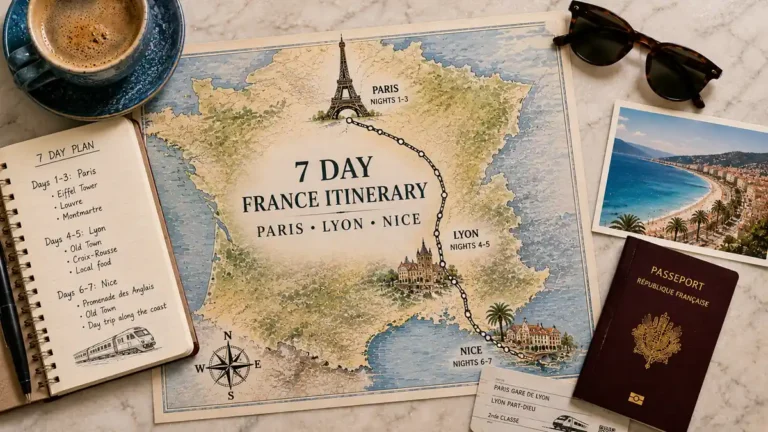
- About a week. Paris and one region reachable directly by train, with one base in each. Fits travelers with fixed leave who want the capital plus a genuine change of scene, and who accept that the second region gets sampled, not explored.
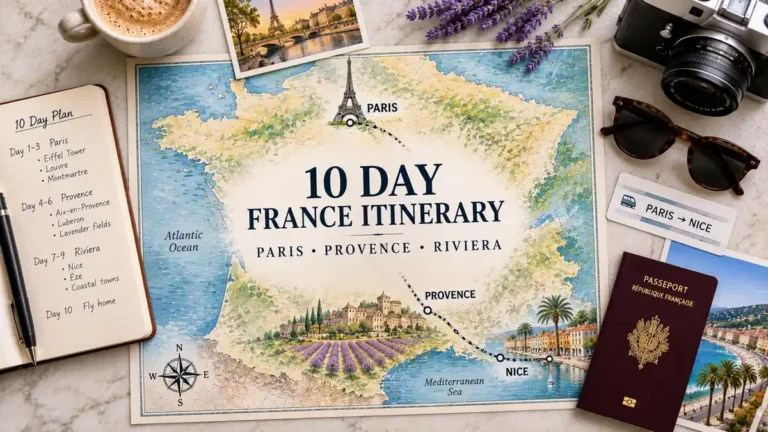
- Around ten days. Paris and one region explored properly from a single base, with day trips out and no repacking. Fits first-timers who want the second half of the trip to feel like a holiday instead of a connection, and it is the length most people underbook.
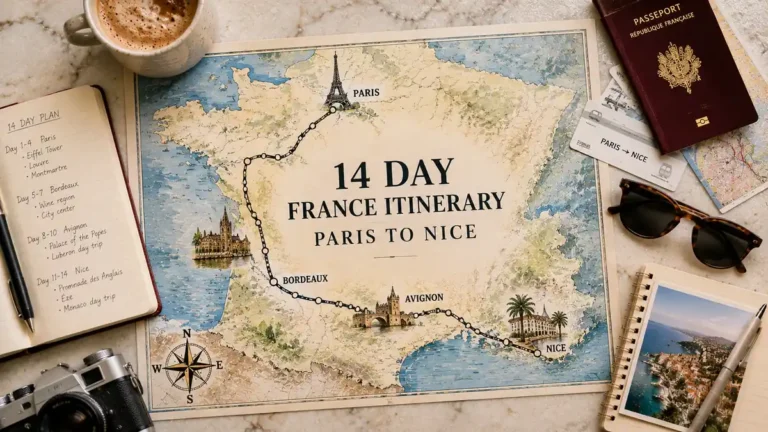
- Two weeks. Paris plus a farther region, or one region taken slowly with a car and two bases inside it. Fits travelers crossing an ocean for this, who want a rural stretch as well as a city one and can absorb one long domestic journey.
The extra days in a two-week trip are worth more as a second base than as a third region. A third region costs a travel day at both ends; a second base inside one region costs a morning. Those tiers describe scope, not sequence — turning a length into an actual route, with nights allocated and stops in order, is the job of our France itinerary guide. Travelers with longer than a fortnight, or with work that follows them, have stopped planning a holiday and should read the guide to longer stays in France instead.
Is It Better to Stay in One Place or Move Around?
Staying put wins: two bases beat five hotels on a first trip to France. A base lets you travel out and back with your bags unpacked, and it turns each day’s transport into a choice you make over breakfast instead of a deadline with a suitcase attached. Day trips replace check-ins, and the days get longer at both ends. The exception is narrow but real. Travelers driving a loop through wine country or the mountains, where the road itself is the attraction and no single town earns two nights, are better off moving — and they are the group who chose a car precisely because of it.
Which Part of France to Visit First
Choose your first region by travel style and season; ranking lists will not help you here. The regions are not competing for a top spot — they suit different trips. Pick the one that contrasts with Paris: coast, wine country, châteaux, mountains or villages. The trip then has two characters, not one.
Read the table from the left. The condition is the decision you are actually making; the region is the consequence, and the last two columns tell you what that consequence costs you in time and transport.
Region shorthand only — the length column is a planning benchmark, not a route.
| Who it suits | Region | Fits with Paris in | Train or car |
|---|---|---|---|
| Best for: travelers who want sea and sun without driving | French Riviera, the Mediterranean coast | About a week, one coastal base | Train all the way; no car needed |
| Best for: first-timers drawn to castles, gardens and history | Loire Valley, château country | About a week, day trips from one town | Train to the valley, car once there |
| Best for: travelers who want storybook villages and winter markets | Alsace, on the German border | About a week, two small towns | Train between towns, car for the wine route |
| Best for: anyone planning the trip around wine and food | Bordeaux and its surrounding vineyards | Around ten days, city plus vineyards | Train to the city, car or tours outside it |
| Best for: travelers who want markets, light and slow days | Provence, inland from the coast | Around ten days to do it slowly | Train south, then a car for the villages |
| Best for: walkers and anyone who wants mountains or snow | The French Alps, in the south-east | Two weeks, or a trip of its own | Train to the valley, car or shuttles above |
One clause per region is the correct amount of detail at this stage, because the depth belongs to the pages that own it. If you prefer the country’s headline destinations argued out and ranked before you commit, that is the job of our guide to the best places to visit in France. Coast-led travelers have a second decision underneath the first — a lively Riviera town or an emptier Atlantic stretch — and comparing the beaches themselves settles it, since the coast you pick determines the base. When wine is the organising principle, the question becomes which growing area suits your palate and your appetite for driving, which the wine regions guide lays out side by side. And if you are travelling for the food, the regional kitchens differ more sharply than the landscapes do; our French food guide covers them region by region.
Does the Season Change Which Region You Pick?
Yes, for two of the styles above and barely at all for the rest. The coast and the mountains are season-dependent: a Riviera base in the cold months is a quiet town beside a grey sea, and an Alpine valley is either a walking trip or a snow trip, never both in one visit. Cities, châteaux and wine country hold their value across far more of the year, which is why the shoulder months suit them so well — fewer people, easier tables, the same buildings. If your dates are locked before your destination, invert the decision and pick the region the season is kind to; our guide to the best time to visit France works in that direction. A winter trip also works on its own terms: France’s Christmas markets are the clearest example of a holiday that only exists in the cold half of the calendar.
How to Get Around France: Train, Car, or Both
Take the train between Paris and the big cities, and rent a car for villages and countryside. Most first trips need both at different moments: rail covers the long haul in and out of Paris, while a car unlocks the rural stretch no train reaches. The mix follows the region you picked.
The rule comes from the shape of the network. The TGV — France’s high-speed rail system — radiates outward from Paris: north to Lille, east to Strasbourg, south to Marseille and the Mediterranean, south-west to Bordeaux and on towards the Spanish border. Along those spokes, rail is fast, frequent and far easier than flying. Across them it is neither. The awkward journeys in France are the lateral ones, because the map assumes you are coming back through Paris to get anywhere else, and that geometry is exactly why the rural regions everyone recommends — the Loire, Provence, the Dordogne, Alsace — need a car once you have arrived in them.
Three ways to put that together:
- Train only. Suits city-to-city trips and coastal towns that sit on a rail line, and travelers who do not want to drive abroad. The tradeoff: villages, vineyards and anything at the end of a lane quietly drop off your map.
- Car only. Suits a loop through one rural region where the driving is part of the pleasure. The tradeoff: city driving and parking are a punishment, and you pay for the vehicle on every day it sits still.
- Hybrid, which fits most first trips. Train out of Paris to the regional hub, pick the car up at that station, drive the countryside, drop it back where you collected it. The tradeoff: one more transaction to organise, and both legs need booking.
Return the car before you re-enter Paris. Driving into the capital to hand back a rental is the classic self-inflicted wound of a France trip, and the train that replaces it is faster door to door. If rail is carrying the whole trip, our France train itinerary shows how the spokes combine into something workable. If the car is the point, the France road trip guide covers the drives worth building a holiday around. And the mechanics of the rental itself — what you need to hold, what to decline, what to check before you drive off — belong to our guide on renting a car in France.
What to Book First for France, and How Far Ahead
Book in this order: entry status, flights, long-distance trains, timed-entry attractions, then the admin. The sequence follows what sells out or gets more expensive with time. Cover, connectivity and packing come last because none of them is capacity-limited. Trains are the item most first-timers leave too late.
Long-distance rail tickets open for sale in batches, not continuously. SNCF, the national operator, normally opens sales about four months before departure for TGV INOUI and INTERCITÉS services, and 60 days ahead for OUIGO Train Classique, its low-cost brand on the older, slower lines. SNCF itself notes that engineering works can move an opening, so treat that window as the norm and confirm with the operator before you plan around a specific date. Trains are the one booking where waiting carries a cost and no upside: the cheap fares go first, and the expensive ones never run out.
Timed entry is now normal booking behaviour at major indoor attractions. You choose a slot when you buy, and turning up without one can mean not getting in at all. Because those rules differ by venue and change without much notice, the safe habit is to book the two or three sights you would be genuinely disappointed to miss as soon as your dates are fixed, then leave the rest of the days loose.
Entry requirements sit outside this page by design, but one rule is worth knowing before you build anything: the Schengen short-stay allowance is 90 days within any 180-day period. What that means for your passport, and which pre-travel authorisation applies to you, is resolved in our guide to France entry requirements. The admin block comes last precisely because none of it is competitive: travel insurance for France can be bought the week you book the flights, an eSIM for France can be activated the night before you fly, and a physical French SIM card only makes sense if your handset will not take an eSIM or you are staying for weeks. Packing genuinely does come last, because it follows the trip shape you have now fixed — a rail trip and a village drive want different luggage, which our France packing list sorts out by trip type.
Tours and activities
Book skip-the-line tickets, day trips and local tours with free cancellation on most activities.
You can also browse everything on getyourguide.com.
Tripstou may earn a commission if you book through this link, at no extra cost to you.
What Do First-Time Visitors to France Get Wrong?
Over-scheduling ruins more first trips to France than any other mistake. Four cities in ten days, a new hotel every second night, a checklist of sights — the itinerary looks full on paper and travels badly. The fix is fewer bases and slower days, decided before anything is booked.
Five failures account for most of the damage, and every one of them is a planning decision, not bad luck:
- The sprint itinerary. Each move costs a morning, a check-in and an evening, so a four-stop trip spends a large share of itself in transit. Cut one stop and the remaining ones improve.
- Getting the car decision backwards. Renting one for a city-only trip means paying to park it; skipping one for a village trip means watching the good parts from a station platform. The region decides this, not habit.
- Leaving trains and timed entries until the last minute. Both are capacity-limited, and both are cheapest at the moment they go on sale. Late booking converts a fixed budget into a smaller trip.
- Skipping the greeting. Say bonjour before any request — in a shop, at a counter, when asking directions. It is the one language expectation that visibly changes how you are treated, and forgetting it reads as rudeness rather than shyness.
- Assuming Paris is the whole country. The capital’s prices, pace and crowding are not national traits, and travelers who judge France by three days there consistently misjudge what the rest of the trip will feel like.
The greeting is one of several small conventions that quietly change the quality of a trip, and the full set — mealtimes, tipping norms, how to address staff — lives in our France travel tips. On safety, the short version: France is broadly safe for visitors, and the realistic risk is pickpocketing in crowded tourist spots and little beyond it, which our guide to safety in France covers properly.
What Shapes the Cost of a Trip to France
France sits mid-to-high for Western Europe, and the region you choose moves the total most. Season, pace and transport mode do the rest. The country itself is not the variable: Paris and the Riviera in high summer and a rural region in the shoulder months are different trips at different costs.
Three spend styles, and what each one actually buys here. The currency throughout is the euro.
- Budget. Hostels and small family-run guesthouses, bakery breakfasts, market lunches, regional trains and a lot of walking. France is generous to this style in rural regions and in the shoulder months, and openly hostile to it in Paris and on the Riviera at the height of summer.
- Mid-range. Three-star or small boutique hotels, one restaurant meal a day with the rest assembled from markets, trains between regions and a car for the rural stretch. This is where most first trips land, and where regional choice swings the total hardest.
- High-end. Château hotels and design properties, tasting menus, first-class rail and private transfers. France accommodates this style better than almost anywhere in Europe, which is precisely the problem — in Paris and on the Riviera there is effectively no ceiling.
The cheapest lever is not where you sleep. It is how often you move: every base change buys a fare, a transfer and half a day you have already paid for, which is why the two-base trip usually costs less than the four-base one at the same standard. For the actual numbers — daily budgets, what each category runs to, how the seasons move them — see our breakdown of what a France trip costs. And travelers planning significant shopping should read up on the VAT refund in France before they buy, because the paperwork starts at the till, not at the airport.
Frequently Asked Questions
Can You See Paris and the South of France in One Week?
Yes, as Paris plus one southern base, not a tour. Give the capital the first half of the week, take a direct train south, and stay put for the rest. Adding a third stop inside the same seven days spends the balance of your trip in transit.
Can You Travel France Without Renting a Car?
Yes, if your trip stays on the rail network: Paris, the big cities and the coastal towns served by direct trains all work without one. Wine country, hilltop villages and the Dordogne do not. Where you want those without driving, day tours from a rail-served base are the workaround.
Do You Need to Book Museums and Attractions in Advance in France?
Only the famous indoor ones. Major museums and monuments increasingly sell timed slots, so a visit without a booking is a gamble; smaller museums, churches, markets and gardens still take walk-ups. Sort the shortlist you would travel specifically to see, and leave the rest to the day.
Do People in France Speak English?
In Paris, the big cities and tourist areas, widely — hotel and restaurant staff generally switch without being asked. In villages and rural regions it thins out fast. Opening with bonjour before you speak English changes the response more than your accent does, and it costs nothing to learn.
Is France Expensive Compared to Other European Countries?
It sits in the upper-middle of Western Europe: generally dearer than Spain or Portugal, generally cheaper than Switzerland or the Nordic countries. What makes it feel expensive is sit-down restaurant meals and city hotel rooms. Bakeries, markets and regional trains stay unusually good value.
Is France Safe for Tourists?
Yes, by the standards of Western Europe, with petty theft as the realistic concern. It concentrates where crowds do: station concourses, metro carriages, queues outside famous sights. Carrying a bag that closes and keeping your phone out of your back pocket removes most of the exposure a first trip has.
Related Guides
- Best places to visit in France — the destinations argued out in detail, once you know which style of region you want.
- France itinerary guide — turning your trip length into an actual route, with nights allocated and stops in order.
- Best time to visit France — the season decision in depth, including which regions reward which half of the year.
- France by train — how the rail spokes combine when the train is carrying the whole trip.
- What a France trip costs — daily budgets and category-by-category numbers behind the spend styles above.
- France entry requirements — what applies to your passport before you book anything else.
Did this guide save you time or money? Tripstou is independent and reader-funded — if you'd like to give something back, you can support the site with a crypto contribution of any size.