You have narrowed Strasbourg down to two areas, and now you want someone to call it. Petite France and Krutenau are the names that survive most shortlists, and each arrives with a worry attached. The worry about Petite France is that it is a tourist set piece — lovely in photographs, hollow to sleep in, and priced for the view. The worry about Krutenau is the reverse: too far out, too student, too loud once the bars fill.
Both worries are half right. This guide takes them dimension by dimension — character, noise, price, walking distance, dinner and drinks, traveler fit, and whether market season changes the answer. The verdict comes first and the reasoning follows.
One thing is worth knowing before you read further. The two areas are an easy walk apart. What you are really choosing is where you wake up and where your evenings happen.
Quick Answer
Petite France is the better base for most first-time, short-stay visitors to Strasbourg. Krutenau is the stronger choice when evenings, food and price matter more than the postcard setting. The two areas sit an easy walk apart, so the choice comes down to how you want your evenings to feel.
Trust Layer
Tripstou comparison guide for travelers choosing between options. Covers tradeoffs, traveler fit, and decision logic.
Produced with AI assistance and reviewed by Alex Perrut, working in tourism since 2015, for the Tripstou editorial team. See our editorial process for details.
Last factual review: August 24, 2026.
Official sources consulted: France.fr, Atout France.
Key Takeaways
- Book Petite France for a first, short Strasbourg visit; the postcard setting is most of what that trip buys.
- Choose Krutenau when dinner, evening life and the nightly rate matter more than waking up inside the historic centre.
- The two areas make different noise: Petite France is busy by day, Krutenau lively after dark.
- Ask for a quiet room in both areas, but for opposite hours — daytime in one, evening in the other.
- Both sit about ten minutes from the cathedral and an easy walk apart, so the choice is lower-stakes than it feels.
- December sharpens both trade-offs without flipping the verdict, and the cheaper Krutenau rooms usually disappear before the expensive ones.
Table of Contents
Is Petite France Too Touristy to Stay In?
No — Petite France is heavily visited by day, but that does not disqualify it as a base. The crowds thin as day-trippers leave. The real split is taste: Petite France gives you postcard immersion, while Krutenau gives you the everyday rhythm of a lived-in quarter. Neither is objectively better.
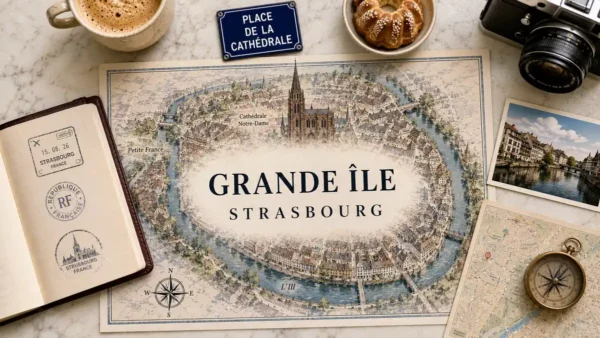
The gap between them is footfall, not authenticity. Petite France is a quarter inside the Grande Île, Strasbourg’s UNESCO-listed historic centre, and it absorbs most of the city’s photo traffic as a result. Krutenau is the student and university quarter, so its daytime rhythm belongs to people heading to class, to work and to the shops they always use.
For a stay, the question is who is on your street and when. In Petite France you share your morning with people who came specifically to look at it, and you get the lanes back in the evening. In Krutenau nobody is looking at your street at all. Two or three nights inside the postcard feels like a treat; a full week of it can start to feel like sleeping in a viewing gallery.
None of this is a quality judgement. Both are pleasant places to wake up, and the deeper texture of the older quarter — its lanes, its water, its history — belongs in our guide to Petite France. Read this dimension as a taste split and let the sections below carry the decision.
Petite France Is Loud by Day, Krutenau After Dark
The two areas are loud at opposite hours. Petite France carries daytime noise — footsteps, tour groups, shutter clicks — and goes quiet once visitors leave. Krutenau inverts it: calm through the working day, then lively into the evening around its bars. Petite France suits early sleepers; Krutenau suits people out late anyway.
That inversion should change what you ask for when you book. In Petite France the vulnerable hours are daytime, so a room over an inner courtyard protects a nap or a slow morning while a window above the main walking lanes does not. In Krutenau the same request points the other way, towards a room set back from the bar streets. Book a quiet-side room in either area and you are protecting completely different hours of the day.
The weight you give this depends entirely on how your evenings run. Light sleepers who are in bed before the bars get going are better served by Petite France, where the street empties after the day visitors go. If you are out late anyway, Krutenau’s evening sound is noise you are inside of, not noise you are trying to sleep through. That one distinction resolves this section for most people.
Krutenau Is the Cheaper Base
Krutenau is the cheaper base of the two for comparable rooms. Petite France charges a location premium: you are paying for the canals, the timbered façades and a doorstep in the most photographed part of the city. Krutenau sits a short walk away and prices closer to ordinary city rates.
The premium is honest — the address genuinely is the attraction. What is easy to miss is that it is paid per night and consumed in the first two days, which is why it reads as fair value on a weekend break and poor value on a week-long stay. Krutenau sells a comfortable bed near good food. Only one of these two areas charges you for scenery.
Peak season widens the gap on both sides. Expect a firm peak-season premium and tighter availability across the historic centre when the Christmas markets are running, with Krutenau staying the softer of the two. If the nightly rate is the deciding factor in your booking, the city-wide budget-stay areas stretch further than either of these; if you are booking at the top end, compare against Strasbourg’s luxury stays before paying a postcard premium for a mid-range room.
How Far Apart Are Petite France and Krutenau?
Both areas are about ten minutes’ walk from the cathedral and an easy walk from each other. That proximity is why this decision is lower-stakes than it feels. Krutenau edges the transport point through tram access at Porte de l’Hôpital; Petite France edges it on waking up inside the historic centre.
The practical consequence is that you will spend time in both areas whichever one you book. Crossing between them is a short stroll over the island, so a Krutenau base does not cost you Petite France mornings, and a Petite France base does not cost you Krutenau dinners. Your booking decides the start and the end of each day, and very little in between.
Transport barely moves the needle here, but it moves it Krutenau’s way. The tram at Porte de l’Hôpital, a few minutes’ walk from Rue de la Krutenau, puts the main station a short ride away, which matters if you arrive by train with luggage. If you want the wider orientation before committing to either side, our Strasbourg guide sets out how the centre fits together.
Krutenau Wins Dinner and Drinks
Krutenau wins dinner and drinks, and it is not close. Its restaurants and bars serve a resident student population, so the area stays busy on an ordinary weeknight. Petite France’s evening offer thins once day visitors leave, which makes it calm to sleep in and quieter to eat in.
The margin shows up in the walk home more than the walk out. From Krutenau you finish dinner and are back in your room within minutes, with no planning required beyond deciding when to leave. From a Petite France base you organise the evening slightly more deliberately, because the quarter settles down as its day visitors thin out. In a city this compact that is never a hardship — it is a small amount of effort, repeated every night of the trip.
The counterweight is the section above. The density of bars that makes Krutenau strong for dinner is the same density that makes it audible at night, and you cannot buy one without the other. Deeper detail on the quarter’s character sits in our Krutenau guide. If late nights are the point of the trip, check the city-wide nightlife-first areas before you settle on either of these two.
Who Should Stay Where: First-Timers, Couples, Families
First-timers and couples lean Petite France; food-led, younger and longer-staying travelers lean Krutenau. Families can work in either, decided by which kind of noise they mind more: daytime crowds at the door in Petite France, or evening bar noise in Krutenau. Every line below compares only these two areas.
- First visits: Petite France, because waking up inside the postcard is most of what a short first trip is for — city-wide alternatives sit in our first-time areas guide.
- Couples: Petite France again, on the strength of quiet evenings in a setting built for slow walks — see our areas for couples for bases beyond these two.
- Families: Either works, so choose on nap timing and bedtimes rather than on address — the full picture is in our family areas guide, and specific properties live in our best family hotels in Strasbourg.
- Food-led and younger travelers: Krutenau, without hesitation, because the eating and drinking happen on your doorstep instead of a walk away.
- Longer stays and repeat visitors: Krutenau, since everyday life wears better over a week than a heavily visited stage set does.
Each of these is a one-line verdict inside a two-area choice, not a city-wide ranking. If your traveler type is the thing driving the booking, the linked guides resolve it across all of Strasbourg.
Does the Verdict Change for the Christmas Markets?
No — the verdict holds in December, but both sides of it sharpen. Petite France puts you inside the market atmosphere and inside its heaviest daytime crowds. Krutenau gives you a calmer daytime retreat a short walk from the same streets. Whichever you pick, book well ahead.
The base-choice consequence is about recovery, not access, because both areas reach the markets on foot. A Petite France room means stepping out into the busiest version of the quarter every time you leave or return, which suits travelers who want to be in it all day. A Krutenau room means walking in, then walking back out to a street that is quiet when you want to drop bags and rest.
Book early either way, and expect stricter terms in market season. Rooms across the historic centre go first, minimum-stay requirements become common around weekends, and the cheaper Krutenau option often disappears sooner than the expensive one — it is what everyone reaches for second. Leave it late and you end up outside both areas entirely.
How to Choose Between Petite France and Krutenau
Book Petite France for a first, short visit to Strasbourg. Book Krutenau when evenings, food and price outrank the postcard setting. Both keep you within walking distance of everything most visitors come for. If neither feels right, the shortlist is the problem, and the full area picture is the fix.
The two lists below are mutually exclusive on purpose. If you find yourself nodding at items on both sides, weight the evening conditions — they shape more days of a trip than the scenery conditions do.
Choose Petite France if:
- This is your first visit and you are staying two or three nights.
- You want canals and timbered houses outside the door at breakfast.
- You are asleep before the bars fill and want a silent street after dark.
- You are happy to walk to dinner and to pay for the address.
Choose Krutenau if:
- You have already seen the historic centre and are back for a second trip.
- You want restaurants and bars within a few minutes of your bed.
- The nightly rate is a deciding factor in the booking.
- Your evenings run late and your mornings start slowly.
Winners below match the sections above; the table summarises the page and adds nothing new.
| Decision dimension | Winner | Reason in one clause |
|---|---|---|
| Character and atmosphere | Conditional, split by taste | Postcard immersion against lived-in everyday rhythm |
| Noise and sleep | Conditional, split by bedtime | One is loud by day, the other after dark |
| Room price level | Krutenau, by a clear margin | Noticeably cheaper for comparable rooms |
| Location and walking | A tie in practical terms | Both about ten minutes from the cathedral |
| Dinner and drinks | Krutenau, and not close | Restaurants and bars serve resident demand |
| Christmas market season | No change to the verdict | Both trade-offs sharpen; book early either way |
If both lists leave you cold, widen the search instead of forcing the choice. Strasbourg has other bases that solve different priorities — station access, quiet residential streets, more space for the money — and the full ranked picture is in our Strasbourg where-to-stay guide.
Hotels and places to stay
Compare hotels, apartments and stays for your dates in one search.
Search hotels and stays on hotels.com →
Tripstou may earn a commission if you book through this link, at no extra cost to you.
Frequently Asked Questions
Can you walk from Krutenau to Petite France with luggage?
Yes — it is a short walk across the island, and most travelers do it without thinking. Cobbled lanes in the older quarter are the only real friction, so wheeled cases are slower and louder there. Arriving by train, the tram at Porte de l’Hôpital is the easier option.
When is Petite France least crowded?
Petite France is quietest early in the morning and again after the day visitors leave. The middle of the day carries the heaviest footfall, when day-trippers and tour groups overlap. Staying in the quarter is the reliable way to get those quiet stretches, because you are already there when everyone else has gone.
How far is Krutenau from Strasbourg train station?
Krutenau reaches Strasbourg’s main station by tram in a short ride. The stop is Porte de l’Hôpital, a few minutes’ walk from Rue de la Krutenau. Walking is possible but crosses the whole historic island, so the tram is the sensible choice with bags or after a long journey.
Is parking easier in Krutenau or Petite France?
Neither area is easy for parking, and the difference is too small to decide a booking. Both sit in or beside the historic centre, where street space is limited and cars are kept to the edges. Assume a car park and a short walk in, whichever you choose.
Are Petite France hotel rooms noisy at night?
Usually not — the quarter empties as day visitors leave, and the lanes go quiet. The exception is a room directly above one of the main walking routes, which clear last on busy evenings. Daytime footfall is the noise worth planning around, so ask about the courtyard side.
Which area suits solo travelers better, Petite France or Krutenau?
Krutenau suits most solo travelers better, because eating alone is easier in restaurants built for residents, not visitors. The short walk home from dinner helps too. Petite France is the better fit for a solo trip built around quiet mornings, photography and slow walks by the water.
Related Guides
- Where to Stay in Strasbourg — every area ranked, for readers whose shortlist is still open.
- Petite France, Strasbourg — the quarter in full detail, beyond the base decision.
- Krutenau, Strasbourg — what the student quarter is actually like day to day.
- The Grande Île — the UNESCO-listed island centre both areas sit in or beside.
- Strasbourg Travel Guide — the wider destination frame for first-time planning.
- Best Family Hotels in Strasbourg — named properties for travelers with children.
Did this guide save you time or money? Tripstou is independent and reader-funded — if you'd like to give something back, you can support the site with a crypto contribution of any size.