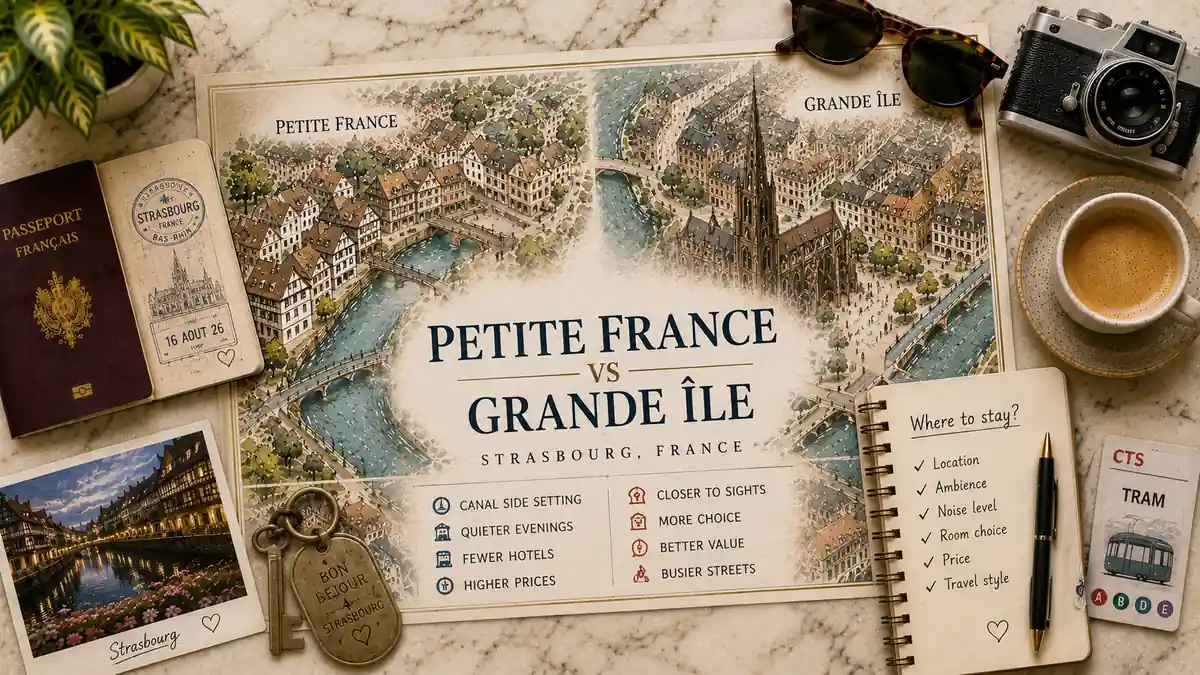
You have two booking tabs open: hotels in Petite France, hotels on the Grande Île. One question stands between you and a confirmed reservation — which side of Strasbourg’s historic centre to book. The comparison, as almost every search result frames it, has a geography problem baked in. Petite France sits inside the Grande Île, at the western end of the same island. It is a part of the thing it is being compared against.
This page fixes that first, then resolves the choice that actually exists: the Petite France pocket against the rest of the island — the cathedral core, Place Kléber, and the quieter edges taken together as one option. Six dimensions follow, each with a named winner, an honest margin, and the condition that flips it. The stakes here are moderate, and we say so plainly. The difference is still real enough to be worth ten minutes before you pay.
Quick Answer
Petite France is part of the Grande Île — the real choice is its pocket versus the rest of the island. The pocket trades proximity, room supply, and value for canal-side setting and calmer evenings. Most first-time visitors do better on the rest of the island; couples who want the postcard setting should book the pocket.
Trust Layer
Tripstou comparison guide for travelers choosing between options. Covers tradeoffs, traveler fit, and decision logic.
Produced with AI assistance and reviewed by Alex Perrut, working in tourism since 2015, for the Tripstou editorial team. See our editorial process for details.
Last factual review: August 16, 2026.
Official sources consulted: France.fr, Atout France.
Key Takeaways
- Petite France sits at the western end of the Grande Île, so the real choice is its pocket versus the rest of the island.
- Most travelers should book the rest of the island, which wins on proximity to the sights, room supply and price.
- Book the Petite France pocket when the canal-side setting and quiet evenings matter more than convenience — couples and light sleepers especially.
- The core trade is setting and evening calm on one side against proximity, deeper room supply and better value on the other.
- Choosing wrong costs you a slightly longer walk, not a wasted trip: both options sit on one small island.
- Christmas market season compresses the difference: the pocket loses its evening calm and its thin inventory sells out first.
Table of Contents
Petite France Is Part of the Grande Île — Here’s the Real Choice
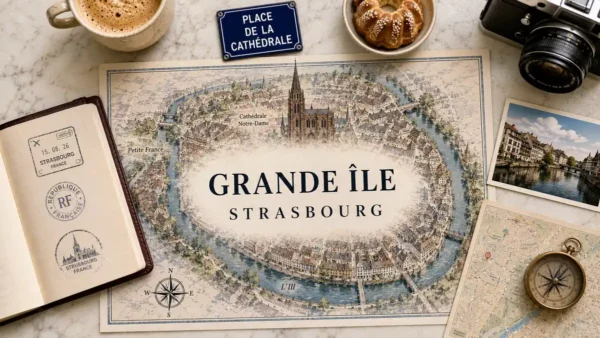
Petite France is not a separate district — it occupies the western end of the Grande Île itself. The Grande Île is Strasbourg’s island historic centre, ringed by the main channel of the Ill and the Canal du Faux-Rempart. So the honest comparison is the Petite France pocket against everything else on that island.
Scored literally, the Grande Île wins every category by default, because it contains its opponent. That tells you nothing you can act on. From here, “the rest of the island” means the cathedral core, the Place Kléber and Carré d’Or stretch, and the quieter residential edges, taken together as a single option — and every verdict below scores the Petite France pocket against that combined alternative.
Keep the scale in view. The whole island runs roughly 1.25 km by 0.75 km, and all of it sits on the UNESCO World Heritage list. You are choosing between two ends of one walkable historic centre. The containment fact is not trivia: it means the worst case of choosing wrong here is a slightly longer walk, never a wasted trip.
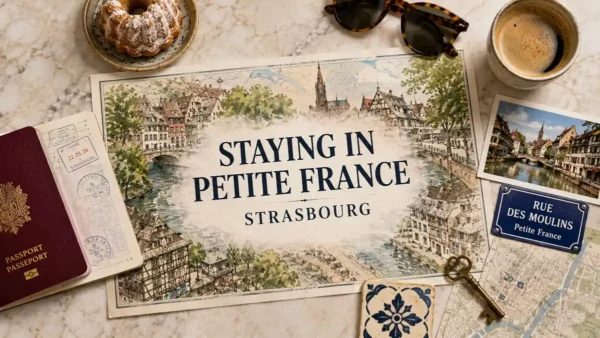
This page owns the margin only — the winner per dimension, whether it is decisive or close, and what flips it. For what the canal quarter is actually like day to day, see our guide to Petite France in Strasbourg; for the island as a whole and how it works as a base, see the Grande Île.
Which Side Is Closer to Strasbourg’s Main Sights?
The rest of the island wins on proximity to Strasbourg’s main sights, though the margin is close. The cathedral sits in the island’s southern portion and Place Kléber near its centre, which puts the rest of the island a few streets nearer to most headline sights than the Petite France pocket.
Call it close. Because the island is small, the proximity advantage shows up as a handful of extra street corners per outing, never as a transport decision. Nobody staying in the pocket is taking a tram to the cathedral, and nobody on the cathedral side is skipping the canal quarter because it felt far.
One condition flips this cleanly: if the sight you most want to be near is the canal quarter itself — the covered bridges, the weirs, the half-timbered waterfront — the pocket wins by definition, because you are already standing in it. That is the only version of this dimension where the margin becomes wide.
Proximity matters in proportion to how much sightseeing you actually do. A trip built around two or three set-piece sights barely registers the difference; a trip that criss-crosses the island six times a day feels it every single time. For what those sights are and how to sequence them, work from our Strasbourg travel guide.
Petite France Is the Quieter Base After Dark
The Petite France pocket is the quieter base after dark, and the margin is decisive. Its lanes empty once the day visitors leave, while the rest of the island keeps restaurant and bar traffic running later into the night. Light sleepers notice this more sharply than any other difference between the two.
The island splits by time of day, not by character. Both options are busy at midday; only one of them stays busy after dinner. The pocket’s evening quiet is a by-product of what it is — a compact corner with limited late trade — while the rest of the island carries the centre’s evening economy on its streets.
There is an obvious counter-case. If you want to walk out of your hotel late and find somewhere still serving, the pocket is the wrong base and its quiet turns into a cost. Book the rest of the island instead, and use where to stay in Strasbourg for nightlife to narrow it down.
Evening calm is the one dimension where the pocket’s advantage is not moderate. If quiet nights are your deciding variable, you can stop reading the other five.
Which Side Is More Crowded During the Day?
Petite France takes the heavier daytime crush, so the rest of the island wins this dimension. Its photogenic lanes are a fixed stop on every walking tour and day-trip route, and those lanes are narrow, which concentrates the crowd. The margin is close: the cathedral surroundings draw heavy crowds too.
Two conditions erase the gap almost entirely. Early risers see the pocket before the tour groups arrive, and off-season travelers see a version of it that barely resembles the summer photographs. In both cases the crowding dimension stops mattering.
Staying in a crowded area is a different experience from visiting one. You arrive before the crowd and come back after it, which is exactly the advantage the day-trippers filling those lanes never get. Daytime crowds are the weakest of the six dimensions for a booking decision — score it, then let it lose to the others.
Petite France Runs Pricier for an Equivalent Room
The rest of the island wins on value and supply, and the margin is consistent. Petite France charges a setting premium for an equivalent room, and its small footprint means fewer properties competing for your booking. Thin supply also means the pocket sells out first whenever demand rises.
Three things push the pocket’s rates up: the postcard setting itself, a physically small area that cannot add much inventory, and steady demand from travelers who arrived wanting exactly that view. The rest of the island spreads more rooms across more price points, which is what gives you the freedom to shift dates or trade up a category without leaving the island.
This one flips on intent. If the canal setting is the point of the trip — an anniversary, a first visit you have been saving for, a photography-led stay — the premium is the product, and paying it is the correct call. If the room is somewhere to sleep between outings, you are paying for a view you will mostly see from the street.
Budget travelers should start with where to stay in Strasbourg on a budget, which looks across the whole city instead of one pocket. If the premium is not the constraint, where to stay in Strasbourg for luxury covers the top of the market on both sides of this comparison.
Who Should Stay Where: First-Timers, Couples, Short Trips
First-timers should book the rest of the island; couples on a romantic trip should book the Petite France pocket. The first-timer verdict is close, driven by proximity and choice; the couples verdict is decisive, because the setting is the reason to come. Everyone else falls between those two poles.
- First visit to Strasbourg: the rest of the island, narrowly. More rooms, more price points, and the shortest average walk to the sights you came to tick off. Our guide to where to stay in Strasbourg for first-time visitors takes the shortlist further.
- Couples on a romantic trip: the Petite France pocket, decisively. The canal-side setting and the evening quiet are the product you are buying, and no other part of the island reproduces them. See where to stay in Strasbourg for couples.
- Families with young children: the rest of the island. Family room configurations are easier to find where supply runs deeper, and a wider base of properties means less compromise on dates. Where to stay in Strasbourg for families handles the specifics.
- Light sleepers: the pocket, on the strength of the night-quiet verdict alone. This is the one traveler type for whom a single dimension settles the whole question.
- Short trips of one or two nights: the rest of the island, unless the canal setting is the trip. Short stays convert saved walking into actual sightseeing.
Traveler type decides this more cleanly than any single dimension, because it tells you which dimension you are allowed to lose. Couples can lose proximity. First-timers cannot lose supply.
How the Christmas Market Season Changes the Answer
The rest of the island wins narrowly during the Christmas market season, on supply. When the island fills, the pocket’s thin inventory disappears first and its prices climb hardest, while the wider island still leaves something bookable. The usual calm-versus-lively split compresses to almost nothing.
Market season does most of its damage to the night-quiet verdict. The pocket’s evening calm depends on day visitors going home; in that season they stay, and the lanes stay busy well past dark. Book it for the setting then; the silence is off the table.
Everything else holds. Proximity, value, and traveler fit point the same way they do the rest of the year, only with higher prices and heavier crowds on both sides. Book far ahead either way — the season compresses the difference between the two options, and compresses the number of options along with it.
How to Choose Between Petite France and the Rest of the Grande Île
Book the rest of the island unless setting and evening calm outrank proximity and value for you. That is the verdict for most readers, because proximity, room supply, and price carry more weight across a whole trip than atmosphere carries at night. The stakes stay moderate: both options sit on one small island.
| Dimension | Winner | Why it wins |
|---|---|---|
| Proximity to main sights | Rest of the island (close) | Cathedral and central squares sit a few streets nearer |
| Quiet after dark | Petite France pocket (decisive) | Lanes empty once the day visitors head home |
| Crowd pressure during the day | Rest of the island (close) | The pocket’s narrow lanes take the heavier crush |
| Price and room supply | Rest of the island (clear) | Deeper inventory, more price points, no setting premium |
| Fit by traveler type | Split by traveler type | First-timers and families one side, couples the other |
| Christmas market season | Rest of the island (narrow) | Thin pocket inventory sells out first when demand spikes |
Choose the Petite France pocket if…
- The canal-side setting is the reason you picked Strasbourg over another city.
- You are travelling as a couple and the room is part of the occasion.
- You sleep badly with evening street noise below the window.
- You are happy to pay a setting premium and to book well ahead of your dates.
Choose the rest of the island if…
- This is your first visit and you want the headline sights closest to the door.
- You are travelling with children and need family room configurations.
- You want bars, restaurants, and street life still running after dinner.
- Price, choice, or late availability is what is actually driving the booking.
Two questions settle it. If you can name the specific view you want from the window, book the pocket and pay for it. If you cannot, book the rest of the island and spend the difference on dinner.
If neither side of the island convinces you, Krutenau is the off-island alternative to weigh before you look further out. For the full area shortlist across the city, start from where to stay in Strasbourg.
Hotels and places to stay
Compare hotels, apartments and stays for your dates in one search.
Search hotels and stays on hotels.com →
Tripstou may earn a commission if you book through this link, at no extra cost to you.
Frequently Asked Questions
Is Petite France worth staying in, or just visiting?
It is worth staying in if the canal-side setting is part of why you chose Strasbourg. Visiting is enough if you mainly want the photographs. Staying buys the early-morning and late-evening version day visitors never see; for what to see across the city, use our Strasbourg travel guide.
If you stay in Petite France, will you still be close to everything?
Yes. Petite France sits at the western end of the Grande Île, and the whole island is roughly 1.25 km by 0.75 km, so every headline sight stays within an easy walk. You lose a few street corners per outing, never a tram ride or a taxi.
Does the answer change for a one- or two-night trip?
Only in emphasis. Short stays sharpen the choice: with one or two evenings in hand, the atmosphere you book becomes most of the trip. Pick the pocket if calm canal-side evenings are what you came for, and the rest of the island if you want the streets still busy.
Do you need to stay in Petite France to get a canal view?
No. Water rings the whole Grande Île, so canal-facing rooms exist along the island’s edges as well as inside the Petite France pocket. What the pocket gives you is the half-timbered waterfront specifically — the postcard frame. If any water view will do, you have more properties to choose from.
Should you split a Strasbourg stay between both sides of the island?
No. The Grande Île is small enough to cross on foot in well under half an hour, so moving hotels buys you nothing but a packing morning. Pick one side, and walk to the other whenever you want it. Split stays make sense between cities, not between two ends of one island.
Which side of the island suits a solo traveler better?
The rest of the island, in most cases. Solo travelers benefit from the deeper spread of room types and price points, and from streets that stay busy after dinner, which makes eating alone easier. Book the Petite France pocket only if the setting itself is your reason for the trip.
Related Guides
Next steps once the Petite France question is settled:
- Where to Stay in Strasbourg — the full area shortlist, including the neighbourhoods off the island.
- Petite France, Strasbourg — what the canal quarter is like day to day as a base.
- The Grande Île — the island historic centre in full, access included.
- Krutenau — the off-island alternative when neither side of the Grande Île fits.
- Where to Stay in Strasbourg for First-Time Visitors — the shortlist built around a first trip.
- Strasbourg Travel Guide — sights, timing, and how the city fits into an Alsace trip.
Did this guide save you time or money? Tripstou is independent and reader-funded — if you'd like to give something back, you can support the site with a crypto contribution of any size.