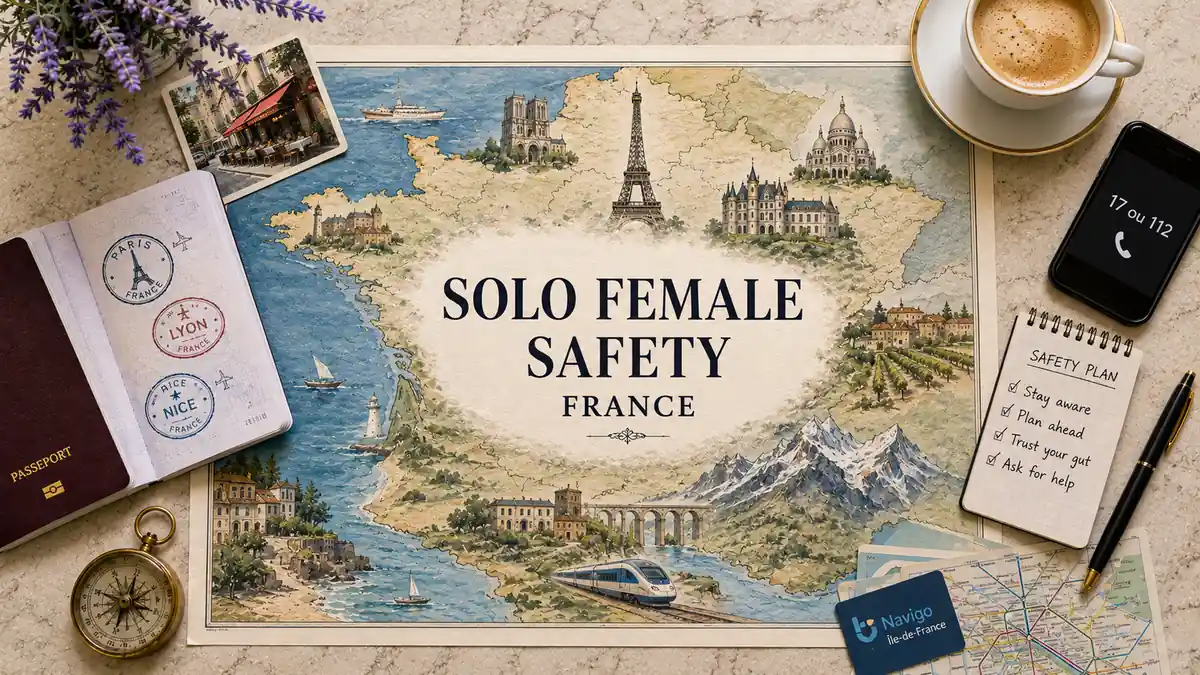
A woman can travel France alone, and the trip works. Solo female travelers move through French cities, trains and small towns every day, and the overwhelming majority of those trips are uneventful. The national safety verdict holds for them as well.
What is gendered here is street harassment. Comments on the street, whistling, a man who will not stop talking to you, being followed for a block: that is the risk layer women report in France, and it is not the same thing as violent crime. Most guides collapse the two, which produces either a page telling you everything is lovely or a page telling you to be afraid. Neither helps you decide anything.
This page holds both facts at once. Harassment is real, documented and criminal in France; it is also usually brief, and there is a sequence that ends it faster than arguing does. You will find what it actually looks like, when it concentrates, how to respond, and the part almost nobody publishes: which official number does which job.
Quick Answer
France works well for solo female travelers: the trip is realistic, not brave. The gendered risk is street harassment, which concentrates in situations — late hours, empty carriages, quiet streets — not districts. Plan night legs in advance so the last walk is short and lit, and learn the harassment alert line before you need it.
Trust Layer
Tripstou safety guide for travelers deciding how safe a destination is and what precautions actually matter. Covers real risk levels, common scams, situational awareness, and protection choices.
Produced with AI assistance and reviewed by Alex Perrut, working in tourism since 2015, for the Tripstou editorial team. See our editorial process for details.
Last factual review: August 21, 2026.
Official sources consulted: France.fr, Atout France.
Key Takeaways
- France works for solo female travelers: the everyday risk is street harassment, not violent crime, and both facts hold together.
- Harassment concentrates in situations — late hours, empty carriages, quiet last stretches — not in districts, which is why no avoid-list protects you.
- Disengage, keep moving toward light and people, cross a staffed threshold — and call 17 or 112 if he closes in.
- Save the numbers before you fly: 3117 or SMS 31177 for transport harassment, +33 9 80 98 31 17 from a foreign phone.
- 3919 is a free, anonymous support line for afterwards — it is not an emergency service and sends nobody.
- Travel insurance earns its cost on a solo trip because you are the only person carrying a backup.
Table of Contents
Is France Safe for Solo Female Travelers?
Yes. Women travel France alone routinely, and the trip works — the risk worth preparing for is harassment, not violence. France is a safe country to travel in generally, and being a woman alone does not change that verdict. What it changes is the kind of encounter you should expect and know how to end.
The country-level picture is settled elsewhere, and this page takes it as read. Our guide to how safe France is overall covers the national verdict, the general emergency numbers and the precautions that apply to every traveler regardless of gender. Everything below is the layer that sits on top of it.
Street harassment and violent crime are different problems with different odds. Harassment is common enough that most women who spend a few weeks in France meet some version of it. Assault by a stranger is rare, and it stays rare for women travelling alone. Both things are true at the same time: you are unlikely to be hurt in France, and you are fairly likely to be bothered.
Two things you will not find on this page: a dress code and a list of neighbourhoods women should avoid. Dress rules move responsibility for a man’s behaviour onto what a woman put on that morning, and they do not describe how harassment actually works. Area blacklists fail differently — they get copied between pages without checking, they name places you were never going, and they leave you unprepared for the quiet street outside your own front door. What replaces both is situational: knowing when exposure genuinely rises, and what to do in the moment.
What Street Harassment in France Actually Looks Like
Street harassment in France is mostly verbal and short-lived: comments, whistling, an approach that will not accept a no. It is neither flirtation nor grounds for cancelling a trip. It happens in daylight and at night, in big cities and small ones, and it usually ends the moment you stop supplying a reaction.
The usual shape is brief. A comment as you pass. A whistle from a car. A “bonsoir” that turns into three more questions when you keep walking, or a man who falls into step beside you for half a block. Most of it stops within seconds and leaves nothing behind but irritation. The version that unsettles people is the persistent one: the man who does not leave when the exchange is obviously over, who follows you for a block, who reappears at the next corner.
Calling this French charm gets it wrong twice. French women name it as harassment, campaign against it, and the law treats it as an offence, so this is not a foreigner misreading a local custom. It is also not evidence that French men are uniquely aggressive. The behaviour exists in every country you have travelled in; France simply has a dense public street culture where more of it happens out loud.
A small share of approaches are not really about you. Some are the opening move of a scam — being chatted up as a pretext, being “helped” at a ticket machine, a friendly stranger steering the conversation toward your bag — and a woman alone is a preferred target because the approach comes with built-in cover. Worth recognising the shapes before you land: our guide to common scams in France sets out how each one runs. The other question solo women ask constantly — how to dress, when to say bonjour, how much French to attempt — is etiquette, not safety, and it lives in our French etiquette and travel tips guide.
Is Street Harassment Illegal in France?
Yes. Street harassment is a punishable offence in France — outrage sexiste — and committing it on public transport is treated as the more serious form. That matters practically: reporting is not a symbolic gesture, because there is an actual offence to report.
Is It Safe to Walk Alone at Night in France?
Walking alone at night in France is generally fine, and risk clusters in specific situations instead of named neighbourhoods. French city centres stay busy late, and lit, populated streets carry very little of the problem. What raises exposure is emptiness, distraction and the last stretch of a journey — the conditions, not the postcode.
The quiet residential street between a lit main road and your door is the classic one. It is short, you are nearly home, and it is often the only part of the evening with nobody else on it. That gap is worth designing away when you book a room, which is why accommodation choice does more work here than area reputation.
Near-empty carriages and long station corridors are the second situation. Late services thin out, and a corridor with three people in it removes the thing that ends most harassment quickly: an audience.
Standing still with your phone out is the third. Visibly lost, stationary, headphones in, bag open — that reads as an opening from across the street. Checking the route inside the café you are about to leave costs nothing. None of this is about what you owe anyone; it is simply where the odds move.
The end of a night out is the fourth, and it is the one where everything stacks. Later hour, thinner streets, alcohol somewhere in the picture, and a route improvised on the spot.
Notice what those four have in common. They are not places. They are moments when you are alone, static or unheard — which is exactly why a map of bad districts protects nobody. The same street is a different proposition at seven in the evening and at two in the morning, and the districts those lists name are usually ones you had no reason to walk through anyway.
How Should You Respond to Street Harassment?
Do not engage or explain — keep moving toward light and people, and put a staffed threshold between you and him. Arguing, apologising and inventing a boyfriend all supply the interaction the behaviour is fishing for. Distance, witnesses and a door with an employee behind it end it faster than any comeback.
The mechanism is worth understanding, because it explains the order. Verbal harassment runs on response. A reply — angry, polite, witty, it makes no difference — tells him the exchange is live and hands him a next line. Silence and a steady pace give him nothing. Most of the time it is over in ten seconds.
- Do not engage. No answer, no eye contact, no explanation. You owe no conversation and no politeness here.
- Keep moving toward light and people. A busier street, a lit shopfront, a café terrace. Direction matters more than speed, and never take a quieter turning to shake him off.
- Cross a staffed threshold. A bar, a hotel lobby, a pharmacy, a station office, any shop still open. Somewhere with a door and an employee behind it.
- Ask staff, not passers-by. Say plainly that a man is following you and that you want to wait inside. Staff have a role and a phone; passers-by have somewhere else to be.
- On a train or metro, change carriage and alert. Move at the next stop, sit near other passengers or toward the operator’s end, and use the transport alert channel instead of negotiating with him.
The step people skip is the fourth one. Asking a stranger in the street for help puts the decision in the hands of someone who can walk away; asking the person behind a counter puts it in the hands of someone who cannot. That is the difference between a bystander and a threshold.
Nothing on that list asks you to be brave or quick-witted, which is the point — under pressure people execute simple sequences, not clever ones. If he does not drop off, or if he blocks your way or touches you, stop working the ladder and call. The next section covers which number does which job.
Who Do You Call If a Man Is Harassing or Following You?
Immediate danger is 17 or 112; harassment on any train or metro is 3117 or SMS 31177. Support after the fact is 3919, which is not an emergency line. Learn which number does which job before you need one; in the moment there is no time to work it out.
- 17 or 112 — immediate danger. 17 reaches the police, whether you are the victim or a witness. 112 is the European emergency number and works from any phone. That pair covers emergencies of every kind; everything below is built specifically for harassment.
- 3117, SMS 31177, or the 3117 app — harassment or assault on public transport. SNCF runs this alert channel nationwide, covering trains, stations and public transport, and stations also have call points you can use. It is meant for the moment it is happening, including from the carriage you have just moved into.
- +33 9 80 98 31 17 — the international line. SNCF provides this number for foreign travelers to reach the same alert service, and it is the one to save if you are travelling on a non-French phone.
- 114 — when you cannot speak aloud. This is the channel for contacting emergency services without talking, which is precisely the situation you are in when he is still standing next to you.
- 3919 — support, not emergency. Free, anonymous, absent from your phone bill and available around the clock, 3919 is a listening and orientation line for women who have experienced violence and for witnesses. It is not an emergency service and it is not the police: it will not send anyone to you. Use it afterwards, or when you want to understand your options — never as the call you make in the moment.
SNCF also partners with a “Safe Places” refuge scheme, which marks doors near stations where you can step in and ask to wait. Screenshot this section before you fly, or put the two numbers you would actually dial into your contacts. Nobody remembers a five-way triage under stress, and a saved number removes the step where you are standing on a pavement searching for one.
The entry that surprises people is 114. Calling for help is assumed to mean speaking, and the moment you most need help is often the exact moment you cannot say anything out loud.
Getting Around Safely After Dark: Metro, Taxis, and Night Trains
French night transport works fine alone, and the decision that matters is made before you go out, not at 01:00. Metros, taxis and night trains are all ordinary options for a woman travelling alone. What changes the night is knowing which one you are taking home and how long the walk at the other end is.
The metro at night is largely a question of which carriage. Late services thin out, and an empty carriage removes the audience that ends harassment quickly. Sit where other passengers are, or toward the operator’s end, and move if the carriage empties or someone settles too close. Changing carriage at the next stop is a completely normal thing to do and needs no justification. If someone is harassing you on board, the alert channel above is exactly what it exists for.
Taxis and ride-hailing are a decide-in-advance tool: order the ride before you leave the venue, and check the plate and the driver against the app before you get in. The fuller answer sits in the FAQ below.
The walk is the part people underestimate. A late metro or a booked taxi is rarely where an evening goes wrong; the eight minutes between the station exit and your door is the piece worth choosing carefully, and you choose it when you book the room, not when you are standing on the platform.
Are French Night Trains Safe for a Woman Alone?
Yes, French night trains are a workable option for a woman travelling alone. A berth can be requested in a women-only couchette when you book, so the compartment you share is other women. Compartment doors have a security deadlock that cannot be opened from outside, and staff are on duty through the night. Otherwise treat it as any shared sleeping space: valuables stay in the berth with you.
Where Should a Solo Female Traveler Stay in France?
Pick your base for the last leg of the night: a staffed reception and a short, lit walk from arrival. Those two levers change more nights than any neighbourhood reputation does. A room that is cheap but twenty-five minutes from the last metro converts every late evening into a decision you did not want to make.
A reception desk staffed late does two jobs. It gives you a door you can get through at any hour without fumbling a keycode in the dark, and it gives you a person to tell if someone walked behind you the last hundred metres. It is the staffed threshold from the response ladder, except this one is where you sleep.
Measure the final walk from the real arrival point, not from the city centre. Map the route from the specific station or stop you will actually use at night, then look at whether it runs along a lit commercial street or through a residential grid that empties by ten. Listings never tell you this. Five minutes on street view does.
Being reachable matters more than being central. A base on a line that runs late, or a short taxi hop from wherever the evening will happen, buys you the option of staying out — which is the freedom you booked the trip for in the first place.
None of this requires a blacklist of areas. Area reputation is a blunt instrument applied to a whole postcode; the walk from one specific door at one specific hour is something you can actually check before you pay.
Is It Awkward or Unsafe to Eat Out and Go Out Alone in France?
Eating and drinking alone is ordinary in France: a terrace table for one raises no eyebrows and no risk. Solo diners are a normal part of French café and restaurant life, at lunch and at dinner. Waiters seat you without comment, nobody assumes you are waiting for someone, and a book on the table is a common sight.
The thing that keeps women in their hotel rooms is the framing, not the risk. Guides that file solo dinner under “exposure” teach a woman to treat an ordinary evening as a tactical decision, and the result is a trip spent eating supermarket bread on a bed. That is the real cost of over-cautious safety writing, and the traveler pays all of it.
The practical reality is undramatic. A terrace at dinner is one of the more public places you can be: staff a few metres away, tables close together, a street full of people. If someone tries to join your table uninvited, the response is the one that works everywhere — no engagement, then a word to the waiter, who handles it as routine.
Going out at night follows the same logic with one addition. Decide the route home before the evening starts, and the rest of the night takes care of itself.
Is Rural France Safer for Solo Women Than the Big Cities?
Neither wins on safety — cities bring more encounters and more open doors, small towns bring quiet but empty streets. The difference is density of encounters and what stays open after dark, not a danger tier. You will hear more comments in a city and have more places to step into; a small town gives you fewer of both.
Cities concentrate everything, strangers included. More people pass you in a day, so more of them say something. That same density puts a lit bar, a pharmacy and a staffed station within a couple of minutes of wherever you happen to be standing, and the transport keeps running. Someone is always awake.
Small towns invert both halves. Almost nobody bothers you, and almost nobody is around. The last bus went hours ago, the square is dark by eleven, and the one place still open closed at nine. Rural France is not dangerous; it is unserved, and unserved is a different problem to solve. In practice it means arranging the return leg before you set out, rather than assuming a taxi will materialise outside a village restaurant.
The useful version of this question is not which is safer but which failure mode you would sooner handle: being spoken to more often, or having nowhere to go at midnight.
If what you actually want is the read on one particular city, that is a different page. Our France safety guide holds the national picture and routes to the city-by-city safety detail, including the city you are probably thinking of. This page keeps the gendered layer; the city verdicts live there.
Do You Need Travel Insurance as a Solo Female Traveler in France?
Travel insurance is worth it for most solo trips to France, because you are your own backup for everything. Alone, nobody else on the trip is carrying a spare phone, a spare booking or a spare hand — a stolen bag or a bad ankle becomes a logistics problem you solve by yourself.
What changes when you travel alone is the recovery, not the odds. Losing a phone as a couple is annoying. Losing it alone takes your map, your tickets, your bank access and your way of calling anyone, all in the same second. A policy with round-the-clock assistance is mostly buying you somebody to call at the moment the thing you would normally call with has gone.
The second solo factor is that nobody else can carry the day. If you are ill in a room in a town where you know no one, the useful part of a policy is the line that arranges a doctor and settles with the clinic directly, not a reimbursement form you fill in three weeks later. Read the assistance clause before the theft clause — for a solo traveler, the phone number is the product.
Which policy to buy is a separate decision, and it turns on cover limits and what your card or national health cover already provides. Our guide to travel insurance for France works through it without naming a winner for everyone.
With the safety question settled, what is left is the trip itself — where to go, how long to give it, and what a realistic route looks like. Start with our France travel guide and build the trip you came for.
Travel medical insurance
SafetyWing Nomad Insurance provides travel medical coverage designed for travelers and digital nomads, with flexible Monthly and Annual plans.
Check Nomad Insurance coverage and current pricing →
New Nomad Insurance Essential members can get 8 weeks of electronic theft coverage free with reward code TRIPSTOU8.
Apply the reward before creating your SafetyWing account by looking for the pink camera icon on the Nomad Insurance page.
Tripstou may earn a commission if you purchase through this link, at no extra cost to you.
Frequently Asked Questions
Is It Safe to Take a Taxi or Uber Alone at Night in France?
Yes, and the safety is in the booking. Order the ride from an app or a rank before you leave the venue, then check the plate and driver against the app before getting in. Sit in the back, share the trip, and never take an unmarked car offered on the street.
What Do You Do If Someone Follows You in France?
Stop trying to lose him and go somewhere staffed. Head for a bar, hotel lobby, pharmacy or station office, tell an employee plainly what is happening, and wait inside. If he blocks your way, touches you, or is still there when you come out, call 17 or 112.
Are Hostels Safe for Solo Female Travelers in France?
Generally yes, and two levers matter more than the price. Look for a reception staffed late or around the clock, and book a women-only dorm when the hostel offers one. A locker you can secure with your own padlock is the third thing worth checking before you book.
Can You Get Help in English as a Woman Travelling Alone in France?
Yes, though it helps to know which routes are built for foreign callers. Dial 112 in an emergency — the European emergency number works from any phone. For harassment on trains or in stations, SNCF runs an international line, +33 9 80 98 31 17, for foreign travelers. Hotel and station staff are the practical fallback.
Is It Safe to Go Out Drinking Alone as a Woman in France?
Yes — a woman at a bar alone is unremarkable in France, and bar staff treat it that way. The usual sense applies to everyone: keep your glass with you and know how you are getting home. Deciding the route back before the evening starts is what actually keeps the night easy.
Is BlaBlaCar or Ridesharing Safe for a Woman Travelling Alone?
Workable, with the checks the platform gives you. Read the driver’s profile and rating history instead of just the price, and prefer accounts with a verified phone and a real review record. Share the ride details and the driver’s name with someone before you set off, then confirm the car on arrival.
Is France Safe for a First Solo Trip as a Woman?
France is one of the easier places to start. Trains connect most of the country without a car, English is widely understood in tourist-facing jobs, and there is almost always somewhere staffed to step into. The preparation that matters is small: a base you can reach late, and two numbers saved.
Related Guides
These guides carry the decisions that sit next to this one:
- Is France safe? — the national verdict, the general emergency numbers, and the city-by-city detail.
- Common scams in France — how the approaches run and how to end them early.
- France travel tips — etiquette, dress conventions, and what visitors most often get wrong.
- Travel insurance for France — what to cover and which policy shape fits your trip.
- France travel guide — planning the rest of the trip, from regions to routes.
Did this guide save you time or money? Tripstou is independent and reader-funded — if you'd like to give something back, you can support the site with a crypto contribution of any size.