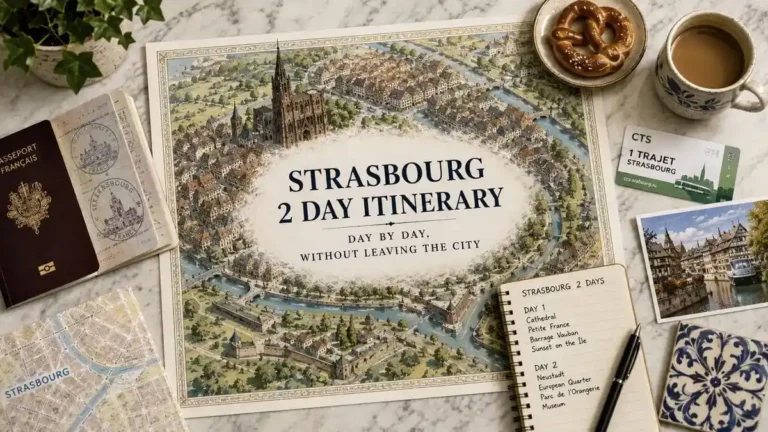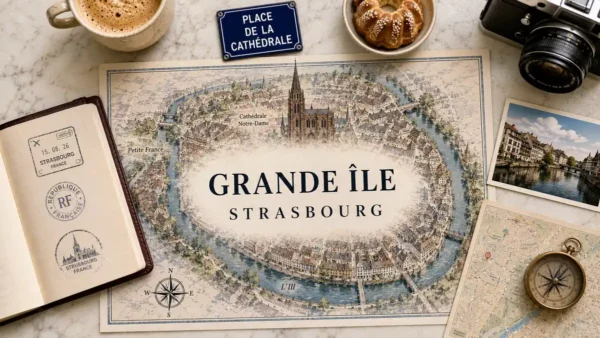
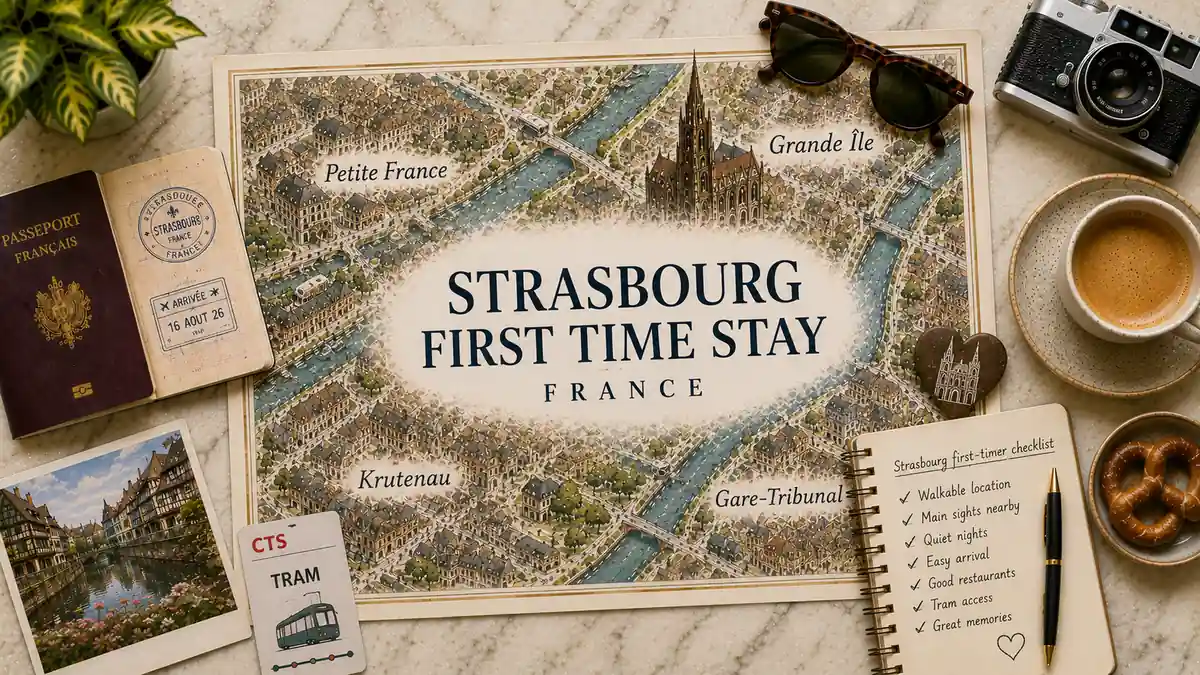
You have picked Strasbourg, so the base decision is the next one. It matters more here than in most French cities because the sights a first-timer comes for sit tightly packed on a single island. That concentration makes the choice unusually clean: there is one obvious central answer and a short list of legitimate alternatives, each suited to a specific kind of arrival. This page resolves the decision by traveler fit — arrival style, trip length, tolerance for noise, and how much a doorstep location is worth to you. It does not list hotels and it does not rank properties. What it gives you is a named area to search in, the honest tradeoff attached to that area, and the conditions under which a first-timer should deliberately book somewhere else.
Quick Answer
The Grande Île is the best base for first-time visitors to Strasbourg, with the main sights on your doorstep. You pay a premium and accept tourist density and some street noise for that convenience. Krutenau is the strongest alternative for travelers who want quieter nights and a more local base near the centre.
Trust Layer
Tripstou stay guide for travelers choosing where to base. Covers area atmosphere, budget, convenience, noise, and traveler fit.
Produced with AI assistance and reviewed by Alex Perrut, working in tourism since 2015, for the Tripstou editorial team. See our editorial process for details.
Last factual review: August 15, 2026.
Official sources consulted: france.fr, Atout France.
Key Takeaways
- Base first-time visitors on the Grande Île: the cathedral, Petite France and the Carré d’Or are all walkable from the door.
- The island’s premium buys time, not luxury, which is why it pays off hardest on a short first trip.
- Choose Krutenau for quieter nights within walking distance, or Gare-Tribunal when your train times drive the whole trip.
- Arriving by car settles the decision early: the pedestrianised core makes a central hotel awkward to reach and leave.
- Book a market-season room months ahead, or plan on a tram-connected district and travel into the island each day.
- Booking far out to save money usually costs you Strasbourg’s evenings, the part of the city first-timers remember.
Table of Contents
Grande Île Is the Best Area for First-Time Visitors
Grande Île is the best base for a first visit because everything you came for is walkable. The island holds the cathedral, Petite France and the Carré d’Or inside one UNESCO-listed core, so a short stay loses no time in transit. It suits first-timers who want to step out of the door and already be there.
Day-to-day, the island feels like a walking city with the car element stripped out. Foot traffic moves steadily between the cathedral square and the canals, terraces spill onto the pavement in the warmer months, and the core reads as one continuous place to be in. It is busy, and for a first visit that density is the point: you are never far from the next thing you planned to see.
Convenience is what actually justifies the premium here. The extensively pedestrianised core removes the transfer overhead that eats into a short trip: no tram to catch before breakfast, no mental arithmetic about the last connection home. If you want the island quarter by quarter — the cathedral precinct, the Carré d’Or, the canal edge — our full Grande Île area guide goes deeper than an area verdict can.
Prices lean high-end inside the island, with mid-range rooms surfacing outside the busiest weeks and budget stock thinning out quickly. Strasbourg’s wider layout — the German-era Neustadt, the university quarter, the outer residential belt — sits beyond this core and is covered in our Strasbourg guide.
The island’s real payoff arrives after dinner. Sleeping inside the core is what lets you walk back out at night without turning the evening into a logistics problem, and that is the part a price comparison never shows you.
Best for: first visits and short stays.
Hotels and places to stay
Compare hotels, apartments and stays for your dates in one search.
Search hotels and stays on hotels.com →
Tripstou may earn a commission if you book through this link, at no extra cost to you.
Is Staying Central Worth the Price in Strasbourg?
For a first, short visit, the convenience of a central base usually outweighs the premium you pay. Strasbourg’s core is compact enough that a central room converts directly into more hours spent in the city. The premium buys back time, and on a short trip time is the scarcer currency.
Price is the first leg of the tradeoff. Room rates lean high-end inside the island and soften as you move outward, so the same budget buys a noticeably better room a short walk away. That gap is real, and it is the honest argument against booking central.
Noise is the second leg. Tourist streets stay lively into the evening, terraces run late in the warmer months, and tram lines skirt the edges of the core. Light sleepers feel it. The island is not a quiet place to sleep during high season, and no amount of area selection changes that on its own.
Convenience is the third leg, and for most first-timers it decides the argument. A central room deletes every transfer from the day, which matters most in the two moments a short trip is usually lost: the slow start in the morning and the reluctant return at night.
Noise on the island concentrates on a handful of streets, so the useful question is which street you land on. Asking for a courtyard-facing or upper-floor room removes most of the objection while keeping the location, and it costs nothing to request.
Is Petite France a Good Place to Stay for First-Timers?
Yes, Petite France works well for first-timers who want atmosphere above all else. It sits inside the Grande Île, so you get the island’s walkability plus the most photographed streets in the city. The tradeoff is crowds by day and a high-end lean on room rates.
Staying here means waking up inside the postcard. Half-timbered houses, canal locks and narrow lanes make the quarter the visual centre of Strasbourg, which is exactly why coach groups and day-trippers funnel through it from mid-morning onward. The crowds are real. They also drain away in the evening, and people staying in the quarter get a version of it that day visitors never see.
Convenience is identical to the rest of the island in practice, since the cathedral and the main shopping streets stay comfortably walkable from any Petite France address. Rooms lean high-end and the properties tend to be small, so choice narrows fast once demand rises. Deeper detail on the quarter itself lives in our Petite France neighbourhood guide.
There is a genuine tension between booking Petite France specifically and booking the wider island, and it comes down to atmosphere against breathing room. We settle that duel properly in Petite France vs Grande Île compared — this page stops at naming it.
Best for: travelers who put atmosphere above quiet.
Krutenau Is the Quieter, More Local Alternative
Krutenau is the strongest non-island base for first-timers who want local atmosphere and quieter nights. It sits just off the eastern edge of the Grande Île, close enough that the core stays walkable on foot. You trade doorstep sights for a neighbourhood that still feels lived-in after the day-trippers leave.
The district carries a student and resident rhythm rather than a visitor one, shaped by its proximity to the university. Cafés, small restaurants and bars here serve people who live in Strasbourg, which changes the texture of an ordinary evening considerably. Nights are calmer here. That is why most travelers choose it.
Convenience holds up well for a first visit: the island core is a comfortable walk across the canal, and the tram network covers the rest of the city without much fuss. Room rates lean mid-range, which is where Krutenau quietly beats the island on value. Our Krutenau area guide covers the district in full.
Krutenau only works if you actually like walking home. The distance is short but it is a distance, and travelers who plan to return to the room mid-afternoon will feel it more than the map suggests.
Best for: quieter nights within walking distance of the core.
Gare-Tribunal Makes Sense If You Arrive by Train
Gare-Tribunal is the practical choice if you arrive by train or leave early the next morning. The station sits on the doorstep and the historic core is an easy walk from it. You give up charm; what you get is the shortest possible gap between platform and room.
The district reads as functional and mixed, with office blocks, everyday shops and a steady flow of commuters alongside the hotels. Nobody books Gare-Tribunal for charm — it is an ordinary working part of the city, and travelers who came for half-timbered façades will notice the drop the moment they step outside.
What it does well is remove friction at both ends of the trip. The walk into the island core is short and straightforward, so a stay here rarely feels remote, and an early departure needs no planning at all. Room rates lean budget to mid-range, which makes this the most forgiving area on the page for travelers watching what they spend on the room.
The station area earns its place on a first-timer shortlist through arrival logic alone. If your train lands late or leaves before the city wakes up, the hour you save at each end is worth more than the atmosphere you give up.
Best for: rail arrivals and early-morning departures.
Other Areas Worth Knowing: Neustadt, Neudorf and Orangerie
These districts suit return visitors or specific needs more than a first visit. Each is a legitimate place to sleep, but none of them puts a first-timer’s shortlist of sights within walking reach. They earn a mention so you can rule them out deliberately, not by accident.
Neustadt is the grand German-era quarter just north of the island, with wide boulevards and monumental architecture. It suits travelers who already know the medieval core and want a different Strasbourg, and it stays quieter at night than anywhere on the island.
Neudorf is a residential district south of the centre, connected by tram and priced accordingly. It works for longer stays and for travelers who want everyday neighbourhood life, though a first-timer on a short trip will spend too much of it commuting in.
Orangerie and Esplanade sit east of the core, near the park, the campus and the European institutions. They suit visitors with business at those institutions or a preference for green surroundings. None is a mistake. They are simply the wrong optimisation for a first visit.
Should a First-Timer Stay Outside the Centre?
Usually no, but three conditions make a non-central base the better call. Those conditions are arriving by car, needing quiet sleep, and travelling during the busiest market weeks. Beyond those, a first visit loses more than it saves by basing away from the core.
Arriving by car is the strongest reason. The centre is extensively pedestrianised and vehicle access to the Grande Île is restricted during the Christmas-market period, so a car-based arrival at a central hotel can turn into an awkward exercise before the trip has begun. A base outside the pedestrian core, with the tram doing the daily work, removes the problem entirely.
Needing genuine quiet is the second reason. The island stays audible into the night in high season, and travelers who sleep badly in busy places will get more from a tram-connected district and a slightly longer walk home. That is the exception, not the rule.
Market-season availability is the third. When central stock runs out, the realistic comparison stops being island versus outskirts and becomes a booked room versus no room. Stepping one district out is a normal, sensible response to that pressure, and it costs less in spend terms as well.
If you are driving, the base decision is settled before you compare areas at all: pick somewhere you can reach and leave the car, then treat the tram as your front door for the rest of the trip.
Best Areas by First-Timer Type
Match your arrival style and priorities to an area in one pass. Every profile below points to a single area and the one reason it wins for that traveler. If two profiles apply to you, let the arrival constraint decide — it is the hardest one to work around later.
- Short stay of a couple of nights: Grande Île, because no time is lost getting to the sights.
- Arriving by train: Gare-Tribunal, because the platform-to-room gap is as short as it gets.
- Arriving by car: outside the pedestrian core, because central vehicle access is restricted and awkward.
- Visiting during the market season: book central early, or accept a tram-connected district and travel in.
- Wants quiet nights: Krutenau, because it keeps the walk short and drops the noise.
- Here for the atmosphere above all: Petite France, because you wake up inside the view.
| Area | Who it suits | Main tradeoff |
|---|---|---|
| Grande Île | First visits and short, sight-focused stays | High-end lean and evening street noise |
| Petite France | Travelers who want maximum atmosphere | Day-tripper crowds and limited room choice |
| Krutenau | Quieter nights with local neighbourhood life | A short walk back to the core |
| Gare-Tribunal | Rail arrivals and very early departures | Functional streets with little visual charm |
| Neustadt | Return visitors wanting a calmer, grander base | Further from the medieval sight cluster |
Arrival style decides more than taste. If you want the unfiltered city-wide picture, including the areas a first-timer filter deliberately screens out, our full where-to-stay-in-Strasbourg guide covers every base in the city.
Where to Stay for the Christmas Market Season
Book central early for market season, or base yourself a tram stop out. Demand across the island climbs sharply while the markets run, and vehicle access to the Grande Île tightens. The decision stops being about atmosphere and becomes about what is still available.
Central rooms sell out months ahead of the market period, so travelers who want an island base should treat the booking as the first fixed point of the trip. Leave it late and the choice narrows to whatever is left, usually at the top of the price range.
The alternative is deliberate and perfectly workable: a tram-connected district outside the core, with the trip in becoming part of the routine. Availability, not preference, drives that choice. Driving to a central hotel is the one plan to avoid during this period, because island vehicle access is restricted while the markets are running.
Common First-Timer Booking Mistakes in Strasbourg
The costliest mistake is booking far out to save money and losing the evening city. Two others follow closely: booking a car-dependent hotel for a trip that will be spent on foot, and leaving a market-season room until late. Each one is avoidable at the search stage, before any money moves.
Booking far out to save looks rational on a comparison screen and rarely survives contact with the trip. Strasbourg’s centre is at its best in the evening, and travelers based on the outskirts tend to head back after dinner and stop going out again. The saving is real; so is the lost half of each day.
The second mistake is choosing a hotel around the car when the trip will be walked. Parking near a pedestrianised core is a constraint, not a convenience, and a base built around vehicle access usually sits further from the things you booked the trip to see — which is why that trade so rarely pays off.
The third is treating a market-season booking like an ordinary one. Central availability disappears well before the period starts, and travelers who wait end up comparing leftovers instead of areas. Book the room first and plan the rest around it.
Frequently Asked Questions
Is Strasbourg city centre noisy at night?
Parts of it, yes. Noise on the Grande Île concentrates on the terrace streets around the cathedral and the main going-out lanes, and it peaks in the warmer months. Quieter pockets exist away from the busiest terraces, so the street you book on matters more than the district you choose.
How far in advance should you book a hotel in Strasbourg?
Book on a normal planning timeline outside the market season, and far earlier for it. Central Strasbourg rarely demands a long lead time in ordinary weeks. For the Christmas market, think months rather than weeks — the island sells out first, and late bookers end up choosing from leftovers.
Can you drive to your hotel on the Grande Île?
Not easily, and during the Christmas-market period not at all in the usual sense. The island core is extensively pedestrianised, and on-street parking there is closed off while the markets run. If you are driving, choose a base outside the pedestrian core and travel in without the car.
Do you need to stay in the centre to see Strasbourg’s main sights?
No. The main sights cluster on the Grande Île, and tram-connected districts reach it easily, so an outer base still works. What you lose is the evening: travelers based further out tend to head back after dinner instead of returning to the island for a second look.
Is Strasbourg’s old town the same area as the Grande Île?
Yes. The Grande Île is Strasbourg’s historic island core and what listings usually mean by the old town or city centre. It is UNESCO-listed and holds the cathedral, Petite France and the Carré d’Or, so a room advertised in any of those names sits in the same walkable area.
Do first-time visitors need to stay near a tram stop in Strasbourg?
Only if you base outside the island. A Grande Île room makes the trip walkable and the tram optional, so proximity to a stop barely matters. Book anywhere else and the walk to the nearest stop shapes your day more than the district name does.
Related Guides
- Where to stay in Strasbourg: every area compared
- Grande Île area guide
- Petite France neighbourhood guide
- Krutenau area guide
- Petite France vs Grande Île compared
- Strasbourg travel guide
Did this guide save you time or money? Tripstou is independent and reader-funded — if you'd like to give something back, you can support the site with a crypto contribution of any size.