Bordeaux, Burgundy, Champagne, Alsace, the Loire, the Rhône, Provence — every one of them sounds like the right answer, and none of them tells you which to book. Most roundups make this worse by ranking regions on prestige, a variable that has almost nothing to do with whether a trip works. The regions separate on things you can actually decide against: the wine style you drink, how easily you reach the vines without a car, how formal the tastings feel, and how much the landscape gives you on the days you are not drinking. This guide groups the shortlist so the selection logic is visible, names the strongest pick for a first wine trip, and covers the two practicalities most lists skip — whether you need to book a tasting at all, and what tastings broadly cost. One region, chosen well, beats three regions rushed.
Quick Answer
Bordeaux is the best first French wine trip: famous, well organised, and easy to visit without a car. The choice comes down to the wine style you want and how easily the region is reached from Paris. Travelers who want rosé, sunshine and Mediterranean scenery should choose Provence instead.
Trust Layer
Tripstou selection guide for travelers choosing between multiple places. Covers selection criteria, traveler fit, and trip value.
Produced with AI assistance and reviewed by Alex Perrut, working in tourism since 2015, for the Tripstou editorial team. See our editorial process for details.
Last factual review: August 4, 2026.
Official sources consulted: France.fr, Atout France.
Key Takeaways
- Bordeaux is the strongest first French wine trip: famous labels, organised visits, and a walkable city base without a car.
- Match the region to the wine you drink: Alsace for whites, Provence for rosé, the Rhône for big reds.
- Champagne is the only major region that works as a day trip from Paris; everywhere else rewards an overnight base.
- The most celebrated estates are often the hardest to get inside; the neighbour two gates down pours generously.
- Book ahead for anything small or rural; larger houses in Bordeaux and Champagne still take walk-in visitors.
- Pick one region and stay put — each relocation costs a tasting day, and rushed wine trips satisfy nobody.
Table of Contents
Which French Wine Region Should You Visit?
Bordeaux is the best French wine region for a first visit, and the easiest famous one to do well. Two variables decide the rest: the wine style you actually drink, and how easily the region is reached from Paris. Everything else — prestige, scenery, formality — ranks below those two.
Wine style is the variable travelers underrate. A region built on structured reds will not satisfy someone who drinks crisp whites at lunch, no matter how celebrated its labels are. Access is the second filter, because a region you can reach and move around without a car removes the drink-driving problem entirely. Prestige and formality come third: the grander the estate, the more scheduled and less conversational the visit tends to feel. Scenery matters most on the hours between tastings, which is where Alsace, the Loire and Provence quietly outperform the benchmark names.
Choose the region by the wine you already drink, not the one you want to learn about. Tasting rooms reward familiarity — a day of precise Burgundy is largely wasted on someone whose usual bottle is chilled rosé, while the same day lands perfectly for a reader who already reads producer names on labels.
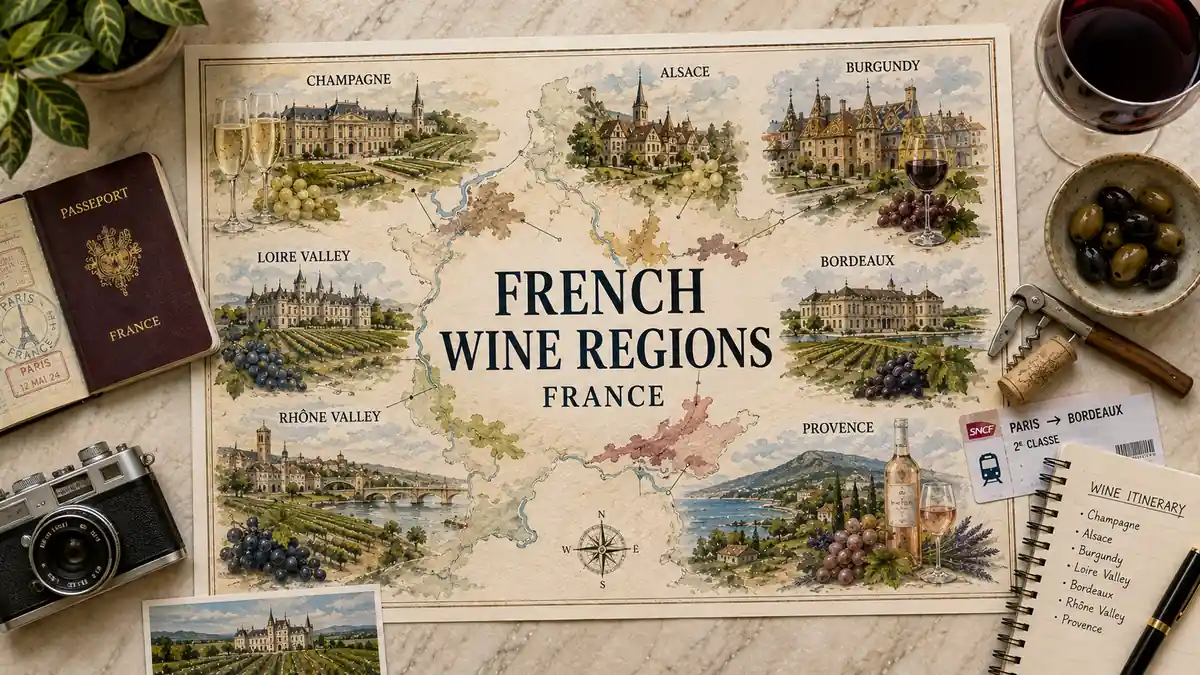
Geographically, the regions sit in three loose clusters. Champagne, Alsace and the Loire run across the north and east, close to Paris and to each other. Bordeaux stands alone on the Atlantic side. The Rhône and Provence run down the south-east, sharing warmth, sun and a road spine. That rough map explains most of the access differences below.
| Region | Wine style | Where to base | Who it suits |
|---|---|---|---|
| Bordeaux | Structured reds, plus sweet and dry whites | Bordeaux city, compact and walkable | Wants the famous name done easily |
| Burgundy | Precise reds and whites from tiny plots | Beaune, with Dijon as the alternative | Cares about producers and provenance |
| Champagne | Sparkling wine and deep chalk cellars | Reims or Épernay, both small | Has one spare day out of Paris |
| Loire Valley | Crisp whites, light reds, sparkling wines | Tours or Angers on the river | Wants châteaux alongside the tastings |
| Alsace | Aromatic dry whites, Riesling above all | Colmar, or Strasbourg for transport | Wants villages and walkable vineyard trails |
| Rhône Valley | Powerful reds, peppery Syrah and blends | Lyon in the north, Avignon further south | Drinks big warm reds at home |
| Provence | Pale rosé, herbal reds and whites | Aix-en-Provence, or Marseille for transport | Wants wine plus Mediterranean scenery |
Pick one region and stay there. Wine regions punish the touring instinct: the estates are rural, the visits are timed, and each relocation eats a tasting day. Two regions work only when they sit close enough to share a rail line, which in practice means Champagne with Alsace, or the Loire with a Paris base. If wine is one thread in a longer route, the sequencing belongs on the route pages, not here — see the 7-day France itinerary, the 10-day France itinerary or the 14-day France itinerary, and the broader France travel guide for country-level planning.
The Easiest Wine Regions to Reach from Paris
Champagne is the easiest wine region to reach from Paris and the only comfortable day trip. Alsace and the Loire Valley follow, both well connected by rail from central Paris. Bordeaux is further but direct. Provence and the southern Rhône are relocations, not excursions.
The accessibility ladder, in relative terms:
- Champagne — closest of the major regions to Paris; suits anyone with one free day and no intention of hiring a car.
- Loire Valley — direct rail to the river towns; suits travelers who want the vineyards and the châteaux from a single base.
- Alsace — high-speed rail to Strasbourg, then a short regional hop into the vineyards; suits a compact multi-day base.
- Bordeaux — direct and straightforward, but far enough that it deserves its own stay; suits a dedicated wine trip.
- Rhône and Provence — reached through Lyon and the south; suit travelers already heading that way for other reasons.
The day-trip-versus-base decision follows from that ladder. A day trip buys you one or two visits and a train nap; a base buys you evenings in wine towns, which is where much of the pleasure sits. Champagne is the only major region where the day trip is genuinely the sensible option. Everywhere else, staying overnight converts a rushed morning into an actual trip, and the Paris region guide covers what else sits within that easy northern radius.
Cars change the maths. Some regions are workable without one — Alsace’s village route and the larger houses in Champagne and Bordeaux are set up for visitors arriving by rail and on foot. Many individual estates are not, and rural France is thin on buses. Distance from Paris matters less than what waits at the far end: the big houses run scheduled visits a solo traveler can join, while the small domaines that make Burgundy and the Rhône compelling sit down farm tracks with no public transport at all.
Bordeaux, Burgundy and Champagne: The Benchmark Wine Trips
Bordeaux, Burgundy and Champagne deliver the names everyone recognises and the visitor infrastructure to match. All three share one trade-off: fame raises prices, formality and booking pressure. They reward travelers who want the definitive version of French wine and accept a less spontaneous, more expensive trip.
Bordeaux
Bordeaux made the list because it is the one famous region a first-time visitor can do well without local knowledge. The city sits at the centre of its own vineyards, the châteaux are used to receiving visitors, and much of the region works through organised half-day visits instead of guesswork on country lanes.
What separates Bordeaux from the others is scale with structure. Left Bank and Right Bank produce recognisably different reds within easy reach of one base, so a single hotel covers real variety. The trade-off is atmosphere: the grand estates can feel corporate next to a family cellar, and the most celebrated names are the hardest to get inside. Depth on the vineyards sits in the Bordeaux region guide, and the city base in the Bordeaux city guide.
Pick this if: you want the famous French wine trip and want it to run smoothly on a first attempt.
Burgundy
Burgundy earns its place on cellar prestige rather than convenience. Its reputation rests on tiny plots and small family domaines, where the person pouring is often the person who made the wine. That intimacy is the whole appeal, and it is also the source of every complication.
Against Bordeaux, the contrast is clean on both style and culture. Bordeaux blends and builds structure at scale; Burgundy works single grape varieties across fragmented vineyards, and its visiting culture runs on advance contact and personal introductions instead of open tasting rooms. Expect more effort per visit and more reward per glass. Burgundy suits travelers who arrive with questions, not travelers who arrive with a checklist. Our Burgundy travel guide covers Beaune, the Côte d’Or and how to plan the region at car pace.
Pick this if: you already read producer names on labels and want to meet the people behind them.
Champagne
Champagne is the sparkling pick and the most accessible of the big three, sitting closest to Paris of any major wine region. Its chalk cellars tunnel deep beneath the towns, and the famous houses receive visitors on published schedules, which makes it the easiest benchmark region to visit on impulse.
What makes it distinct is the split personality. The grandes maisons deliver polish, theatre and a tour that runs like clockwork; the small growers scattered through the villages offer the opposite experience and require far more planning. Doing only the big houses is the most common mistake, because the region’s character lives in the gap between the two. Many travelers treat it as a day out from a Paris base and never stay a night.
Pick this if: you have one spare day out of Paris and want sparkling wine at the source.
Prestige works against you at the very top. The estates whose labels you recognise from restaurant lists are frequently the ones that decline visits from the general public altogether, while the producer two gates down pours generously for anyone who wrote ahead. Fame and access run in opposite directions in all three of these regions.
Alsace and the Loire Valley: Best for Whites, Villages and Châteaux
Alsace and the Loire Valley win on scenery per day. Alsace pairs dry white wine with half-timbered villages along a single signposted route. The Loire spreads châteaux, crisp whites and light reds along a river. Both suit travelers who want the landscape to earn its place alongside the tastings.
Alsace
Alsace made the list for the highest concentration of pretty in French wine country. Its vineyards run along one continuous signposted route at the foot of the Vosges, threading through flower-hung villages that sit close enough together to walk or cycle between. Compactness is the practical advantage: nothing is far from anything.
The wine is what separates it from the rest of this page. Alsace is France’s white-wine region above all others — Riesling, Pinot Gris and Gewurztraminer, mostly dry, mostly single-variety, and unusually easy to taste side by side. Germanic influence runs through the food and architecture too, so the trip feels different from anywhere else in France. Region detail sits in the Alsace guide, and the transport base in the Strasbourg guide.
Pick this if: you want dry white wine and the prettiest village density in France.
Loire Valley
The Loire is the pick for travelers who need a wine trip to be more than a wine trip. Châteaux, gardens and river towns run alongside the vineyards, so a day divides naturally between two very different kinds of sightseeing. It is the region that keeps a mixed-interest group happy.
Its wines are the most varied on this page: crisp whites in the east, light reds in the middle, sparkling wines around Saumur, and a spread of sweet styles between them. That variety is the distinguishing feature, and also the reason the Loire lacks one flagship identity. Distances along the valley are longer than they look on a map, so a single base plus day loops works better than constant moves. Château depth belongs in the Loire Valley guide.
Pick this if: you are travelling with someone who does not care about wine.
Alsace is the one major French wine region you can tour on foot between villages. That single fact resolves the trip for anyone unwilling to drive after tasting, and it is why Alsace often outperforms grander regions for couples travelling without a car.
The Rhône Valley and Provence: Best for Big Reds and Rosé
The Rhône Valley makes France’s most powerful reds; Provence makes its defining rosé. The split is straightforward: choose the Rhône for depth, structure and cooler-weather drinking, and Provence for pale rosé, warm light and easy Mediterranean days. Both run south, so both suit trips already heading that way.
Rhône Valley
The Rhône belongs on any shortlist built around big reds. The valley runs south from Lyon along the river, with steep northern slopes producing intense Syrah and the broader southern half producing warm, generous blends. Few French regions offer that much red-wine variation along one axis.
What distinguishes it is drinkability at every level. The Rhône produces famous bottles and excellent everyday ones from the same villages, so tastings rarely feel like museum visits. The catch is logistics: the valley is long, the vineyards are strung out, and the north and south feel like separate trips. Lyon anchors the northern half — see the Lyon region guide for the surrounding vineyards and the Lyon city guide for the base itself.
Pick this if: big, warm, peppery reds are what you actually drink at home.
Provence
Provence is the rosé region, and the only one on this page where the wine is genuinely secondary to the setting. Vineyards sit among hills, stone villages and pine, within reach of the coast, and the tasting style is relaxed to match. Nothing about a Provençal wine day feels ceremonial.
Its distinguishing feature is how well wine folds into a normal holiday. A morning tasting, an afternoon swim and a long lunch is the standard shape of the day, which is why Provence suits travelers who would not otherwise plan a wine trip at all. The wines lean light, dry and pale, with herbal reds and whites behind them. The Provence guide covers the region, and Marseille works as the transport gateway.
Pick this if: you want rosé, sunshine and a beach within reach of the vines.
Rosé country continues to the coast, which matters for travelers pairing wine with the sea. Vineyards run almost to the shoreline in places, so a coastal base can absorb tastings without a dedicated wine itinerary. Rosé travels badly as a souvenir and brilliantly as a lunch — Provence is the one region where drinking in place clearly beats shipping bottles home. The French Riviera guide covers that stretch, and Nice works as the eastern base.
Beyond the Famous Names: Corsica, Savoie and the Cider Alternatives
Skipping the famous regions buys space and easier access to producers. Corsica, Savoie, Normandy and Brittany see a fraction of the wine tourism, so tastings feel less scheduled and more conversational. These suit repeat visitors to France, travelers who dislike crowds, and anyone building a trip around landscape first.
Four alternatives worth considering, each with a clear reason and a route out:
- Corsica — island wines almost nobody plans a trip around, made between mountains and sea, and best treated as a bonus on an island holiday. Start with the Corsica guide.
- Savoie, via the Alps — sharp alpine whites grown on mountain slopes, ideal for travelers whose real destination is the peaks. Route through the French Alps guide.
- Normandy — not wine country at all, but the home of cider and Calvados, with orchard tastings that follow much the same rhythm. See the Normandy guide.
- Brittany — the honest exception on this page. Brittany is cider country, not wine country, and it suits travelers who came for the coast anyway. Details in the Brittany guide.
None of these replaces a benchmark region on a first wine trip, and none pretends to. Their value is different. Normandy and Brittany are open about not being wine regions, which is exactly why their producers feel less formal than a Bordeaux château with a visitor department. Travelers who have already done the famous names often find these the more memorable stops.
Do You Need an Appointment to Taste Wine in France?
Most French estates expect an appointment, and many small domaines will not open the door without one. Larger houses in Bordeaux and Champagne keep public opening hours and often welcome walk-in visitors. Book ahead for anything small, family-run, or set outside a town centre.
The pattern tracks estate size more than region. Big houses, cooperatives and châteaux with visitor centres run scheduled tours and can absorb people who turn up. Small producers are working properties where the owner may be in the vines, in the cellar, or away entirely. Season shifts the pattern further: summer and harvest tighten availability everywhere, and quieter months often mean fewer scheduled slots even at larger estates. Village tasting rooms and wine shops are the reliable fallback when nothing can be booked.
The estates worth the drive are precisely the ones with nobody staffing a tasting room. An email sent a week ahead opens more doors in French wine country than any booking platform, and it costs nothing to send. Comfortable shoes and a layer for cold cellars matter more than they sound — the France packing list covers what to bring.
What Wine Tastings Cost in France
Tasting costs fall into three broad tiers. Small family producers frequently pour at no charge, with an unspoken expectation that you buy a bottle or two before leaving. Established estates and cooperatives usually apply a modest tasting fee, often waived against a purchase. Prestige châteaux and the grandes maisons charge materially more, and their cellar tours are priced as experiences in their own right. The fee itself matters less than what it signals: a paid, ticketed visit usually means a guided tour on a fixed schedule, while a free pour means a conversation at the counter. Fees change often, so confirm directly with the estate when you book.
Tours and activities
Book skip-the-line tickets, day trips and local tours with free cancellation on most activities.
You can also browse everything on getyourguide.com.
Tripstou may earn a commission if you book through this link, at no extra cost to you.
Can You Visit French Vineyards During the Grape Harvest?
Yes, but many producers restrict or suspend visits while they are picking. The vendanges run from the end of August to the end of October, lasting 8 to 15 days at any single estate. Regional start dates are set by prefectural authorisation, so the calendar shifts with the growing season.
The trade-off is stark. Harvest brings the vineyards to life — full trucks, running presses, the smell of fermentation across whole villages — and no other time of year shows you the work behind the bottle. It also brings closed doors. Tasting rooms cut hours, tours pause, and the people who would normally receive you are picking. Some estates lean into it and run harvest experiences; others simply stop.
Contact the estate directly before travelling in that window. A visit confirmed by email is worth more than any published opening hours during harvest, and producers will usually tell you plainly whether the timing works.
Frequently Asked Questions
Can you visit Champagne as a day trip from Paris?
Yes. Champagne is the closest major wine region to Paris and the only one that genuinely works in a day. The catch is what a day excludes: the grande maison cellars in our Champagne travel guide are doable, the scattered village growers are not. Book the cellar visit before you travel.
Do you need a car to visit French wine regions?
Not always. Alsace’s village route, plus the larger houses in Champagne and Bordeaux, are built for visitors arriving by rail and on foot. The small domaines are where a car becomes unavoidable — and where you then need a designated driver, because France enforces a strict blood-alcohol limit.
How many wine regions does France have?
There is no single official answer. Counts vary because sources draw the lines differently: some group by administrative wine area, others by appellation family or wine style. Travel guides name fewer headline regions; wine-education sites split France into many more. For planning a trip, the seven names here are enough.
What is the largest wine region in France?
Two answers circulate, and both are defensible. By planted area and sheer volume, Languedoc-Roussillon in the south is usually named France’s largest wine region. By fine-wine output and international reputation, Bordeaux takes the title, which is why most travel guides name it first. Neither fact should decide where you visit.
Is wine tasting free in France?
Sometimes, but free rarely means no obligation. Small family producers often pour at no charge on the understanding that you leave with a bottle, and village tasting rooms and wine shops work the same way. Famous estates almost always charge, and their cellar tours are priced as paid experiences.
What is the drink-driving limit in France?
France’s general limit is 0.5 g/L of blood, equivalent to 0.25 mg/L of exhaled air. Drivers holding a probationary licence, and those in accompanied driving, are held to 0.2 g/L of blood, or 0.10 mg/L of exhaled air. Plan a designated driver before any tasting day.
What is the best month to visit French vineyards?
There is no single best month — the choice turns on whether you want the harvest. The vendanges run from the end of August to the end of October, when vineyards are at their most alive but many cellars pause visits. Outside that window, estates have more time for you.
Related Guides
- France travel guide — country-level planning around whichever wine region you choose.
- Bordeaux region guide — vineyard depth for the strongest first-trip pick.
- Alsace guide — the white-wine route and its walkable villages.
- Loire Valley guide — châteaux and wine along the river.
- Provence guide — rosé country and its Mediterranean setting.
- 10-day France itinerary — where a wine region fits inside a longer route.
- Travel to the Rhône Valley — the wine corridor linking Lyon to Provence.
- Renting a car in France — whether to drive, the rules at the counter, and when not to hire at all.
Did this guide save you time or money? Tripstou is independent and reader-funded — if you'd like to give something back, you can support the site with a crypto contribution of any size.