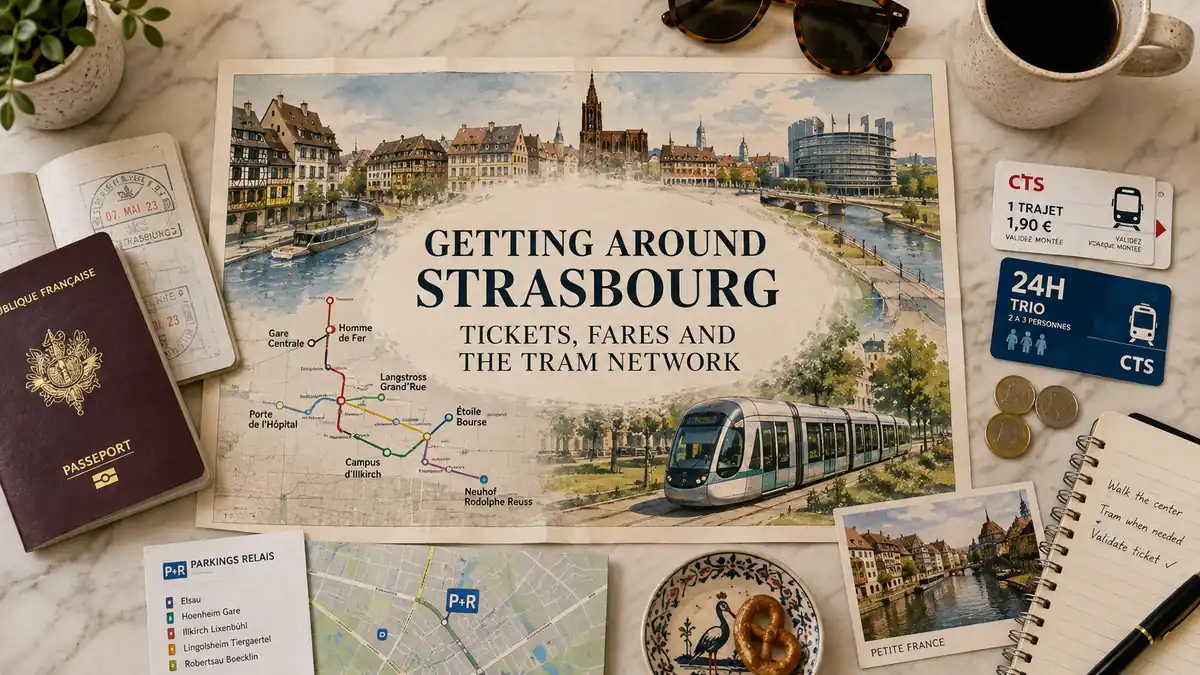
Strasbourg’s centre is pedestrianised and most visitors cover it on foot. This guide starts where that fact leaves off — at the ticket machine. It sets out what a CTS ticket currently costs, which product fits which kind of trip, and the two situations that break the walk-everywhere default: arriving by car, and crossing the Rhine into Kehl.
Fares are the reason this page exists. Strasbourg has re-priced its network twice in recent memory, and the base fare came down instead of up, which is why so much of what circulates online is wrong by a whole generation of pricing. Every figure below comes from the operator’s own product pages, not from aggregators or older guides.
The order here is the ticket decision first, the network second. If you read only two sections, read the fare table and the pass verdict — between them they resolve the only purchase most visitors need to make.
Quick Answer
Most visitors can walk central Strasbourg and ride rarely; a €1.90 single covers any tram trip. A 24-hour pass only pays off from the third ride in a day, a count short trips rarely reach. Arriving by car, use park-and-ride; for two or three riding together, the 24H TRIO earns its price.
Trust Layer
Tripstou transport guide for travelers deciding how to make a specific journey. Covers realistic options, tradeoffs by traveler type and luggage, passes, and arrival cases.
Produced with AI assistance and reviewed by Alex Perrut, working in tourism since 2015, for the Tripstou editorial team. See our editorial process for details.
Last factual review: August 15, 2026.
Official sources consulted: France.fr, Atout France.
Key Takeaways
- Most visitors walk central Strasbourg and ride once or twice, so buying singles as you go beats buying a pass.
- A €1.90 single lasts one hour with transfers and covers the whole network, including the tram across to Kehl.
- The €4.60 24-hour pass only pays off from the third ride, a count most walk-first Strasbourg days never reach.
- Two or three people riding together should buy the €10.20 24H TRIO, which breaks even at six journeys.
- Arriving by car, park-and-ride costs €4.20 a day and includes tram travel for everyone in the vehicle.
- Validate on the platform before boarding trams and lines G and H; ordinary buses validate inside the vehicle.
Table of Contents
Most of Strasbourg Is Walkable — You May Not Need a Ticket
Strasbourg’s centre is compact and pedestrianised, so most visitors ride the tram once or twice a whole trip. Walking is the default mode here, not a budget compromise. Buy single tickets as you need them, or nothing at all; a pass is the wrong instinct for a walk-first city.
That sits underneath the broader orientation in our Strasbourg city guide, which already concludes you will not need a car here. Where you sleep decides how true it stays. A base on or beside the Grande Île keeps almost everything within walking distance, and that choice is handled in our guide to where to stay in Strasbourg.
- Walking — suits anyone based in or near the Grande Île, where most of the sightseeing sits. Tradeoff: cobbles are unkind to wheeled luggage and to tired feet at the end of a long day.
- Tram — suits the trips that cross the ring: the main station, the outer neighbourhoods, the park-and-ride sites and Kehl. Tradeoff: you pay per hop unless you ride enough to justify a day pass.
- Bike — suits longer flat runs out to the parks and along the canals. Tradeoff: you handle locking, parking and the weather yourself.
A short stay realistically produces one or two tram rides in total. That is the whole reason buying as you go beats buying ahead. The tram earns its fare on journeys that cross the ring road; inside it, waiting on a platform usually costs more time than walking the same distance.
How Much Is a Tram Ticket in Strasbourg?
A single CTS ticket costs €1.90 and is valid for one hour, transfers included. That hour covers the entire Eurométropole network — tram, bus and BRT — and it includes the cross-border run into Kehl in Germany. Buying onboard from a bus driver is the one fare that rises, at €2.50.
All prices below are CTS’s own published fares for the Eurométropole network.
| Ticket | Price | What it covers | Best for |
|---|---|---|---|
| Single ticket | €1.90, or €2.50 from the driver | One hour of travel, transfers and Kehl included | The occasional ride most visitors make |
| Pack of 2 tickets | €3.60 for the pack | Two single journeys, same one-hour validity | Two people making one trip each |
| Packs of 10 or 30 tickets | €17.10 or €47.50 per pack | Ten or thirty singles at a reduced unit price | Longer stays and families riding often |
| 24H SOLO pass | €4.60 for one person | Unlimited travel 24 hours from first validation | One person riding three or more times |
| 72H SOLO pass | €10.20 for one person | Unlimited travel 72 hours from first validation | Three days of heavy riding by one person |
| 24H TRIO pass | €10.20 for up to three people | Unlimited travel 24 hours, one to three people | Two or three people travelling together |
Buying a contactless CTS ticket for the first time adds a €0.20 support cost for the card itself, charged once. The one-hour window then runs from your first validation: change between tram and bus as often as you like inside it, stamping the ticket again on each leg. A return journey later in the day needs a second ticket.
Transport is a small line in a Strasbourg budget, and our Strasbourg trip cost guide shows where it sits against accommodation and food. Arriving by air is a separate journey with its own fares and options, covered in the Strasbourg airport transport guide.
Is a Strasbourg Transport Pass Worth It?
No, for most visitors — a 24-hour pass only beats singles from the third ride in a day. At €4.60, the 24H SOLO has to clear three journeys at the €1.90 single fare before it saves anything. A walk-first trip in a pedestrianised centre rarely produces three tram rides in one day.
The arithmetic is short. Two journeys cost €3.80 and stay under the pass; the third pushes you to €5.70 and the pass wins. The real question is therefore never what the pass costs — it is whether your day genuinely contains three separate tram trips.
Most Strasbourg days do not. A pedestrianised centre collapses the distances that would otherwise generate rides, and a short visit needs almost no transport at all; our two-day Strasbourg itinerary shows how much of the city works on foot. The 72H SOLO at €10.20 is the exception for genuinely heavy riders, breaking even at six journeys across three days — the pattern of someone sleeping outside the centre and commuting in daily.
Pass value in Strasbourg is decided by where you sleep, not by how long you stay. Stay central and you will never reach the ride count; stay two tram stops out and you reach it on day one.
When the 24H TRIO Beats Everything for Two or Three People
The 24H TRIO costs €10.20 and covers one to three people for 24 hours from first validation. It breaks even at six journeys in total — three each for a pair, two each for a trio — which a group moving between a park-and-ride, the centre and Kehl reaches without trying. This is the one Strasbourg pass that can win on its first day, and the only product worth buying before you know how much you will ride.
Where to Buy Tickets and How Validation Works
Buy on the CTS app or at a machine, and validate before boarding a tram. Validation is where visitors slip: trams and BRT lines G and H use platform validators, so a ticket stamped onboard is a ticket stamped too late. Ordinary buses work the other way and validate inside the vehicle.
- The CTS app — buys and stores tickets on your phone, including immediate-departure products
- Ticket machines — at tram stops, the reliable fallback when the app will not cooperate
- Partner outlets — 95 shops and kiosks across the network, four of them over the border in Germany
- CTS agencies — for packs, passes and anything that needs a human
- The bus driver — singles only, at the €2.50 onboard fare
Tickets bought through the app’s Immediate Departure option are valid from the moment of purchase instead of from validation, so you can buy on the platform and step straight onto the tram. Those tickets also cover TER trains inside the Eurométropole at no extra cost. One thing not to plan around: CTS runs on its own app, Badgéo cards and contactless tickets, so do not arrive expecting to tap a bank card at a validator.
Validation is a habit more than a rule. Stamp it on the platform, then board. Other ground-level habits for a first visit, the ones that have nothing to do with tickets, are collected in our Strasbourg travel tips.
Six Tram Lines Do the Real Work — Buses Barely Matter
Six tram lines carry almost every visitor journey in Strasbourg, and one of them crosses into Germany. Two BRT routes, lines G and H, behave like trams for validation purposes. The 35 bus routes exist mainly for residents heading to suburbs that few visitors have any reason to reach.
Lines A to F cover the ground that matters: the main station, the edges of the Grande Île, the European institutions, the park-and-ride ring and, on line D, the crossing into Germany. Trams run every 5 to 10 minutes through the 06:30 to 20:00 window. At that frequency, checking a timetable is rarely worth the effort — you walk to the platform and wait.
Buses fill the gaps that trams leave, and of the 35 routes only the eight Chron’hop core services are ones a visitor might plausibly board. Three Hibus routes cover the night and work differently enough to deserve their own section below.
One boundary is worth naming clearly: day trips out of Strasbourg run on TER regional trains, not on the CTS network, so a tram ticket does nothing for them. Which towns earn a day and how they sequence is handled in our three-day Strasbourg itinerary.
Train and bus tickets
Compare routes, schedules and prices across rail and bus operators in one search, with mobile tickets on your phone.
New to Omio? Code NEW10 takes 10% off your first booking — or APPNEW10 if you book inside the Omio app. Both apply to bookings up to €80.
Search routes and compare prices on Omio →
Tripstou may earn a commission if you book through this link, at no extra cost to you.
Can You Take the Tram to Kehl, Germany?
Yes. Tram line D crosses the Rhine into Kehl, and an ordinary €1.90 single covers the trip. There is no supplement, no separate German ticket and no border procedure to plan for. Day passes cover Kehl on the same terms, because CTS treats the crossing as ordinary travel on its own network.
Line D runs over the river and reaches Kehl town centre. Nothing about the ticket changes on the way: same fare, same one-hour validity, same platform validators. The 24H SOLO, 72H SOLO and 24H TRIO all include Kehl, which means a group already holding a TRIO pays nothing extra to cross.
Going deeper into the Ortenau district on the German side is where a different product starts to matter. The Europass range extends beyond the tram to TGO buses and trains: Europass Mini 24H costs €7.80, while the family versions cost €11.00 for one adult with two children aged 4 to 12, or €16.60 for two adults with two children. All run 24 hours from purchase.
None of this makes Kehl an excursion pitch. It is a network fact — the tram map does not stop at the Rhine, which quietly widens what a €1.90 ticket can reach.
What Time Do Trams Stop Running in Strasbourg?
Trams, the BRT lines and the Chron’hop bus routes run until 00:30; ordinary buses stop at midnight. After that, three Hibus night routes take over — but only on Thursday, Friday and Saturday nights. Any valid CTS ticket or pass is accepted on them at no extra charge.
Hibus is three routes, N1, N2 and N3, running hourly between 00:30 and 05:00. The night restriction is the detail that catches people out: on a Tuesday, 00:30 is the end of the network entirely. N3 runs through to Kehl Bahnhof, so the cross-border link survives into the small hours on the nights it operates.
Ticketing does not change after dark. There is no night surcharge, so a 24H SOLO validated in the afternoon still works at 02:00 the same night. An hourly night bus rewards planning your last ride, not your last drink — miss an N-route departure and the next one is a full hour away.
Park-and-Ride Beats Driving Into the Centre
Do not drive into the centre. Park-and-ride costs €4.20 for the day and includes unlimited tram and bus travel for everyone in the car, up to seven occupants. Twelve sites ring the city on tram lines A to F, all open around the clock, 5 to 25 minutes from the centre.
The Grande Île is largely closed to through traffic and central parking is both scarce and expensive, so a car driven into the core costs you money and time at once. Park-and-ride is the exception that rescues a car arrival. The day rate is valid between 04:30 and 02:00 and covers 1 to 7 people, which means the price attaches to the car, not to the head.
Four people arriving together pay €4.20 for parking plus all their tram travel that day. The same group buying singles for one round trip each would spend more than three times as much before parking is even counted.
Longer stays move onto a tiered rate:
- 24 hours — €7.20, with transport still included for everyone in the car
- 48 hours — €14.40, the practical tier for a weekend arrival
- 72 hours — €21.60, covering a three-night stay
- Beyond 72 hours — €20 per extra 24 hours, and transport is no longer included
The jump after 72 hours is deliberate. Park-and-ride exists to keep visiting cars out of the centre for the length of a stay, and it stops rewarding you the moment the car becomes storage.
Getting Around Strasbourg by Bike
Strasbourg is one of France’s most cycled cities, and a bike here is a genuine transport mode. The terrain is flat, the cycle network is continuous, and crossing the city takes little longer than crossing a neighbourhood on foot. For anything beyond the Grande Île, cycling often beats waiting for a tram.
The bike wins whenever your route runs across the city instead of along a tram line — out to the parks, along the canals, or between two neighbourhoods that would otherwise need a change. It loses on short hops. Unlocking, parking and locking again eats the time saved on a one-stop journey, which is the calculation to make before you take a bike out for a single errand.
The city runs a public bike-hire scheme, Vélhop, with automated self-service stations across the centre alongside staffed hire points. Self-service covers short hops between stations; the staffed points are where longer hires are arranged, which is the route to take for a full day out along the canals.
Frequently Asked Questions
Does a CTS ticket work on TER trains inside Strasbourg?
Only if you bought it in the CTS app. Tickets purchased through the app’s Immediate Departure option include TER trains inside the Eurométropole at no extra cost; tickets bought any other way do not. The day-ticket alternative is the Alsa+ 24h EMS at €4.60, which adds TER but excludes the Strasbourg–Kehl train.
Do Strasbourg trams run on Sundays?
Yes. The tram network runs on Sundays, and all six tram lines operate. The one exception on the wider network is BRT line H, which does not run that day; line G is unaffected. Nothing about tickets, fares or validation changes at the weekend, so a Sunday needs no separate plan.
Is public transport free for children in Strasbourg?
Not for visitors. Strasbourg does run free travel for under-18s, but it is tied to residency in the Eurométropole, so visiting children need tickets like anyone else. For a family, the 24H TRIO covering up to three people or a ten-ticket pack is usually the cheapest route.
Is there a group ticket for more than three people in Strasbourg?
Not a standard one. The 24H TRIO stops at three people, so a group of four or five needs either a second pass or the Alsa+ 24h group day ticket at €7.20, which is sold for weekends and public holidays only. Arriving by car, park-and-ride covers up to seven occupants.
Are taxis worth taking to get around Strasbourg?
Taxis exist, but treat them as a fallback, not a daily mode. In a pedestrianised centre served by six tram lines, most journeys are quicker on foot or by tram. Keep a taxi in reserve for heavy luggage, or for a late night when the Hibus routes are not running.
How does the Christmas market period change getting around Strasbourg?
Driving gets harder; the tram keeps working. During the market season the Grande Île closes to vehicle traffic for the busiest part of the day, a few central tram stops are skipped while the main interchange keeps running, and central car parks fill up. Park-and-ride becomes the practical way in.
Related Guides
- Strasbourg city guide — the orientation layer above this page: what the city is, what it costs to see, and how long to give it.
- Strasbourg airport transport — the arrival journey from Entzheim, with its own fares, options and timings.
- Strasbourg trip cost — daily budgets, spend bands and where transport actually lands in the total.
- Where to stay in Strasbourg — the area choice that decides whether you ride at all.
- Two days in Strasbourg — how much of the city a short visit covers on foot.
- Strasbourg travel tips — the practical habits worth knowing before a first visit.
Did this guide save you time or money? Tripstou is independent and reader-funded — if you'd like to give something back, you can support the site with a crypto contribution of any size.