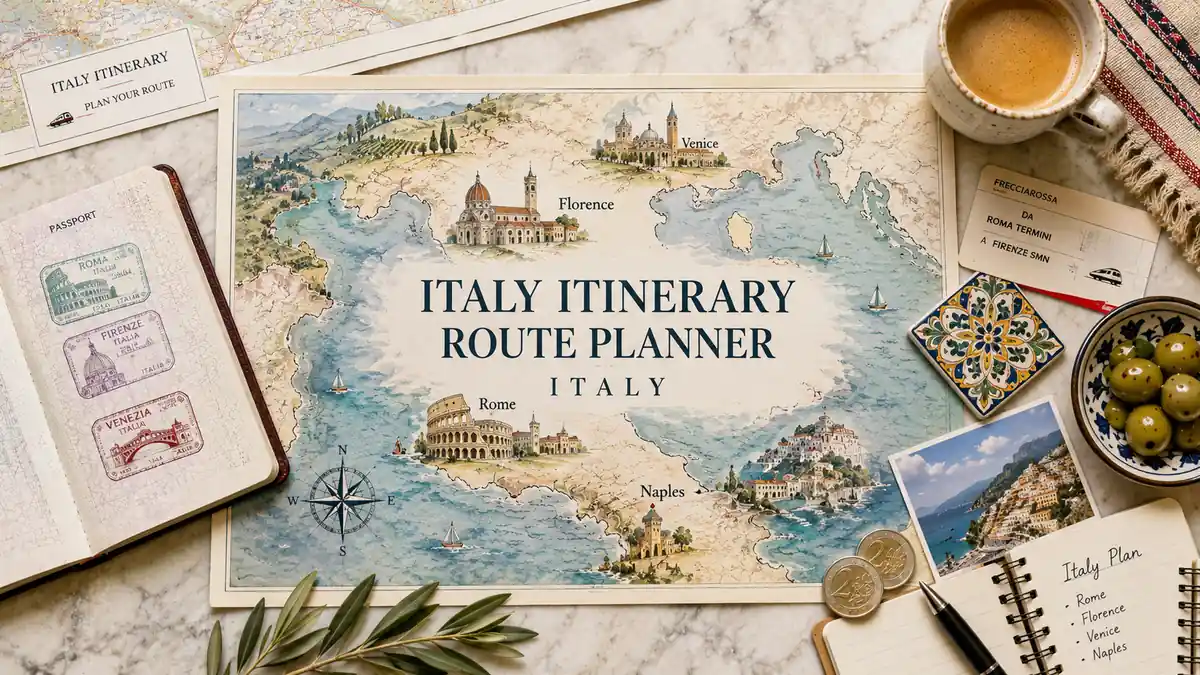
You have chosen Italy — now the real questions are how long to go and which way to travel. This page is the decision layer between picking the country and booking a plan: it resolves your trip length and the order of your stops, then points you to the matching day-by-day itinerary. Most first trips run 7 to 14 days and revolve around three cities: Rome, Florence and Venice. The winning route moves in one direction down the high-speed spine — north to south or south to north — so you never backtrack. Longer trips don’t add more cities so much as more nights and one extra region. Below, you’ll decide how many days you need, how to sequence the cities cleanly, whether to fly open-jaw, and how to weight north versus south. Then you route out to the 7, 10 or 14-day plan that fits.
Quick Answer
A first Italy trip needs about 7 to 14 days, built around Rome, Florence and Venice. Match length to coverage: 7 days covers the big three, while 10 to 14 days add the coast or the south. Fly open-jaw, keep nights in fewer places, and pick the duration plan that fits your dates.
Trust Layer
Tripstou itinerary guide for travelers planning a route. Covers pacing, stop count, stop order, base logic, and trip length.
Produced with AI assistance and reviewed by Alex Perrut, working in tourism since 2015, for the Tripstou editorial team. See our editorial process for details.
Last factual review: June 29, 2026.
Official sources consulted: Italia.it, ENIT.
Key Takeaways
- Plan about 7 to 14 days for a first Italy trip, matching length to how much ground you want to cover.
- Build the route around Rome, Florence and Venice — the big three that anchor nearly every first-trip itinerary.
- Sequence stops in one geographic direction, north to south or south to north, so you never backtrack.
- Fly open-jaw, landing in one city and departing from another, to skip a wasted backtracking travel day.
- Keep two to three cities per week with multiple nights each, then route out to the matching duration plan.
Table of Contents
How Many Days Do You Need in Italy?
Italy needs about 7 to 14 days for a first trip, depending on how much ground you want. Seven days covers the big three: Rome, Florence and Venice. Ten days adds the coast or lakes, and 14 days lets you reach the south without rushing each stop.
| Duration | Realistic coverage | Best for | Pace |
|---|---|---|---|
| About 7 days | Rome, Florence and Venice | First-timers short on time | Fast but focused, few day trips |
| About 10 days | Big three plus coast or lakes | One extra region without rushing | Comfortable, room for a slower stop |
| About 14 days | Big three plus south or islands | Wider first trips and slower travellers | Relaxed, time for day trips |
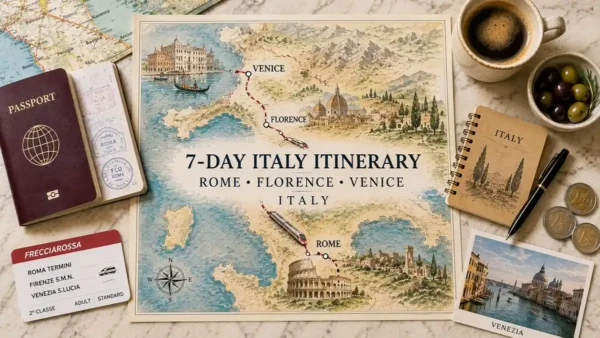
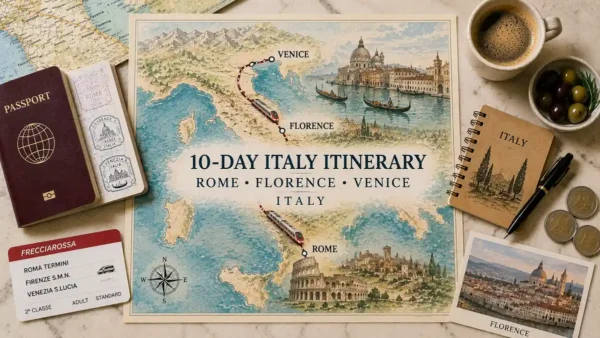
Each band maps to a dedicated plan. For a tight first trip, the 7-day Italy itinerary keeps you on the big three. Adding a region works best with the 10-day Italy itinerary, while the 14-day Italy itinerary reaches the south or the islands. More days rarely buys more cities — it usually buys more nights per stop and fewer transfers, which is the better trade on a first trip.
How to Sequence Italy Without Backtracking
Sequence Italy in one geographic direction, north to south or south to north, and never double back. Italy’s high-speed rail runs as a spine down the country, so a straight line keeps transfers short and travel days few. Backtracking burns days you could spend inside a city.
Treat the train as your route backbone, not a sightseeing decision. The main corridor links the northern cities to Rome and continues south, so choosing a single direction means every leg moves you forward instead of retracing ground.
Two rules keep the route clean:
- Pick your entry and exit cities first, then fill the middle in map order.
- Group nearby stops together so you never cross the same ground twice.
Decide the direction before the cities — the order of stops should follow the map, not a wishlist. Treat any fares or journey times you see as ranges and confirm them when you book.
Train and bus tickets
Compare routes, schedules and prices across rail and bus operators in one search, with mobile tickets on your phone.
New to Omio? Code NEW10 takes 10% off your first booking — or APPNEW10 if you book inside the Omio app. Both apply to bookings up to €80.
Search routes and compare prices on Omio →
Tripstou may earn a commission if you book through this link, at no extra cost to you.
Which Cities to Visit First: the Big Three
Visit Rome, Florence and Venice first — they form Italy’s core first-trip route. All three sit on the high-speed spine, so they connect in a straight line with short rail legs. Run them in either direction: Rome to Venice, or Venice to Rome, depending on your flights.
Each city plays a distinct role in the route:
- Rome anchors the southern end with the deepest history; start or end here. The Rome travel guide covers what to prioritise.
- Florence sits in the middle as the Tuscany base and natural pivot. The Florence guide details the city core.
- Venice caps the northern end and works cleanly as an open-jaw exit. The Venice guide handles its layout.
Want stops beyond the core? The best places to visit in Italy shortlist shows where to extend the line without breaking it — sequencing the extras as route stops, not ranking them.
Should You Fly Open-Jaw Into and Out of Italy?
Yes — fly into one city and out of another to avoid returning to your start. Open-jaw flights match Italy’s straight-line route: land in Milan or Venice in the north, depart from Rome or Naples in the south. You skip a backtracking leg and save a travel day.
Open-jaw tickets often price similarly to a standard return on many European and long-haul routes, so the main gain is time, not just convenience. Booking the entry and exit airports first also locks your route direction before you choose stops.
The cheapest-looking round-trip into a single airport often costs you a wasted day backtracking at the end — count that day against any fare difference. Treat airfares as variable and compare open-jaw against round-trip for your specific dates.
North Italy vs South Italy: Which Route to Choose
Go north for cities and lakes, south for coast and a slower pace. Weight your route north if art cities, Alpine lakes and design appeal most; weight it south for the coastline, islands and a more relaxed rhythm. Most first trips lean north, then dip south as days allow.
| Factor | North weighting | South weighting |
|---|---|---|
| Pace | Faster, city-to-city by rail | Slower, coast and island time |
| Landscape | Lakes, mountains and art cities | Coastline, volcanoes and islands |
| Anchor cities | Milan, Venice and Bologna | Naples and the southern coast |
| Best for | First trips and short stays | Repeat visits or slower travellers |
For a north-weighted route, Milan opens the door to the lakes and the design scene — the Milan guide covers the base — while Bologna adds food and a central rail hub; the Bologna guide details the stops. For a south-weighted route, Naples anchors the coast and the islands beyond, and the Naples guide shows how to use it as a southern gateway.
Don’t split a first trip evenly between the far north and the deep south — pick the weighting that matches your travel style and keep the whole route in one line.
How to Pace an Italy Trip: Fewer Places, More Nights
Plan two to three cities per week and avoid one-night stops. Each move costs a half-day in packing, transfers and check-in, so fewer bases means more actual time in each place. Multiple nights per stop also unlock day trips without changing hotels.
The cheapest itineraries are usually the slowest ones: fewer transfers cut transport spending and let you use day trips instead of new hotels — see the Italy trip cost guide for how pacing shapes a budget. Timing matters too; the season you travel affects crowds and pace, so check the best time to visit Italy before locking your nights per stop.
A packed route with a new city every two days feels productive on paper but loses hours to logistics — fewer places, more nights is almost always the better trip.
How to Extend Your Italy Route as Days Grow
Add the coast at 10 days and the south at 14. The big-three core stays fixed; extra days extend outward from it rather than reshuffling it. At 10 days, slot in the Amalfi Coast, Cinque Terre or the lakes. At 14, reach Naples, Puglia or the islands.
The principle is additive: keep the core line, then append the next-nearest region in your chosen direction so the route never doubles back. Ten days earns one extra region; 14 days earns the south or an island without rushing each stop.
This page sets the route logic; the matching duration child turns it into a day-by-day plan, and the complete Italy travel guide covers everything around the trip. Pick the length that fits your dates, then route out to that plan.
Frequently Asked Questions
Is 7 days enough for Italy?
Seven days is enough to see Italy’s big three without rushing, but not much more. It covers Rome, Florence and Venice at a steady pace, with one or two short day trips. For the full breakdown, follow the 7-day Italy itinerary.
Can you see Rome, Florence and Venice in one week?
Yes, one week comfortably covers Rome, Florence and Venice. The three sit on the high-speed spine, so two to three nights each leaves time for the main sights without long transfers. Run them in either direction to match your open-jaw flights.
How many cities can you visit in two weeks in Italy?
Two weeks comfortably covers four to six cities at a sensible pace. Keep the big-three core, then extend south to Naples or the islands, or add the lakes and coast. The 14-day Italy itinerary maps this out without one-night stops.
Should you start your Italy itinerary in Rome or Venice?
Start wherever your cheapest open-jaw flights land — both ends work equally well. The route runs in a straight line either way, so begin in Venice and finish in Rome, or reverse it. Let airfares and arrival times decide the direction, not habit.
Is it better to base in one city or move around Italy?
Moving in one direction beats a single base for a first trip. Italy’s highlights spread across regions, so a north-to-south line reaches more without backtracking. Limit yourself to two or three bases, keeping multiple nights each, and use day trips instead of constant hotel changes.
How far ahead should you plan an Italy itinerary?
Lock your route direction and trip length first, then book flights and key trains a few months ahead. Settling entry and exit cities early fixes the sequence, so the rest of the plan falls into place. Choose your duration, then route out to the matching day-by-day plan.
Related Guides
- 7-day Italy itinerary — the full day-by-day plan for one week on the core spine.
- 10-day Italy itinerary — a balanced plan that adds one region without rushing.
- 14-day Italy itinerary — two weeks with a southern or island extension.
- Best places to visit in Italy — the shortlist to sequence into your line.
- Italy trip cost — how pacing and stops shape a realistic budget.
- Best time to visit Italy — when to travel for crowds and pace.
- Complete Italy travel guide — the country-wide planning hub.
Did this guide save you time or money? Tripstou is independent and reader-funded — if you'd like to give something back, you can support the site with a crypto contribution of any size.