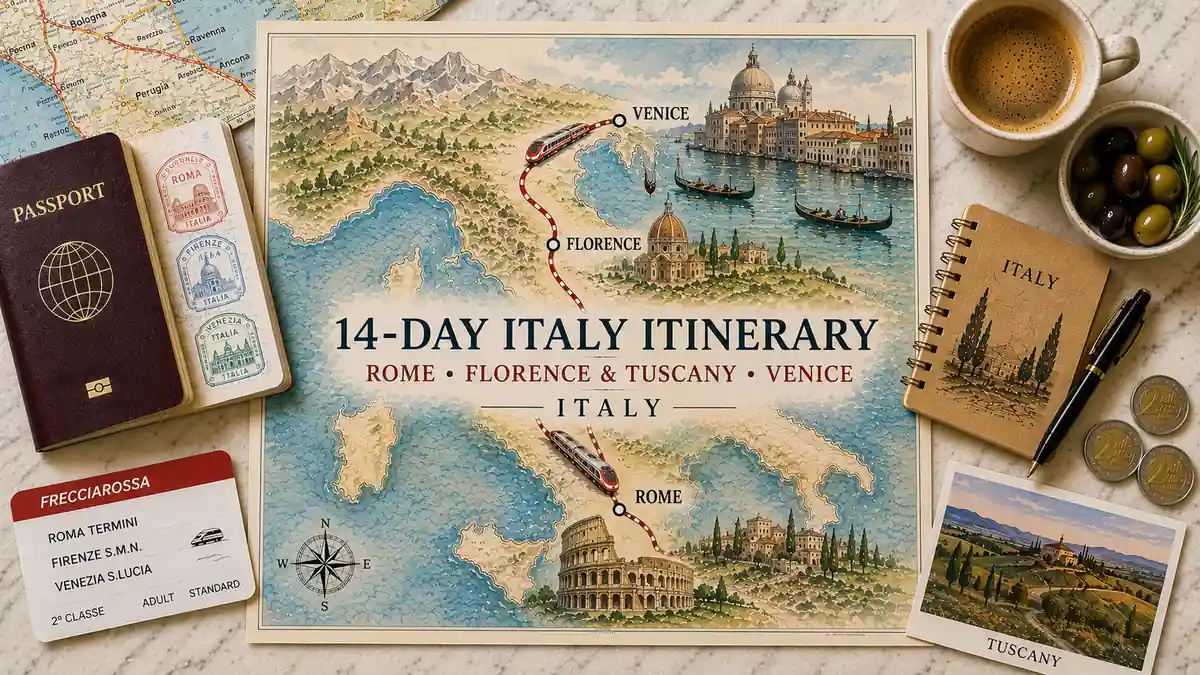
Two weeks is enough time to see Italy well — if you sequence it right. The mistake most 14-day plans make isn’t choosing the wrong cities; it’s zig-zagging the map, losing half-days to backtracking, and cramming the arrival day with sightseeing you’re too jet-lagged to enjoy. This guide hands you one opinionated route rather than a menu to assemble yourself: fly into Rome, work steadily north, and fly home from Venice, with clear nights allocated to each stop. You’ll get a day-by-day spine through Rome, Florence and Tuscany, and Venice, plus the pacing logic behind every night split — why three nights is the floor, when to base and day-trip, and how to move between cities without wasting a day. If you have the appetite or the extra days, one extension section shows what to add first and what to cut first.
Quick Answer
The best 14-day Italy route flies into Rome, works north, and exits from Venice — no backtracking. Split the two weeks across three anchor stops: roughly four nights in Rome, four in Florence and Tuscany, and the rest in Venice. It suits first-timers wanting depth over a checklist; add Cinque Terre or Amalfi with extra days.
Trust Layer
Tripstou itinerary guide for travelers planning a route. Covers pacing, stop count, stop order, base logic, and trip length.
Produced with AI assistance and reviewed by Alex Perrut, working in tourism since 2015, for the Tripstou editorial team. See our editorial process for details.
Last factual review: July 3, 2026.
Official sources consulted: Italia.it, ENIT.
Key Takeaways
- Fly into Rome, travel steadily north, and fly home from Venice so you never lose a day backtracking over covered ground.
- Split the fourteen days as four nights in Rome, four in Florence and Tuscany, and six across Venice and the north.
- Give every anchor stop at least three nights, since two nights leaves only one real sightseeing day after travel.
- Relocate between Rome, Florence, and Venice, but base in Florence and day-trip to Tuscany’s hill towns to avoid repacking.
- Move between the three cities by high-speed train, booking ahead for lower fares and skipping a rental car entirely.
- Add Cinque Terre first when you gain days, and cut the northern leg first when the trip shrinks below fourteen.
Table of Contents
The Best 14-Day Italy Route, Day by Day
The best 14-day Italy route runs Rome → Florence and Tuscany → Venice, working steadily south to north. It spends four nights in Rome, four in Florence and Tuscany, and six across Venice and the route north. This spine keeps travel short, sights logically grouped, and every arrival day realistically paced.
- Days 1–4: Rome — the classical core and jet-lag buffer
- Days 5–8: Florence & Tuscany — Renaissance art and hill-town day-trips
- Days 9–14: Venice & the north — canals and the final stretch home
Each leg below follows the same shape: how many nights, the two or three sights worth building your days around, and the onward move. Depth stays even across all three stops, so no city feels rushed while another drags. Use the city guides when you need street-level detail — this page sequences the route; those pages go deep on what to do inside each stop.
Days 1–4: Rome
Rome earns four nights as the trip’s classical core and your jet-lag buffer. Land, settle, and don’t over-plan the first afternoon — the ancient center, the Vatican, and an evening in Trastevere fill three unhurried days. On the morning of Day 5, take the fast train north to Florence. For a full breakdown of neighborhoods and sights, the Rome city guide and our roundup of the best places to visit in Italy go deeper than a route page should.
Days 5–8: Florence & Tuscany
Florence anchors the middle four nights, with Tuscany reachable as day-trips from a single base. Two days cover the Renaissance core — the Duomo, the Uffizi, and the Accademia — leaving two for Siena, San Gimignano, or a Chianti vineyard. Then move on to Venice by train on Day 9. The Florence city guide maps the museums and the day-trip options in detail.
Days 9–14: Venice & the Route North
Venice and the north take the final six nights, closing the route at your exit airport. Give Venice itself three unhurried nights — the canals, San Marco, and a quieter island like Burano — then use the remaining time for Verona, Padua, or simply a slower pace before flying home. The Venice city guide covers where to stay and how to dodge the worst of the day-tripper crush.
The order matters more than the cities themselves. Front-loading Rome gives your body the arrival day it needs, while saving Venice for last means you end on the calmest, most walkable stop instead of fighting crowds while still jet-lagged.
Tours and activities
Book skip-the-line tickets, day trips and local tours with free cancellation on most activities.
You can also browse everything on getyourguide.com.
Tripstou may earn a commission if you book through this link, at no extra cost to you.
Where to Start and End Your Italy Itinerary
Start in Rome and end in Venice — enter from the south and exit from the north. This direction follows Italy’s geography in one continuous line, so you never double back over ground you’ve already covered. Open-jaw flights into Rome and out of Venice make it seamless and typically cost no more than a round trip.
Reversing the route works too, but it fights the pacing. Landing in Venice means navigating a car-free maze of canals and vaporetti on your most jet-lagged day, while Rome — bigger, better connected, easier to reach from any airport — absorbs a groggy arrival far more forgivingly. South-to-north also warms up as you go, easing you out of Rome’s summer heat toward the cooler north. For the wider national picture that frames these choices, our complete Italy travel guide sets the context.
Open-jaw beats a round trip here for a reason most planners miss: a return flight out of Rome would cost you a full travel day retracing the route south, quietly wiping out one of your fourteen.
How Many Nights to Spend in Rome, Florence, and Venice
Give Rome four nights, Florence and Tuscany four nights, and Venice and the north six between them. The pacing rule behind the split is simple: no anchor stop gets fewer than three nights, because two nights leaves only one full day after travel. Arrival day rarely counts as real sightseeing time.
Here’s how each allocation earns its place:
- Rome — 4 nights: three full days for the ancient core, the Vatican, and the neighborhoods, plus a buffer day for arrival fog.
- Florence & Tuscany — 4 nights: two days in the city, two for hill towns or vineyards, all from one base.
- Venice & the north — 6 nights: three for Venice itself, three to spread across Verona, Padua, or a gentler final stretch.
Treat these as editorial ranges, not hard rules. Slow travelers can drop the north and give Venice more room; fast movers can trim a night anywhere and slot in a fourth stop. What two weeks in Italy actually costs is a separate question — see what a two-week Italy trip costs for the budget side.
Venice is the stop that rewards the extra night. The day-trip crowds clear by evening, so your third night buys the empty, lamplit city that the two-night visitor never sees.
Should You Move Cities or Base and Day-Trip?
Relocate for the three main stops, but base and day-trip within Tuscany. The spine cities — Rome, Florence, and Venice — sit too far apart to day-trip between, so you sleep in each. Tuscany works the opposite way: one base, usually Florence, reaches the hill towns and vineyards without repacking.
The logic comes down to distance and hassle. A few practical scenarios:
- Rome to Florence to Venice: always relocate — these are the pillars of the route, each a full stay.
- Siena, San Gimignano, Chianti: day-trip from Florence — close enough to return the same evening.
- Verona and Padua: either day-trip from Venice or overnight if you want a slower end.
Keep the base decision broad and let the city guides handle the where-to-stay depth. Tuscany is the only leg where staying put clearly wins. The hill towns are close enough to reach and return in a day, so a second base there costs more packing time than it saves in travel.
Hotels and places to stay
Compare hotels, apartments and stays for your dates in one search.
Search hotels and stays on hotels.com →
Tripstou may earn a commission if you book through this link, at no extra cost to you.
Getting Between Stops Without Wasting Days
Move between the three anchor cities by high-speed train, not by car or plane. Italy’s fast rail line connects Rome, Florence, and Venice directly, city center to city center, so you skip airport transfers and parking entirely. Booking ahead lowers fares, and a mid-morning departure protects both your last morning and first afternoon.
A few connection habits keep travel days short:
- Ride the high-speed services on the main Rome–Florence–Venice corridor; they run frequently through the day.
- Book online in advance for the lowest fares — walk-up prices climb sharply, and treat any figure you see as a range to verify before booking.
- Leave late morning. That way the departure city keeps its breakfast and the arrival city keeps its afternoon.
Skip a rental car for this route. Parking is costly, city centers restrict traffic, and the train is faster between the stops that matter. A car only earns its keep if you build in serious rural Tuscany time — and even then, you rent it locally, not for the whole trip.
Train and bus tickets
Compare routes, schedules and prices across rail and bus operators in one search, with mobile tickets on your phone.
New to Omio? Code NEW10 takes 10% off your first booking — or APPNEW10 if you book inside the Omio app. Both apply to bookings up to €80.
Search routes and compare prices on Omio →
Tripstou may earn a commission if you book through this link, at no extra cost to you.
Adapting the Route: Cinque Terre, Tuscany, or the Amalfi Coast
Add Cinque Terre first when you gain days, and cut Venice’s nights first when you lose them. Cinque Terre sits on the rail line north of Tuscany, so it extends the route without breaking the south-to-north flow. The Amalfi Coast is the bigger detour — worth it only with real extra time.
This is one route that flexes, not a menu of parallel itineraries. Grow it or shrink it around the same Rome-to-Venice spine using the rules below.
| Version | Who it suits | How the nights shift | Main trade-off |
|---|---|---|---|
| Classic three-city spine | First-timers wanting depth over speed | 4 Rome / 4 Tuscany / 6 Venice and north | Skips the coast entirely |
| Add Cinque Terre | Hikers, coast lovers, photographers | Trim a night from Rome or the north | Villages get crowded around midday |
| Add the Amalfi Coast | Return visitors with extra days | Needs 16-plus days or a dropped stop | Forces a detour back to the south |
Adding Cinque Terre (who it suits)
Add Cinque Terre if you want coastline and hiking without leaving the spine. It slots in between Florence and Venice, so a two-night stop costs you little in travel logic — trim a night from Rome or the north to keep the total at fourteen. It suits walkers and photographers over travelers chasing museums. For how the five villages stack up against other options, see which Italian places make the cut.
Adding the Amalfi Coast (who it suits)
Add the Amalfi Coast only if you have days to spare, because it pulls you south of Rome and off the northbound line. It suits return visitors who’ve already done the classic trio and want dramatic coastline over more cities. On a strict fourteen days it forces a hard cut elsewhere. If that’s your appetite, a different trip length may fit better.
What to Cut With Fewer Days
Cut the north first, then trim Venice, if your trip shrinks below fourteen days. The route north — Verona, Padua, the slower final stretch — is the most expendable padding, so lose it before touching the three anchor stops. Below three nights per pillar, drop a whole city instead of thinning all of them. For shorter and longer plans, browse Italy itineraries for other trip lengths.
Cinque Terre extends this route almost for free because it lies on the same rail spine north of Tuscany. Amalfi never does — adding it without extra days forces a backtrack south that unravels the whole no-return logic.
Frequently Asked Questions
How do you get from Rome to Florence to Venice by train?
Take Italy’s high-speed trains along the Rome–Florence–Venice corridor, which link the three city centers directly. Book online in advance for the lowest fares, since walk-up prices run higher. Aim for a mid-morning departure so you keep your last morning in one city and your afternoon in the next.
What is the best time of year for a two-week Italy trip?
Late spring and early autumn suit a two-week Italy trip best, balancing warm weather with thinner crowds. These shoulder seasons spare you the peak-summer heat that makes Rome and Florence uncomfortable midday, while keeping northern stops like Venice pleasant. Midsummer works too, but expect fuller sights and higher temperatures throughout.
Is 14 days enough to see Italy?
Fourteen days is enough to see Italy’s classic core well, not all of it. Two weeks comfortably covers Rome, Florence with Tuscany, and Venice at an unhurried pace, with room for one coastal add-on. Trying to add the south or the lakes on top forces rushed stops and wasted travel days.
Do you need to rent a car for this Italy itinerary?
No — this route runs entirely on trains, so a rental car adds cost and hassle without saving time. City centers restrict traffic and parking is expensive, while high-speed rail beats driving between the main stops. Rent locally only if you plan serious time exploring rural Tuscany’s back roads.
Is it better to run this Italy route in reverse, from Venice to Rome?
Usually no — running Rome to Venice keeps the pacing and geography in your favor. Reverse only if your inbound flight lands in Venice or Milan, since backtracking south to start in Rome would waste a travel day. Otherwise, arriving in car-free Venice while jet-lagged makes a harder first day.
Should you book Italy’s headline sights in advance?
Yes — reserve timed tickets for the busiest sights, like the Vatican Museums, the Colosseum, and Florence’s Uffizi and Accademia, before you arrive. Advance slots spare you long queues and the risk of sold-out days during peak months. Book once your night-by-night plan is fixed, so the dates line up.
Related Guides
- Italy itineraries for other trip lengths — how to choose a duration and compare route options.
- Complete Italy travel guide — country context, regions, and when to go.
- Best places to visit in Italy — which destinations are worth your limited days.
- What a two-week Italy trip costs — budgets, ranges, and where the money goes.
- Rome city guide — neighborhoods, sights, and where to stay.
- Florence city guide — the Renaissance core and Tuscan day-trips.
- Venice city guide — canals, islands, and dodging the crowds.
Did this guide save you time or money? Tripstou is independent and reader-funded — if you'd like to give something back, you can support the site with a crypto contribution of any size.