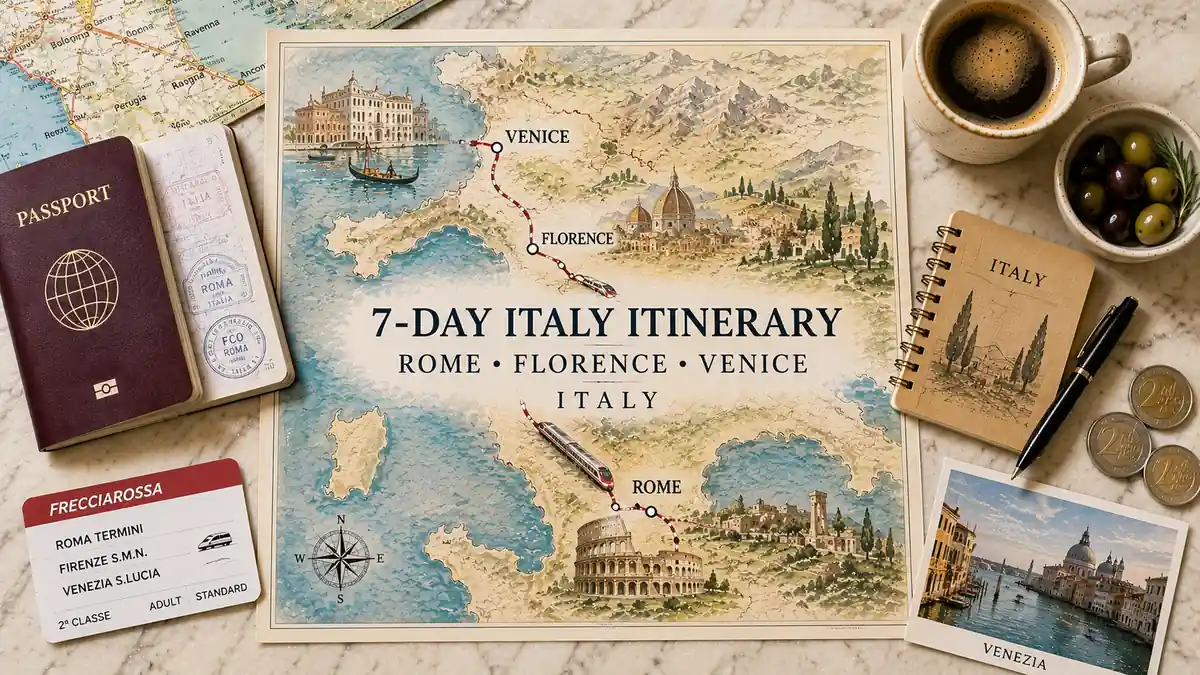
One week in Italy forces three decisions before anything else: which cities, in what order, and how many nights in each. Try to fit the whole country into seven days and you spend the trip on trains instead of in piazzas. This guide gives you one decisive route built for first-timers — Rome, then Florence, then Venice, moving north in a straight line on high-speed rail. You get a night split that matches how much each city actually holds, a day-by-day plan, the transport that ties it together, and clear rules for stretching or shrinking the week. No menu of parallel options, no backtracking, no wasted days. Just the route that reliably works and why it beats the alternatives.
Quick Answer
Spend seven days in Italy on the Rome → Florence → Venice route, connected by high-speed train. Split the week roughly three nights in Rome, two in Florence, and two in Venice. This route suits first-timers who want the classic highlights without rushing, while slower travelers can comfortably drop to two cities.
Trust Layer
Tripstou itinerary guide for travelers planning a route. Covers pacing, stop count, stop order, base logic, and trip length.
Produced with AI assistance and reviewed by Alex Perrut, working in tourism since 2015, for the Tripstou editorial team. See our editorial process for details.
Last factual review: July 3, 2026.
Official sources consulted: italia.it, enit.it.
Key Takeaways
- Follow the Rome → Florence → Venice line north on high-speed rail, so every train leg moves you forward without backtracking.
- Split the week roughly three nights in Rome, two in Florence, and two in Venice to match each city’s size.
- Fly into Rome and out of Venice to save the full sightseeing day a round-trip return would waste.
- Skip the rental car entirely — city-center high-speed trains connect all three stops faster and cheaper than driving.
- Travel in spring or autumn for milder weather, thinner crowds, and lower prices than peak summer.
- Choose three cities at a comfortable pace or a slower two-city week, but never squeeze a fourth stop into seven days.
Table of Contents
Is 7 Days Enough to See Italy?
Yes, seven days is enough to see Italy’s essential highlights, but not the whole country. One week comfortably covers a focused three-city route through Rome, Florence, and Venice. It buys the classic first-timer trip — the major art, ruins, and canals — while leaving the south and islands for a return visit.
The realistic math is simple. Five days stretches to two cities without rushing. Seven days is the sweet spot for three connected cities. Ten days opens room for a fourth stop or a southern detour toward Naples and the Amalfi Coast. Trying to add a fourth city inside seven days is where most first plans break — you end up sleeping in a different bed almost every night and seeing station platforms more than piazzas.
What one week does not buy is depth of country. Sicily, Puglia, the Dolomites, and the Cinque Terre all sit outside a comfortable seven-day loop. If your priority is the headline experiences rather than covering ground, one week delivers. For broader context on how these regions fit together, see our Italy travel guide. Treat seven days as the highlights reel, not the full film.
The Best 7-Day Italy Route: Rome → Florence → Venice
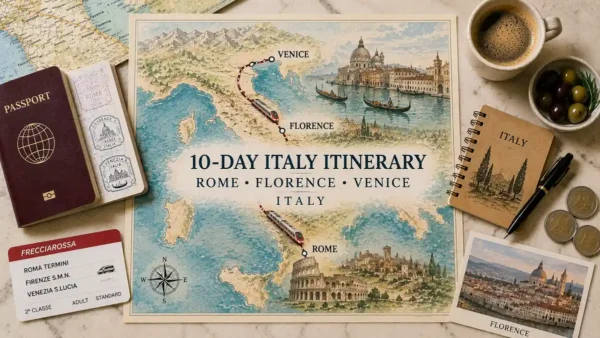
Rome → Florence → Venice is the strongest seven-day Italy route because it runs in one straight geographic line heading north. You never backtrack, and each high-speed train leg moves you forward toward the next city. Flying into Rome and out of Venice removes the wasted day a round-trip return would cost.
- Days 1–3: Rome — the classical core
- Days 4–5: Florence — Renaissance art and Tuscany
- Days 6–7: Venice — canals and the lagoon finale
The order matters as much as the stops. Rome is the biggest city and the busiest arrival airport, so it makes sense to land there fresh and tackle it first. Florence sits directly on the high-speed line between Rome and Venice, so it slots in naturally without a detour. Venice, tucked in the northeast corner, is the logical end of the line and a memorable place to close the trip. Reversing the route works too, but starting in Rome matches most transatlantic and long-haul flight schedules.
This route also draws from Italy’s most-visited shortlist without trying to cover it. If you want to see how these three cities rank against alternatives like Milan, Naples, or the Cinque Terre, our guide to the best places to visit in Italy lays out the wider field.
The open-jaw booking — into Rome, out of Venice — is what makes this line beat any loop. A round-trip back to your arrival airport would burn most of a sightseeing day just returning to the start.
How Many Nights in Rome, Florence, and Venice
Split the week roughly three nights in Rome, two in Florence, and two in Venice. Rome earns the most nights because its sights are spread across the city and demand two full days minimum. Florence and Venice are compact and reward two nights each without leaving you idle or rushed.
| City | Nights | Why it earns them |
|---|---|---|
| Rome (start) | Three nights, two full days | Sprawling sights need time and legwork |
| Florence (middle) | Two nights, one full day | Compact core, walkable in a day |
| Venice (finish) | Two nights, one full day | Small island, magical after day-trippers leave |
Three nights in Rome gives you two clear sightseeing days plus an arrival evening to recover from the flight. Florence packs its headline art into a tight center, so one full day covers the Duomo, the Uffizi, and Ponte Vecchio, with the second morning free for a leisurely start or a nearby view. Venice works the same way: one full day for St Mark’s and the Grand Canal, one for getting lost in the quieter back canals.
Give Rome the spare night, not Venice. Venice empties out by evening as the day-trippers leave, so even two nights already buys you the calm, half-lit city that most visitors never see.
Hotels and places to stay
Compare hotels, apartments and stays for your dates in one search.
Search hotels and stays on hotels.com →
Tripstou may earn a commission if you book through this link, at no extra cost to you.
Your Day-by-Day 7-Day Italy Itinerary
Your seven days break into three legs — Rome, then Florence, then Venice. Rome takes days one to three, Florence days four and five, and Venice days six and seven. Each day anchors on two or three marquee sights, never an exhaustive list, and high-speed trains keep the travel days short.
| Leg | Anchor sights | Onward move |
|---|---|---|
| Days 1–3: Rome | Colosseum, Vatican Museums, St Peter’s | High-speed train north to Florence |
| Days 4–5: Florence | Duomo, Uffizi, Ponte Vecchio | High-speed train east to Venice |
| Days 6–7: Venice | St Mark’s, Doge’s Palace, Grand Canal | Fly home from Venice (open-jaw) |
Days 1–3, Rome. Day one is arrival and an easy evening walk around the historic center and its floodlit fountains. Day two takes on ancient Rome — the Colosseum, Roman Forum, and Palatine Hill in one linked route. Day three crosses the river to Vatican City for the Vatican Museums, the Sistine Chapel, and St Peter’s Basilica. Book the big-ticket sites ahead. For the full spread of neighborhoods and sights, see our Rome travel guide.
Days 4–5, Florence. A high-speed train gets you from Rome to Florence in about an hour and a half, so leave Rome after breakfast and you have the afternoon in Tuscany. Day four covers the Duomo and its dome climb, plus a sunset from Piazzale Michelangelo. Day five is for the Uffizi Gallery and a slow wander over Ponte Vecchio. Depth on museums and day trips lives in our Florence travel guide.
Days 6–7, Venice. The train from Florence to Venice runs around two hours, dropping you steps from the Grand Canal. Day six is the classic core — St Mark’s Square, the Basilica, and the Doge’s Palace. Day seven trades the crowds for the quiet islands or the back lanes of Cannaregio and Dorsoduro before your flight out. Our Venice travel guide covers the lagoon in detail.
Tours and activities
Book skip-the-line tickets, day trips and local tours with free cancellation on most activities.
You can also browse everything on getyourguide.com.
Tripstou may earn a commission if you book through this link, at no extra cost to you.
Getting Between Rome, Florence, and Venice by Train
The entire route runs on high-speed rail — no rental car needed. Two short train legs connect the cities: Rome to Florence takes roughly an hour and a half, and Florence to Venice around two hours. City-center stations put you in the historic core on arrival, so a car only adds cost and parking headaches.
For this specific route, the transport choice is not really a contest:
- High-speed train (recommended): fast, frequent, city-center to city-center, and stress-free. It is the default for Rome–Florence–Venice.
- Rental car: a liability here. Italy’s historic centers restrict traffic, Venice bans cars outright, and you would park on the outskirts and pay for the privilege.
- Domestic flights: pointless between these three cities — airport transfers and security erase any time saved over the train.
Fares shift with demand and how far ahead you book, so treat prices as ranges and buy directly from the rail operator. Book the high-speed legs a few weeks out and the fare can fall by half — the cheapest tiers sell first and the trains fill, so waiting for the platform is the expensive choice.
Train and bus tickets
Compare routes, schedules and prices across rail and bus operators in one search, with mobile tickets on your phone.
New to Omio? Code NEW10 takes 10% off your first booking — or APPNEW10 if you book inside the Omio app. Both apply to bookings up to €80.
Search routes and compare prices on Omio →
Tripstou may earn a commission if you book through this link, at no extra cost to you.
Best Time of Year for a Week in Italy
Spring and autumn are the best windows for a week in Italy. Aim for roughly April to early June or September to October. These shoulder seasons bring mild weather, thinner crowds, and softer prices than peak summer. July and August run hot and crowded, while winter is quiet and cheaper but colder, with shorter days.
Season changes the trip more than any other lever you control on this route. In midsummer, Rome bakes, the Vatican queues stretch for hours, and Venice can feel overrun by midday. In the shoulder months you get comfortable walking weather and shorter lines at the same marquee sights. Winter has real charm — Venice in fog is unforgettable and hotels are cheapest — but expect some rain and a slower rhythm.
Costs track the calendar closely, with peak-summer accommodation the priciest and shoulder or winter stays noticeably lower. For how seasonal timing feeds into an overall budget, see our guide to Italy trip costs. If you can only travel in summer, book everything further ahead and start each sightseeing day early.
What to Skip on a 7-Day Italy Trip
Skip a fourth city, the southern regions, and pacing-breaking day trips on a seven-day route. One week has room for three cities done well or four done badly. Cutting the extras protects the trip: you keep unhurried mornings, avoid constant repacking, and actually see each place instead of its train station.
The common temptations to leave out:
- A fourth city. Adding Milan, Naples, or Bologna means another travel half-day and one fewer night everywhere else.
- The south. Naples, the Amalfi Coast, and Sicily are wonderful but far — they belong to a ten-day-plus trip, not this one.
- Long day trips. Pompeii from Rome or a Tuscany hilltown from Florence sounds tempting but consumes a full day you cannot spare.
- Rushing marquee sites. Half a day at the Vatican or the Uffizi beats sprinting through three sights before lunch.
The most tempting mistake is a Tuscany hilltown day trip out of Florence. It eats a travel day you do not have and quietly steals the second night Venice needs to be worth the stop.
How to Adapt This Route with More or Fewer Days
Shrink the trip by cutting a city; grow it by adding days, not stops. Cut Florence or Venice first when time is tight, and add the south or a fourth northern city when it grows. The core line stays the spine — you trim or extend from its ends, never rebuild it. That keeps one coherent route across lengths.
If you have fewer than seven days:
- Five days: drop to two cities. Rome plus Florence, or Rome plus Venice, both hold up without rushing.
- Cut Venice first if art and antiquity matter most; cut Florence first if you want the contrast of the canals.
If you have more than seven days:
- Nine to ten days: add a southern swing to Naples and the Amalfi Coast, or extend nights in the cities you love.
- Add before Rome, not after Venice when you tack on the south, so you do not fight the northbound line.
For alternative trip lengths and the general planning method behind them, our Italy itinerary guide covers the full range. When you do add a fourth city, place it before Rome rather than after Venice — the high-speed line runs north, and hanging Naples off the end forces exactly the backtrack this route was built to avoid.
Frequently Asked Questions
How far in advance should you book Colosseum, Uffizi, and Vatican tickets?
Book these three well ahead — ideally several weeks before your trip, and earlier still in peak summer. The Colosseum, Uffizi, and Vatican Museums all release timed-entry slots that sell out fast, and turning up without a reservation can mean a long queue or no entry at all.
How long is the direct train from Rome to Venice?
The direct high-speed train from Rome to Venice takes roughly four hours. On this itinerary you split that journey with a stop in Florence, so no single ride runs that long — Rome to Florence is about an hour and a half, and Florence to Venice around two hours.
Should you fly into Rome and out of Venice?
Yes, book an open-jaw ticket into Rome and out of Venice. Because the route runs one direction north, flying back to your arrival airport would waste most of a sightseeing day. Multi-city fares usually cost about the same as a round-trip, so you save the day at no real premium.
Do Italy’s high-speed trains require seat reservations?
Yes, high-speed trains like the Frecciarossa and Italo require a seat reservation tied to a specific departure. Your ticket books you onto one train, not any train that day. Buy a few weeks ahead to lock in a cheaper fare, since the lowest-price seats sell first and prices climb as trains fill.
How much walking does a 7-day Italy itinerary involve?
Expect a lot of walking — Rome, Florence, and Venice are all best explored on foot. Rome’s sights are the most spread out, so you cover the longest distances there, while Florence and Venice are compact but paved with cobbles and, in Venice, countless bridge steps. Comfortable shoes matter more than any other packing choice.
Is it better to base in one city or move between all three?
Move between all three — a single base does not work for this route. Rome, Florence, and Venice sit too far apart for day trips, so basing in one would mean hours of daily backtracking on the train. Changing hotels twice is worth it to wake up inside each city you came to see.
Related Guides
- Italy Itinerary Guide — alternative trip lengths and the full planning method.
- Italy Travel Guide — country-wide context, regions, and first-trip basics.
- Best Places to Visit in Italy — the wider shortlist this route draws from.
- Italy Trip Cost — budgets, seasonal pricing, and what a week runs.
- Rome Travel Guide — deeper detail on the route’s first stop.
- Florence Travel Guide — museums, day trips, and Tuscany from Florence.
- Venice Travel Guide — the lagoon, canals, and quieter islands.
Did this guide save you time or money? Tripstou is independent and reader-funded — if you'd like to give something back, you can support the site with a crypto contribution of any size.