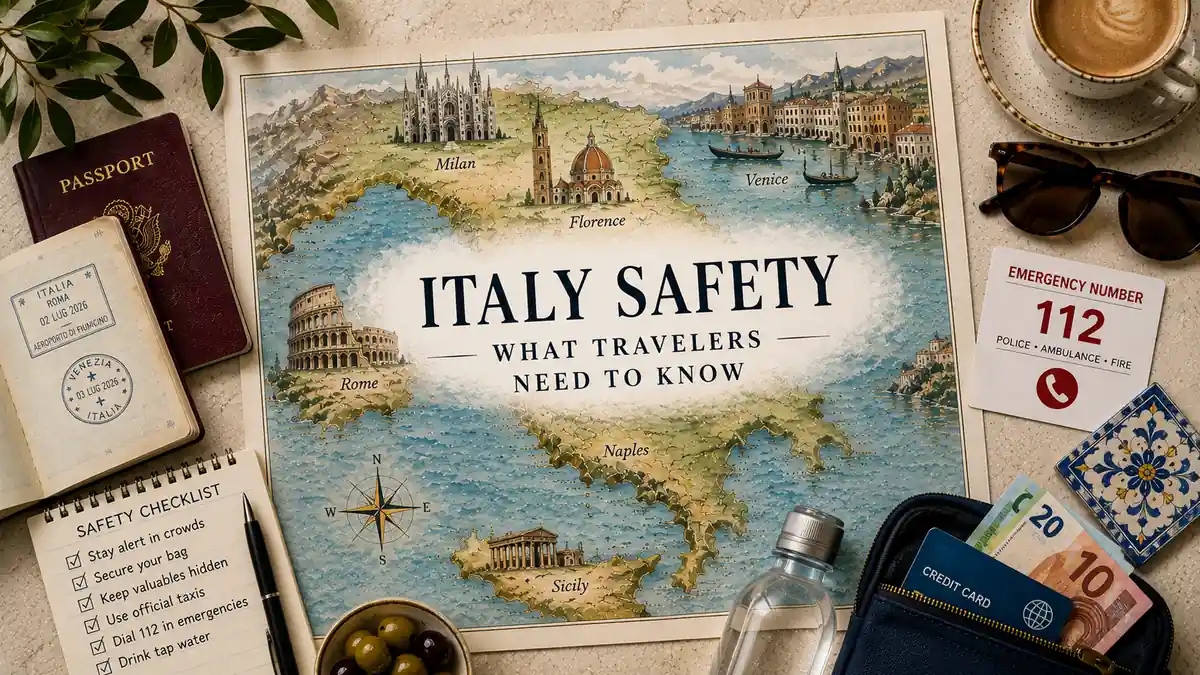
Italy is one of the world’s most visited countries, and for most travelers it is also one of the more reassuring places to explore. Still, “is Italy safe?” is a fair question to ask before booking — and the honest answer is yes, generally very safe, with one main risk to manage. Violent crime against tourists is rare. What you actually need to plan around is petty theft, above all pickpocketing in crowded, high-traffic spots. This guide gives you the practical version: the verdict, the real risks ranked, how and where pickpocketing happens, the prevention moves that work, whether it is safe at night and on foot, and the reassurance basics every visitor should know.
Quick Answer
Italy is generally very safe for travelers, and violent crime against tourists is rare. The main risk is petty theft — pickpocketing concentrated in crowded tourist sites, major train stations, and packed public transit. Stay alert in crowds, secure your bag across your body, and most visitors feel comfortable exploring both day and night.
Trust Layer
Tripstou planning guide for travelers resolving one travel decision. Covers the main variable, traveler context, and practical tradeoffs.
Produced with AI assistance and reviewed by Alex Perrut, working in tourism since 2015, for the Tripstou editorial team. See our editorial process for details.
Last factual review: July 2, 2026.
Official sources consulted: italia.it, enit.it.
Key Takeaways
- Italy is generally very safe for travelers, and violent crime against tourists is rare across the country.
- Petty theft, above all pickpocketing, is the one real risk worth planning around before your trip.
- Pickpockets concentrate in crowded transit, major train stations, and the busiest tourist attractions, not in specific neighborhoods.
- A zipped bag worn across your body at the front prevents most opportunistic theft in crowds.
- Italian cities are safe to walk after dark on lit, busy central streets; take a taxi when isolated.
- Dial 112 for any emergency, and Italy’s tap water is safe to drink nationwide.
Table of Contents
Is Italy safe for tourists?
Yes, Italy is generally very safe for tourists, and violent crime against visitors is rare. Most trips pass without any serious incident. The one thing worth managing is petty theft, especially pickpocketing in crowds. For the current advisory picture, check your government’s official travel guidance before you go — but the baseline is reassuring.
Italy is a mature, well-policed destination with enormous tourism infrastructure, and millions of visitors arrive each year without trouble. Serious crime aimed at travelers is genuinely uncommon. The everyday reality is far closer to lost sunglasses than any real danger.
Advisory wording shifts with events, so treat official travel guidance as your live source rather than any fixed claim on a page. The steady, structural picture does not change much. Italy is safe to visit; the practical work is protecting your valuables, not avoiding the country.
If your trip involves entry paperwork, sorting your documents early is its own kind of safety net. That is a separate topic, and this guide keeps its focus on personal safety on the ground.
What are the main safety risks in Italy?
The main safety risks in Italy rank clearly: petty theft first, minor tourist scams second, and situational night-time caution third. Serious violent risk to travelers stays low. Pickpocketing is by far the most common problem, while scams tend to cost money rather than threaten safety. Nothing here should keep you from booking.
The table below sizes each risk the way a traveler actually experiences it — how likely it is, how serious it is, and what you do about it.
| Risk | Likelihood | Severity | Practical response |
|---|---|---|---|
| Pickpocketing and petty theft | Common in crowds | Low, non-violent | Secure your bag, stay alert in crowds |
| Minor tourist scams | Occasional at hotspots | Low, financial only | Agree prices first, refuse street gifts |
| Night-time street incidents | Uncommon in central areas | Low to moderate | Keep to lit, busy streets |
| Violent crime against tourists | Rare for travelers | Serious but unlikely | No special measures needed |
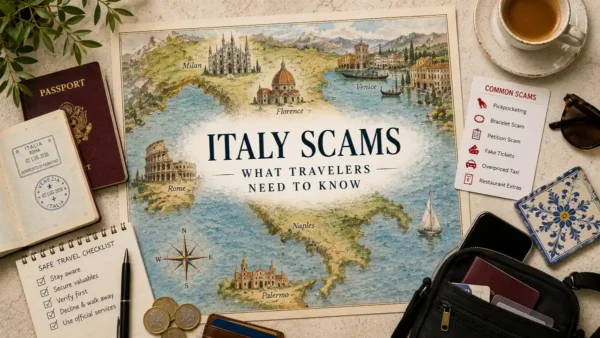
Scams are their own category, distinct from pickpocketing. They are usually about parting you from money through a staged interaction — an unrequested “gift,” a rigged game, or a padded bill — not about physical harm. We keep the mechanics out of this page and cover them in full in our guide to common scams in Italy.
Solo female travelers ask a sharper version of the safety question, and Italy generally answers it well, with the same crowd-and-transit caution as everyone else. The nuance deserves its own space, so we treat it separately in our guide to solo female travel safety in Italy.
How bad is pickpocketing in Italy?
Pickpocketing is common enough to plan around but rarely serious. It is the single most common issue tourists face in Italy, yet it is opportunistic and non-violent — thieves want an easy grab, not a confrontation. Basic awareness prevents the large majority of incidents. Treat it as a nuisance to manage, not a reason for fear.
The scale is best understood directionally: it is more common in Italy’s busiest tourist cities than in quieter towns, and it spikes where dense crowds and distracted visitors overlap. Hard current figures move around and are easy to misread, so the useful takeaway is the pattern, not a statistic.
The reassuring part is what pickpocketing is not. It is not mugging, and it is not aimed at your safety. A thief who fails to lift your wallet simply moves on to an easier target. That is exactly why prevention works so well — you are not outrunning danger, just removing an easy opportunity.
Where do pickpockets operate in Italy?
Pickpockets work the predictable places: crowded public transit, major train stations, and the busiest tourist attractions. The pattern is national, not city-specific — anywhere tourists cluster and attention drifts is fair game. Metros, packed buses, and station concourses are classic spots. The risk follows the crowd, so it rises exactly where you would expect.
Reported hotspots across Italy follow that same logic. Treat these as a pattern to stay alert in, not a guarantee of trouble:
- Rome: Termini station, and around the Colosseum, Trevi Fountain, and Pantheon.
- Milan: the Duomo square and its surrounding crowds.
- Florence: the Uffizi area and Santa Maria Novella station.
- Nationwide: express airport trains, metro lines, and packed city buses.
The giveaway is not the neighborhood — it is the moment your attention splits: boarding a full metro car, framing a photo at a fountain, or checking a map on a station concourse. Pickpockets read distraction, not districts, which is why the same handful of situations recur city after city.
For the local picture in each destination — including which specific areas warrant extra care — see the dedicated city guides for Rome, Florence, Venice, Milan, Naples, and Bologna. This page stays at the national pattern and routes you to the local detail.
How do you avoid pickpockets in Italy?
The most effective move is a zipped bag worn across your body at the front. Skip back pockets and open totes. Keep visible cash low and your phone put away in crowds, and stay alert on transit and at big attractions. Most theft is opportunistic, so removing the easy opportunity removes most of the risk.
Think of prevention as a short ladder, from the single highest-impact habit down to the small ones:
- Wear a zipped crossbody bag on your front in any crowd. This alone handles most of the risk.
- Never keep a wallet or phone in a back or open side pocket.
- Split your money: a small amount for the day, the rest and a backup card left at your accommodation.
- Stay hands-on with your bag when boarding transit and in tight crowds — the classic grab moments.
- Keep your phone away while walking; do not set it down on café or bar tables facing the street.
The bag position matters more than the bag itself. A cheap zipped pouch worn in front beats an expensive anti-theft backpack worn behind you, because the whole game is line of sight. If a thief cannot reach a zip without your hand or eyes on it, they look elsewhere.
Is Italy safe at night and for walking around?
Yes, Italy is safe to walk around, including after dark in central, well-lit areas. Cities stay lively into the evening, and streets around restaurants and main squares are busy and comfortable. The same petty-theft caution applies — crowds and inattention, not violence, are the concern. Solo travelers and couples alike explore Italian cities at night routinely.
The night-time decision logic is simple and evergreen. Stick to lit, busy central streets where people are out; those are the streets you will naturally want anyway. If you end up somewhere quiet, isolated, or poorly lit — a deserted station forecourt late at night, an empty stretch on the edge of the center — take a taxi or a rideshare instead of walking it.
Ordinary common sense carries the rest. Keep your bag secured on late transit, know roughly where you are heading, and trust your read of a place. Solo female travelers can follow the same defaults with confidence, and we cover the specific considerations in our dedicated safety guide.
Frequently Asked Questions
What is the emergency number in Italy?
Dial 112, Italy’s national emergency number, for police, ambulance, or fire. It works across the whole country, connects to a multilingual operator, and is free from any phone, including mobiles without a SIM. Save it before you travel so you are not searching for it in a stressful moment.
Is tap water safe to drink in Italy?
Yes, tap water is safe to drink throughout Italy, meeting strict EU quality standards. You can refill a bottle from the tap or from the public drinking fountains found in most cities and towns. Water labeled “acqua non potabile” is the only exception — that sign means not drinkable.
Is public transport safe in Italy?
Yes, Italy’s trains, metros, and buses are safe and reliable, and using them is not a safety concern in itself. The one thing to watch is pickpocketing in packed carriages and busy stations, where crowds make easy cover. Keep your bag zipped and in front when boarding, and you will be fine.
How much cash should I carry in Italy?
Carry only a small amount of cash for the day — enough for coffees, snacks, and small vendors — and rely on cards for most spending. Italy is widely card-friendly, so you rarely need large sums. Keep a backup card and the rest of your cash at your accommodation, not all on you.
Are the police helpful to tourists in Italy?
Yes, Italian police are generally helpful and used to assisting tourists, especially in major cities. If something is stolen, report it at the nearest station to get the report (“denuncia”) your travel insurance will require. In busy tourist areas you will often see officers on foot, which adds a visible reassurance.
Is Italy safe for families with children?
Yes, Italy is a very family-friendly and safe destination for traveling with children. Italians are famously warm toward kids, and restaurants, museums, and public spaces welcome families easily. The same petty-theft awareness applies — keep bags secured in crowds — but there are no child-specific safety concerns beyond ordinary travel common sense.
Related Guides
Keep planning with the rest of the Italy cluster. These guides pick up where this safety overview routes you — the parent hub, practical etiquette, the deeper safety topics, and entry paperwork:
- Italy travel guide — the parent hub for planning your whole trip.
- Italy travel tips — etiquette, money, and practical know-how.
- Common scams in Italy — how the staged setups work and how to shut them down.
- Solo female travel safety in Italy — the sharper version of the safety question.
- Italy visa and entry requirements — sort your documents before you go.
- Italy Travel Insurance
Did this guide save you time or money? Tripstou is independent and reader-funded — if you'd like to give something back, you can support the site with a crypto contribution of any size.