You have chosen Italy, and now Bologna is asking for two or three of your days. It is a fair question to hesitate over. Bologna is not on the standard first-timer circuit, and it does not sell itself with a single postcard image the way Venice or Florence do. What it has is a red-brick centre wrapped in porticoes, a square — Piazza Maggiore — that functions as the city’s living room, a university older than most European nations, and a kitchen tradition that other Italian cities quietly defer to.
It also sits exactly where you want a base to sit: on the high-speed rail spine between Florence, Milan and Venice, an hour or less from half of northern Italy. That combination changes what a visit to Bologna is for. This guide resolves the planning fan in order — whether the city earns your time, how many days it needs, which season works, how you arrive, where you sleep, what you spend, and which day trips are real. Each variable is answered once here, then routed to the page that owns the detail.
Quick Answer
Bologna is worth visiting for travelers who care about eating well and want a walkable, less crowded city than Florence. 2 full days cover the city, and a third day buys one rail day trip. Stay inside the Centro Storico on a first visit; Bologna rewards food-led travelers and rail day-trippers.
Trust Layer
Tripstou city guide for travelers planning a city trip. Covers trip length, stay style, season, cost, and mobility tradeoffs.
Produced with AI assistance and reviewed by Alex Perrut, working in tourism since 2015, for the Tripstou editorial team. See our editorial process for details.
Last factual review: September 4, 2026.
Official sources consulted: Italia.it — Italian National Tourism Portal, ENIT — Italian National Tourist Board, Marconi Express — Bologna Airport Monorail, Bologna Welcome — Official City Tourist Board.
Key Takeaways
- Two full days cover Bologna itself; a third day is worth adding only as a rail day trip to Modena or Parma.
- Book dinner at an osteria before you arrive; that one habit decides how well you eat more than your budget does.
- Base yourself in the Centro Storico on a first visit, or near Bologna Centrale if day trips drive the plan.
- April to June and September to October work best; parts of August close the family-run kitchens you came for.
- The Marconi Express links the airport to Bologna Centrale in about 7 minutes, so arrival needs almost no planning.
- Bologna complements Florence instead of replacing it: base here for the region, and give Florence its own nights.
Table of Contents
Is Bologna Worth Visiting?
Bologna is worth visiting if you travel for food and prefer a walkable city to a crowded one. It rewards travelers adding depth to a Florence–Venice run, and first-timers who dislike queues. It is a weak choice for icon collectors chasing famous sights.
The practical case is the centre itself. Bologna’s historic core is compact, arcaded and lived in, so a day here is a sequence of squares, market lanes and long covered walks instead of a shuttle between ticket lines. Crowds concentrate around Piazza Maggiore and thin out within a few streets. You are sharing the city with students and residents, and that changes the texture of an ordinary afternoon more than any individual monument does.
What Bologna does not offer is a marquee sight that justifies the trip on its own. There is no Uffizi here, no Grand Canal. If your Italy plan is built around famous objects — and there is nothing wrong with that plan — Bologna will read as a pleasant gap between the places you actually came for. Travelers who measure a trip by what they ate, walked and noticed get far more out of it than travelers who measure it by what they ticked off. That tension is worth naming before you commit days to it, and it is the same tension that shapes any shortlist of the best places to visit in Italy.
Bologna is a poor choice as your only Italian city and an excellent second or third one. Its payoff comes from contrast — with Florence’s density of art, with Venice’s theatre — so it works best once you have something to compare it against. If this is your first Italy trip and you have a week, our Italy travel guide sets the wider route, and Bologna slots into it as the recovery city with the best food.
What Bologna Is Known For
Bologna is known for its food, its porticoes and its university. Piazza Maggiore and the Basilica di San Petronio anchor the centre; the Two Towers mark the skyline; the Archiginnasio holds the old seat of Europe’s oldest university; Santo Stefano gathers seven linked churches; and the Quadrilatero’s market streets sell what the kitchens cook.
These entities sit inside a walking radius of roughly fifteen minutes from Piazza Maggiore, which is the orientation fact that matters for planning. The porticoes tie them together — arcaded walkways run for kilometres through the centre and continue uphill to the Sanctuary of San Luca on the ridge above the city, the longest covered walk of its kind. You do not need a map strategy here. You need shoes.
The food identity and the university identity are the same identity. A city that has hosted students since the Middle Ages developed cheap, generous, technically serious cooking, and the guild traditions behind tortellini and mortadella grew alongside the lecture halls. That is why the market streets sit a hundred metres from the old anatomical theatre, and why Bologna’s nicknames — la grassa, la dotta — always arrive as a pair. For which of these places actually deserve your hours, and in what order, see our guide to things to do in Bologna.
Can You Climb the Asinelli Tower?
The Asinelli Tower is closed for area maintenance, and no reopening date has been published. When it is open, a reservation is mandatory: entry is timed, latecomers are turned away, and the ticket is not refunded. Admission runs €5 full and €3 reduced.
The official alternative for a 360-degree view over the rooftops is the Clock Tower — the Torre dell’Orologio on Piazza Maggiore — which is open to visitors. Plan the panorama around that tower and treat the Two Towers as something you photograph from below.
Tours and activities
Book skip-the-line tickets, day trips and local tours with free cancellation on most activities.
You can also browse everything on getyourguide.com.
Tripstou may earn a commission if you book through this link, at no extra cost to you.
How Many Days You Need in Bologna
You need 2 days in Bologna to cover the city, and 3 days if you want a day trip. Two full days handle the centre, the porticoes and the eating without rushing any of them. The third day is not more Bologna — it is Modena, Parma or Florence by train.
One day is a stopover, not a visit. It buys Piazza Maggiore, a walk through the Quadrilatero, and one properly booked meal, which is a genuinely good day and a thin version of the city. What it does not buy is the second layer — Santo Stefano in the quiet of early morning, the climb toward San Luca, an unplanned hour in a market.
The second day is where Bologna stops being a stop and becomes a place. It absorbs the sights you skipped, the neighbourhood streets east of the centre, and the difference between eating once well and eating well repeatedly. Most travelers who leave disappointed left after a single afternoon.
The third day only pays if you spend it on a train. A third day inside Bologna repeats the second — the city is small, and its rewards are depth of experience, not volume of sights. Spent on Modena or Parma, that same day turns a city break into a regional one. For how the hours actually distribute, see our 2-day Bologna itinerary and the 3-day Bologna itinerary; for how the city fits a longer national route, our Italy itinerary guide places it on the rail spine.
| Trip length | What it realistically buys | Who it fits | The tradeoff |
|---|---|---|---|
| 1 day | Piazza Maggiore, the market lanes, one booked meal | Rail travelers breaking a Florence–Venice journey | You see the centre and miss the city |
| 2 days | The full centre, the porticoes, unhurried eating | First-time visitors treating Bologna as a destination | No time for the wider Emilia-Romagna region |
| 3 days | Everything above plus one full rail day trip | Food-led travelers and anyone basing here | A day away means a day less in Bologna |
When to Visit Bologna
April to June and September to October are the best times to visit Bologna. Weather is mild enough for long walks, kitchens are open, and the centre stays busy without feeling besieged. High summer is hot and humid; late autumn brings fog that settles over the city for days.
- April to June (spring): the strongest window. Long light, comfortable walking temperatures, and full restaurant service. Suits first-time visitors and anyone planning day trips. The tradeoff is that this is also when accommodation demand climbs across the region.
- September to October (early autumn): equal to spring and often quieter. Warm days, cooler evenings, and the food calendar at its best as autumn produce arrives. Suits food-led travelers. The tradeoff is a rising chance of rain by late October.
- July and August (high summer): hot, humid and heavy in the enclosed centre. Suits travelers with fixed holiday dates and a tolerance for heat. The real tradeoff is not weather but closures: many family-run trattorie shut for part of August, and the places you most wanted may be dark.
- November to March (late autumn and winter): the cheapest and least crowded stretch. Suits repeat visitors and museum-minded travelers. The tradeoff is fog and short days, though the porticoes make Bologna one of the more forgiving Italian cities in bad weather.
Season here is a kitchen question before it is a weather question. Bologna’s whole argument is what you eat, and the shoulder months are precisely when the small, family-run places are open and unhurried — which is not something a temperature chart will tell you. Prices across accommodation follow the same national rhythm, moving up in spring and early autumn and easing in winter. For how Bologna’s windows line up with the rest of the country, see the best time to visit Italy.
How to Get to Bologna
Bologna Centrale is the default arrival — it sits on the high-speed line linking Milan, Florence and Rome. Bologna Guglielmo Marconi Airport handles flights and connects to Centrale by the Marconi Express monorail in about 7 minutes. Anyone already travelling in Italy should arrive by train.
The Marconi Express is the one official rail link between the airport and the city, and it removes the entire question of how to get in. Tickets are €12.80 single and €23.30 return, the service runs from 05:40 to midnight, and the ticket also covers 75 minutes on TPER urban buses once you reach Centrale. Outside those hours, a night bus covers the same route. That is the whole decision.
Which arrival suits your trip depends on where Bologna sits in the plan. Coming from Florence, Milan, Rome or Venice, the train wins on time and on centre-to-centre convenience — Centrale puts you a ten-minute walk from the old town. Flying in makes sense only when Bologna opens the itinerary. If you want the full comparison of shuttle, taxi and private options with timetables, that lives in our guide to getting from Bologna airport to the city centre.
How to Get Around Bologna
You will walk almost everywhere in Bologna, and a car is a liability in the centre. The Centro Storico is small enough to cross on foot, and its porticoes keep you dry in rain and shaded in heat. Transit is optional here.
Walkability changes what you have to plan. There is no transit map to learn, no zone system to decode, no daily decision about passes — which is why Bologna suits travelers who dislike logistics. Bring shoes you can wear for eight hours on stone. The one genuine climb is the arcaded ascent to San Luca, which is a deliberate half-day outing.
For the rare bus ride, a TPER urban ticket costs €2.30 from a retailer or by contactless payment on board, and it stays valid for 75 minutes. That single fact covers most visitors’ entire transport spend. Bus lines, zone rules and validation mechanics are resolved in our guide to getting around Bologna. The centre is comfortable to walk at night with normal city awareness; the specifics are in our Bologna safety guide.
Where to Stay in Bologna
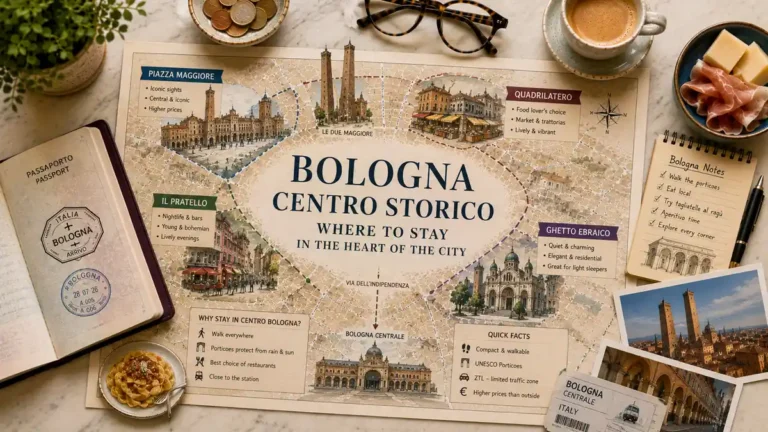
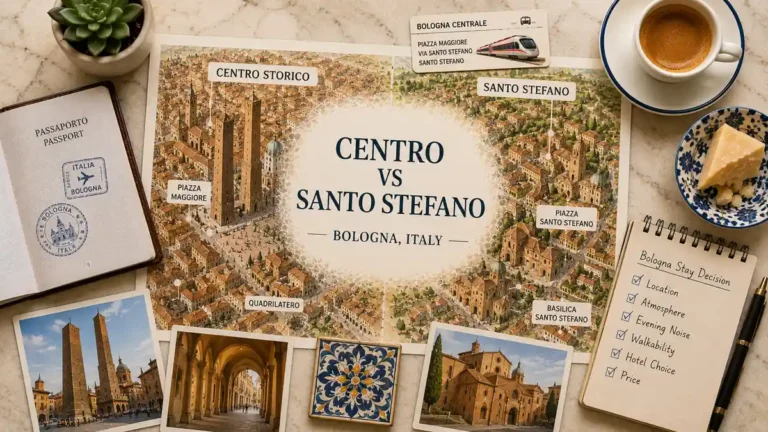
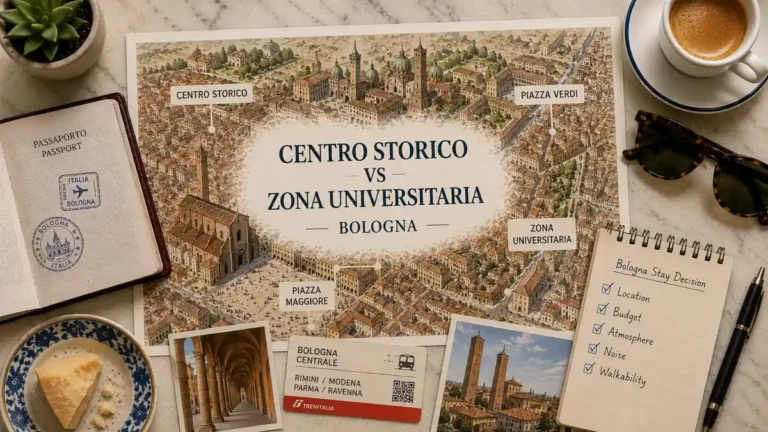
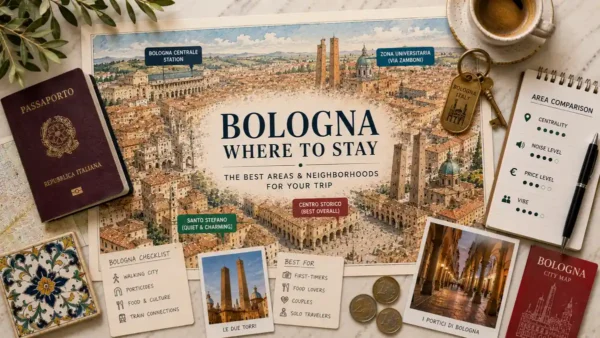
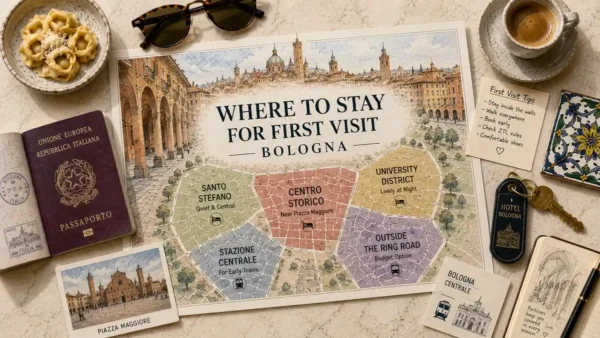
Stay inside the walls, in the Centro Storico, on a first visit to Bologna. Everything worth walking to is within a short stroll, and the evening happens around you instead of after a bus ride. Quiet-seeking couples and day-trip planners have two better options.
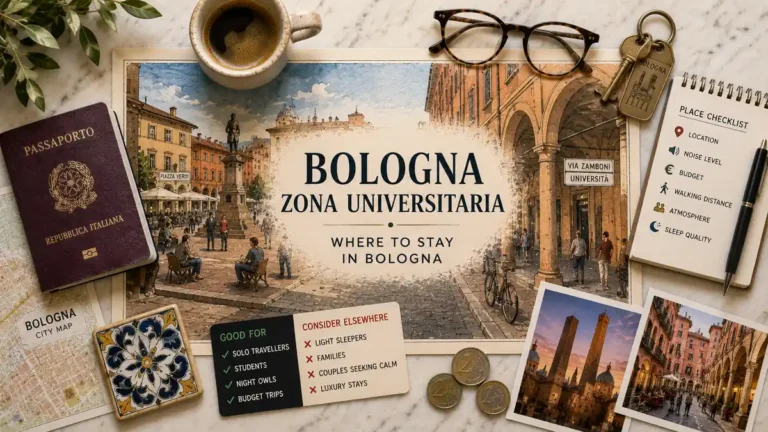
The Centro Storico is the default because it removes friction. You step out of the door into the city you came for, dinner is a walk home, and the day never requires transport. The tradeoff is noise: the streets around Piazza Maggiore and the university quarter stay lively late, and thin windows carry it.
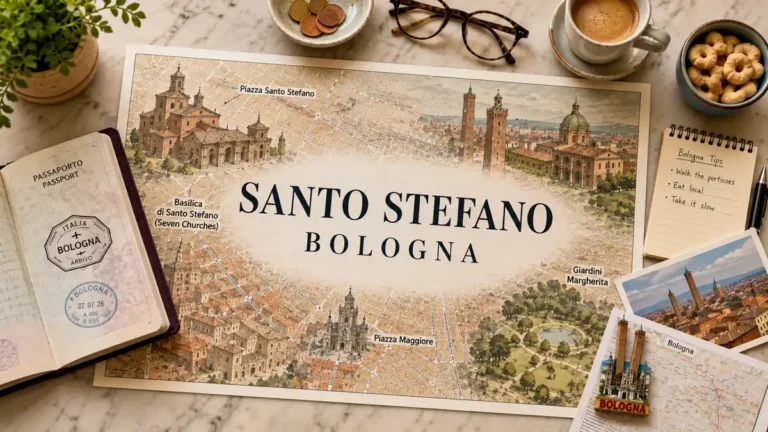
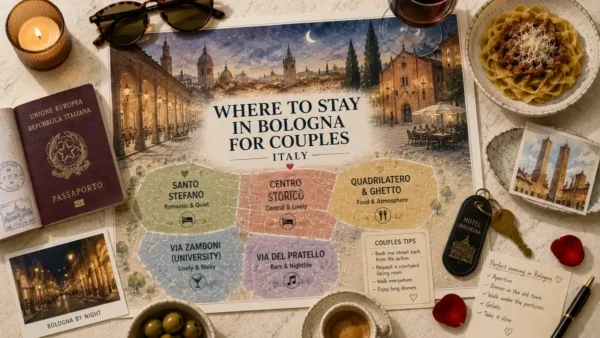
The Santo Stefano quarter answers that. Its streets are quieter, greener and more residential while still inside the historic centre, which suits couples and light sleepers who want the location without the volume. You pay for it with a slightly longer walk to the market lanes and a calmer evening scene.
The streets near Bologna Centrale suit anyone building a trip around day trips. Being minutes from the platforms turns early departures into a non-event, and the area is generally better value than the core. The tradeoff is atmosphere — this is a working station district, and the evening walk home lacks the porticoed charm you booked Bologna for.
The choice between the centre and the station streets is really a question about how many trains you plan to catch. Two or more day trips, and proximity to Centrale earns its keep; one or none, and the centre wins outright.
- First-time visitors: the Centro Storico, walking distance from Piazza Maggiore — see where to stay in Bologna for a first visit.
- Couples: the quiet residential streets around Santo Stefano — see the best areas in Bologna for couples.
- Families: calmer edges of the centre with space and easy access — see where to stay in Bologna with family.
- Nightlife: the university quarter, where the evening runs latest — see the best areas in Bologna for nightlife.
- Budget: the station district and the streets just outside the walls — see budget areas to stay in Bologna.
- High-end: the historic core around Via Farini and the palazzo streets — see luxury areas in Bologna and our pick of luxury hotels in Bologna.
The full area-by-area breakdown, with what each street pattern is actually like, is in our guide to where to stay in Bologna.
Hotels and places to stay
Compare hotels, apartments and stays for your dates in one search.
Search hotels and stays on hotels.com →
Tripstou may earn a commission if you book through this link, at no extra cost to you.
How to Eat Well in Bologna
Book dinner at an osteria, make lunch your value meal, and treat the Quadrilatero as a tasting stop. That sequence solves the three ways travelers eat badly here — turning up unbooked at night, overpaying at dinner, and mistaking a market for a restaurant.
Dinner needs a booking because the good places are small. The osterie that make Bologna’s reputation run a dozen tables, take reservations days ahead in the shoulder seasons, and turn away walk-ins without ceremony. An unbooked evening in Bologna does not mean going hungry; it means eating somewhere you would not have chosen. The reservation costs nothing and decides the meal.
Lunch is where the value lives. The same kitchens serve the same tradition at midday for noticeably less, service is less pressured, and a booked dinner plus a good lunch produces a better eating day than two expensive dinners. Travelers on tighter budgets should invert the usual pattern entirely and make lunch the main meal.
The Quadrilatero is a food market with a shopping street’s rhythm, and its best hour is late morning. Go for cured meats, cheese, fresh pasta and a glass standing up — not for a sit-down dinner, which is what the lanes are least equipped to deliver. Orientation on the dishes themselves takes one sentence: tagliatelle al ragù, tortellini in brodo and mortadella are the city’s signatures, and every menu will confirm it. One booking caution: many family-run places close for part of August, so an August trip needs its dinners locked earlier. Local table manners, tipping and ordering customs are covered in our Bologna dining customs and local tips.
How Much a Bologna Trip Costs
A mid-range day in Bologna runs about €120–€200 per person, flights excluded. That undercuts Florence and Venice for a comparable trip, and the city eats well at every spend level. Your daily total is driven by where you sleep and how you eat, since walking removes transport almost entirely. Every spend style works here.
- Budget — about €50–€90 per person per day: a bed outside the walls or near the station, lunch as the main meal, and an evening built around market food and a glass of wine. Bologna is unusually kind to this style — the student population keeps a real low-cost eating economy alive, and walking means you buy no transport at all.
- Mid-range — about €120–€200 per person per day: a small hotel or apartment inside the historic centre, one booked osteria dinner most nights, and lunch kept simple. This is the style the city is built for, and it is where a Bologna trip diverges most sharply from the same trip in Florence.
- High-end — from about €300 per person per day: a palazzo hotel in the core, tasting menus and producer visits in the surrounding region. Bologna delivers here but does not punish you for it the way the marquee cities do, since the premium sits in the food rather than in a scarce view.
Mid-range travelers get the biggest jump in quality in Bologna, because eating well here is gated by booking ahead, not by budget. A reserved table at a modest osteria beats an unreserved one at an expensive restaurant, which is not true in most Italian cities. Costs drift upward in spring and early autumn and settle in winter, following the same rhythm as the season windows above.
For the actual line items — accommodation, meals, tickets and transport broken out day by day — see our Bologna trip cost breakdown. For how the city compares with the rest of the country when you are budgeting a whole route, see our Italy trip cost guide.
Best Day Trips from Bologna by Train
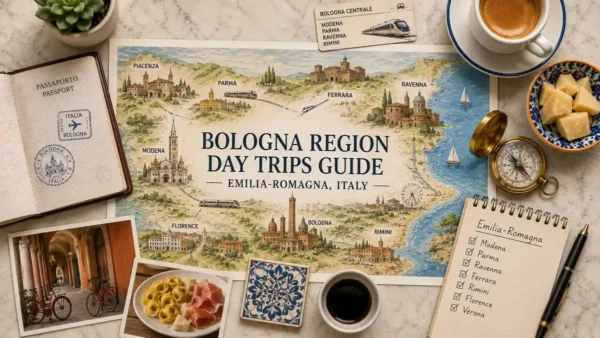
Modena, Florence, Parma and Ravenna are the four day trips worth taking from Bologna Centrale. All four sit within roughly an hour and a quarter by rail, which leaves a full day at the other end. Bologna’s central position on the network is the reason.
Every one of these is a genuine day trip, not a stretch — you leave after breakfast and are back for a booked dinner. Modena is the shortest hop and the easiest to underestimate. Parma rewards a full day and rushes badly if you give it half. Ravenna trades food for mosaics and is the most different from Bologna of the four. Florence is the one that most travelers already have on the itinerary, which changes the calculation entirely.
| Destination | Rail time from Bologna Centrale | Best for | Genuine day trip? |
|---|---|---|---|
| Modena | Around 20–35 minutes | Balsamic tradition and a compact historic centre | Yes — the easiest of the four |
| Florence | Around 35–40 minutes by high speed | Renaissance art on a fixed, booked plan | Yes, but it cannot cover the city |
| Parma | Around 46 minutes to 1h10 | Ham, cheese and an unhurried provincial pace | Yes — give it the full day |
| Ravenna | Around 1 hour | Byzantine mosaics you see nowhere else | Yes, with an early start |
Rail time ranks these four, but the return timetable decides them — check the last useful train back before you commit the day. What to actually do once you arrive belongs to the wider region: our Bologna region and day-trip guide covers each destination properly, including the food-producer visits that are the real reason to leave the city.
Is Bologna a Good Base for Florence?
Yes — Bologna works as a base for Emilia-Romagna, with Florence an easy day trip by high-speed train. The ride runs roughly 35–40 minutes each way. But Bologna complements Florence; it does not replace it, and a day trip cannot cover what Florence holds.
Florence’s sights need Florence evenings. The Uffizi, the Duomo complex and the Oltrarno absorb more than a single daylight visit, and the city’s best hours are early and late — precisely the hours a day-tripper spends on a train. Base in Bologna to see Emilia-Romagna cheaply and eat better; give Florence its own nights when Florence is the point of the trip.
Frequently Asked Questions
Is one day in Bologna enough?
One day is enough to like Bologna, not to know it. Make it work by booking a table before you arrive and staying on foot within ten minutes of Piazza Maggiore. Leave the San Luca portico and the eastern quarters for a return visit with two days.
Is Bologna walkable?
Yes — Bologna is walkable end to end, including the arrival from the station. The porticoes make that walk workable in rain and in August heat, which is unusual among Italian cities. The one thing that does not roll well is a wheeled suitcase, since the older lanes are stone and uneven.
Do you need a car in Bologna?
No. A car is a liability in Bologna, not an asset: the historic centre is heavily restricted to traffic, parking inside the walls is a problem to solve, and everything you came for is walkable. Day trips run on rail from Bologna Centrale, so even Modena and Parma need no driving.
Do you need to book restaurants in Bologna in advance?
Yes for dinner, rarely for lunch. The osterie that carry Bologna’s reputation are small, and an unbooked evening usually means eating somewhere you did not choose. If you arrive without a table, go early, eat at the counter, or move dinner to lunch the next day.
Are restaurants closed in August in Bologna?
Many family-run trattorie close for part of August, when owners take their own holiday. Larger restaurants and places aimed at visitors mostly stay open, so you will eat — just not necessarily where you planned. An August trip needs its dinner bookings made earlier than a spring one.
How long is the train from Bologna to Florence?
The high-speed train from Bologna Centrale to Florence takes roughly 35 to 40 minutes each way. That range fits a morning departure and an evening table back in Bologna, and it is the reason so many Italy routes treat these two cities as a single rail pairing.
Related Guides
- Things to do in Bologna — which sights actually earn your hours, and in what order.
- Where to stay in Bologna — the full area-by-area breakdown behind the three areas above.
- 2-day Bologna itinerary — how the two core days distribute in practice.
- Bologna trip cost — accommodation, meals and tickets broken out as line items.
- Bologna airport to city centre options — every arrival mode compared, with timetables.
- Bologna region and day-trip guide — Modena, Parma, Ravenna and the wider Emilia-Romagna.
Did this guide save you time or money? Tripstou is independent and reader-funded — if you'd like to give something back, you can support the site with a crypto contribution of any size.