Italian food is not one cuisine. It is a set of intensely regional cuisines that change street by street and border by border, shaped by what each place grows, cures, and has cooked for centuries. Eating well here is as much about how you eat as what you order — the course order, the coffee timing, the difference between a real gelateria and a tourist trap all matter as much as the dish itself.
This guide gives you two things. First, the signature dishes worth targeting, organized by region so you know what belongs where. Second, how eating in Italy actually works — the meal structure, the coffee rules, the gelato tells, and the simple heuristics that keep you out of the tourist-menu zone. Learn both and Italy becomes one of the easiest countries in the world to eat brilliantly.
Quick Answer
Eat regionally: Italy’s best food is local — Roman pastas, Neapolitan pizza, Emilian ragù, and Sicilian sweets. Region is the main variable, because dishes change sharply from north to south — so match each plate to its place. Learn a little meal structure and coffee etiquette, eat where locals do, and you sidestep the tourist traps.
Trust Layer
Tripstou planning guide for travelers resolving one travel decision. Covers the main variable, traveler context, and practical tradeoffs.
Produced with AI assistance and reviewed by Alex Perrut, working in tourism since 2015, for the Tripstou editorial team. See our editorial process for details.
Last factual review: July 2, 2026.
Official sources consulted: italia.it, enit.it.
Key Takeaways
- Italian food is regional, not national — match each dish to its home city to eat the best version.
- Target one signature plate per place: carbonara in Rome, pizza in Naples, ragù in Bologna, risotto in Milan.
- Italian meals run antipasto, primo, secondo with contorno, then dolce, but most diners order just two or three courses.
- Order cappuccino only in the morning; after a meal Italians drink a plain espresso, never a milky coffee.
- Spot real gelato by muted natural colors and covered steel tubs; skip the bright, whipped, sky-high mounds.
- Avoid tourist traps by eating a short seasonal menu a few streets back from the headline monument.
Table of Contents
How does Italian food change from north to south?
Italian food has no single national cuisine — it is defined by region. Cooking shifts from the butter, rice, and cured meats of the north to the tomatoes, olive oil, and bolder flavors of the south. Match your plate to where you are, and you eat the best version of it.
Where you travel shapes what you eat more than any menu choice, so choosing regions is really choosing cuisines. If you are still deciding routes, our guide to the best places to visit in Italy pairs naturally with the food map below. The country breaks into three broad bands.
Northern Italy: rice, butter, and the Emilian food heartland
Northern Italy cooks with butter, rice, and cured meats more than olive oil and tomato. The north runs on richness. Risotto and polenta stand in for the dried pasta of the south, and slow, creamy dishes dominate the table. Emilia-Romagna is the region’s — and arguably the country’s — food heartland, home to ragù, tortellini, tagliatelle, Parmigiano-Reggiano, balsamic vinegar, and mortadella. Order pasta here and it is usually fresh and egg-rich.
Central Italy: Roman pastas and Tuscan classics
Central Italy is the home of Rome’s iconic pastas and Tuscany’s rustic cooking. Carbonara and cacio e pepe both belong to Rome and Lazio, built on egg, pecorino, and pepper with no cream at all. Tuscany leans toward the grill and the garden: bistecca alla fiorentina, the bread soup ribollita, and the summer bread salad panzanella. It is simple, seasonal, and ingredient-first.
Southern Italy and the islands: pizza, mozzarella, and Sicilian sweets
Southern Italy is defined by tomato, olive oil, and bold, sun-driven flavor. Naples gave the world pizza napoletana and mozzarella di bufala, and its pastries — the shell-shaped sfogliatella above all — are a category of their own. Sicily runs its own culinary republic: arancini, cannoli, and the ricotta cake cassata carry Arab and Greek influences you taste nowhere else in Italy. This is the spice-and-citrus end of the country.
The clearest dividing line here is not really north against south but fresh egg pasta against dried semolina — cross from Emilia into Rome and Naples and the entire plate changes underneath you.
Which Italian dishes should you try, region by region?
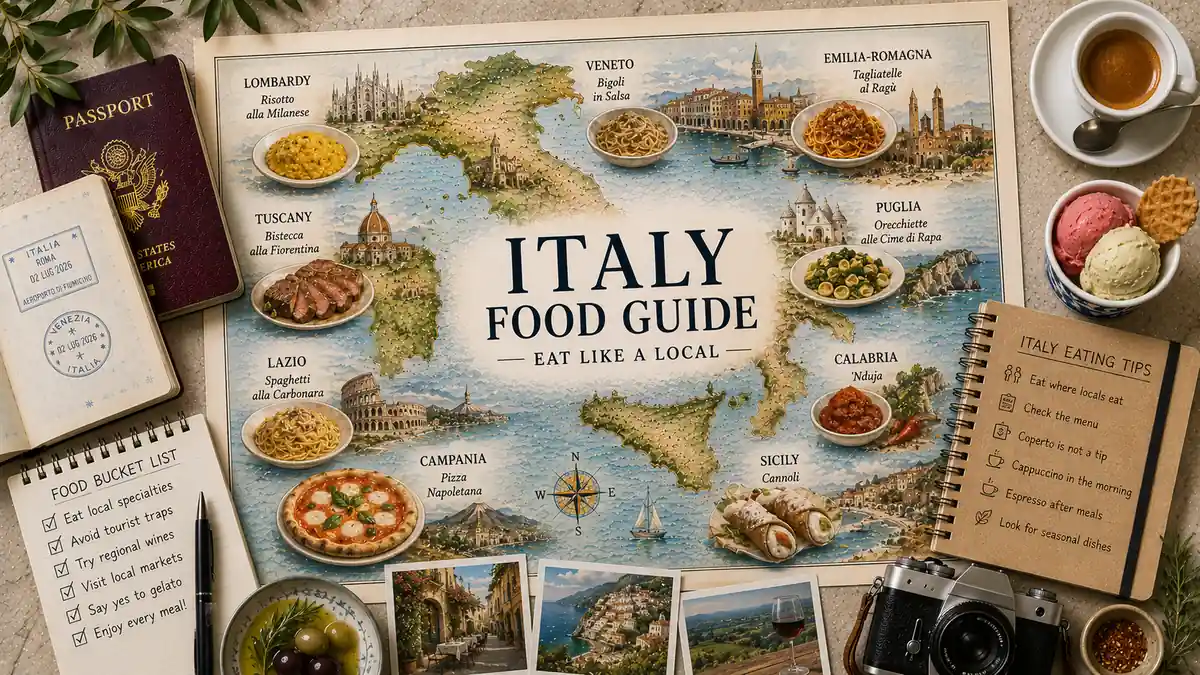
Target the plate each place perfects: carbonara in Rome, pizza in Naples, ragù in Bologna, risotto in Milan. These are the highest-signal dishes for a first visit, because every region guards its own specialty. Order what is local to where you stand, and skip the generic tourist menu.
The table below maps the must-try dishes to their home region, running roughly north to south. Treat it as a shortlist, not an encyclopedia — the point is to eat each thing where it is best.
| Signature dish | Region or city | What it is |
|---|---|---|
| Ragù, tortellini, tagliatelle | Bologna and Emilia-Romagna | Rich meat sauces and fresh egg pasta |
| Risotto alla milanese, ossobuco | Milan and Lombardy | Saffron rice and slow-braised veal shank |
| Carbonara, cacio e pepe | Rome and Lazio | Egg-and-pecorino pastas made without cream |
| Bistecca, ribollita, panzanella | Florence and Tuscany | Grilled T-bone steak and hearty bread dishes |
| Pizza napoletana, mozzarella di bufala | Naples and Campania | Wood-fired pizza and buffalo-milk mozzarella |
| Arancini, cannoli, cassata | Sicily | Fried rice balls and ricotta-filled sweets |
The dish points to the city, and the city points to the trip. Use these one-line hooks as your eating shortlist, then open the relevant city guide when you want depth on where to eat:
- Rome — carbonara and cacio e pepe; see our Rome travel guide.
- Florence — bistecca alla fiorentina over the coals; more in our Florence travel guide.
- Venice — cicchetti, the small bar bites eaten standing; see our Venice travel guide.
- Milan — risotto alla milanese and ossobuco; our Milan travel guide has more.
- Naples — pizza napoletana at its source; see our Naples travel guide.
- Bologna — ragù and tortellini; more in our Bologna travel guide.
A dish’s authenticity fades the farther it travels from home. Carbonara is unremarkable in Venice, and cicchetti make no sense in Rome — so build your eating around each city’s own specialty, not a national wish-list you carry from town to town.
How do Italian meals work, course by course?
Italian meals follow a set order: antipasto, primo, secondo with contorno, then dolce. You do not order every course, though — most diners pick two or three. A pasta and a main, or an antipasto and a pasta, is a normal meal. The sequence is a menu map, not a mandate.
Knowing the courses helps you read any menu instantly, because Italian menus are organized by this exact structure. Here is what each course means:
- Antipasto — the starter: cured meats, cheeses, marinated vegetables, seafood.
- Primo — the first course: pasta, risotto, gnocchi, or soup.
- Secondo — the main: meat or fish, usually served plain.
- Contorno — the side dish, ordered separately alongside the secondo.
- Dolce — dessert, often followed by an espresso and sometimes a digestivo.
If you order only one course, make it the primo. That is where regional identity lives — the pasta or risotto is the plate a town has spent generations perfecting, while the secondo is often the simpler part of the meal.
When can you order a cappuccino? Italian coffee rules
Order a cappuccino in the morning only — Italians treat milky coffee as a breakfast drink. After a meal, the norm is an espresso, ordered simply as a caffè. Milk after lunch is seen as heavy on a full stomach. Coffee taken at the bar, standing, is quicker and usually cheaper than sitting at a table.
The vocabulary trips up more visitors than the timing does. A few pointers save confusion:
- Un caffè means an espresso — the default cup, not a mug of filter coffee.
- Cappuccino and caffè latte are morning drinks; order them before mid-morning.
- Macchiato is an espresso “stained” with a little milk, fine any time of day.
- Ordering “a latte” in English can get you a glass of plain milk — ask for a caffè latte.
No barista will refuse you an afternoon cappuccino. The rule is social, not enforced, so the only real cost of breaking it is quietly marking yourself as a visitor — order what you enjoy and don’t overthink it.
Gelato vs ice cream: how to spot the real thing
Real gelato is denser, less fatty, and more intensely flavored than mass-produced ice cream. It is churned slower and served slightly warmer, so the taste hits harder on the tongue. The quick tells of a good gelateria are natural, muted colors, seasonal flavors, and gelato kept in covered steel tubs. The fluffy, brightly mounded displays are the mass-market signal.
You can judge a gelateria in about ten seconds from the case alone. Watch for these signs:
- Muted, natural colors — pistachio is dull green-brown, not neon; mint is off-white, not turquoise.
- Seasonal flavors — real fruit gelato follows what is ripe, so the lineup shifts through the year.
- Covered or steel tubs — the best shops store gelato flat and covered, out of the light.
- Sky-high mounds — tall, whipped peaks usually mean added air, stabilizers, and coloring.
The banana test works almost anywhere in Italy: genuine banana gelato is a dull grey-beige, so a bright yellow scoop is a reliable sign the whole case leans on artificial color and flavor.
What’s the best Italian street food to try?
Italy’s best street food is regional: supplì in Rome, arancini in Sicily, fried pizza in Naples. Florence adds schiacciata sandwiches, and Venice serves cicchetti, small bar snacks eaten standing. Each is cheap, fast, and tied to its city, so street eating is one of the easiest ways to taste a place without a sit-down meal.
Street food is also where you eat best on a light budget and a tight schedule. The place-anchored shortlist:
- Rome — supplì (fried rice-and-mozzarella croquettes) and pizza al taglio, pizza sold by the slice and weight.
- Sicily — arancini, stuffed fried rice balls, plus pane e panelle chickpea fritters in Palermo.
- Naples — pizza fritta, deep-fried folded pizza, and the fried snacks known as cuoppo.
- Florence — schiacciata sandwiches and the offal roll lampredotto, a true Florentine street staple.
- Venice — cicchetti, bite-size bar snacks eaten standing with a small glass of wine.
How do you eat well and avoid tourist traps in Italy?
Eat where the dish is local and away from the main sights — that one rule avoids most traps. Short, seasonal menus signal a kitchen that cooks fresh. Photo menus, multilingual boards, and hosts waving you inside signal the opposite. Walk a few streets back from the headline monument before you sit down.
The trap restaurants cluster in the most obvious spots for a reason: they sell to people passing through once, so they never have to be good. A handful of habits keep you out of them, and none of them cost anything:
- Choose places with a short menu that changes with the season over ones listing hundreds of dishes.
- Skip anywhere with photos of the food or a host actively pulling passersby off the street.
- Eat the local specialty in its home region, and be wary of a restaurant far from any sight.
- Look for a room with Italians in it, especially around the local lunch and dinner hours.
A menu translated into six languages is a louder warning than a high price. It means the kitchen cooks for people who will never come back, not for locals who would notice if the food slipped. For the wider trip context around your eating, our Italy travel guide sets the frame.
Frequently Asked Questions
What is a coperto or service charge in Italian restaurants?
A coperto is a small fixed cover charge per person, listed on the menu and added to the bill. It pays for bread, table linens, and the place setting, not for service. It is standard across Italy, usually a modest flat amount, and is not a tip or an error.
Do you tip in Italian restaurants?
Tipping is not expected in Italy the way it is in the US. Service is generally included, and the coperto already covers the table. Locals often leave a little loose change or round up the bill for good service, but there is no obligation and no standard percentage.
What is the most famous food in Italy?
Pizza and pasta are Italy’s most famous foods worldwide, with Neapolitan pizza and Bolognese ragù leading the list. But no single dish represents the whole country, because fame is regional: carbonara belongs to Rome, risotto to Milan, cannoli to Sicily. The most famous dish depends entirely on where you are standing.
What is the difference between a trattoria, osteria, and ristorante?
A ristorante is the most formal and usually priciest option, with a fuller menu and table service. A trattoria is a casual, family-run place serving regional home cooking. An osteria was traditionally a simple wine-and-food spot, though today the three labels overlap and any of them can serve excellent food.
What time do Italians eat lunch and dinner?
Italians eat lunch roughly from 1 to 2:30 pm and dinner from about 8 pm onward, later in the south. Many kitchens close between lunch and dinner, so arriving mid-afternoon often means no hot food. Eating at local hours also steers you toward restaurants that cook for residents, not passing tourists.
Can you drink tap water in Italian restaurants?
Yes, tap water is safe to drink across Italy, but most restaurants serve bottled water by default. If you ask for acqua del rubinetto (tap water), some places will bring it, though many simply expect you to order still or sparkling bottled water with the meal. Public fountains are also safe.
Related Guides
- Italy travel guide — the trip-planning hub for the whole country.
- Best places to visit in Italy — where to go, including for food.
- Rome travel guide — the city of carbonara and cacio e pepe.
- Florence travel guide — Tuscan steak, ribollita, and street schiacciata.
- Venice travel guide — cicchetti and the Venetian bar-snack tradition.
- Milan travel guide — saffron risotto and northern Lombard cooking.
- Naples travel guide — the birthplace of pizza and sfogliatella.
- Bologna travel guide — ragù, tortellini, and the Emilian food heartland.
Did this guide save you time or money? Tripstou is independent and reader-funded — if you'd like to give something back, you can support the site with a crypto contribution of any size.