Florence — Firenze in Italian — is the capital of Tuscany and the city where the Renaissance happened. Michelangelo’s David, Botticelli’s Venus, Brunelleschi’s dome and the Ponte Vecchio all sit inside a historic center small enough to cross on foot in half an hour. That combination is what makes Florence unusual: the art density of a capital city inside a footprint the size of a neighborhood. It also makes it demanding to plan, because everyone who visits wants the same two museums on the same mornings. This guide resolves the whole planning fan with a verdict on each piece — whether Florence is worth the stop, how many days it needs, when to go, which part of the city to base yourself in, how to arrive and move around, roughly what it costs, and what has to be booked before you leave home. No prior Italy knowledge assumed.
Quick Answer
Florence is worth visiting for the world’s densest concentration of Renaissance art and architecture, in a walkable center. Trip length is the main decision: three days suits most visitors, two is the compressed minimum, four to five adds Tuscany. Base in or near the historic center and book the Uffizi and Accademia before you fly.
Trust Layer
Tripstou city guide for travelers planning a city trip. Covers trip length, stay style, season, cost, and mobility tradeoffs.
Produced with AI assistance and reviewed by Alex Perrut, working in tourism since 2015, for the Tripstou editorial team. See our editorial process for details.
Last factual review: September 4, 2026.
Official sources consulted: italia.it, enit.it, Gallerie degli Uffizi, Opera di Santa Maria del Fiore.
Key Takeaways
- Florence rewards art, architecture and food-led travelers; it disappoints anyone chasing nightlife, big-city scale or a beach.
- Three days is the balanced length that slots Florence between Rome and Venice; two compresses, four to five add Tuscany.
- Autumn and late winter beat the midsummer peak, trading long daylight for cooler walking and shorter museum queues.
- Every central base works because the center is so small; choose your area by character, not by distance to the Duomo.
- Walk everywhere and never drive in: a camera-enforced ZTL restricts non-resident cars across the historic center.
- Book the Uffizi and Accademia first — ticketed sites, not hotel tier, decide both your schedule and your Florence budget.
Table of Contents
Is Florence Worth Visiting?
Florence is worth visiting for one reason above all: nowhere else concentrates this much Renaissance art and architecture. The whole of it sits inside a historic center you can cross on foot in under half an hour. The tradeoff is that Florence is small, crowded at peak, and finished in days, not weeks.
What the city is best for is narrow and deep:
- Renaissance art at close range — the Uffizi and the Accademia hold works most visitors have only seen in books, a few streets apart.
- Architecture you walk through — the Duomo complex, the Ponte Vecchio and the main piazzas cost nothing to stand in front of.
- Food-led travel — Tuscan cooking, market lunches and wine country close enough to reach and return the same day.
- A short, high-density stop — Florence adds a distinct chapter to an Italy route without swallowing it.
It disappoints a predictable group. Nightlife-first travelers find the evening small and early compared with Rome or Milan. Anyone who wants big-city scale, wide boulevards or a beach within reach is in the wrong city, and the peak-season crush through the core streets is real. Florence is also a place you can genuinely exhaust, which is rarely true of a capital.
The constraint here is museum capacity, not distance. Nothing in the center is far, so what actually shapes your days is how many ticketed collections you can get into and when. That single fact drives almost every other decision on this page. If you are still deciding where Florence sits among your stops, our Italy travel guide frames the country as a whole, and the roundup of the best places to visit in Italy compares it against the alternatives.
What Florence Is Known For
Florence is known for a compact core of Renaissance landmarks you can walk between. The Duomo and its dome, the Uffizi, the Accademia’s David, Ponte Vecchio and the view from Piazzale Michelangelo are the names that bring people here. Almost all of them sit within twenty minutes of each other on foot.
That concentration is the city’s defining trait, and it explains why the ticketed collections — not the walking — decide the shape of your days. The Uffizi and the Accademia both run on timed entry and both sell out in season. The Duomo complex is a separate ticket again, covering the dome climb, the baptistery and the campanile. Across the river, the Pitti Palace and the Boboli Gardens are the natural half-day when the centre feels crowded, and San Miniato al Monte sits above Piazzale Michelangelo for the same view with fewer people in it.
This is orientation, not a shortlist. For the full attraction line-up, what each one actually delivers and how to fit them together, see our guide to the best things to do in Florence.
How Many Days You Need in Florence
Three days is the right length for Florence. That covers the Uffizi, the Accademia and the Duomo complex without stacking two major museums into one day, and still leaves an evening across the river. Two days works if you accept a highlights-only pace; four to five opens Tuscany day trips.
Pacing is what makes three days work. Each of the big-ticket sites is effectively a half-day once you count timed entry, the walk, and a proper lunch afterwards. Two of them in a single day is possible and almost always regretted.
Qualitative comparison — pacing only, no route order.
| Trip length | What it buys | What you sacrifice | Who it suits |
|---|---|---|---|
| 2 days | The headline art and the Duomo area, tightly scheduled | Downtime, second-tier museums, any spontaneity | Travelers slotting Florence between Rome and Venice |
| 3 days | The same sights at a human pace, plus Oltrarno evenings | Little — this is the balanced version of the trip | Most first-time visitors on a wider Italy route |
| 4–5 days | Florence in full, plus day trips into Tuscany | Days that could go to another Italian city | Slower travelers using Florence as a regional base |
Notice what the fourth day actually buys: it is rarely spent in Florence at all. Once the core sights are done, the extra time goes to the hill towns and vineyards outside the city, which means the choice between three and five days is really a choice between a city stop and a Tuscany base.
Day-by-day sequencing belongs to a dedicated itinerary, not to this hub. For the exact plan, see the 2-day Florence itinerary for the compressed version or the 3-day Florence itinerary for the balanced one.
When to Visit Florence
Autumn and late winter are the best times to visit Florence. Both keep the walking comfortable and the museum queues shorter than the midsummer peak, when heat and crowds arrive together. Florence sits inland, with little shade and no coast to escape to.
Each season trades one thing for another, and the differences are directional rather than dramatic.
| Season | What it’s like | Best for | Main tradeoff |
|---|---|---|---|
| Spring | Mild and green, with crowds building steadily | Walking the city and first day trips | Popular period, so stays book out early |
| Summer | Hot, bright and busiest through the core | Long evenings and outdoor dining | Midday heat with almost no shade |
| Autumn | Warm early, cooler later, noticeably calmer | Museums, food season and Tuscan countryside | Shorter daylight as the season goes on |
| Winter | Cool and quiet, occasional grey stretches | Art-first trips and lower-demand stays | Cold mornings, less outdoor life |
One thing season does not fix is ticketing. Quieter months thin out the streets and the piazzas, but the Uffizi and the Accademia run on timed entry all year, so a winter visit still needs the same booking discipline as an August one. Timing changes the city around you, not the queue you are in.
If Florence is one stop among several, the season question is really a national one — snow in the north and heat in the south move on different schedules. Our guide to the best time to visit Italy covers that month by month.
Where to Stay in Florence, by Traveler Type
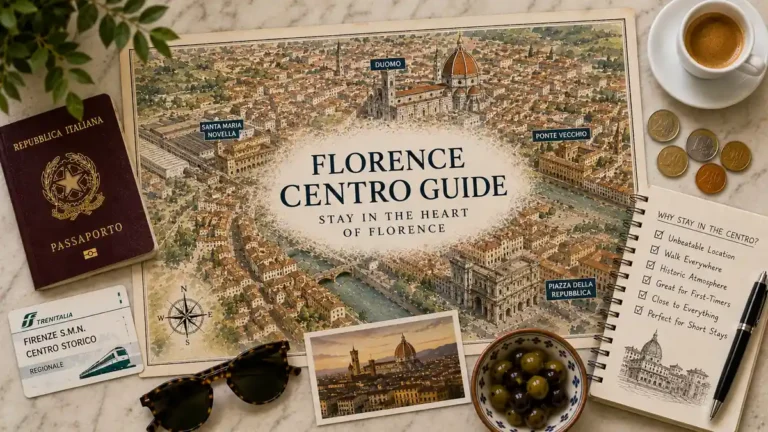
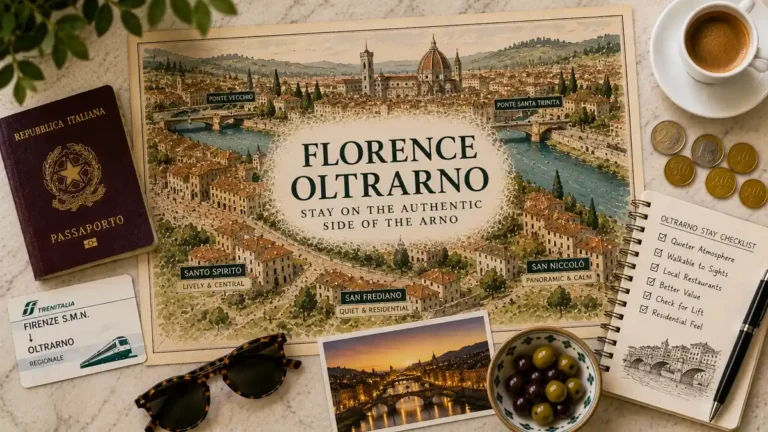
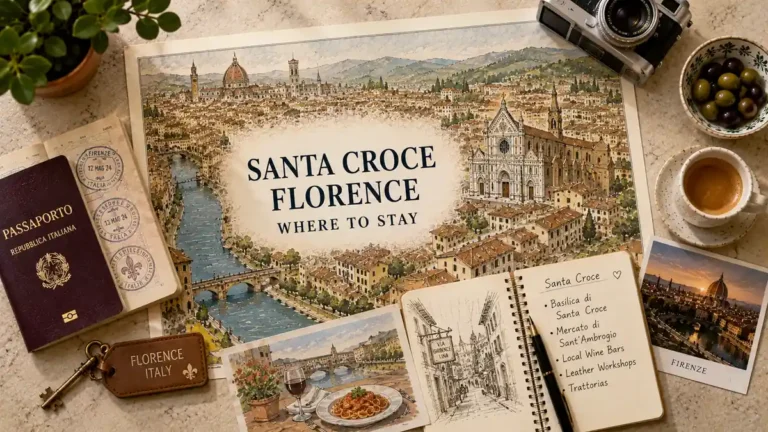
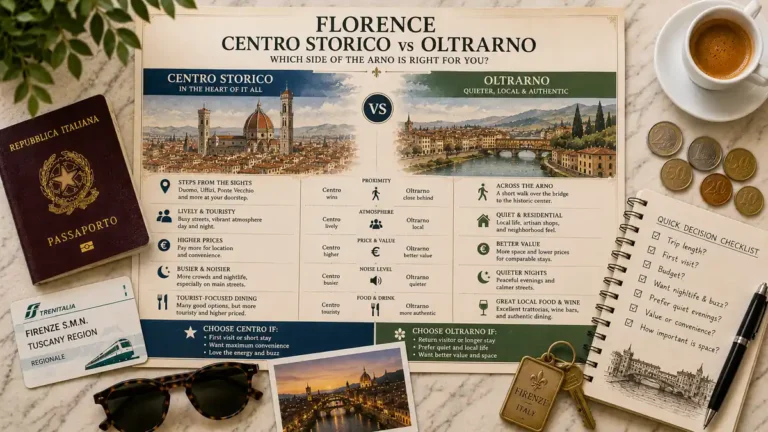
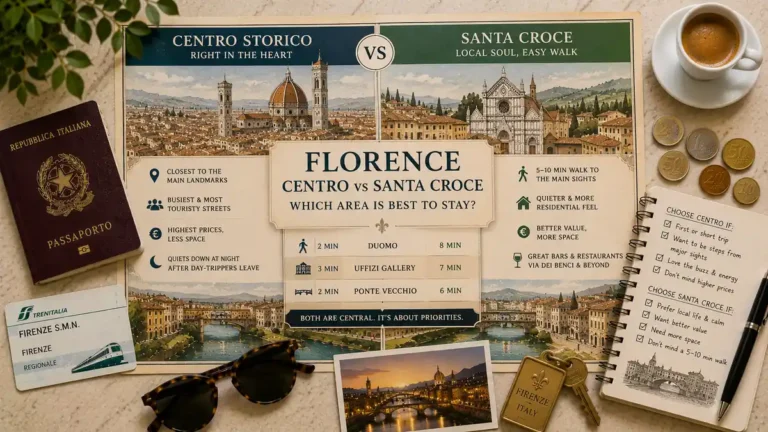
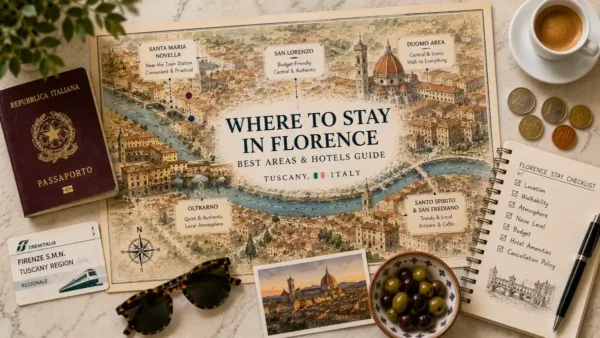
Every central base in Florence works, so the real choice is character. The historic center puts you inside the monuments; Oltrarno, across the river, trades that for quieter streets and artisan workshops; Santa Croce sits between them with more evening life. Distances between them are walking distances.
At character level, the three broad options break down like this:
- Historic center — Best for: first-timers who want to step out of the door into the Duomo, the Uffizi and the main piazzas.
- Oltrarno — Best for: repeat visitors and couples who want workshop streets, artisan shops and dinner away from the tour flow.
- Santa Croce — Best for: travelers who want bars and evening life without leaving the walkable core.
Paying up for the most central address buys you very little in walking time — the map is too small for that. What it buys is the ability to go back to the room in the middle of the day, which matters far more than most people expect in a city you cover entirely on foot and in summer heat.
Resolving the actual neighborhood and property is a separate job, and it has its own page. Start with where to stay in Florence for the full area breakdown, then go straight to the verdict that matches your trip: first-time visitors, couples, families, nightlife, budget travelers, luxury stays, or the curated list of luxury hotels in Florence.
Hotels and places to stay
Compare hotels, apartments and stays for your dates in one search.
Search hotels and stays on hotels.com →
Tripstou may earn a commission if you book through this link, at no extra cost to you.
Getting to Florence: Airports and Trains
Most long-haul visitors reach Florence by train. Rome and Milan both sit roughly 1h30 to 2h away on the high-speed line, so flying into a large hub and connecting by rail usually beats routing to a small airport. Florence (FLR) and Pisa (PSA) are the nearest airports.
The practical picture is short. Florence’s own airport sits at the end of the T2 tram line, 20 minutes from the city on a €2 urban ticket, which makes it the easy arrival when a route works; Pisa serves a wider spread of low-cost flights from within Europe, reached by the €6.50 PisaMover shuttle to Pisa Centrale and a regional train of roughly 50 minutes to 1h20 onward. For intercontinental arrivals, Rome Fiumicino, Milan and Bologna carry far more long-haul traffic, and all three connect onward by fast train. Landing at a hub and taking the rail leg is often faster door to door than waiting for a connecting flight.
Entry requirements depend on your nationality, so check official guidance for your passport before booking. For the transfer itself — which service runs from which airport, and how long each leg realistically takes — see our guide to Florence airport transport.
Getting Around Florence
You walk Florence. The historic center crosses end to end in roughly 15 to 30 minutes, which puts nearly every major sight within an easy stroll of a central base. You will not need transit for the core, and you must not drive into it.
Medieval geometry explains it. Florence’s monuments were built for a compact city and they stayed where they were, so the walking distances between the Duomo, the Uffizi, the Ponte Vecchio and Oltrarno are measured in minutes. Public transport becomes useful mainly for reaching the station, the airport or the hills above the city. Comfortable shoes matter more than any ticket.
A ZTL (limited traffic zone) restricts non-resident cars in the historic center, and cameras enforce it automatically, so park outside and walk in. Ticketing, validation, ZTL detail and the routes worth knowing are covered in our guide to getting around Florence.
How Much a Florence Trip Costs
Florence is mid-priced by Italian city standards: a mid-range day runs roughly €120–€220 per person, budget nearer €70, high-end above €300. Museums and central accommodation are where the money goes; food and movement cost little, because you walk everywhere and the city eats well at neighborhood prices. Spend style, not the city itself, decides the daily total.
What each spend style buys here:
- Budget — hostels, guesthouses or a room just outside the core, market and bakery lunches, and a short list of paid entries. Florence rewards this style because the streets, piazzas and river views cost nothing.
- Mid-range — a central three or four-star, one sit-down dinner a day, and the main museums booked ahead. This is where most trips land and where the city feels best value.
- High-end — historic hotels inside the center, guided access to the major collections, and Tuscan day trips with a driver. Florence supports this well, though the compact center means comfort is what you buy, not convenience.
The number of ticketed sites you commit to moves a Florence budget more than the hotel tier does. Nearly every headline experience in this city is a paid entry, and they stack quickly across a three-day stay — which is why two travelers in identical hotels can end up spending very differently.
Current ranges belong on the pages that maintain them. For the city-level breakdown by spend style see our guide to Florence trip costs, and for the wider route budget see how much a trip to Italy costs.
What to Book Before You Arrive in Florence
Book the Uffizi and the Accademia first, before anything else in the trip. Demand in Florence concentrates on those two collections, and turning up without a reservation is how short trips lose half a day. The Duomo complex has separate entrances per site, so plan it as its own decision.
Almost every visitor wants the same two museums, and both sell nominative timed-entry tickets for which reservation is mandatory, so the slots that suit a short stay go first — which is why they belong in the calendar before flights and hotels feel settled. Booking ahead of the day of entry adds a €4 reservation fee per ticket at each gallery. The Duomo complex is different in kind: the cathedral, the dome climb, the bell tower, the baptistery and the museum are separate entrances, only the dome climb requires a reserved time slot, and treating them as one visit is the most common planning mistake here.
Most other things can wait. Restaurants, day trips, walking tours and second-tier museums are usually arrangeable once you have arrived and know how the days are actually running. Booking those in advance tends to lock a schedule you will want to change.
For the full attraction list and how each site’s booking actually works, see our guide to the best things to do in Florence. For the pre-trip friction — dress codes, timing, the small rules that catch first-timers — run through our Florence travel tips before you go.
Tours and activities
Book skip-the-line tickets, day trips and local tours with free cancellation on most activities.
You can also browse everything on getyourguide.com.
Tripstou may earn a commission if you book through this link, at no extra cost to you.
Who Florence Suits — and How It Fits Your Italy Trip
Florence suits art, architecture and food-led travelers, and it fits almost any Italy route. The city sits on the high-speed rail spine between Rome and Milan, which makes it the natural middle stop on a first Italy trip. It is thinnest for nightlife seekers and anyone hoping for a beach.
The rail geography does most of the work. Rome to Florence to Venice, or Rome to Florence to Milan, are the two routes most first trips end up building, and Florence’s short stay length is exactly what makes them work — three days here plus longer in the bookend cities is a well-balanced two-week Italy. Slot it in the middle and you break up the two long city stops with a smaller, calmer one. For the full route logic, see our Italy itinerary guide.
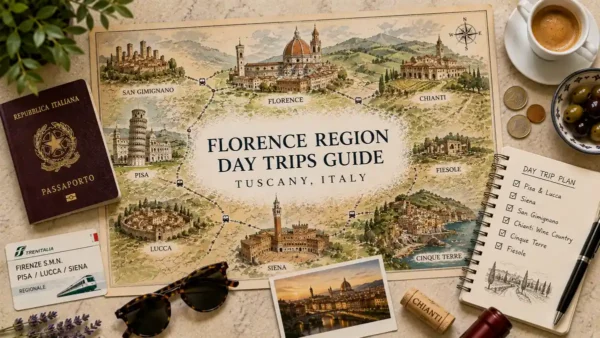
Florence also doubles as the base for Tuscany, which is what stretches a three-day stop into a week without changing hotels; the region’s towns, vineyards and day-trip options are covered in our Florence and Tuscany region guide.
Safety rarely changes the plan here; our Florence safety guide covers what does need attention. The travelers who leave disappointed are almost always the ones who came for scale — Florence gives you depth in a small frame, and that is the whole deal.
Frequently Asked Questions
Is 2 days in Florence enough?
Two days is enough for the headline sights, but only with a schedule. You can see the Uffizi, the Accademia and the Duomo area if all three are booked and sequenced tightly. What you lose is downtime, the smaller museums and any chance to wander Oltrarno in the evening.
Is Florence expensive?
Florence is mid-priced by Italian city standards — roughly €120–€220 per person a day at mid-range — and cheaper than its reputation suggests if you are not chasing every museum. The city’s best-known assets — the Duomo exterior, Ponte Vecchio, the piazzas and the river walks — cost nothing. Paid entries and a central room are what actually push a Florence day upward.
Is Florence safe for tourists?
Florence is a comfortable city for visitors, including walking back to your hotel after dinner. The realistic concern is pickpocketing in the crowded pinch points around the Duomo, Santa Maria Novella station and the Ponte Vecchio — busy tourist streets, not the city as a whole. Standard awareness is enough.
How far is Florence from Rome by train?
Rome to Florence takes roughly an hour and a half on a high-speed train, city center to city center. That makes the two cities easy to pair on the same trip, and it is usually faster than flying once airport transfers and check-in are counted. Milan sits at a similar distance.
Can you drive into Florence’s historic center?
No — a camera-enforced ZTL keeps non-resident cars out of the historic center. In practice this rarely matters, because you would not want a car in a city you cross on foot in half an hour. Rent one only for Tuscany day trips, and collect it as you leave Florence.
Do you need to speak Italian in Florence?
No. English is widely used in hotels, museums, restaurants and shops across the tourist-facing city, so you can plan a whole trip without Italian. A handful of phrases still changes how you are treated — buongiorno, buonasera, per favore and grazie go a surprisingly long way in smaller neighborhood places.
What should you wear to visit the Duomo and churches in Florence?
Cover your shoulders and knees. Florence’s churches, including the Duomo, apply a modest dress code, and visitors in vest tops or short shorts are turned away at the door. In summer, a light scarf or a thin shirt kept in your bag is the simplest fix, since the same rule applies across the city’s churches.
Related Guides
Each of these pages resolves one Florence decision in full depth:
- 2 days in Florence — the compressed highlights route, hour by hour.
- 3 days in Florence — the balanced version most first visits should follow.
- Where to stay in Florence — full neighborhood breakdown and area verdicts.
- Things to do in Florence — every sight worth your time, prioritized.
- Florence trip cost — what a day here actually runs by spend style.
- Getting around Florence — walking routes, transit and the ZTL rules.
- Florence and Tuscany region guide — using the city as a regional base.
- Florence travel tips — the practical rules first-timers wish they knew earlier.
Did this guide save you time or money? Tripstou is independent and reader-funded — if you'd like to give something back, you can support the site with a crypto contribution of any size.