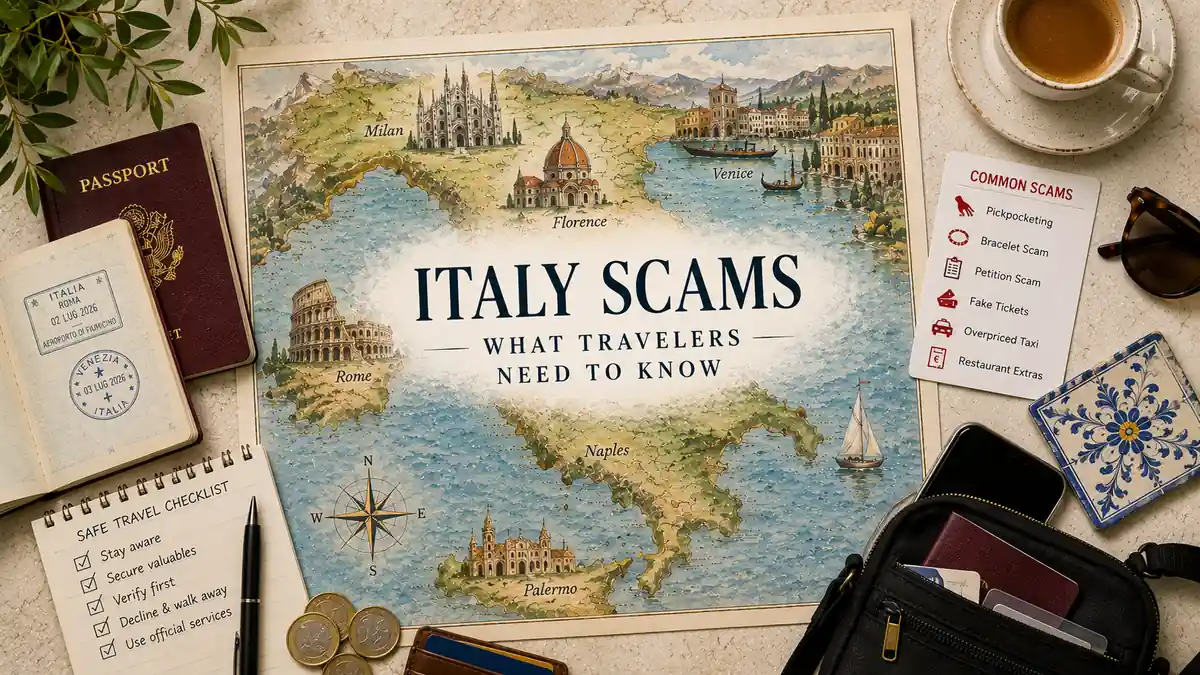
Italy’s real travel risk is deception, not danger. Violent crime against tourists is uncommon, but the country’s most visited squares, monuments, and train stations attract organized pickpockets and practiced street hustlers who work the crowds. Almost every scam here shares one trait: it needs your attention or your trust for a few seconds, and it falls apart the moment you refuse to engage.
This guide catalogs the scams you are most likely to meet in Italy, scam by scam — how each one works, how to spot it early, and the one move that shuts it down. It also maps where these cons cluster, from Rome’s Trevi Fountain to the platforms at Termini, and ends with the prevention habits that cover all of them. Read it as a recognition tool: once you know the pattern, most Italian scams stop working.
Quick Answer
Italy’s most common scams are pickpocketing and street distraction cons in tourist hotspots; violent crime is rare. The risk depends on location and engagement — scams cluster at major sights and stations and rely on you stopping to interact. Keep valuables secured, decline unsolicited gifts, games, and help, and walk away.
Trust Layer
Tripstou planning guide for travelers resolving one travel decision. Covers the main variable, traveler context, and practical tradeoffs.
Produced with AI assistance and reviewed by Alex Perrut, working in tourism since 2015, for the Tripstou editorial team. See our editorial process for details.
Last factual review: July 2, 2026.
Official sources consulted: italia.it, enit.it.
Key Takeaways
- Italy’s real travel risk is deception, not violence — pickpocketing and street cons far outnumber any threat of physical harm.
- Scams cluster where crowds do: Rome’s monuments and train stations first, then Venice, Florence, Milan, and Naples.
- Most street scams open with an unsolicited gift, game, or petition — declining and walking away defeats nearly all of them.
- Taxis and restaurants overcharge through the broken-meter and inflated-extras tricks, so learn the legitimate meter and coperto rules first.
- Secure valuables in front-worn bags, verify tickets, guides, and taxis through official channels, and stay alert in crowds.
Table of Contents
What Are the Most Common Scams in Italy?
The most common scams in Italy are pickpocketing and a handful of predictable street and sales cons. These fall into six recurring families: pickpocketing and bag theft, street distraction games, taxi overcharging, restaurant bill tricks, fake tickets and counterfeit goods, and ATM skimming. Recognizing the family matters more than memorizing every variant.
Almost none of these involve force. They rely on crowds, distraction, or a moment of misplaced trust, which is why the same defensive habits work against all of them. Here is the full roster you are likely to encounter:
- Pickpocketing and bag theft — the dominant risk, worst in crowds and on public transport.
- Street distraction cons — a “gift,” game, or petition that creates obligation or diverts your eyes.
- Taxi overcharging — a “broken” meter or an off-book fare agreed in your head, not on the dial.
- Restaurant bill tricks — inflated extras and tourist-menu markups hidden behind the legitimate coperto.
- Fake tickets and counterfeit goods — bogus skip-the-line passes, unofficial “guides,” and street-sold fake designer items.
- ATM and card skimming — tampered standalone machines and shoulder-surfing at the keypad.
Where Scams Cluster: Pickpocket Hotspots and City Risk Zones
Pickpocketing clusters at Rome’s biggest sights and its main train stations, then repeats across every major tourist city. Density is the driver: thieves work where crowds are thickest, distraction is easiest, and a bumped shoulder goes unnoticed. The specific con changes by city, but the pattern — crowds plus a moment of inattention — does not.
The hotspots below are where the roster above concentrates. Each city has a dominant local flavor worth knowing before you arrive:
- Rome — Trevi Fountain, the Colosseum area, and Termini station: dense pickpocketing, plus friendship-bracelet and dropped-ring approaches around the monuments.
- Venice — crowded vaporetto stops and the tight lanes near St. Mark’s: bag-jostling and inflated bills at tourist-facing cafés.
- Florence — the Duomo and Ponte Vecchio crush: pickpockets and fake-ticket touts working the queues.
- Milan — the Duomo square and central stations: aggressive friendship-bracelet and “free gift” approaches.
- Naples — busy markets and transit hubs: bag-snatching and scooter-side grabs, so keep bags on the wall side.
The riskiest few minutes of an Italian trip are usually the ones right after you step off a train — luggage in both hands, phone out for directions, standing exactly where thieves expect disoriented arrivals to pause.
Street and Distraction Scams to Recognize
Most Italian street scams begin the same way — a stranger hands you a “gift” or invites you into a game. The goal is obligation or distraction: once you hold the object or watch the con, your wallet and attention are exposed. The defense is identical across every variant below: don’t accept, don’t engage, keep walking.
The tactics look different, but they share one weakness — none of them survive a traveler who simply doesn’t stop.
The friendship-bracelet scam
A man near a monument ties or pushes a colored string onto your wrist, calls it a gift, then demands payment once it is on. It is most common around Rome’s Colosseum and Florence’s Duomo, often worked in pairs while a second person eyes your bag.
- Spot it: an over-friendly stranger reaching for your wrist or offering a “free” bracelet.
- Avoid it: keep your hands in your pockets, say a firm no, and don’t break stride.
The rose scam
A seller presses a rose into your hand or gives one to your partner as a “gift,” then follows you demanding money. Refusing after you have taken it feels awkward in front of a date — which is exactly the pressure the con is built on.
- Spot it: an unsolicited flower offered with a smile and no mention of price.
- Avoid it: don’t take it; a raised hand and “no, grazie” ends it cleanly.
The dropped-ring scam
Someone bends down near you, “finds” a gold ring, and asks if it is yours; when you say no, they offer to sell it as valuable treasure. The ring is worthless brass, and the exchange is often cover for a pickpocket working close.
- Spot it: a stranger “discovering” jewelry at your feet and starting a conversation.
- Avoid it: ignore the find, keep moving, and check your bag isn’t being approached.
The fake petition / clipboard scam
A group — often presenting as deaf or collecting for charity — pushes a clipboard petition at you to sign. While your eyes are on the paper, a second person works your pockets, or the clipboard itself hides a hand reaching for your bag.
- Spot it: a clipboard thrust at you in a crowd, usually by several people at once.
- Avoid it: don’t take the pen or the paper; cross your arms over your bag and walk on.
Cup-and-ball street gambling
Cup-and-ball, sometimes played with three shells, is never a game you can win — it is a fixed con with planted “winners” in the crowd to lure you in. Anyone appearing to pocket easy cash is part of the act.
- Spot it: a fast street game drawing an eager crowd near a monument or station.
- Avoid it: don’t watch, don’t bet, and be aware the crowd itself may be picking pockets.
Taxi Overcharging and the “Broken Meter” Trick
The taxi scam in Italy is a “broken” meter or an off-book fare invented on the spot. Licensed white taxis are legitimate and metered; the con is a driver who claims the meter is out and names a high flat price instead. You defeat it by insisting on the meter or agreeing the fare before you get in.
The wrinkle is that Italy has both legitimate fixed fares and fake ones. Many airports run an official flat rate into the historic center, so a quoted flat price is not automatically a scam — the tell is whether it matches the posted official rate, not whether a number was named at all. Treat fares as figures to verify rather than assume, and check the current official rate before you travel.
- Use official white taxi ranks; ignore drivers who approach you inside terminals or stations.
- Confirm the meter is running from the start, or agree the fixed airport fare posted at the rank.
- For airport routes, know that an official flat rate to the center exists, and treat anything above it as negotiable or refuse.
- Ask for a receipt — legitimate drivers issue one without a fuss.
Restaurant Bills: Coperto vs. Genuine Overcharging
Coperto is a normal Italian cover charge, not a scam — the real trick is inflated extras. The coperto is a small per-person fee for the table setting and bread, listed on the menu and charged nearly everywhere. Genuine overcharging is different: unrequested dishes, tourist-menu markups, vague “fish of the day” pricing, and totals that don’t match what you ordered.
The clearest warning sign is not the coperto line at all — it is the special with no printed price. Dishes sold by weight, especially fish and seafood, are where tourist bills quietly double, so ask the cost before you nod yes. For coperto treated as an ordinary part of Italian dining, see our Italy travel tips.
- Read the menu for the coperto and any service charge before ordering — both must be printed.
- Ask the price of anything offered verbally, especially specials sold by weight.
- Refuse extras you didn’t order, and check the total against the menu before you pay.
Fake Tickets, Unofficial Guides, and Counterfeit Goods
Buy tickets and tours only through official channels, and skip street-sold “designer” goods entirely. At major monuments, touts sell fake skip-the-line passes and pose as licensed guides; at stalls and on blankets, sellers push counterfeit bags and sunglasses. Both cons target the sales moment, and both can cost you more than the price — including a fine.
The two variants below are worth separating, because one wastes your money and the other can put you on the wrong side of the law.
Fake tickets and unofficial “skip-the-line” guides
Fake-ticket touts sell overpriced or invalid passes, and unofficial “guides” attach themselves to you at the entrance, then demand a fee. Official tickets come from the monument’s own website or box office, and licensed guides carry a visible ID badge.
- Spot it: someone selling tickets in the queue or offering to “walk you straight in.”
- Avoid it: book through official sites in advance or buy at the on-site box office, and ask any guide for their license.
Counterfeit designer goods (and the buyer-fine risk)
Street-sold counterfeit bags, sunglasses, and watches are illegal to buy in Italy, and buyers — not only sellers — can be fined. The goods are fakes whatever the “deal,” and police do enforce the law against tourists as well as vendors.
- Spot it: blanket stalls and street sellers offering luxury brands at a fraction of retail.
- Avoid it: don’t buy, and walk away if a seller turns pushy.
What makes Italy’s counterfeit trade unusual is that the penalty can land on the buyer, so the “bargain” bag risks costing far more than a genuine one ever would.
Tours and activities
Book skip-the-line tickets, day trips and local tours with free cancellation on most activities.
You can also browse everything on getyourguide.com.
Tripstou may earn a commission if you book through this link, at no extra cost to you.
ATM and Card Skimming
Card skimming in Italy targets standalone ATMs — use bank machines and shield your PIN. Skimmers capture your card data from a tampered slot while a hidden camera or shoulder-surfer reads your PIN. Independent machines in tourist areas and “helpful” strangers at the keypad are the two clearest warning signs.
Skimming is the quietest scam on this list because you often discover it days later, on your statement. A few habits close the gap:
- Prefer ATMs attached to a bank branch over standalone machines on the street.
- Cover the keypad with your other hand as you type your PIN.
- Check the card slot for anything loose or bulky before you insert.
- Decline anyone offering to “help” at the machine, and don’t get distracted mid-transaction.
How to Avoid Getting Scammed in Italy
Avoid most Italian scams by securing your valuables and declining every unsolicited stranger who approaches you. Nearly every con here needs your engagement or your inattention, so a secured bag and a firm “no” defeat the majority before they start. The rest comes down to verifying official services and staying alert in crowds.
The habit that pays off most in Italy is the one you reach for when you feel least at risk — stepping off a train, toasting at dinner, framing a photo at a fountain — because those relaxed seconds are exactly when scammers move. Build the checklist below into your routine and the whole roster stops working on you.
- Carry valuables in a front pocket or a zipped, cross-body bag worn to the front in crowds.
- Keep your phone off the table and out of your back pocket at cafés and on transit.
- Treat every unsolicited gift, game, petition, or “helpful” approach as a setup, then decline and walk.
- Buy tickets, tours, and taxis through official channels, and verify guides and meters.
- Split cash and cards, and carry only what you need for the day.
- Stay most alert where scams cluster: monuments, markets, and station platforms.
These habits handle deception specifically. For the wider picture of how safe the country is overall, see our Italy safety guide, and for planning the rest of your trip, our Italy travel guide sets the context.
Frequently Asked Questions
What should you do if you get scammed in Italy?
Stop the loss immediately: cancel any exposed cards and secure your remaining cash and documents. If something was stolen, file a report at the nearest police station — you will need it for an insurance claim. Contact your embassy only if your passport is taken. Acting within minutes limits most of the damage.
Which Italian city has the most pickpockets and scams?
Rome has the most pickpockets and scams of any Italian city, driven by its huge tourist crowds and busy transit. Its Trevi Fountain, Colosseum area, and Termini station are the highest-risk zones. Venice, Florence, Milan, and Naples follow, each with its own dominant con. Density of tourists, not the city itself, drives the risk.
Are taxis in Italy safe?
Yes, taxis in Italy are generally safe — the risk is overcharging, not danger. Licensed white taxis with a company name and meter are legitimate; use official ranks or a booking app, and ignore drivers who approach you inside stations. Confirm the meter is running or agree a posted fixed fare before departing.
Can you refuse to pay the coperto in Italy?
No, you generally cannot refuse the coperto if it is printed on the menu, because it is a legitimate per-person cover charge, not an optional tip. What you can dispute is anything not listed — unrequested dishes, verbal specials with no stated price, or a total that doesn’t match your order. Always check the menu first.
Should you report a tourist scam to the police in Italy?
Yes, report it if you lost money or property, mainly because you need an official police report to make a travel-insurance claim. For pickpocketing or theft, go to the nearest police station or the tourist police in major cities. Petty street cons rarely lead to recovery, but reporting still documents the incident.
Are street sellers and petition-holders in Italy always scammers?
Not always, but treat unsolicited approaches with caution. Many licensed vendors and genuine charity collectors operate legally, yet the classic distraction cons — clipboard petitions, “free” bracelets, and pushy flower sellers — copy their look to lower your guard. The safe default is simple: don’t stop, don’t accept anything placed in your hand, and keep walking.
Related Guides
- Italy safety guide — the overall verdict on how safe Italy is for travelers.
- Italy travel tips — practical prep on money, transport, and everyday costs like coperto.
- Italy travel guide — the trip-planning hub for the whole country.
- Italy solo female travel safety — the added layer for travelers going it alone.
- Italy travel insurance — what cover is worth having if a theft does happen.
Did this guide save you time or money? Tripstou is independent and reader-funded — if you'd like to give something back, you can support the site with a crypto contribution of any size.