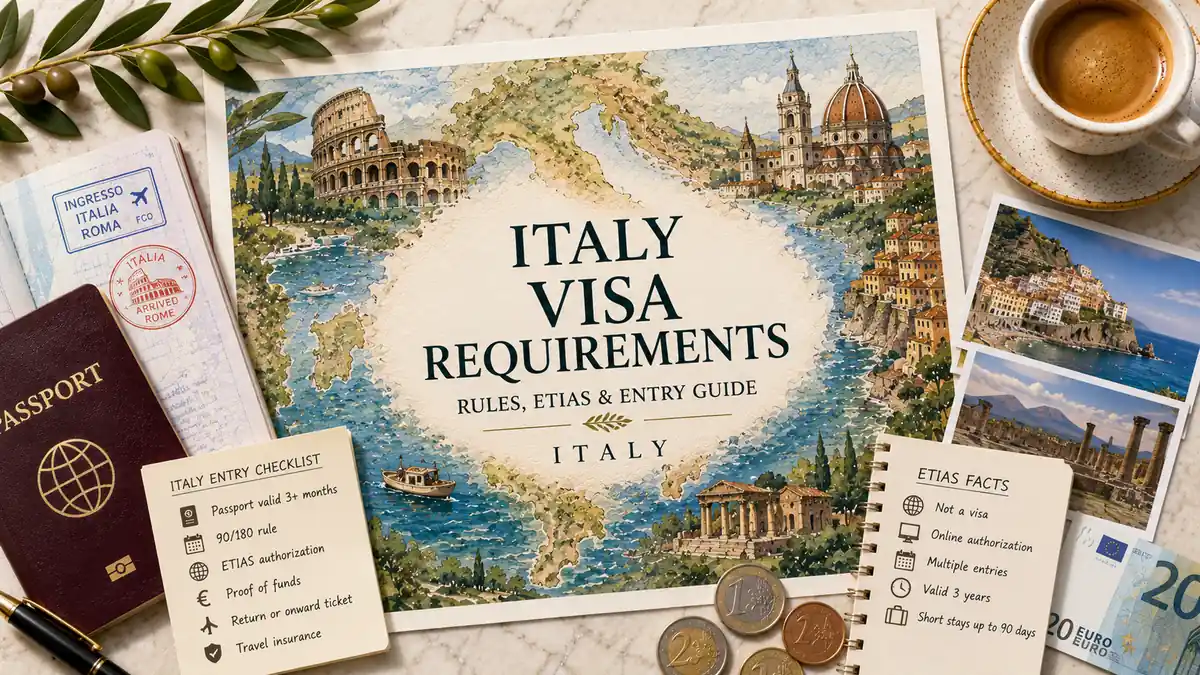
Planning a short trip to Italy raises one gating question before flights and hotels: do you legally need anything to enter the country? For most short-stay tourists — including US, UK, Canadian, and Australian passport holders — the answer is reassuringly simple, but the rules are changing. Italy sits inside the Schengen Area, so its entry requirements follow shared European rules on how long you can stay and what authorization you carry. This guide answers the full decision in order: whether you need a visa, how the 90/180-day limit works, what ETIAS is and when it starts, how the new EES border system affects you, and which passport and document conditions you must meet. It is written for the visa-exempt short-stay traveler, not for anyone pursuing work, study, or residency. EES already runs at the border, while ETIAS has not started, so the practical answer today is not the one you will get once both apply.
Quick Answer
Most visa-exempt tourists need no visa for stays of up to 90 days in Italy. The Schengen 90/180 rule governs how long you may stay, and the ETIAS travel authorization has not started. Check your passport validity, count your Schengen days, and watch for ETIAS before you travel.
Trust Layer
Tripstou planning guide for travelers resolving one travel decision. Covers the main variable, traveler context, and practical tradeoffs.
Produced with AI assistance and reviewed by Alex Perrut, working in tourism since 2015, for the Tripstou editorial team. See our editorial process for details.
Last factual review: July 2, 2026.
Official sources consulted: Italia.it, ENIT, ETIAS (European Union).
Key Takeaways
- Visa-exempt tourists — US, UK, Canadian, and Australian passport holders — need no visa for Italian stays up to 90 days.
- The 90/180 rule caps you at 90 days across the whole Schengen Area, not per country, on a rolling window.
- ETIAS is a travel authorization, not a visa — an online security screening that visa-exempt travelers will need once it starts.
- The new EES logs entries and exits biometrically, replacing passport stamps and enforcing your Schengen day count automatically.
- Your passport must be valid at least three months beyond departure and issued within the last ten years.
- Staying longer than 90 days, or for work or study, requires a national long-stay visa through an Italian consulate.
Table of Contents
Do you need a visa to visit Italy?
No — most visa-exempt tourists do not need a visa for a short trip to Italy. Nationals of countries with a Schengen visa waiver, including the US, UK, Canada, and Australia, may enter for tourism and stay up to 90 days without applying for a visa in advance.
Whether you fall under the waiver depends on your nationality, not your destination. Italy applies the same visa-exempt list as the rest of the Schengen Area, so if you can enter France or Spain visa-free for tourism, the same holds for Italy. Travelers from countries without a waiver must apply for a Schengen short-stay visa through an Italian consulate before departure — a separate process this page does not cover in depth.
The 90-day allowance is not per country. It is a shared Schengen budget, which is where most travelers trip up. If Italy is one stop on a longer European trip, plan the whole route against that limit rather than treating each border as a fresh start. For wider trip planning beyond entry rules, see our Italy travel guide.
How does the Schengen 90/180-day rule work?
The Schengen 90/180 rule lets you stay a maximum of 90 days within any rolling 180-day period. Those days are counted across the entire Schengen Area, not per country — time spent in France, Spain, or Germany all draws down the same 90-day allowance you would use in Italy.
The word rolling is what catches travelers out. The 180-day window is not a fixed calendar block that resets on a set date — it moves with you. On any given day, border officers look back over the previous 180 days and add up how many you have already spent in the zone. If the total tops 90, you are overstaying, even when this particular trip is short.
A worked example makes it concrete. Spend 60 days in the Schengen Area in spring, and you have only 30 left for the rest of that rolling window. A two-week Italian holiday may fit; a month-long return may not. Days from a trip to Greece or Portugal months earlier still count against your Italian stay — the allowance follows your passport, not the destination. If you travel in Europe often, track your entry and exit dates and check them against an online 90/180 calculator before booking.
What is ETIAS, and do you need it for Italy?
ETIAS is a travel authorization, not a visa. It is the European equivalent of the US ESTA — an online pre-screening that visa-exempt travelers will need before entering Italy and the rest of the Schengen Area. It checks you against security databases; it does not grant the kind of permission a visa does.
The distinction matters because the two do different jobs. A visa is permission to enter, assessed and issued by a consulate before you travel. ETIAS is a lightweight screening layer applied to people who are already visa-exempt — it confirms you are not a known risk, then lets the existing waiver stand. Put simply, ETIAS screens travelers who are already allowed in, while a visa decides whether they are allowed in at all.
| Aspect | ETIAS authorization | Schengen short-stay visa |
|---|---|---|
| What it is | Online pre-travel security screening | Formal permission to enter the area |
| Who needs it | Travelers from visa-exempt countries | Travelers whose nationality requires a visa |
| How you get it | Quick online application tied to your passport | Consulate application and appointment before travel |
| Role at the border | Confirms an existing waiver stands | Grants the entry right itself |
Not everyone needs it. ETIAS applies to nationals of visa-exempt countries — the same travelers who today enter Italy with just a passport. If your nationality already requires a Schengen visa, ETIAS does not apply to you, and you continue on the visa route instead.
When does ETIAS start, and is it required yet?
ETIAS is not required to enter Italy, and no applications are being collected. Status: the European Union has not published a start date, and says it will announce one several months before launch. Until it starts, a valid passport and any existing visa waiver remain sufficient for entry.
Timelines can slip. ETIAS has been announced and postponed more than once, and the official start date is set at the European level. The practical move is to check the current requirement status shortly before you travel, using an official source, instead of relying on a date you read months earlier.
A transitional period is expected once the system starts, before the requirement is enforced strictly. After that, arriving without an approved ETIAS can mean being turned away at the border. Apply before you book non-refundable travel once the system is confirmed live.
How much does ETIAS cost, and how do you apply?
ETIAS is expected to cost around €20 for adults, valid for up to three years. The authorization stays tied to the passport you applied with, or expires with it — whichever comes first. You apply online by entering passport, background, and travel details, and most approvals are expected within a short time.
Treat the figures as approximate and confirm the current fee before you apply. The known shape of the scheme looks like this:
- Fee: around €20 per adult application; verify the current amount before applying. Certain age groups, such as younger and older applicants, are expected to be exempt from the fee.
- Validity: up to three years, or until your passport expires — whichever is sooner. A new passport means a new ETIAS.
- Coverage: one authorization covers multiple short trips within its validity, provided each stay respects the 90/180 limit.
- Application: an online form linked to your passport; have travel and accommodation details ready.
- Timing: many approvals are expected to be fast, but some cases take longer, so apply well before departure.
One authorization is not a season pass. ETIAS lets you make repeated trips over three years, but each visit still counts against the same 90-day Schengen budget — the authorization controls whether you may enter, not how long you may stay.
What is the EES, and how does it change entering Italy?
The EES, or Entry/Exit System, is a biometric border system that records travelers electronically instead of stamping passports. At Italian entry points, it registers your name, passport, face, and fingerprints, then logs each entry and exit. It is designed to track Schengen stays automatically and enforce the 90/180 limit more precisely.
For you, the visible change is at the border. On your first crossing under EES, expect to register biometrics at a kiosk or booth, which can add time to that first arrival. After enrollment, later crossings are meant to be faster. The system has replaced the passport stamp.
EES also closes a gap travelers once relied on. With entries and exits logged digitally, an overstay is recorded automatically — there is no missed or faded stamp to fall back on. The system is fully operational at every Schengen external border, so expect it on any arrival from outside the area. ETIAS and EES are separate: EES logs your crossings, while ETIAS authorizes them.
What passport and document requirements must you meet?
Your passport must stay valid at least three months beyond departure and be issued within the last ten years. Both conditions apply independently — a passport still inside its expiry date can be refused if it was issued more than ten years ago. Carry proof of onward or return travel too.
Before you leave, run through the entry checklist so nothing is missing at the gate:
- Passport validity: at least three months beyond your departure date, and issued within the last ten years.
- Onward or return ticket: officers may ask for evidence you plan to leave within the allowed period.
- Funds and accommodation: proof you can support your stay is occasionally requested.
- Blank pages: at least one free passport page is generally expected for entry processing.
- Cash declaration: carrying €10,000 or more in cash typically must be declared at the border.
Check the issue date, not just the expiry. The ten-year issue rule is the condition most travelers overlook, and it has turned people away at the gate despite an apparently in-date passport — renew early if yours is approaching a decade old. Requirements beyond the passport are checked case by case rather than on every arrival, but it pays to be ready.
Anything outside entry rules belongs on a different page. For general trip preparation and packing, see our Italy travel tips. If your concerns lean toward personal safety and scams, our Italy safety guide covers that separately, since this page keeps to entry authorization and documents.
Frequently Asked Questions
Is ETIAS a visa?
No, ETIAS is not a visa — it is a travel authorization that pre-screens visa-exempt travelers before they reach the border. It does not grant work or residency rights, extend your 90-day allowance, or replace a national visa. It simply confirms that your existing waiver still stands.
Do children need ETIAS?
Yes, children generally need their own ETIAS authorization, since it is tied to each individual passport, not to a family group. However, certain younger applicants are expected to be exempt from the fee, though they still require an approved authorization. Apply separately for every family member who holds a passport.
What happens if you overstay 90 days in Italy?
Overstaying the 90-day limit can lead to fines, deportation, and an entry ban that blocks return to the entire Schengen Area for months or years. Because the new EES logs exits digitally, overstays are recorded automatically — there is no missed stamp to rely on. Track your days carefully.
Does ETIAS guarantee entry into Italy?
No, an approved ETIAS does not guarantee entry — the final decision always rests with border officers at the Italian point of arrival. They may still ask for proof of onward travel, funds, or accommodation. ETIAS confirms you passed pre-screening; it does not override the officer’s judgment at the border.
How can you stay in Italy longer than 90 days?
To stay beyond 90 days, you need a national long-stay visa, applied for at an Italian consulate before you travel. These cover purposes such as study, family, or extended residence. If you plan to keep working remotely, Italy’s digital nomad visa is the long-stay route built for that. The visa-waiver and ETIAS routes only cover short tourist stays.
Related Guides
Continue planning your trip with the core Italy pages next to this one:
- Italy travel guide — the full planning hub for routes, regions, and when to go.
- Italy travel tips — practical prep, packing, and on-the-ground advice beyond entry rules.
- Italy safety guide — how safe Italy is, plus common scams and how to avoid them.
- Italy digital nomad visa — the long-stay route for staying beyond 90 days to work remotely from Italy.
- Italy travel insurance — cover options, and where proof of insurance fits into an application.
- Italy trip cost — budgeting the trip the entry paperwork is for.
Did this guide save you time or money? Tripstou is independent and reader-funded — if you'd like to give something back, you can support the site with a crypto contribution of any size.