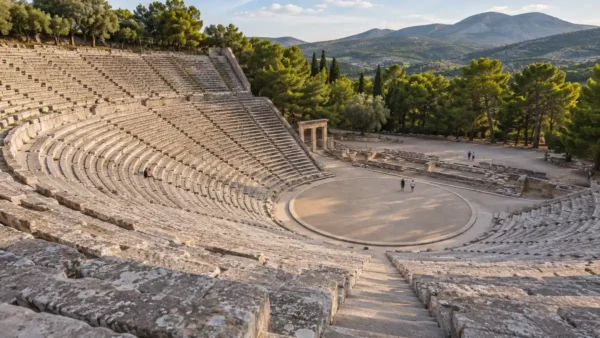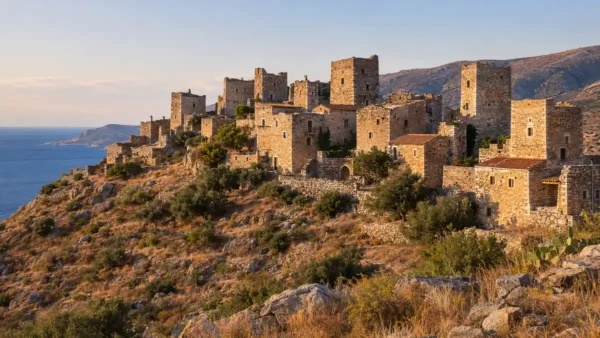
Fourteen days in Greece works best as four stops in one direction: Athens, Naxos, Santorini, then Crete, with three nights at each of the first three and four in Crete. Every hop between stops is a direct ferry line, and the trip flies home from Crete, not Athens, so no day is spent retracing ground. It suits first-timers wanting islands without a car until Crete; the cost is skipping the classical mainland.
Two weeks is the first trip length that comfortably holds Athens, two Cyclades islands and Crete without a rushed day. This guide gives the nights at each stop, the move between each pair of stops with realistic journey bands, and the reasoning behind the order. It also marks the point where adding places starts to cost more than it gives. It closes with the swaps that matter: what to cut first when time shrinks, where extra days go, and how to trade Crete for the classical mainland if ancient sites matter more than a third island.
The Recommended Route: Athens, Naxos, Santorini and Crete in 14 Days
The recommended 14-day route runs Athens, Naxos, Santorini, then Crete. Spend three nights in Athens, three on Naxos, three on Santorini and four on Crete based in Chania. Each hop is a direct ferry, and the trip ends with a flight home from Crete, so no day goes to doubling back.
- Days 1–3: Athens — the classical core and ferry gateway
- Days 4–6: Naxos — the slow Cyclades middle
- Days 7–9: Santorini — the showpiece
- Days 10–14: Crete — the long finale from Chania
Journey times are bands by vessel type; check the sailing you book.
| Stop | Nights | Onward move | Journey band |
|---|---|---|---|
| Athens | 3 nights, days 1–3 | Ferry from Piraeus to Naxos | About 3¼ to 7 hours by vessel |
| Naxos | 3 nights, days 4–6 | Direct ferry to Santorini | About 1 to 3 hours by vessel |
| Santorini | 3 nights, days 7–9 | Direct ferry to Heraklion, then express bus to Chania | Ferry about 1.5 to 4.5 hours; bus about 2 hours |
| Crete (Chania) | 4 nights, days 10–14 | Fly home from Chania or Heraklion | Direct in season, or connecting via Athens |
All three crossings run year-round, though sailings thin outside summer. Santorini to Heraklion has the fewest sailings of the three, so book that crossing first, as soon as the trip dates are fixed, especially in summer. How far ahead to book each hop, and how the lines change by season, is covered in the Greece island-hopping guide.
Days 1–3: Athens — the classical core and ferry gateway
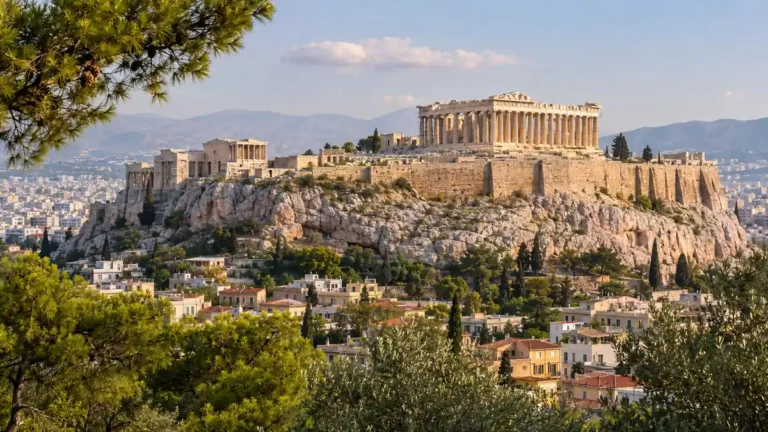
Athens takes the first three nights and does two jobs: it is the classical core of the trip and the port you leave from. The Acropolis and its museum fill one full day. The old lanes of Plaka and Anafiotika below the rock carry the second. A first-evening walk under the lit Acropolis is enough orientation after a long flight.
Three nights here also absorbs a late arrival without costing an island day. For where to stay and how to use the city, see the Athens city guide; arrival basics for the country sit in the Greece travel guide.
Leave on a morning ferry from Piraeus to Naxos. The crossing runs roughly 3¼ to 7 hours depending on the vessel. A morning sailing still leaves the Naxos afternoon usable.
Days 4–6: Naxos — the slow Cyclades middle
Naxos holds days 4 to 6, three nights on the largest island of the Cyclades. Its role is the calm before the showpiece. Long sandy beaches on the west coast and the mountain villages of the interior slow the route down after Athens. The marble Portara gateway above the harbour makes the first-evening anchor.
A car is not essential for three nights here. The Naxos travel guide covers bases and getting around, the Cyclades guide places Naxos among its neighbours, and the beaches that justify the stop feature in our pick of the best beaches in Greece.
The direct ferry on to Santorini takes about 1 to 3 hours depending on the vessel. Conventional and high-speed boats both work the line year-round. It is the shortest hop of the trip.
Days 7–9: Santorini — the showpiece
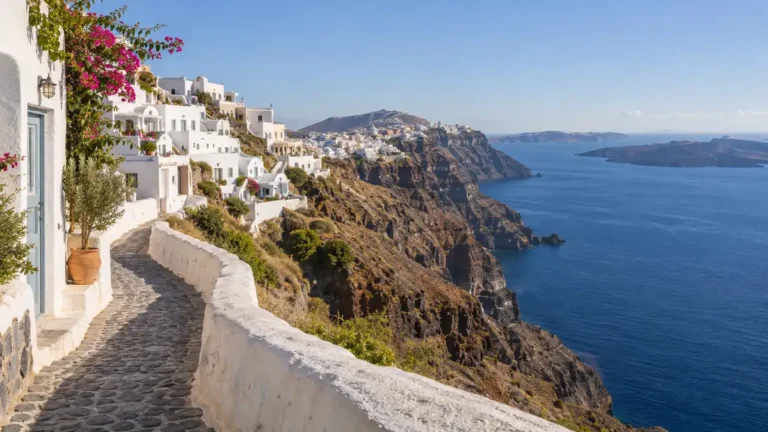
Santorini gets days 7 to 9 and three nights, placed late so the trip peaks here. The caldera is the reason to come. A walk along the rim between Fira and Oia and one sunset from the cliff edge are the two anchors that justify the stop. Three nights is enough.
These are also the priciest nights of the route, which is a reason to hold Santorini at three and put spare nights elsewhere. The Santorini travel guide covers where to base on the caldera, and the Greece trip cost breakdown shows how the island shifts a two-week budget.
Crete is reached by the direct ferry to Heraklion, about 1.5 to 4.5 hours depending on the vessel, with fewer sailings outside summer. From Heraklion, the KTEL express bus reaches Chania in about 2 hours, or pick up a rental car in Heraklion and drive west.
Days 10–14: Crete — the long finale from Chania
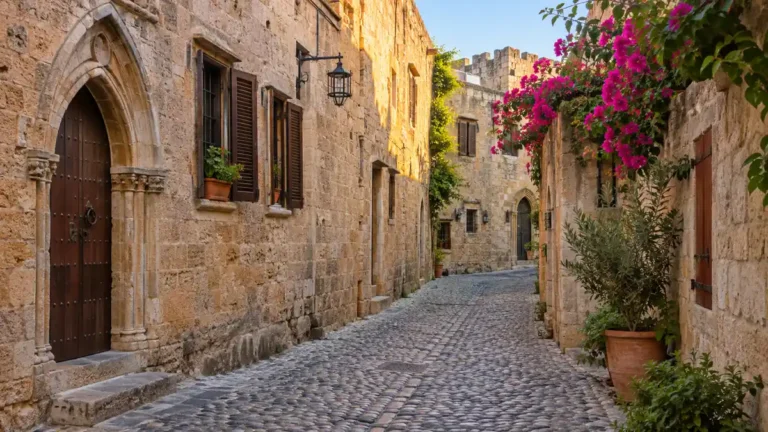
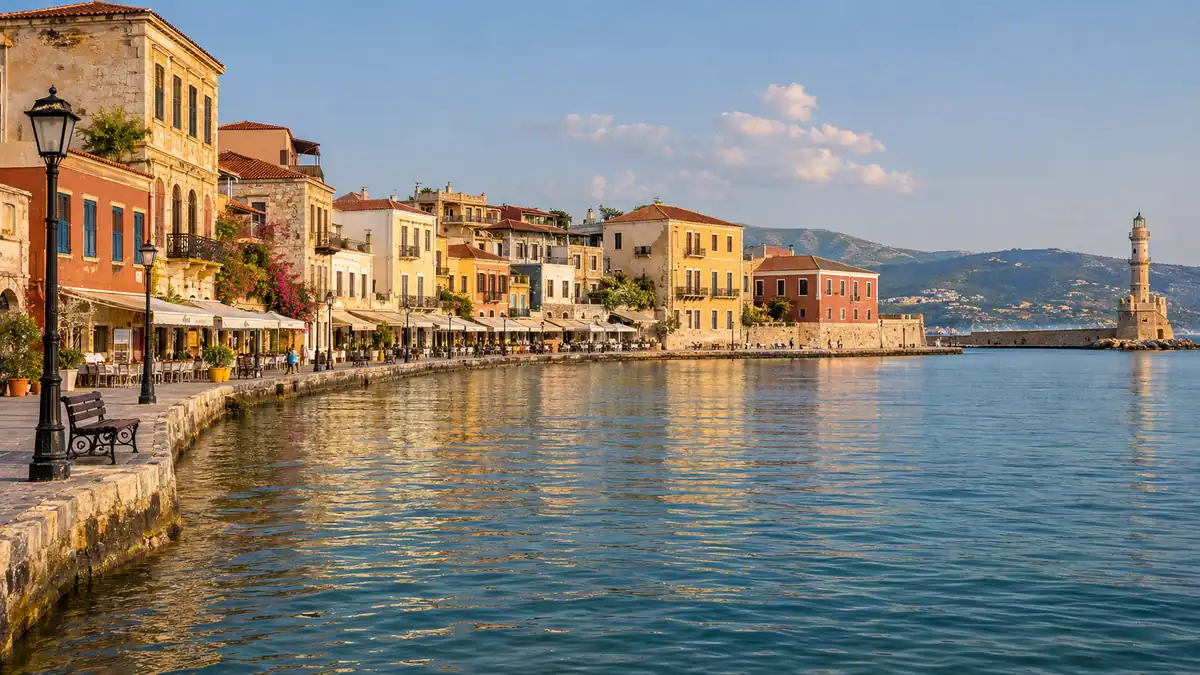
Crete closes the route with four nights, days 10 to 14, based in Chania. The biggest island gets the most nights because its distances are real. The arrival day goes mostly to the ferry and the transfer west. Heraklion is the ferry port and a transit point, not a base. Chania’s Venetian harbour and old town anchor the evenings; one day goes to a west-coast beach, and one to a gorge walk or a mountain drive.
A car makes those two outings easier, while buses are enough if you stay on the coast. The Chania guide covers the base itself, and the Crete travel guide maps the rest of the island.
The last move is a flight home from Chania or Heraklion, direct in season or with a connection through Athens. Either way, the trip ends where it stands. No ferry back.
Tours and activities
Book skip-the-line tickets, day trips and local tours with free cancellation on most activities.
You can also browse everything on getyourguide.com.
Tripstou may earn a commission if you book through this link, at no extra cost to you.
Is 14 Days Enough for Greece, and How Many Stops Does It Hold?
Fourteen days holds four stops, three of them islands. The workable shape is Athens plus Naxos, Santorini and Crete, at three or four nights each, because every move between stops costs about half a day. Add a fifth stop and the trip starts spending more of its time in transit than in places.
The ceiling comes from the ferries, not the calendar. Three island hops plus the flight home already put roughly two days of the fortnight on boats, buses and airport runs. A fifth stop adds another half-day move and shaves a night off somewhere else. That is where the trip turns into transfers.
The nights follow a simple logic:
- Three nights is the floor for an island. It buys an arrival afternoon, two full days and a departure morning. Two nights leaves one real day, which is not enough to justify the crossing.
- Four nights goes to the largest stop. Crete is big enough that its arrival day goes mostly to the ferry and the transfer west, so the extra night protects three usable days.
- Athens takes three nights at the start. It absorbs jet lag and a delayed arrival without eating into island time.
- Every stop past four costs a night from the others. On a fixed fortnight, more places always means less time in each.
This route is the standard shorter Greece line of Athens, Naxos and Santorini with a four-night Crete block added on the end. The reasoning behind trip length tiers lives in our guide to how many days to plan for Greece. The islands here were chosen to chain along direct ferry lines. Picking different islands is a separate question, covered in the guide to choosing Greek islands and the wider list of best places to visit in Greece.
Why Naxos Comes Before Santorini and Crete Comes Last
The route runs in one direction so every stop connects to the next by a direct ferry. Naxos sits on the line from Piraeus, Santorini on the line to Crete, and Crete has the airports to leave from. Reverse any pair and the trip picks up a backtrack or an indirect connection somewhere along the way.
The order also sets the mood of the trip. Naxos comes first because it is the calmer island: beaches, villages and space to recover from Athens. Santorini comes second so the most dramatic scenery lands late, when the trip should peak. Put Santorini first and Naxos feels like a step down.
Crete goes last and gets the longest stay for three reasons. It is too big to rush. It is where a car or a long bus ride enters the plan. And it has its own airports, so the trip can end there without a return crossing.
Should You Fly or Take the Ferry Between the Greek Islands?
Take the ferry: no hop on this route is a flight. Each leg is a direct ferry, so flying only enters at departure. Many published two-week plans instead fly between islands, and between Greek islands that usually means connecting through Athens.
Flying Naxos to Santorini would mean routing through the capital, which turns a short direct crossing into most of a day of airports. The ferry wins every hop here on time as well as simplicity. If you get seasick, take the ferry anyway, but choose the larger conventional boats over the high-speed ones, which ride rougher in wind. The island-hopping guide explains when that changes on other island pairs, and the Cyclades overview shows how the ferry lines run through the group.
Train and bus tickets
Compare routes, schedules and prices across rail and bus operators in one search, with mobile tickets on your phone.
New to Omio? Code NEW10 takes 10% off your first booking — or APPNEW10 if you book inside the Omio app. Both apply to bookings up to €80.
Search routes and compare prices on Omio →
Tripstou may earn a commission if you book through this link, at no extra cost to you.
Do You Need to Go Back to Athens to Fly Home?
No. The route ends in Crete on purpose: fly home from Chania or Heraklion, either direct in season or with a connection through Athens. Returning to Athens by ferry would spend a travel day retracing sea you already crossed, and it adds nothing the flight connection does not already cover.
“Via Athens” means a same-day connection. You fly from Crete to Athens and change onto the long-haul flight without an overnight stop. Stay in Chania on the last night either way. If the flight leaves from Heraklion, the express bus of about 2 hours back east is the one transfer to plan around.
The reverse route makes sense in one case only. If flights into Crete are cheaper than flights into Athens, start in Chania and finish in Athens instead. The order of the islands flips, and the logic holds. Its one cost is that ending in Athens puts a ferry right before the flight home, and a sailing cancelled by strong wind could then cost you the connection.
Direct international flights from Crete are mostly a summer pattern, and the ferries thin at the same time of year. Outside the main season, check both before fixing dates; the guide to the best time to visit Greece shows when the lines and flights run fullest.
Islands and Crete or the Classical Mainland: Who This Route Suits
This route suits first-timers who want islands without a car until Crete, at the cost of the classical mainland. Delphi, Meteora and the Peloponnese stay off the plan, because reaching them well means a different two weeks built around driving. Travelers who rank ancient sites above beaches and caldera views should pick that mainland shape instead.
Two weeks in Greece is the Athens-and-islands core plus a second block. That block is either Crete or the deeper mainland, and this page takes Crete. The choice comes down to what the traveler came for:
- Choose this route if beaches, ferries and island villages are the point, and you would rather not drive for the first nine days.
- Choose the mainland block if Delphi, Meteora or the ancient sites of the Peloponnese matter more than a third island, and a rental car suits you.
Cost affects the stop count in one place. Santorini holds the priciest nights, so a tight budget is better served by keeping it at three nights than by adding a stop; the cost guide for a Greece trip shows the gap. Season matters too, since the island lines are fullest in the warmer months covered by the seasonal guide to Greece.
The mainland alternative is its own trip shape, laid out in the Greece road trip guide. How to swap it into this route is covered in the next section.
How to Adapt This Route with Fewer or More Days
Cut Crete first when the trip shrinks, since it is the only stop that leaves the Cyclades line. When the trip grows, add nights to Crete or Naxos, never a fifth stop. Swap Crete for the mainland when classical sites matter more than a third island; every other change is a one-island swap.
Crete is the easiest block to remove because it is bolted onto the end. Dropping it changes no other ferry. Each change below is a rule applied to this route, not a second itinerary:
- Fewer days: drop the Crete block first. The trip becomes Athens, Naxos and Santorini, ending with a ferry or a flight back to Athens.
- Swap Crete for the mainland: base in Nafplio for the Peloponnese, or drive to Delphi and Meteora following the Greece road trip route. Either one replaces the last four or five days.
- Swap an island: Paros can stand in for Naxos as a livelier middle stop, and Milos suits travelers who put coastline above villages. Use Mykonos only as a nightlife swap.
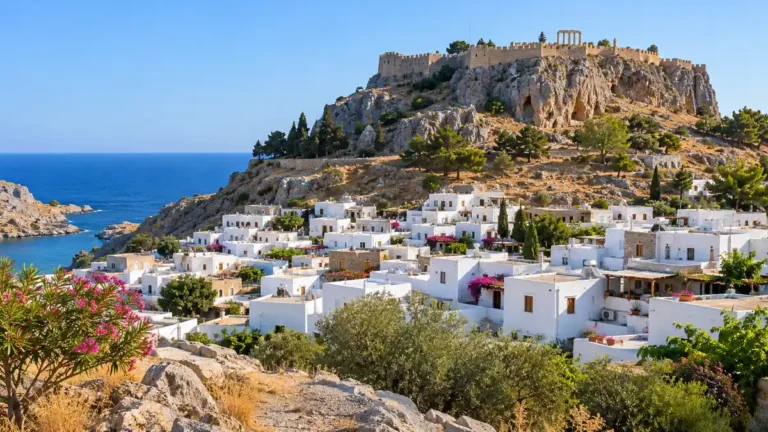
- Other island groups: they do not chain with this line, so plan them as a separate trip. Rhodes lies far to the east in the Dodecanese. Corfu and Zakynthos belong to the Ionian islands, which have no ferry link to the Cyclades.
- More days: add nights to Crete first, then Naxos. A fifth stop brings back the transfer problem the extra days were meant to solve.
Editorial Note on This Fortnight
This page plans one 14-day route through Greece, from Athens by ferry to Naxos, Santorini and Crete, with its order, nights and onward moves. It is not a Greece destination guide, a list of things to do at each stop, a hotel roundup or a ferry booking guide.
This fortnight from Athens to Crete was looked over by Alex Perrut, working in tourism since 2015, for the Tripstou editorial team. The text itself was written with AI assistance, and our editorial process covers both steps.
Official sources consulted: Visit Greece, Greek Ministry of Tourism, KTEL Heraklion-Lasithi.
Did this guide save you time or money? Tripstou is independent and reader-funded — if you'd like to give something back, you can support the site with a crypto contribution of any size.