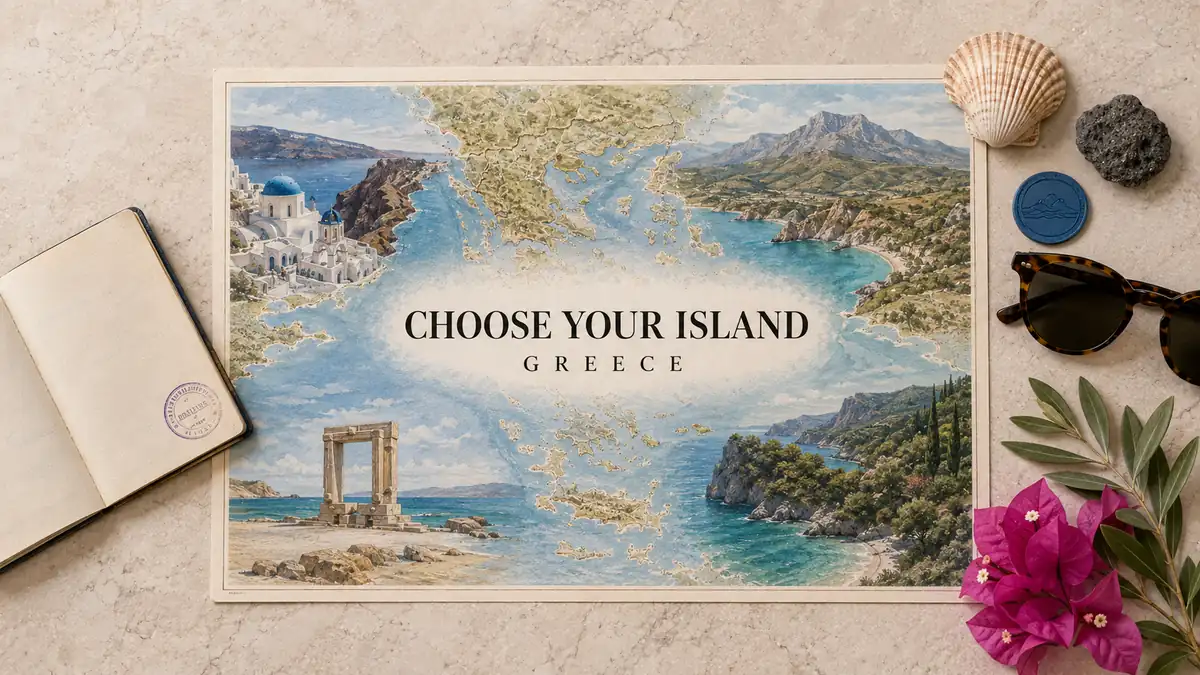
Greece is the easy part. The island is where the decision stalls: there are around 6,000 Greek islands and islets, 227 of them inhabited, and the usual advice is a ranked list of names with no reasoning attached. A list does not help you choose. A method does.
This guide narrows the field in three moves. First the island group, because groups differ from each other far more than islands differ inside a group. Then your traveler type, because a honeymoon, a family week and a nightlife trip point at different islands in the same waters. Then the name, from a shortlist of nine islands, each carrying one concrete reason to be on it and one condition that tells you to pick it.
The stance running through the page: fewer islands, chosen well, beat an ambitious hop. Two islands with real nights in each will outperform four seen from a harbour.
Quick Answer
Naxos or Paros in the Cyclades is the best-balanced choice for most first-time visitors to the Greek islands. The real decision is the group, not the island: pick one group per trip and choose within it. For a honeymoon, Santorini is the strongest alternative; for a full week on a single island, Crete.
Trust Layer
Tripstou selection guide for travelers choosing between multiple places. Covers selection criteria, traveler fit, and trip value.
Produced with AI assistance and reviewed by Alex Perrut, working in tourism since 2015, for the Tripstou editorial team. See our editorial process for details.
Last factual review: August 28, 2026.
Official sources consulted: Visit Greece, Greek Ministry of Tourism.
Key Takeaways
- Choose the island group before the island: groups differ from each other far more than islands differ inside one group.
- Naxos or Paros gives first-time visitors the classic Cyclades look without the queues and premiums of Santorini or Mykonos.
- Santorini and Mykonos are worth their premium only for a specific trip: one great view, or a late-night scene.
- Plan roughly one island per week inside a single group, because every extra move spends a day you cannot recover.
- Crete carries a two-week trip alone, combining mountains, Venetian harbour towns and a distinct regional food culture.
- Quiet is a season and a village as much as an island; a well-chosen base beats a famous name.
Table of Contents
How to Choose a Greek Island: Group First, Then Traveler Type
The fastest way to choose a Greek island is to pick the island group first, not the island. Groups differ more from each other than islands differ within them, so one decision eliminates most of the map. Then match your traveler type, and only then commit to a name.
Ranking 227 inhabited islands is a bad use of your attention, because most of them were never candidates for your trip. Work down the funnel instead:
- Step 1 — choose the group. The group settles architecture, landscape, how far you travel and how reachable everything is. Whitewashed and bare, or green and Venetian? That single question removes most of the country.
- Step 2 — choose the traveler type. Inside one group, a family week, a honeymoon and a nightlife trip land on different islands. Name your trip type honestly before you name the island.
- Step 3 — choose the name. Only now does the shortlist matter, and it should be short: one main island, plus a second only if the calendar genuinely supports it.
The trips that go wrong here usually go wrong at group level. Two islands picked from two different groups turns a holiday into a transfer schedule, and no amount of good island choice repairs it afterwards.
The Greek Island Groups and What Each One Is Like
Greece’s islands fall into six main groups plus Crete, and each group has a distinct character. Choosing between the Cyclades, the Ionian, the Dodecanese, the Saronic, the Sporades and the North Aegean settles architecture, landscape, crowd level and how far you travel. Read the six sketches below and most of the map disappears.
| Group | Character | Headline islands | Best for |
|---|---|---|---|
| Cyclades | Whitewashed cubic villages, bare hills, deep blue sea | Santorini, Mykonos, Naxos, Paros, Milos | First trips, couples, the classic Greek image |
| Crete | Largest island, mountains, gorges, its own food culture | Chania, Heraklion, Rethymno as bases | A full trip on one island, no moving |
| Ionian Islands | Green and lush, Venetian towns, softer Italian feel | Corfu, Zakynthos, Kefalonia, Lefkada | Lush scenery and easy beach comfort |
| Dodecanese | Medieval and Italianate layers, southeastern Aegean | Rhodes, Kos, Patmos | History folded into a beach holiday |
| Saronic Islands | Small and low-key, closest group to the capital | Hydra, Aegina, Poros, Spetses | Day trips and short add-ons from Athens |
| Sporades & North Aegean | Pine forest to the sea, larger agricultural islands | Skiathos, Skopelos, Lesbos, Chios, Samos | Repeat visitors wanting fewer people |
Cyclades
The Cyclades are the postcard Greece: whitewashed cubic villages, bare hillsides and deep blue sea across a tight cluster in the central Aegean. The islands sit close together, which makes the group the most natural place to combine two islands in one trip. It suits first-timers, couples and anyone chasing the classic image. The meltemi, a strong dry north wind, blows through the group in summer and can make exposed beaches and sea crossings uncomfortable. Island-by-island depth lives in our Cyclades guide.
Crete
Crete is a group of one. It is the largest Greek island, big enough to feel like a small country, with mountain ranges, gorges, Minoan sites and a food culture recognised as its own regional cuisine. Harbour towns run along the north coast and function as separate bases. It suits travelers who want a full trip in a single place and dislike packing twice. Reachable by air and by sea from the mainland.
Ionian Islands
The Ionian Islands lie off the west coast and are the green ones: olive and cypress landscape, Venetian architecture and a softer, more Italian feel than the Aegean. Corfu and Zakynthos are the headline names, with Kefalonia and Lefkada behind them. The mainland Peloponnese sits directly across the water as the group’s landward neighbour and gateway — it is mainland Greece, and pairing an Ionian island with the mainland Peloponnese by road is one of the country’s better combinations. Group detail sits in our Ionian Islands guide.
Dodecanese
The Dodecanese stretch along the southeastern Aegean near the Turkish coast and carry the most visible history of any group: crusader fortifications, Italianate civic architecture and Ottoman traces in the same streets. Rhodes anchors the group, with Kos and Patmos alongside. It suits travelers who want ruins and old towns folded into a beach holiday. Several islands here have airports with international connections in summer.
Saronic Islands
The Saronic Islands sit closest to Athens, in the gulf on the city’s doorstep, which makes them the day-trip and long-weekend group. Hydra, Aegina, Poros and Spetses are the names — small, low-key, and car-free in Hydra’s case. They suit travelers with a short trip, or a spare day at either end of a longer one, using the capital as the base. Plan that side of the trip with our Athens guide.
Sporades & North Aegean
The Sporades and the North Aegean are the pine-green, less-visited Aegean. Skiathos, Skopelos and Alonnisos form the Sporades, with dense forest running down to the water; Lesbos, Chios and Samos anchor the North Aegean, larger and more agricultural. Both groups suit repeat visitors who want fewer people and accept thinner onward reach in exchange.
Santorini and Mykonos: Who the Icons Actually Suit
Santorini and Mykonos earn their fame, but each suits a specific traveler instead of a first-timer default. Santorini sells one of the most dramatic settings in the Mediterranean; Mykonos sells nightlife and a polished scene. Both sit at the top of the Greek island price ladder and both tend to be crowded in high summer.
Santorini
Santorini is a volcanic caldera island whose cliff-top villages look out over a flooded crater, and it is the one Greek view people book an entire trip around. What makes it distinct on this page is that the scenery is the destination: you come for the caldera edge, the light and the clifftop walk between the main villages, not for the breadth of the island. It is the priciest island on this shortlist and it tends to feel busy in season. Depth and orientation sit in our Santorini guide.
Pick this if: you want one unforgettable view and will pay a premium to wake up to it.
Mykonos
Mykonos is the nightlife capital of the Greek islands, with beach clubs and a dense bar scene wrapped around a photogenic whitewashed town. What separates it from the other Cyclades picks is that the island runs on its scene more than its landscape — the town, the clubs and the crowd are the product. It sits at the same premium level as Santorini, and rest is not what it sells. Couples looking for quiet have better options one ferry away. Our Mykonos guide covers it properly.
Pick this if: you want to go out late and treat the island itself as a social destination.
Santorini’s crowd problem is really a location problem. The caldera villages are where everyone stands, and the inland and eastern parts of the island carry a fraction of that pressure — which is why the island frustrates day-trippers and rewards people who stay.
Naxos, Paros and Milos Are the Cyclades Sweet Spot
Naxos, Paros and Milos beat the famous Cyclades names on balance for most travelers. They carry the same whitewashed villages and clear water, with more space, easier value and a slower rhythm. None of the three asks you to plan your day around a viewpoint queue. This trio is the honest first-trip and family recommendation.
Naxos
Naxos is the all-rounder of the Cyclades: the largest island in the group, with long sandy beaches, mountain villages, a working agricultural interior and a lively port town. Its advantage on this page is self-sufficiency — you can spend a week here without feeling you should be somewhere else, which no other Cyclades pick delivers as comfortably. It is gentler on the budget than Santorini or Mykonos, and its shallow beaches make it the easiest of the group with young children. Our Naxos guide goes deeper.
Pick this if: you have one week, children in tow, or both.
Paros
Paros is the balanced Cyclades base: whitewashed villages, a walkable harbour town, decent beaches and a genuine local life running alongside the visitors. What makes it distinct here is its position as a hub — it is well connected within the Cyclades in season, which makes it the natural base if you want a second island without engineering the trip around it. It reads as a lighter Mykonos with fuller everyday texture and softer prices. Our Paros guide has the full picture.
Pick this if: you want one comfortable base with a second island kept as an option.
Milos
Milos is the Cyclades pick for coastal scenery: a volcanic island of white rock formations, sea caves and coves reached by boat or on foot. Its distinction on this page is atmosphere, because it tends to be quieter than Naxos or Paros and its landscape looks unlike anything else in the group. It is not a nightlife island, and it rewards people happy to spend whole days on the water. It stays well connected by sea in season. See our Milos guide for the detail.
Pick this if: you are a couple who would trade a busy town for a strange, beautiful coastline.
The Cyclades sweet spot exists because fame and quality separated here. Naxos and Paros were never less beautiful than their neighbours, only less photographed, and the price gap that opened up is a gap in publicity rather than in the islands themselves.
Crete, Rhodes, Corfu and Zakynthos Cover What the Cyclades Can’t
Outside the Cyclades, four islands each solve a need the whitewashed islands cannot. Crete offers a full trip on one island, Rhodes layers medieval history into a beach destination, Corfu delivers green Ionian landscape with Venetian towns, and Zakynthos pairs a dramatic coast with easy family logistics. Pick by the need, not the name.
Crete
Crete is the largest Greek island and the only one that comfortably holds a two-week trip on its own. Its distinction is range: mountains, gorges and serious walking sit beside Minoan sites, Venetian harbour towns and a food culture recognised as its own regional cuisine. Chania is the standout base, with a Venetian old port and quick reach into the west of the island. Airports here carry international connections in summer. Start with our Crete guide, then our Chania guide for the base itself.
Pick this if: you want one island to carry the entire trip.
Rhodes
Rhodes is the history pick: its walled medieval old town is still lived in, layered over Hellenistic remains and Ottoman traces. What makes it distinct here is that the culture and the beach holiday occupy the same island — a morning inside the walls and an afternoon on the coast need no change of base. It anchors the Dodecanese in the southeastern Aegean and has an airport with international connections in summer. Our Rhodes guide covers it fully.
Pick this if: you want deep history without giving up the beach part of the holiday.
Corfu
Corfu is the green face of Greece, an Ionian island of olive and cypress groves with an old town shaped by centuries of Venetian rule. Its distinction on this page is that it feels Italian at the edges — arcaded streets, pastel façades and a landscape that stays lush while the Aegean turns dry and bare. It suits travelers who want scenery and a proper town over stark island minimalism. It has an airport with international connections in summer. Our Corfu guide has more.
Pick this if: you want green landscape and café-lined streets more than bare Cycladic rock.
Zakynthos
Zakynthos combines a dramatic cliff-and-cove coastline with resort infrastructure that makes a beach week simple to organise. What sets it apart here is the logistics: rooms, food and boat trips are set up for travelers who want the day planned lightly, which is exactly what families with young children need. The coast is the draw, and it is best seen from the water. It has an airport with international connections in summer. Our Zakynthos guide has the specifics.
Pick this if: you want a beach-led family week with the arrangements already in place.
All four of these islands reward staying put. Each is large enough that a day trip to a neighbouring island subtracts from the trip instead of adding to it — the opposite instinct to the one the Cyclades encourage.
Which Greek Island Fits Your Travel Style?
Match yourself to a traveler type and the shortlist collapses to one or two islands. First-timers land on Naxos or Paros, families on Naxos or Zakynthos, couples on Santorini or Milos, night owls on Mykonos, and quiet-seekers on Milos. Read the ladder below and take the line that describes your trip.
- First-time visitors → Naxos or Paros. Both give you the classic Cyclades look with room to breathe, and neither requires clever planning to enjoy.
- Families with children → Naxos, or Zakynthos for a resort week. Naxos wins on shallow beaches and everyday practicality; Zakynthos wins when you want the week largely arranged for you.
- Couples and honeymooners → Santorini for the view, Milos for the escape. Santorini is the celebration island; Milos is the one where nobody is watching.
- Nightlife → Mykonos. Nowhere else in Greece concentrates late bars, clubs and beach venues in one walkable place.
- Quiet and least touristy → Milos, or the Sporades if you have been before. Milos tends to stay calmer than its Cycladic neighbours; the Sporades go further still, at the cost of onward connections.
- History and long trips → Rhodes or Crete. Rhodes for a lived-in medieval town beside the sea, Crete when two weeks need to happen in one place.
One warning about the quiet category: quiet is a season and a village as much as an island. Naxos in early June and Naxos in mid-August are two different trips, and a well-chosen village on a famous island often beats a famous village on a quiet one.
How Many Greek Islands Can You Visit in One Trip?
Plan roughly one island per week and keep every island inside a single group. A week supports one or two islands; ten days supports two or three; two weeks supports three at most. Every extra island costs you travel days, packing churn and the evenings that make an island feel like a place.
- About one week → one or two islands, one group. One island buys you a real sense of the place; two buys contrast, at the cost of half a day in transit. Best for first trips and anyone who wants to relax rather than execute a plan.
- About ten days → two or three islands, still one group. This is the length where a shortlist works: a hub island plus one or two neighbours. Best for returning visitors and travelers who like variety inside a familiar area.
- About two weeks → three islands maximum, or one big island in depth. Three islands with genuine nights in each is the ceiling before the trip becomes logistics. Crete alone is the better version of this for travelers who want depth over breadth.
One island per week sounds conservative until you count what changing island actually costs. A departure morning, an arrival afternoon and a first night in a bed you have not learned yet — that is most of a day gone, twice, for each move you add.
Frequently Asked Questions
How many Greek islands are there?
Greece has around 6,000 islands and islets, and 227 of them are inhabited. Totals differ between sources because the count depends on where the size threshold for an islet is set. The inhabited number is the one that matters when you are choosing where to go.
Which is the most beautiful Greek island?
Santorini is the usual answer, because the caldera view is the most dramatic single sight in the islands. Beauty here splits by type, though: the Ionian islands are green and Venetian, the Cyclades are white and sculpted. Pick the landscape you want, not the reputation.
Which is the cheapest Greek island to visit?
Naxos and Crete sit at the cheaper end of the shortlist, and Santorini and Mykonos at the expensive end. Larger islands with real year-round populations generally cost less than small, famous ones, because they are not built around visitors alone. Less-visited groups run cheaper still.
Which Greek islands are closest to Athens?
The Saronic islands — Hydra, Aegina, Poros and Spetses — sit in the gulf just off Athens, closer than any other group. That proximity makes them the natural choice for a short trip or a spare day, but it also means they feel less remote than the Aegean.
Is Santorini worth visiting, or is it overrated?
Santorini is worth it if the caldera view is the point of your trip, and overrated if it is not. The scenery genuinely has no equal in Greece, but the cliff-top villages carry the crowds and the highest prices. Travelers who want space or value should choose elsewhere.
Related Guides
Once the island is chosen, the rest of the trip follows quickly. Start with the country picture, then let the trip length decide the shape.
- Greece travel guide — the full country overview, and the parent of everything on this page.
- 7-day Greece itinerary — the natural next step if your answer above was one or two islands.
- 10-day Greece itinerary — how to shape a hub island plus a neighbour or two.
- 14-day Greece itinerary — for three islands with real nights, or Crete in depth.
- Greece packing list — what island travel actually asks you to bring.
Did this guide save you time or money? Tripstou is independent and reader-funded — if you'd like to give something back, you can support the site with a crypto contribution of any size.