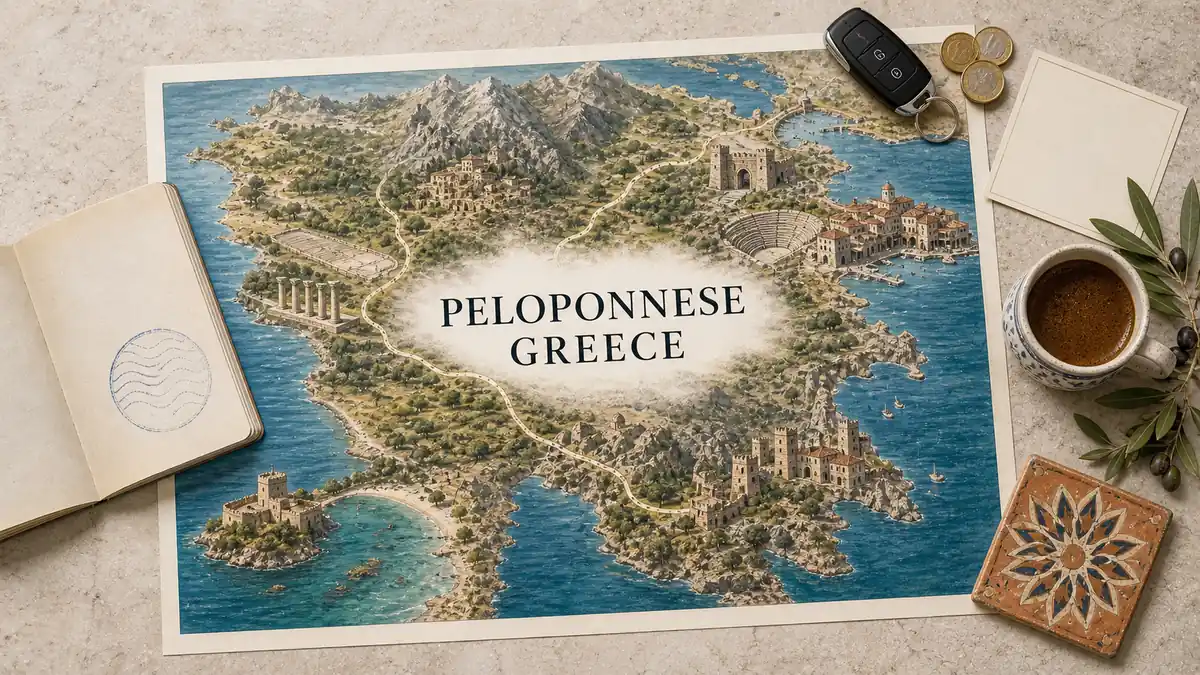
Most Greece trips default to islands, and most travelers never look south-west of Athens. The Peloponnese is the alternative: mainland, not an island, joined to the rest of the country at the Isthmus of Corinth and reachable by car in an easy morning. It concentrates the country’s headline antiquity — Mycenae, Epidaurus, Ancient Olympia, Mystras — into one drivable peninsula, then adds a first-capital seaside town, mountain villages, and a coast that holds its own against anywhere in the country.
This guide answers the allocation questions: whether the region deserves days at all, which of its five sub-regions you should weight, how many days each ambition needs, whether you can do it without a car, where to sleep, and when to come. Stop order and pacing belong to a route guide. What follows is the shape of the decision.
Quick Answer
Yes — the Peloponnese is worth your days: a mainland peninsula pairing Greece’s greatest ancient sites with coast, no ferries. Trip length is the main variable: about three days covers the Argolis, while five to seven days does the peninsula properly. Base first in Nafplio, rent a car in Athens, and favour shoulder season.
Trust Layer
Tripstou region guide for travelers planning a regional trip. Covers sub-areas, trip shape, base strategy, timing, and mobility tradeoffs.
Produced with AI assistance and reviewed by Alex Perrut, working in tourism since 2015, for the Tripstou editorial team. See our editorial process for details.
Last factual review: August 29, 2026.
Official sources consulted: Visit Greece, Greek Ministry of Tourism.
Key Takeaways
- The Peloponnese is mainland Greece, reached by road from Athens, so no part of your trip depends on ferry schedules.
- Three days covers the Argolis alone; five to seven days is the length that does the peninsula justice.
- Weight one sub-region heavily instead of touring all five — the choice of area shapes the whole trip.
- A rental car is the trip-shaping decision; without one your reach ends at Nafplio and the Argolis.
- Nafplio works as the default first base, with a second southern or western base only from five days up.
- Shoulder months beat high summer here, because the region’s greatest ancient sites are open ground with almost no shade.
Table of Contents
Where Is the Peloponnese, and Is It an Island?
The Peloponnese is not an island. It is a large peninsula of mainland Greece, south-west of Athens, joined to the rest of the country at the Isthmus of Corinth and linked again by the Rio–Antirrio bridge. You reach it by road, and you travel it by road.
That single fact changes the mechanics of the whole trip. Nothing here depends on a boat schedule, so your days are yours to spend: you can leave Athens after breakfast and stand inside an ancient citadel before lunch. The peninsula’s shape also makes it naturally circular — the motorway runs down the east side, roads cross the mountainous interior, and the west coast brings you back north towards the bridge. Planning it is a matter of choosing which arc of that circle you have time for.
Within a wider Greek trip, the Peloponnese is the mainland counterweight to island time, and it slots most easily onto the front or back of an Athens arrival. For how it fits alongside the rest of the country, the complete Greece travel guide sets out the national picture.
Is the Peloponnese Worth Visiting?
Yes, for travelers who want antiquity, small coastal towns, and the freedom of a car. It concentrates more of Greece’s headline ancient sites than any other region, and it does so without a single boat. It is a weaker choice for anyone whose picture of Greece is whitewashed island scenery.
The case for it is density plus variety. Mycenae, Epidaurus, Ancient Corinth, Ancient Olympia, Mystras, and Ancient Messene all sit inside one peninsula, and between them are mountain villages, Venetian sea castles, and long stretches of coast that never fill up the way the famous islands do. Nafplio, Greece’s first capital, gives the region a genuinely handsome town to come back to at night. The beaches are a real reason to come, not a consolation prize, and the national ranking is settled over on the guide to the best beaches in Greece.
The case against is honest and worth hearing. Distances are longer than the map suggests, the interior is mountainous, and without a car much of the region simply closes to you. Summer heat on unshaded ruins is punishing. And there is no island postcard here — no ferry wake, no caldera.
Set against island time, this is a different holiday, not a cheaper version of one; the trade-off is examined nationally in where to go in Greece and from the other side in the guides to the Greek islands and island hopping in Greece. The Peloponnese’s antiquity is spread out, so it pays back travelers who enjoy the drive between sites nearly as much as the sites themselves — if the driving reads as dead time to you, spend those days on an island.
The Peloponnese’s Sub-Regions and What Each Offers
The peninsula divides into five travel choices: Argolis, Arcadia, Laconia and the Mani, Messenia, and the west and north. Which one you weight decides the whole trip, because each sits a different distance from Athens and rewards a different pace. Few travelers do all five well.
| Sub-region | Character | Anchor places | Best for |
|---|---|---|---|
| Argolis (north-east corner) | Famous antiquity at short driving distances | Mycenae, Epidaurus, Ancient Corinth, Nafplio | First-timers and short trips from Athens |
| Arcadia (mountain interior) | Stone villages, gorges, cool upland air | Dimitsana, Stemnitsa, the Lousios gorge | Walkers and travelers escaping coastal heat |
| Laconia and the Mani (deep south) | Byzantine ruins and stark tower country | Mystras, Monemvasia, Areopoli, Kardamyli | Second visits and slow, atmospheric driving |
| Messenia (south-west) | Sea castles, soft coast, olive country | Ancient Messene, Pylos, Methoni, Koroni | Travelers pairing ruins with real beach days |
| The west and north | Open plains and the bridge approach | Ancient Olympia, the Rio–Antirrio crossing | Loop trips arriving from western mainland Greece |
The table is for scanning; the profiles below are for choosing. Site-by-site depth on what to actually see in each area lives in things to do in the Peloponnese, and the quieter corners that never make a first itinerary are collected in hidden gems in the Peloponnese. Weight one sub-region heavily and treat the others as passing acquaintances. That is how good Peloponnese trips are built.
Argolis: Big-Name Antiquity Within Reach of Nafplio
Argolis is the region’s easy entry point, closest to Athens and richest in famous names. Mycenae, Epidaurus, and Ancient Corinth all sit within short drives of each other, and the theatre at Epidaurus is the anchor experience most travelers remember. Nafplio is the natural base — a harbour town of Venetian fortresses and marble streets, and the only base here that works without a car. Best for: first-time visitors with limited days.
Arcadia: Mountain Villages in the Interior
Arcadia is the Peloponnese with the sea removed, and it feels like a different country. Stone villages cling to slopes above the Lousios gorge, air stays cooler than the coast, and the anchor experience is a slow walk between monasteries and old bridges. Dimitsana and Stemnitsa are the recognised bases, small and quiet in equal measure. Best for: travelers who want mountain walking and cool nights instead of beach time.
Laconia and the Mani: Mystras, Monemvasia, and the Wild South
Laconia and the Mani are the peninsula’s most atmospheric stretch, and its most demanding drive. Mystras is the anchor — a whole Byzantine city on a hillside — while Monemvasia hides an inhabited medieval town behind a rock in the sea. Further south, the Mani turns bare and stony, with tower villages above empty coves. Gytheio, Areopoli, and Kardamyli all make credible bases. Best for: returning visitors with time to drive slowly.
Messenia: Coast, Castles, and Ancient Messene
Messenia is where the Peloponnese balances ruins against real beach days. Ancient Messene is the anchor site, extensive and unusually uncrowded, while Pylos, Methoni, and Koroni string sea castles along a gentler, greener coastline. Kalamata is the practical gateway and the region’s transport hub, though the smaller coastal towns are the pleasanter places to sleep. Best for: travelers who want swimming built into an archaeology trip.
The West and North: Ancient Olympia and the Road In
The west and north exist on most trips as a corridor with one enormous exception. Ancient Olympia is that exception — the birthplace of the Games, and the anchor experience that justifies the detour inland. North of it, the coast road runs up to the Rio–Antirrio bridge, which is how you arrive from or leave towards western mainland Greece. Best for: travelers closing a loop instead of returning to Athens.
How Many Days You Need in the Peloponnese
Five to seven days does the Peloponnese properly, covering two or three sub-regions without permanent driving. Three days is the honest minimum, and it buys the Argolis alone. Two weeks turns the peninsula from a section of a Greece trip into the trip itself.
- About 3 days — the Argolis at highlight pace: Nafplio as a single base, with Mycenae, Epidaurus, and Ancient Corinth reachable as short outings. Suits travelers adding a mainland block to an island-led trip. The trade-off is that the south and west stay entirely out of reach.
- 5 to 7 days — the peninsula at its natural length: the Argolis plus one southern or western sub-region, on two bases. Suits first-timers who want antiquity and coast in the same week. The trade-off is choosing between the Mani and Messenia instead of having both.
- Around 2 weeks — the full circle, with Arcadia’s interior and time to sit still in a village or on a beach. Suits repeat visitors and slow travelers. The trade-off is that it consumes a whole Greek holiday, leaving no room for islands.
Inside fixed trip lengths, the arithmetic is simple. A 7-day Greece itinerary can hold Athens plus the Argolis, but not much more; a 10-day Greece itinerary opens up a second Peloponnese base; and a 14-day Greece itinerary lets the peninsula run alongside island time without either feeling rushed. Stop order, driving legs, and pacing are a separate job, handled in the Greece road trip guide.
Adding the Mani costs more driving than any other extension on this peninsula, which is why three-day trips that try to reach it end up seeing more of the car than of the region.
Getting to the Peloponnese from Athens
You drive. The Argolis sits around an hour and a half from central Athens by motorway, and the far south or west is closer to a half-day behind the wheel. Buses cover the main towns, and rail is limited. The road, not a timetable, sets the shape of your day.
The default route is the Athens–Corinth motorway, which crosses the Isthmus and then splits towards Nafplio, Sparta and the south, or Patras and the west. It is a toll road, so budget for tolls as part of the drive without expecting them to change your plans. Roads are good on the motorway spine and slower once you turn off it — that slowdown, not the distance, is what stretches southern journeys.
KTEL buses run from the Kifissos terminal in Athens and serve the main towns and regional capitals, with coverage thinning steeply once you leave those corridors. Rail is limited: suburban services reach the edge of the region, but onward rail is not a full network, so check current status before building any plan around it. Athens itself is the gateway you will pass through in both directions, and the Athens travel guide covers the city end of the trip.
Getting Around the Peloponnese: Car, Bus, and the Rail Question
A rental car is the default here, and it shapes the entire trip. Without one, you are realistically limited to Nafplio and the Argolis, which KTEL buses serve well enough for a short visit. The Mani, Arcadia, and much of Messenia effectively require driving.
The practical decision is not car versus bus on price — it is car versus a smaller trip. A car unlocks the tower villages of the Mani, the gorge country of Arcadia, and the castle coast of Messenia, all of which sit away from bus corridors and reward arriving at odd hours. Buses connect towns, not sites; they are built for residents commuting to regional capitals, and they do that job honestly without ever becoming a sightseeing network. Rail stays limited, and its current status is worth checking before you rely on it.
Picking the car up in Athens and returning it to Athens is usually the cleaner arrangement, because the peninsula’s loop shape brings you back past Corinth anyway and one-way drops from the deep south rarely pay for themselves. Expect mountain roads with genuine switchbacks, village streets narrower than the map implies, and drive times that run longer than distances suggest. Keep the tank comfortable in the interior. A quick read of common tourist scams in Greece covers the rental and road-side traps worth recognising before you sign anything.
Where to Base Yourself in the Peloponnese
Nafplio is the default first base. It sits central to the Argolis, it is the only realistic base for a car-free trip, and it was Greece’s first capital — a genuinely pleasant town to return to each evening, not merely a convenient one.
Short trips should stay single-base. Three days in Nafplio wastes no time repacking, and everything the Argolis holds is a manageable outing away. From five to seven days, pair Nafplio with one southern or western base: Monemvasia or Kardamyli for Laconia and the Mani, Pylos or Koroni for the Messenian coast, with Kalamata as the more practical if less charming option. Two bases is the ceiling for a week — a third turns the holiday into logistics.
The car-free constraint is worth restating plainly: outside Nafplio and the Argolis, basing yourself without a car will strand you. Solo travelers tend to find the base towns here small, walkable and easy to read at night, and the guide to solo female travel safety in Greece covers the national picture. The choice of base town matters more than the choice of property, because it sets your daily driving radius for the whole trip.
Hotels and places to stay
Compare hotels, apartments and stays for your dates in one search.
Search hotels and stays on hotels.com →
Tripstou may earn a commission if you book through this link, at no extra cost to you.
When to Visit the Peloponnese
May to June and September to October are the sweet spot for the Peloponnese. The weather is warm, the coast is open, and the ancient sites are calm. July and August bring real mainland heat, and much of it lands on exposed ruins with almost no shade.
The regional trade-off is not simply hot against cool. Late spring is the interior’s best moment, when Arcadia is green and the mountain villages are comfortable, while September holds the warmest sea and the emptiest beaches of the year. High summer is manageable if you accept an early-morning-and-evening rhythm at the sites and swim through the middle of the day. At the edges of the year the coast goes quiet, some seasonal places close, and the mountains come into their own for anyone who came for walking instead of swimming.
Shade is the variable most people underestimate here — Mycenae, Ancient Messene and Olympia are open ground, and the difference between June and August at those sites is larger than the temperature gap suggests. Month-by-month national detail sits in the guide to the best time to visit Greece, and the practical consequence of that heat, from sun cover to proper walking shoes for uneven ruins, is handled in the Greece packing list.
Frequently Asked Questions
Is Nafplio a good base for the whole Peloponnese?
Nafplio is the right base for the Argolis, not for the whole peninsula. From there, Mycenae, Epidaurus and Ancient Corinth are easy outings, and the town itself is worth the evenings. The Mani, Messenia and Arcadia sit too far south and west to work as day trips.
How long does it take to drive from Athens to the southern Peloponnese?
Reaching the deep south takes most of a morning or more, against roughly an hour and a half to the Argolis. The motorway spine moves quickly; the time goes once you turn off it onto mountain roads. Plan the far south as a travel day, not an afternoon detour.
Can you visit the Peloponnese without renting a car?
Yes, but only a smaller version of the region. KTEL buses from Athens reach Nafplio and the main towns, which is enough for an Argolis trip built around one base. Arcadia’s villages, the Mani’s tower country and Messenia’s castle coast stay effectively out of reach without driving.
Is the Peloponnese worth visiting in winter?
Winter suits a specific traveler. The ancient sites are at their quietest, the light is good, and the mountain interior comes into its own for walking and village stays. The coast, though, goes dormant, seasonal places close, and swimming is off the table. Come for the ruins and the uplands.
Can you do the Peloponnese as a day trip from Athens?
You can day-trip to one corner of it. Mycenae, Epidaurus or Nafplio work as a single long day from Athens, and Ancient Corinth is closer still. The peninsula as a whole does not: everything south or west of the Argolis needs at least one night on the ground.
Related Guides
Keep planning with the guides that pick up where this one stops:
- Greece itinerary ideas — how the Peloponnese fits alongside Athens and the islands across different trip lengths.
- Greece trip cost — what a mainland trip realistically costs compared with island time.
- Greek food guide — what to order in the Peloponnese’s olive and mountain country.
- Cyclades travel guide — the island region most travelers weigh against the mainland.
- Ionian Islands travel guide — the green island group off the peninsula’s western side.
- Zakynthos travel guide — a single-island alternative for travelers who want beaches first.
Did this guide save you time or money? Tripstou is independent and reader-funded — if you'd like to give something back, you can support the site with a crypto contribution of any size.