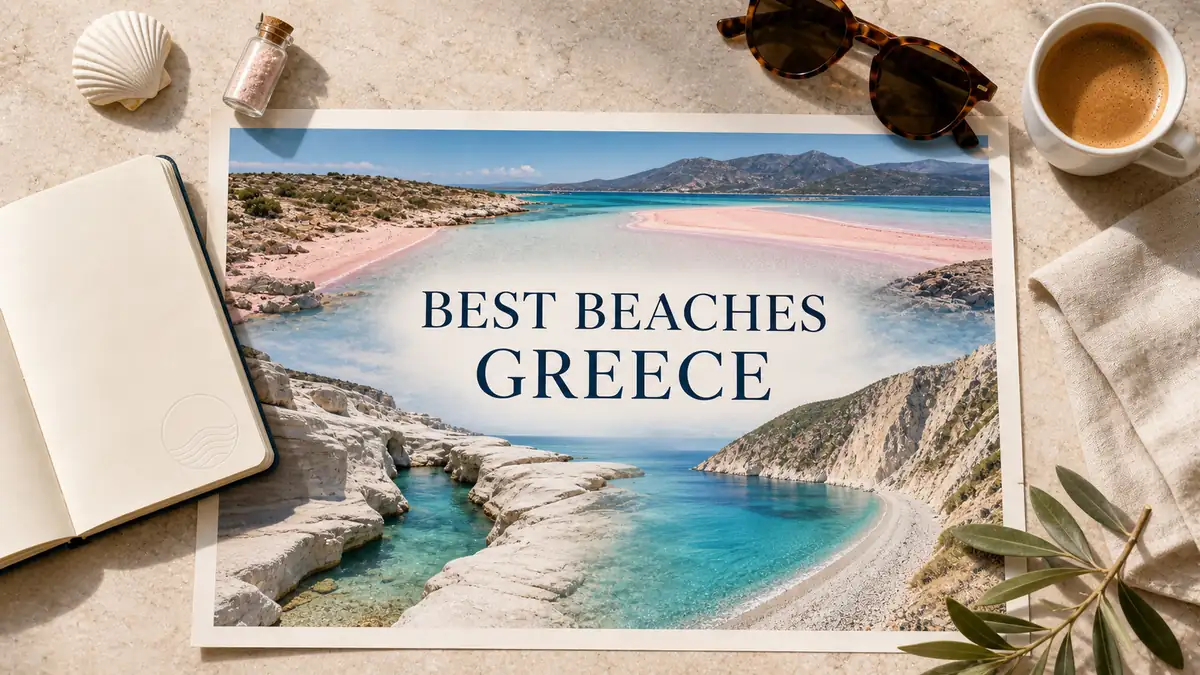
Greece has thousands of beaches, and fame is a poor guide to which ones are worth your day. Some of the most photographed names have been fenced, priced or crowded past the point of pleasure; others still earn every hour of effort it takes to reach them. This shortlist cuts the country down to twelve beaches, grouped by region, judged on the beach itself — the sand, the water, the setting, the effort — and never on the town or the taverna behind it. It also answers the question underneath the search: which island to pick if beaches are the reason you are going. Navagio, Elafonissi and Sarakiniko all appear, but not all three get the verdict their reputation implies. Where a famous name underdelivers, you get the quieter beach that beats it, and where a beach is hard to reach, you get told before you commit a day to it.
Quick Answer
Elafonissi on Crete is the best beach in Greece: pink-tinted sand, warm shallow lagoon, room to spread out. The island matters more than any single beach, and Crete and Naxos carry the deepest beach rosters in the country. Scenery-first travelers should choose Sarakiniko on Milos instead, a white volcanic moonscape.
Trust Layer
Tripstou selection guide for travelers choosing between multiple places. Covers selection criteria, traveler fit, and trip value.
Produced with AI assistance and reviewed by Alex Perrut, working in tourism since 2015, for the Tripstou editorial team. See our editorial process for details.
Last factual review: August 28, 2026.
Official sources consulted: Visit Greece, Greek Ministry of Tourism.
Key Takeaways
- Elafonissi on Crete leads the shortlist: pink-tinted sand, a warm shallow lagoon, and enough room to escape the crowd.
- Choose Crete for beach depth and variety, or Naxos when you want great sand within walking distance of town.
- Navagio is closed to landing and swimming; the clifftop viewpoint and offshore boat stops are the only access.
- Fame and beach quality run opposite in Greece: the most photographed islands rarely have the best sand.
- Santorini underdelivers on beaches — hot volcanic shingle, no pale-water clarity — so spend beach days on another island.
- Car-free travelers should pick Naxos, where the island’s best beach is also the one walkable from town.
Table of Contents
The Best Greek Beaches at a Glance
Elafonissi on Crete is the best beach in Greece, a shallow pink-tinted lagoon you can wade across. The twelve picks below are grouped by region and judged on one thing only: the beach itself. Towns, ruins and food never entered the scoring, because they belong to a different decision.
| Region | Shortlist beaches | Beach character | Who it suits |
|---|---|---|---|
| Crete, west and east coasts | Elafonissi, Balos and Vai | Pink-tinted sand, shallow lagoons, a palm grove | Travelers wanting variety from one island base |
| The Cyclades, central Aegean | Sarakiniko, Kolymbithres, Plaka, Agios Georgios | Carved volcanic rock or long, soft, shallow sand | Photographers and families, on different islands |
| The Ionian Islands, western Greece | Myrtos, Porto Katsiki, Paleokastritsa, Navagio | Cliff-backed coves, green headlands, calmer water | Scenery-first travelers happy to drive |
| The Peloponnese, mainland southwest | Voidokilia on the Messinian coast | A dune-backed horseshoe bay, almost perfectly round | Road-trippers who want no ferry involved |
The list was cut on four criteria: the quality of the sand or rock, the clarity and swimmability of the water, the strength of the setting, and how much effort the beach costs you to reach. A beach had to win on at least two of those to survive. Fame counted for nothing. That is why Navagio appears with a warning attached, and why two beaches most visitors have never heard of outrank several household names. If you want the wider country picture around these picks — regions, transport, trip shape — the Greece travel guide holds it.
The first-timer mistake is booking an island because of one photograph, then discovering the beach is a full day trip from the hotel. The beach you saw on a screen is rarely near the town you book. On Crete, two of the three shortlist beaches sit at opposite ends of the island, and neither is a casual afternoon from the other.
Crete Has the Deepest Beach Roster in Greece
Crete holds more shortlist-grade beaches than any other Greek island. Three of the twelve picks sit on one island, and they are genuinely different from each other: a pink-tinted lagoon in the far southwest, a shallow turquoise bay in the northwest, and a palm grove on the east coast.
Crete’s advantage is scale. It is large enough to hold several distinct coastlines, so one island buys you lagoon swimming, wild northwestern bays and a subtropical outlier without a single ferry. The tradeoff is driving: the island is long, and beach days here are day trips, not strolls. Two of the three picks below work best from the western end, which makes Chania the practical base for a beach-led week. The Crete guide covers how the rest of the island fits around them.
There is no gate fee at these beaches at present; what you pay for is transport, not entry. Sunbed-and-umbrella sets are the real on-the-day cost, and rates differ enough between beaches and operators that you should check on arrival and bring your own shade if you would prefer to skip them.
Elafonissi and Balos are both day trips from the same base, and running them on consecutive days wastes one of them — the second lagoon never lands as hard as the first. Split them with something else.
Elafonissi
Elafonissi is the best beach in Greece and the reason Crete tops this list. Crushed shell fragments tint stretches of the sand pink, and the water across the sandbar stays warm and shallow enough to wade a long way out. That combination is what separates it from every other pick here: most Greek beaches give you either the colour or the shallows, and almost none give you enough space to escape the crowd that the colour attracts. It sits at the far southwestern corner of Crete, so a visit means a long drive on winding road or a seat on an organised coach. Go early or late; the middle of the day belongs to the tour buses.
Pick this if: you want the best beach in Greece and will give up most of a day crossing Crete for it.
Balos Lagoon
Balos earns its place on water colour alone — a shallow turquoise lagoon held between a sandbar and a rocky islet, unlike anything else on the Greek mainland or islands. What makes it different from Elafonissi is wildness: there is no resort strip behind it, the sand is coarser, and the setting feels closer to a remote headland than a beach destination. Access is the tradeoff. You either drive a rough unsurfaced road and then walk a steep 20–30 minute path down to the sand, or take a boat from Kissamos, which removes the walk and adds a schedule. Neither option is casual, and the lagoon is at its best before the boats arrive.
Pick this if: you will accept a rough approach on foot or by boat for a lagoon you can stand up in.
Vai
Vai is the outlier that proves Crete’s range: a beach backed by a genuine palm forest, on the island’s far eastern tip. Nowhere else on this list looks remotely tropical, and that is the entire case for it — the sand is good and the water is clear, but the palms are what you remember. It works as the anchor of an eastern Crete day, paired with the drive out through the island’s drier, emptier end. The distance from the western beaches is real, which is why Vai suits travelers already exploring that side and rarely justifies a crossing on its own.
Pick this if: you are already exploring eastern Crete and want a swim under palm trees.
Cyclades Beaches: Sculpted Rock and Easy Sand
The Cyclades split into scenery islands and sand islands, and that split decides which one you book. Milos delivers white volcanic rock formations that look engineered; Naxos and Paros deliver long, soft, swimmable sand. Choosing the wrong side of that line is the most common Cyclades beach mistake.
This is the group most people picture when they picture Greece, and it is also where expectations most often miss. The famous Cycladic skylines and the good Cycladic beaches are on different islands. Milos is the scenery island, Naxos the sand island, and Paros the compromise that does a decent version of both. Exposure matters here too: the summer meltemi hits north-facing and west-facing coasts hardest, so the sheltered side of an island can be a different day entirely from the windward side. The Cyclades guide maps how the islands connect.
Sarakiniko is a landscape, not a beach day. Plan a swim somewhere else on Milos the same afternoon, or you will leave the island having spent the best hours sitting on hot rock.
Sarakiniko, Milos
Sarakiniko is the most photographed stretch of coast in the Cyclades and the strongest scenery pick on this list. Wind and sea have carved the white volcanic rock into smooth ridges and channels with almost no vegetation, which is why it reads as lunar in every photograph ever taken there. It is not a conventional beach: there is no real sand, very little shade, and swimming means entering from rock into a narrow inlet. Set against the sand picks, that is the point: you come for the shapes and the light, and the swim is a bonus. It sits close enough to the island’s main port to reach easily.
Pick this if: the photograph matters more to you than the swim.
Kolymbithres, Paros
Kolymbithres is the best example in the Cyclades of rock and sand in the same place. Weathered granite boulders divide the bay into a series of small coves, each with its own patch of sand, so the beach behaves like several private pockets instead of one open strip. Sarakiniko makes you choose between sculpted rock and a proper swim; Kolymbithres refuses the choice, and that is its edge. It sits across the bay from Paros’s main resort town, reachable by road or by small boat, and the coves fill in high season because each one is small. Arrive early and you can have a pocket to yourself.
Pick this if: you want sculpted rock scenery without leaving a sociable, easy island.
Plaka and Agios Georgios, Naxos
Naxos has the best sand in the Cyclades, and these two beaches are why. Plaka is a long, wide, soft-sand stretch that keeps its space even in high season, and Agios Georgios is the shallow, sheltered bay within walking distance of the main town. Together they answer a question no other Cycladic island answers as well: where can a family swim safely, on real sand, without a car? The water at Agios Georgios stays shallow a long way out, and both beaches carry enough facilities to make a full day workable. They share one entry here because they are one island decision.
Pick this if: you are travelling with small children and want shallow water and sand within walking distance of your bed.
The Ionian Has Greece’s Most Dramatic Coastline
The Ionian is where Greece’s most photographed cliff-and-cove beaches concentrate. These islands trade the Cyclades’ bare volcanic drama for green headlands, sheer white cliffs and water that stays calmer through summer, because the meltemi that batters the Aegean barely reaches this coast.
The Ionian’s signature is vertical. Beaches here sit at the bottom of cliffs, which produces the views and also the effort — most of them involve a descent, a drive along a corniche, or both. The water is a strong point: sheltered, exceptionally clear over pale pebble, and generally calmer than the exposed Aegean coasts. Kefalonia and Lefkada are covered through the Ionian Islands guide, while Corfu holds the group’s greenest coastline. Navagio also belongs to this region, on Zakynthos, and its access situation is different enough to need its own verdict below.
The Ionian’s famous beaches are viewpoints first. Myrtos and Porto Katsiki both photograph better from the road above than from the shingle below, so build the stop above into the plan before you commit to the descent.
Myrtos, Kefalonia
Myrtos is the most striking beach view in Greece that you can still walk down to. A white pebble crescent sits inside a steep amphitheatre of cliffs, and the pale stone bed turns the water an unusually bright blue that holds its colour far offshore. Its distinction on this list is the contrast between scale and simplicity: an enormous setting with almost nothing built on it. The pebbles are the honest catch — they are hard underfoot and the shelf drops away quickly. This one is for confident swimmers; paddlers will struggle. The road above delivers the view that made it famous, and the descent delivers the swim.
Pick this if: you want the most dramatic setting in the Ionian and are comfortable on pebbles in deep water.
Porto Katsiki, Lefkada
Porto Katsiki has the sheerest cliff face of any beach on this list. A near-vertical white wall drops straight onto a narrow strip of pale pebble and sand on Lefkada’s west coast, with nothing behind it but rock. Where Myrtos is a wide amphitheatre, Porto Katsiki is a single blade of cliff, and the beach itself is small — which means it fills fast and shrinks when the sea is up. Reaching the sand means a long stairway down from the clifftop car park, or a boat from the island’s south. Exposed west-coast conditions can close it on rough days.
Pick this if: you want the sheerest cliffs on the list and do not mind a long stairway down to the sand.
Paleokastritsa, Corfu
Paleokastritsa is the best multi-cove beach destination in Greece. Several small bays sit side by side beneath wooded green headlands on Corfu’s northwest coast, connected by road, footpath and short boat hops. Variety is the whole case for it against the single-beach picks: if one cove is busy, exposed or in shadow, another is minutes away, and small boats run out to sea caves along the same stretch. The setting is greener and softer than the bare Aegean landscapes, and the coves are small, so high season packs them. It is the most family-workable beach in the Ionian.
Pick this if: you want several coves in one place and a green backdrop instead of bare rock.
Is Navagio (Shipwreck Beach) Open?
No — you cannot land on Navagio’s sand or swim in its bay right now. Boats stop offshore without unloading passengers, approaching the wreck itself is banned, and the clifftop viewpoint above the cove stays open. The beach is visible, photographable and completely off limits underfoot.
The restriction runs through 31 October 2026, and it has been extended before, so treat it as the working assumption for any trip you are planning. It follows rockfall from the unstable cliffs that enclose the cove, which is also what makes the beach look the way it does. A visit today means one of two things: the clifftop platform above the bay, which delivers the famous overhead view, or a boat trip along the coast that holds offshore for photographs and swims elsewhere. The Zakynthos guide covers what the island offers around it.
If the drama was the point, Myrtos and Porto Katsiki give you the same cliff-and-turquoise effect and you can actually get in the water. That is the honest trade. Book Navagio as a viewpoint, and take your swim somewhere with a beach attached.
Mainland Greece: Voidokilia and Beaches Near Athens
Voidokilia in Messinia is the mainland’s standout, a near-perfect horseshoe bay backed by dunes. You do not need a ferry to reach a shortlist-grade Greek beach, and Athens itself supports a swim day on the coast south of the city. Both work without an island in the plan.
The mainland is where beach-focused travelers under-look, largely because the islands own the imagery. For a road trip, that is an advantage: the Peloponnese pairs a genuinely top-tier beach with castles, mountain roads and no ferry schedules to work around.
Voidokilia Is the Mainland’s Standout
Voidokilia is the most perfectly shaped beach in Greece. It forms an almost complete circle of pale sand between two headlands, backed by dunes and a lagoon, with a ruined castle on the hill above — a shape so regular it looks designed. What separates it from the island picks is the absence of infrastructure: there is no resort strip, no rank of sunbeds, no boat queue. You park, walk over the dune, and the whole bay opens at once. The water is shallow and sheltered by the horseshoe, which makes it workable for weak swimmers, and there is essentially no shade.
Pick this if: you are driving the Peloponnese and want a great beach with no ferry in the plan.
Best Beaches Near Athens
Athens supports a beach day without leaving the city behind. The coast running south of the centre carries a string of organised beaches with sunbeds, cafés and swimming platforms, and public transport links the city to the coastal suburbs, so a swim works as a half day between museums. Set expectations honestly: these are city beaches. They deliver a clean, easy dip and a sea view, without the sand, water clarity or setting of anything else on this list. Treat them as a break in an urban trip, and let the Athens guide handle the rest of the city.
Which Greek Island Has the Best Beaches?
Crete has the best beaches overall; Naxos is the best pure sand island. Crete wins on depth and variety across a single landmass, while Naxos concentrates long, shallow, family-grade sand within walking distance of one town. Santorini underdelivers on beaches relative to its fame.
Choose Crete when you want range and are willing to drive for it. Choose Naxos when you want the beach to be the easy part of the day. Those two cover most beach-first trips to Greece. Rhodes is the third option worth naming: a large island with organised, easy-access beaches on both a sheltered and an exposed coast, which suits travelers who want facilities and short transfers over wilderness.
Santorini deserves a straight verdict. Its beaches are volcanic — black, red and grey sand or coarse shingle that gets punishingly hot, on a coast with none of the pale-water clarity the island’s photographs imply. The famous images are of the caldera and the cliff towns. Santorini is a landscape and sunset island, and the Santorini guide treats it as one; if beaches are your reason for the trip, spend those days elsewhere. Mykonos is a separate case: its beaches are decent and its beach clubs are the actual draw, which is a travel-style question handled in the next section.
Fame and beach quality run in opposite directions in Greece. The islands with the most photographed skylines have the weakest sand, and the islands with the best sand almost never make a magazine cover.
Trip length settles the rest. One island plus a swim day near Athens fits a 7-day Greece itinerary; two islands, or Crete at a comfortable pace, fits a 10-day itinerary; Crete plus a Cycladic or Ionian island fits a 14-day itinerary without daily packing.
Which Beaches Are Sheltered from the Meltemi Wind?
The Ionian beaches and Crete’s south-facing coast are the most sheltered from the meltemi, the dry northerly wind that runs through the Aegean in summer. Myrtos, Porto Katsiki and Paleokastritsa sit outside its main path entirely. In the Cyclades, exposure is a coast-by-coast question: north-facing and west-facing beaches take the brunt, while bays on the southern and eastern sides of the same island can stay calm on the same day. Wind is a selection variable here. When it blows, move to the sheltered side of the island you are already on.
The Right Greek Beach for Your Travel Style
Match the traveler type, not the fame, and the shortlist resolves quickly. Families belong on Naxos, scenery-first travelers on Milos, and anyone chasing quiet should ignore the four beaches everyone photographs. The picks below reassign the same roster by who you are travelling with.
One practical note before the split: several of these picks are pebble, rock or crushed shell instead of soft sand, and thin-soled water shoes make Myrtos, Sarakiniko and Kolymbithres considerably more pleasant. The Greece packing list covers the rest of the kit.
Best for Families
- Plaka and Agios Georgios, Naxos — shallow, sandy and serviced, with the calmer bay walkable from town.
- Voidokilia — sheltered by its horseshoe shape and shallow across most of the bay, but bring your own shade.
- Paleokastritsa, Corfu — small coves mean short sightlines and an easy switch when one gets busy.
Best for Quiet and Fewer Crowds
- Vai — the eastern end of Crete filters out most day-trippers by distance alone.
- Voidokilia — the mainland location keeps it off almost every island-hopping route.
- Balos, early — genuinely quiet before the boats from Kissamos arrive, and busy afterwards.
The famous beaches charge you in crowds and effort; the quiet ones charge you in distance. That is the whole exchange.
Best for Beach Clubs and Nightlife
Mykonos owns this category outright. Its south coast beaches run on organised clubs with music, service and a scene that starts in the afternoon and carries into the night, which is a different product from every other beach on this list. Paros is the softer alternative — a sociable island with beach bars and no obligation to spend at club prices. Neither belongs on a quiet-swim shortlist, and Mykonos in particular delivers atmosphere ahead of sand quality.
Best Without a Car
- Agios Georgios, Naxos — walkable from the main town, which no other pick here can claim.
- Sarakiniko, Milos — close to the port and served by the island’s bus network.
- Balos — reachable by boat from Kissamos, which removes both the rough road and the steep path.
- The Athens coast — the one beach day on this page that runs entirely on public transport.
Car-free travelers should choose an island whose best beach is also its most accessible one. On Naxos those are the same beach, which is why it keeps winning here.
Best for Scenery and Photography
- Sarakiniko, Milos — the most distinctive coastal landscape in Greece, best in low, early light.
- Porto Katsiki, Lefkada — the sheer cliff face reads strongest from the clifftop above.
- Balos — the lagoon and sandbar are a view from the path above before they are a swim.
- Navagio, from the viewpoint — still the country’s most famous frame, and now the only way to take it.
Frequently Asked Questions
Are Greek beaches sandy or pebbly?
Both, and the split runs by region. Crete, Naxos and the Peloponnese carry the country’s best soft sand, while the Ionian’s famous beaches are pale pebble and Milos is bare volcanic rock. Assume pebble unless a beach is specifically sold on its sand, and pack thin water shoes.
Which beaches in Greece have the clearest water?
The Ionian beaches read clearest, because pale pebble beds and sheltered bays keep the water bright and free of stirred-up sand. Myrtos on Kefalonia is the standout, holding its colour far offshore. Balos and Elafonissi on Crete come closest among the sand beaches, thanks to shallow lagoons over bright seabed.
Do you have to pay to go to the beach in Greece?
No — Greek beaches are public, and the shortlist beaches charge no gate fee at present. What you pay for is transport and, if you want one, a sunbed-and-umbrella set. Those rates vary widely by beach and operator, so check on arrival and bring your own shade to skip the charge.
How do you get to Balos Lagoon?
Two ways, and they suit different travelers. The boat from Kissamos drops you at the lagoon with no walking and a fixed return time. Driving means an unsurfaced road to a clifftop car park, then a steep 20–30 minute descent and the same climb back in full heat.
Are Santorini’s beaches any good?
Not by Greek standards. Santorini’s sand is volcanic — black, red or grey shingle that turns punishingly hot underfoot — and the water lacks the pale clarity the island’s photographs suggest. They work for a short cooling swim between caldera days, but never as the reason to book the island.
When is the sea warmest in Greece?
Late summer into early autumn, once months of sun have loaded the water with heat. Early-season swimming is bracing even when the air feels hot, because the sea lags the land by weeks. If swimming is the priority, the back half of the season beats the front half.
Related Guides
- Greece travel guide — the country-level planning behind every pick on this page.
- Crete guide — the island with the deepest beach roster, in full.
- Cyclades guide — how the scenery islands and the sand islands connect.
- Ionian Islands guide — the group behind Myrtos, Porto Katsiki and Navagio.
- Naxos guide — the best pure sand island for a beach-first trip.
- Peloponnese guide — the mainland route that reaches Voidokilia.
Did this guide save you time or money? Tripstou is independent and reader-funded — if you'd like to give something back, you can support the site with a crypto contribution of any size.