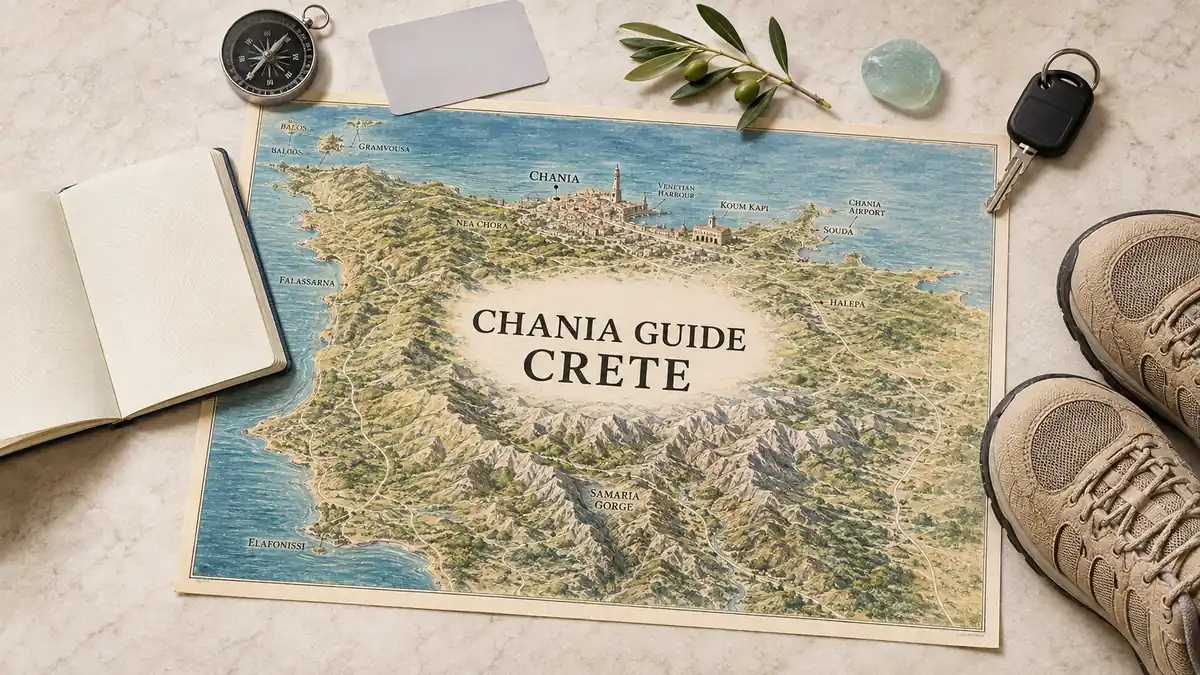
Chania sits on the northwest coast of Crete, and the Venetian Harbour with its 16th-century lighthouse is why most travelers shortlist it. Behind that harbour is an Old Town that is largely car-free and walkable end to end. Balos, Elafonissi and Falassarna are the pull that turns a stopover into a base.
This page settles four decisions: how many days Chania needs, which season to book, what kind of area to sleep in, and whether to hire a car. Those four change the shape of the trip more than anything else on the page, and they are the ones most Chania write-ups leave loose.
It deliberately does not rank the sights, pick your hotel or sequence your days. Each of those has its own guide, linked where it belongs. What you get here is the trip shape — length, timing, base and mobility — resolved before you start booking anything.
Quick Answer
Chania is worth visiting and works best as a base — a Venetian-harbour Old Town paired with west-Crete beaches. Three to four days covers the Old Town plus one or two of Balos, Elafonissi or the Samaria Gorge; two days is Old Town only. Stay in or beside the Old Town and hire a car only for day-trip days.
Trust Layer
Tripstou city guide for travelers planning a city trip. Covers trip length, stay style, season, cost, and mobility tradeoffs.
Produced with AI assistance and reviewed by Alex Perrut, working in tourism since 2015, for the Tripstou editorial team. See our editorial process for details.
Last factual review: September 3, 2026.
Official sources consulted: Visit Greece, Greek Ministry of Tourism.
Key Takeaways
- Chania is a town base with day-trip beaches, so the sand is a drive away, not below your balcony.
- Book three to four days: two covers the Old Town only, and each extra night buys one day trip.
- Late spring and early autumn beat peak summer, with a warm sea, an open gorge and thinner crowds.
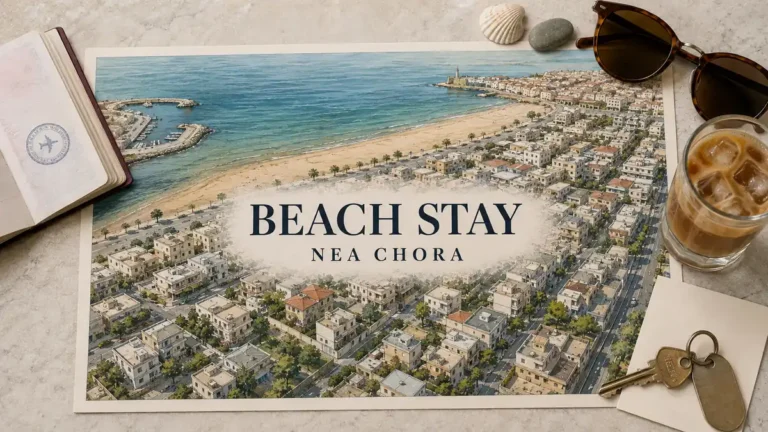
- Stay in or beside the Old Town for atmosphere; the Nea Chora side suits beach-first and budget travelers.
- Hire a car only for the days you drive out to Balos, Falassarna, the south coast or Apokoronas.
- Mid-range spending returns the most in Chania, because the city’s best product is the Old Town base itself.
Table of Contents
Is Chania Worth Visiting?
Chania is worth visiting, and it is the best-looking city base in Crete for harbour evenings and beach days. The Venetian Harbour, the lighthouse and a dense Old Town sit inside one walkable core, and the west coast’s headline beaches are within day-trip reach. It is a base, not a resort.
The reason is density. The Venetian Harbour, the 16th-century lighthouse at the end of the mole, the Topanas lanes and the Jewish Quarter all sit inside a core you cross on foot. Dinner, the waterfront and your room are minutes apart, which is what makes Chania work as an evening city as well as a launch pad. Few places in Crete give you both at the same address.
It suits three travelers in particular: first-time Crete visitors who want one base and no repacking, couples who want atmosphere in walking distance, and beach-plus-culture travelers who refuse to choose between a town and a coastline. Solo travelers do well here too, because the Old Town is compact and social after dark.
The tradeoff is worth knowing before you book. Chania’s great beaches are outside the city. Balos, Elafonissi and Falassarna are full days out with a car or a boat, and the city’s own swimming is the Nea Chora strip beside the Old Town — pleasant, useful, and a long way from the postcards. Travelers who want to wake up on sand should book a coastal resort and visit Chania for a day.
Within Crete, Chania is the western anchor, and the island splits broadly into a Chania-led west and a Heraklion-led east; the island-wide choice is settled in our Crete travel guide. If you are still deciding whether Crete beats the Cyclades for this trip, compare it against the best places to visit in Greece, and use our Greece travel guide for the country-level frame.
What Chania Is Known For
Chania is known for its Venetian Harbour, a 16th-century lighthouse, a car-free Old Town and west-Crete beaches. Add the Samaria Gorge, Cretan cooking and the Apokoronas villages inland, and you have the shortlist that pulls travelers here. Every one of them is named below, and resolved on its own page.
The Old Town is the centre of gravity, and it has quarters worth naming. Topanas is the Venetian-era western quarter of tall houses and narrow lanes. The Jewish Quarter sits beside it, quieter and more residential. The harbour arm curls out to the 16th-century lighthouse, and the Maritime Museum of Crete stands at the western end of the waterfront — the one museum most first visits actually make time for.
The waterfront keeps going in both directions. Koum Kapi, east of the Old Town, is the local evening strip along the sea wall. Nea Chora, west of it, is the city beach and its taverna row. Further east, Halepa carries the neo-classical consulates and mansions from Chania’s diplomatic century, and the Tabakaria district below it holds the old leather-tanning buildings on the water — the least polished and most photographed corner of the city.
Outside town, three names do most of the recruiting. The Samaria Gorge is about 16 km long and the longest gorge in Greece. Balos, Elafonissi and Falassarna are the west-coast beaches people plan whole trips around. Inland, the Apokoronas villages — Vamos, Gavalochori and Douliana — are the stone-village face of the region, and Ancient Aptera adds a hilltop archaeological site within easy reach.
Food is the quiet reason people come back: Cretan cooking is its own tradition, and the Chania market and the village tavernas are where it shows, as covered in our Greek food guide. For the sights themselves — what to see, in what depth, and what to skip — go to our guide to things to do in Chania. This page names them; that one ranks them.
How Many Days You Need in Chania
Three to four days is the right length for Chania. Two days covers the Old Town and the harbour but leaves no room for a full day trip, and the day trips are half the reason to come. Five or more days turns the city into a base for the whole west coast.
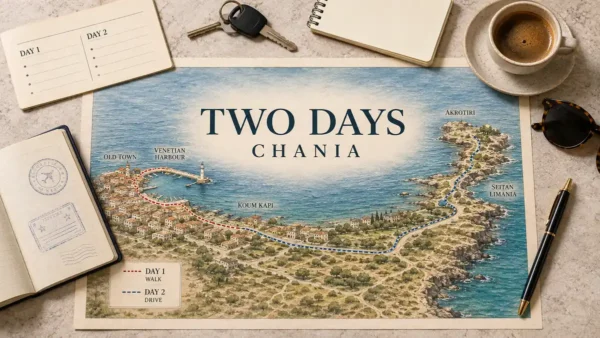
- 2 days — enough for the Old Town, the harbour, the Maritime Museum of Crete and one half-day out to Nea Chora or Ancient Aptera. Is two days in Chania enough? It is, if Chania is a stop on a Crete road trip and the beaches come later. It is not enough for Balos, Elafonissi or the gorge. Sequence it with our 2 days in Chania itinerary.
- 3–4 days — the Old Town at a proper pace plus one or two of Balos, Elafonissi or the Samaria Gorge. This is the length that fits most first visits, and the one that leaves you a spare morning when the wind cancels a boat. Our 3 days in Chania itinerary shows how the days fall.
- 5+ days — Chania becomes a regional base: the full west coast, the south coast, the Apokoronas villages and a rest day between the driving days. It fits slow travelers, families who need a beach day between excursions, and anyone treating western Crete as the whole holiday.
The day trips set the length, and the city does not. Chania’s Old Town is a two-evening town; Balos, Elafonissi and Samaria each consume an entire day. Every extra night you book buys exactly one more of them, which turns the duration question into arithmetic.
Inside a longer Greek trip, Chania usually takes three to four of your nights and pairs with one other region. Our Greece itinerary planner handles the routing, and the fixed-length versions show where Crete lands: a 7-day Greece itinerary generally forces a choice between Crete and the Cyclades, a 10-day Greece itinerary can carry both, and a 14-day Greece itinerary gives Crete enough room to include the south coast.
When to Visit Chania
Late spring and early autumn are the best times to visit Chania. The sea is warm, the Samaria Gorge is open, and the Old Town and the beaches carry fewer people than in peak summer. Room pressure in the Old Town eases in both windows, which is when the city feels like itself again.
Peak summer buys reliability and costs you space. Every boat runs, every tour operates, and the sea is at its most swimmable — but Balos and Elafonissi absorb their heaviest crowds, the gorge is a hot walk, and the Old Town’s best rooms go early. If school holidays fix your dates, go, and plan the beach days for early starts.
Winter flips the city. The Old Town, the tavernas, the market and the museums all work, and you get them without queues, but the beach days and the gorge are off the table and boat services thin out. It is a real trip for a food-led or city-led visitor, and the wrong trip for anyone whose plan involves swimming.
| Season | What you get | What it costs you | Who it suits |
|---|---|---|---|
| Spring shoulder | Open gorge, green inland villages, quiet beaches | Sea still cool at the start of the window | Hikers and first-time visitors who avoid crowds |
| Peak summer | Every boat and tour running, warmest swimming | Crowds at Balos and Elafonissi, heat in the gorge | Beach-first travelers tied to school holidays |
| Autumn shoulder | Warm sea, long harbour evenings, thinner queues | Boat and gorge season winds down late on | Couples and swimmers who want quiet beaches |
| Winter | Old Town, market and tavernas without queues | Beaches, gorge and most boat trips closed | Food-led city breaks and repeat visitors |
The shoulder windows are the ones where Chania’s two halves overlap: the gorge is open and the beaches are still swimmable, while the Old Town has room to breathe. Peak summer gives you both as well, with a crowd tax on the beaches. Winter gives you one half at full strength and closes the other.
Season choice also drives what goes in the bag — shoulder trips need a swimsuit and a jacket in the same suitcase, and gorge days need proper shoes; our Greece packing list covers it. For how Chania’s windows line up with the rest of the country, see our guide to the best time to visit Greece.
Where to Stay in Chania
First-time visitors should stay in or beside the Old Town. Beach-first and value-first travelers do better on the Nea Chora side, a short walk west along the water. This page settles the area type; the full neighbourhood-by-neighbourhood decision belongs to the stay guide linked below.
- Old Town core — Best for: first-time visitors who want to walk to everything. Tradeoff: the lanes are stepped and stone, so wheeled luggage is a nuisance on arrival. Details in our guide on where to stay in Chania for first-time visitors.
- Harbour-side Old Town — Best for: couples who want the lighthouse view from dinner onwards. Tradeoff: the waterfront rooms are the loudest in the city on summer nights. See where to stay in Chania for couples.
- Nea Chora beachside — Best for: families who need sand within a pram push of the room. Tradeoff: the setting is ordinary next to the Venetian core. See where to stay in Chania with kids.
Choosing between these areas street by street — which lanes are quiet, which are loud, how far each sits from the bus station and the beach — is the job of our full guide on where to stay in Chania. If the trip is built around the room itself, the restored Venetian houses are the local speciality, and they are covered in our roundup of boutique hotels in Chania.
Hotels and places to stay
Compare hotels, apartments and stays for your dates in one search.
Search hotels and stays on hotels.com →
Tripstou may earn a commission if you book through this link, at no extra cost to you.
How to Get to Chania
Fly from Athens to Chania in roughly 50 minutes, or take the overnight ferry. Flights land at Chania International Airport, Ioannis Daskalogiannis (CHQ), on the Akrotiri peninsula. Ferries from Piraeus dock at Souda, roughly 7 km east of the city, on a year-round crossing of about 8 to 8.5 hours.
Flying is the default for short trips. The Athens leg is under an hour in the air, which keeps a three-day visit intact, and CHQ sits close enough to the city that the transfer is a short run at the end of it. Getting from the airport into town — the options, and which one suits your arrival time — is covered in our guide to Chania airport to the city.
The ferry suits three groups. Travelers bringing a car take it because the vehicle crosses with them. Overnight travelers take it because the crossing doubles as a night’s sleep and lands them in Crete at the start of a full day. Island-hoppers take it because Souda plugs Chania into the wider ferry network as an entry or exit point.
That last case matters if Crete is one leg of a longer route. Chania works cleanly as the first or last island on a multi-island trip, which is how our Greek islands guide positions it, and the routing logic — which islands connect, in which direction, and how many nights each earns — sits in our guide to Greek island hopping.
Do You Need a Car in Chania?
You do not need a car in Chania itself. The Old Town is largely car-free and walkable end to end, and parking sits outside the historic core. A car earns its keep only on the days you leave the city for the west coast, the south coast or the villages.
A car pays for itself on specific days:
- West-coast beach days to Falassarna and the Balos road, where the drive is the access.
- South-coast days across the mountains, where the timings suit your schedule and not a timetable.
- Apokoronas village days — Vamos, Gavalochori, Douliana — where the point is stopping wherever you like.
- Ancient Aptera and the Akrotiri peninsula, both easy half-days with wheels.
Hire the car for the days you drive, and not for the length of the stay. A vehicle parked outside the walls while you spend two days on foot in the Old Town is money with nothing attached to it, and splitting the hire is what keeps both the city days and the beach days affordable.
Plenty of trips need no car at all. Elafonissi and the Samaria Gorge are both served by organised buses and day tours, Balos is reachable by boat, and the city itself is entirely walkable — the practical detail sits in our guide to getting around Chania. If Chania is one stop on a longer drive through Crete or the mainland, our Greece road trip guide covers how the legs connect.
Day Trips Chania Is the Base For
Chania is the base for Balos, Elafonissi, Falassarna and the Samaria Gorge. Each is a separate full day out of the city. That one rule governs the whole plan: count the day trips you actually want, and that is how many days you book on top of the Old Town.
- Balos — a full day by boat, or by car on a rough final approach. The boat trip makes it reachable with no car at all.
- Elafonissi — a full day on the southwest corner, and it does not combine with Balos. Bus and tour options exist, so no car is required.
- Falassarna — a west-coast beach day built around the sunset; easiest with a car.
- Samaria Gorge — a walk-through day of about 16 km, open in the warm season only, roughly May to October and weather-dependent. Organised transport handles both ends, so a car is unnecessary and slightly awkward.
- Ancient Aptera and the Apokoronas villages — the flexible half-days, easy to pair with each other and good for a lower-energy afternoon.
Balos and Elafonissi sit on opposite arms of western Crete, and travelers who try to fold them into one day arrive at both in a hurry and enjoy neither. Book them as two days, or choose one. The same discipline applies to the gorge: it takes the whole day and the legs that follow it, so the day after Samaria is a slow one by default.
For the beaches themselves — what each one looks like, and how Crete’s compare with the rest of the country — see our guide to the best beaches in Greece. The gorge, Ancient Aptera and the city sights are covered in depth in our guide to things to do in Chania.
Tours and activities
Book skip-the-line tickets, day trips and local tours with free cancellation on most activities.
You can also browse everything on getyourguide.com.
Tripstou may earn a commission if you book through this link, at no extra cost to you.
How Much a Chania Trip Costs
Chania is a mid-range city that rewards a good Old Town base and local eating. It sits below the famous Cycladic islands on the Greek cost scale, and the spend that changes your trip most is where you sleep. Day trips and car hire are the second lever.
- Budget — rooms on the Old Town edges or in Nea Chora, tavernas away from the harbour, buses and organised day tours in place of a hire car. Chania is kind to this style in the city and punishing on the beach days, because boat trips and car hire are where a budget trip leaks.
- Mid-range — a restored house inside the Old Town, a mix of harbour meals and village tavernas, and a car for two or three driving days. This is where Chania gives back the most for what you put in, because the city’s best product is the base itself.
- High-end — harbour-front or Halepa stays, private boat days, a car for the whole trip and dinners chosen for the setting. Chania supports this comfortably, though it lacks the resort infrastructure of Crete’s purpose-built coasts.
The lever most travelers miss is the day-trip budget, and it sits outside the daily spend. Boats to Balos, gorge transfers and car days are one-off costs that scale with how many excursions you plan, so a five-day Chania trip does not cost the same per day as a three-day one.
Actual figures — nightly rates, meal costs, transport and what a realistic daily budget looks like — live in our Chania trip cost breakdown. For the national baseline your Chania numbers sit inside, see our Greece trip cost guide.
Who Chania Suits — and Who Should Base Elsewhere
Chania suits first-time Crete visitors, couples and travelers who want beaches and a real town together. It suits resort-seekers and east-Crete-first itineraries less well, because the swimming that sells the west coast is a drive away and the island’s headline archaeology sits east.
The fit is strongest for people who value the evenings. Couples get a harbour worth walking twice. First-time visitors get one base that covers a city, a beach, a gorge and a set of villages without repacking. Families do well with a Nea Chora address and a slow rhythm. Food-led travelers get the market, the villages and a genuinely distinct regional cuisine. Solo travelers get a compact, easy centre.
The fit is weakest for three groups. Resort travelers who want an all-inclusive with the beach below the balcony should look at Crete’s purpose-built coasts, because Chania’s product is a town. Travelers whose priority is Knossos and the Minoan sites should base east and treat Chania as an excursion. And anyone with two nights on Crete in total will spend most of them driving.
As a west-Crete base, Chania is the obvious answer, and the question worth asking is whether western Crete is where your trip belongs at all. That is an island-level decision — west or east, one base or two, how long Crete needs — and it is resolved in our Crete travel guide, which is where any Crete-wide planning should start.
Chania is a calm city with the usual big-harbour tourist-pressure caveats, and the practical picture is in our guide on is Chania safe, alongside our roundups of common scams in Greece and solo female travel in Greece. For the small first-trip practicalities — market days, taverna etiquette, what to book ahead — see our Chania travel tips.
Frequently Asked Questions
Is Chania or Heraklion a better base in Crete?
Chania is the better base for west-coast beaches, Old Town evenings and the Samaria Gorge. Heraklion works better if Knossos and the Minoan sites are your priority, or if your route runs east. Choose one side of the island per trip and treat the other as an excursion.
Is Chania worth visiting in winter?
Yes, if the trip is built around the town. The Old Town, the market, the tavernas and the museums all run through winter, and you get them without queues. The beaches, the Samaria Gorge and most boat trips are closed, so a swimming trip is the wrong plan.
Is Chania too crowded in August?
August is Chania’s busiest month, and the pressure shows at Balos and Elafonissi more than in the city. The Old Town absorbs crowds well in the morning and fills after dark. Book rooms and boat days early, start beach trips at first light, or shift to a shoulder window.
Is the Samaria Gorge open all year?
No. The Samaria Gorge opens for the warm season only, roughly May to October, and the exact window moves with the weather. Outside it the trail is closed and the through-walk is off the table, which is why winter trips to Chania stay town-based.
How long is the ferry from Athens to Chania?
About 8 to 8.5 hours from Piraeus to Souda, the port roughly 7 km east of Chania, on a year-round overnight crossing. Sailing overnight lands you in Crete at the start of a full day, which is why the ferry suits travelers bringing a car.
Related Guides
- Things to Do in Chania — the sights, the gorge and the beaches, ranked and resolved.
- Where to Stay in Chania — the full neighbourhood decision, street by street.
- 3 Days in Chania Itinerary — the sweet-spot trip, sequenced day by day.
- Getting Around Chania — buses, taxis and boats, with the practical detail.
- Chania Trip Cost — what a Chania trip actually costs, in numbers.
- Crete Travel Guide — the island-wide plan Chania fits inside.
Did this guide save you time or money? Tripstou is independent and reader-funded — if you'd like to give something back, you can support the site with a crypto contribution of any size.