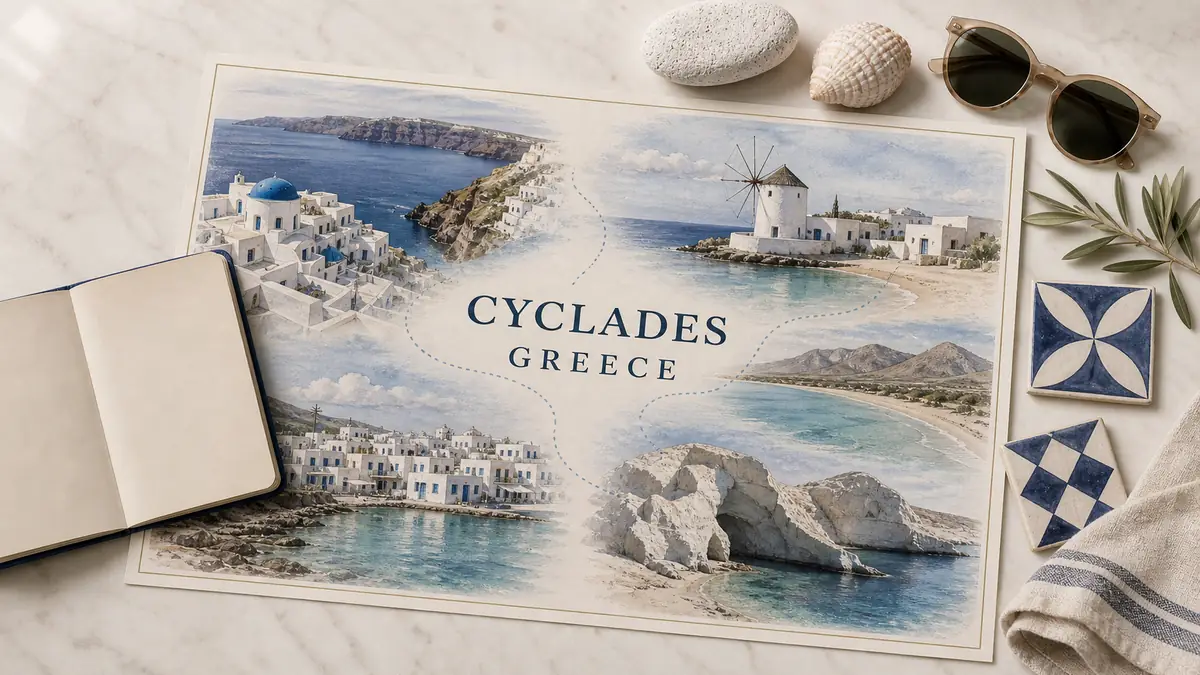
You have chosen Greece, you have chosen the Cyclades, and now the real work starts: deciding which two or three of these islands actually belong on your trip, and when to go. The group runs a long way from one end to the other. Santorini and Mykonos are world-famous and priced accordingly. Naxos, Paros and Milos are quieter, cheaper and, for a lot of travelers, the better holiday. Beyond them sit dozens of smaller islands that thin out fast once the season ends.
Almost everything here works inside a roughly April to October window, and the shape of that season is uneven — the big islands stay busy longer, the small ones wind down early. This guide answers the three questions that decide the trip: which Cyclades islands suit your travel style, how many days the region realistically needs, and when to go. Routes, attractions and itinerary execution hand off to the pages built for them.
Quick Answer
Pick two or three Cyclades islands matched to your travel style instead of racing through many. Traveler type decides: Santorini and Mykonos suit couples and nightlife, while Naxos, Paros and Milos reward beaches, families and tighter budgets. Visit inside the roughly April–October season, ideally the shoulder months, with a week or more.
Trust Layer
Tripstou region guide for travelers planning a regional trip. Covers sub-areas, trip shape, base strategy, timing, and mobility tradeoffs.
Produced with AI assistance and reviewed by Alex Perrut, working in tourism since 2015, for the Tripstou editorial team. See our editorial process for details.
Last factual review: August 28, 2026.
Official sources consulted: Visit Greece, Greek Ministry of Tourism.
Key Takeaways
- Pick two or three islands, not five — every extra hop trades a slow morning for a port morning.
- Traveler type decides the island: Santorini for couples, Mykonos for nightlife, Naxos and Paros for families, Milos for coastline.
- Plan about a week for two islands; ten days buys a third without turning the trip into commuting.
- Shoulder months give warm sea and thin crowds, but small islands wake up later and shut down first.
- The region largely closes outside the roughly April-to-October window, so winter is a warning, not a quieter alternative.
- The Cyclades are Greece’s expensive end, but a quieter island in a shoulder month lands in a different price class.
Table of Contents
Where the Cyclades Are and Which Islands Are in the Group
The Cyclades are a group of Greek islands in the central Aegean, southeast of Athens. Santorini, Mykonos, Naxos, Paros and Milos are the headline names. What binds them is a shared look — whitewashed villages, bare hills, deep-blue water — and short sea distances between one island and the next.
The group is large, but a handful of islands carry almost all the visitor traffic. Santorini and Mykonos are the international names. Naxos and Paros are the big, liveable middle. Milos is the volcanic coastline specialist. Beyond those five sit Ios, Sifnos, Serifos, Folegandros, Amorgos, Andros, Tinos, Syros, Kea, Kythnos, Antiparos, Koufonisia and more, plus Delos — an uninhabited archaeological island reachable only by boat. Syros, not one of the famous names, is the administrative capital of the group.
What separates the Cyclades from Greece’s other island groups is density and coherence. Islands sit close together, look alike, and share a dry, treeless, high-contrast landscape that the Ionian and the Dodecanese do not have. That density is why the region suits a trip built on two or three islands instead of one long stay. If you are still weighing the Cyclades against Greece’s other archipelagos, the national picture belongs in our guide to the Greek islands, and the wider trip frame in the Greece travel guide.
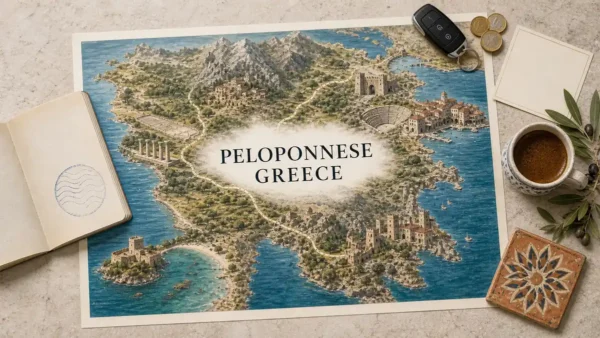
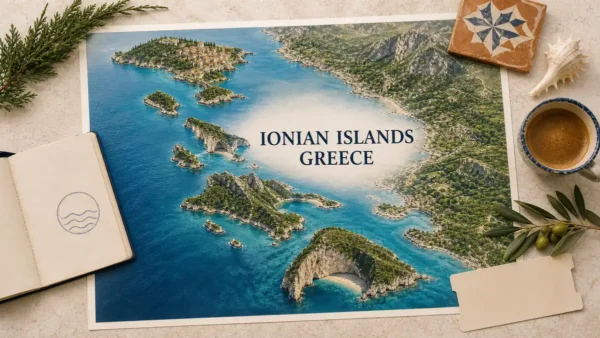
For quick contrast: the Peloponnese is a mainland driving region of ancient sites and mountain villages; the Ionian islands are greener, wetter and softer-edged on the opposite coast; and Zakynthos is the Ionian’s beach-resort headliner. None of them look or feel like the Cyclades.
How to Get to the Cyclades from Athens
Ferries from Athens’ ports are the standard way into the Cyclades. Piraeus carries the most sailings, with Rafina and Lavrio serving parts of the group. Flights reach a few of the larger islands, which mainly helps travelers who are short on time or arriving from outside Greece.
Crossing times span a wide range. The nearest islands on a fast boat take well under an hour; the furthest, on a conventional ferry, can absorb most of a day. Which port you leave from matters as much as which island you are going to, so confirm your departure port before you book anything else in Athens.
Treat the ferry ticket as a real booking, not a formality. Summer sailings to the popular islands fill, and outside high season frequency thins — sharply on the smaller islands, where a daily connection can become a few sailings a week. That thinning is what pulls the decision earlier: book early, and earliest for the famous islands and the shoulder-season edges. Routes, sequencing and how to chain islands together are handled in full in our Greek island hopping guide. Travelers combining the islands with a mainland leg should read it alongside the Greece road trip guide, since the drive and the sailings have to agree on dates.
Which Cyclades Island Should You Visit?
The right Cyclades island is decided by your travel style, not by fame. Santorini and Mykonos dominate the marketing, yet they are the wrong default for families, beach-first travelers and anyone watching spending. Match the island to what you actually want out of the week.
| Island | Best for | What defines it | Main tradeoff |
|---|---|---|---|
| Santorini | Best for: couples who came for the caldera | Cliff-top villages above a flooded volcanic crater | Priciest island, heavy cruise-hour crowds |
| Mykonos | Best for: trips built around nightlife | Beach clubs, late bars, a photogenic old town | Expensive, loud, weak fit for young families |
| Naxos | Best for: families needing space and easy days | Big island with sandy west coast and mountain villages | Needs wheels to see beyond the main town |
| Paros | Best for: first-timers who want a bit of everything | Balanced mix of beaches, villages and evening life | Busy in peak weeks; nothing here is extreme |
| Milos | Best for: swimmers chasing unusual coastline | Volcanic rock formations and dozens of small coves | Quieter evenings, more effort to reach the coast |
Two dimensions sit outside the beach-couples-family-budget grid. Nightlife has one clear regional answer: Mykonos runs the most organised late scene in the Aegean, and the Mykonos guide covers how that plays out across the island. Ancient history has one too — Delos, the UNESCO-listed archaeological island beside Mykonos, is reachable only by boat and is the group’s single most significant site. Neither dimension should decide your whole shortlist on its own.
Fame in the Cyclades is priced, not earned. Santorini and Mykonos charge a premium for a silhouette, and a neighbouring island a short sail away offers the same sea, the same light and the same food for a fraction of the friction — which is exactly why so many repeat visitors stop going back to the famous two.
Attraction-level depth — what to actually do once the islands are chosen — lives in things to do in the Cyclades. If you are still deciding whether the Cyclades beat other Greek destinations entirely, the national shortlist sits in our roundup of the best places to visit in Greece.
Best Cyclades Islands for Beaches
Milos has the most distinctive coastline in the Cyclades, with volcanic rock worked into arches, coves and pale mineral shelves that look like nowhere else in Greece. Naxos is the counterweight: long sandy stretches down its west coast, shallow entry, and enough room that a busy day still feels open. Paros splits the difference and adds reliable wind, which makes it the group’s default for windsurfing and kitesurfing. Santorini’s volcanic beaches photograph well but swim poorly by comparison. Coastal depth for the whole country is in our guide to the best beaches in Greece, and the island itself in the Milos guide.
Best Cyclades Islands for Couples
Santorini is the Cyclades’ couples island, and it earns the reputation on scenery alone — the caldera rim delivers a view no other Greek island can match. It is also the most crowded and most expensive place in the group, so the experience depends heavily on when you go and how far you stay from the rim. Folegandros and Sifnos offer a similar quiet-romantic register with none of the queueing, at the cost of the famous view. Couples who want the classic version should plan around the crowd rhythm covered in the Santorini guide.
Best Cyclades Islands for Families
Naxos is the strongest family island in the Cyclades: shallow sandy beaches, a walkable port town, a working agricultural interior and prices that do not punish a party of four. Paros is the close second, slightly busier and slightly more polished, with easier onward connections. Both islands let children swim, eat and sleep without the logistical strain that Santorini’s cliffs and Mykonos’s late nights impose. Compare them directly in the Naxos guide and the Paros guide before committing to a base.
Best Cyclades Islands on a Budget
Naxos, Paros and Milos are the mainstream value picks in the Cyclades, and they are the standard answer for travelers who want the region without Santorini and Mykonos pricing. Naxos is the kindest of the three on accommodation and everyday eating. Paros costs a little more but connects more easily. Milos sits between them, with a smaller supply of rooms that tightens fast in peak weeks. Push further into the quiet, lower-cost end — Sifnos, Serifos, Folegandros, Koufonisia — and you are in the territory covered by hidden gems in the Cyclades.
How Many Days You Need in the Cyclades
Plan about a week in the Cyclades and spend it on two or three islands. Each move costs roughly half a day once you count checkout, port time and the crossing itself. Two islands across five days feels like a holiday; four islands in the same week feels like commuting between ports.
- 4–5 days: one island, properly. Enough for a base, its beaches and one interior day. Right as an add-on to a wider Greece trip, or for a first taste of the region.
- About a week: two islands, usually one famous and one quiet. The standard Cyclades trip and the length most travelers should default to.
- 10 days: three islands with a genuine rest day on each. Suits travelers who want variety — a beach island, a village island, a nightlife or scenery island — without rushing.
- Two weeks: three or four islands, including one that is harder to reach. The right length for repeat visitors and for anyone pairing the Cyclades with Athens or the mainland.
One base or several? For a first trip of a week or less, favour two bases at most. Multi-base trips buy contrast, which is the region’s real selling point, but they charge for it in packing, ferry timing and lost swimming hours. The islands you leave off the list are what turns the trip into a holiday — every extra island converts a slow morning into a port morning.
Turning a length into an actual route is a different job. Start with our Greece itinerary guide, then use the length that matches: the 7-day Greece itinerary, the 10-day Greece itinerary, or the 14-day Greece itinerary.
When to Visit the Cyclades
The Cyclades run on a roughly April-to-October season, and the shoulder months are its best slice. Late spring and early autumn deliver warm water, clear light and thinner crowds without midsummer’s prices and pressure. Peak summer suits travelers who want heat, full nightlife and every service on the island running.
The peak-summer case is real and worth stating plainly: everything is open, every boat runs, every beach bar is staffed, and the nightlife is at full strength. You pay for it in crowds, in room rates and in the meltemi, the dry north wind that blows hardest through the middle of summer and can disrupt sailings.
The shoulder-season case is the stronger one for most travelers. The sea holds its warmth well past the crowds, walking is pleasant again, restaurants have tables, and the islands feel like places where people live. Shoulder season punishes the small islands more than the big ones, though — the same week that feels perfect on Naxos can find half of a smaller island still shuttered.
Accommodation is the booking that forces your hand. In high season on the popular islands, rooms go early and the good-value ones go earliest, so book early, and earliest for the famous islands. In shoulder season the pressure drops sharply and you can plan closer to the date. Month-level detail across the country sits in our guide to the best time to visit Greece, and shoulder-season trips need a different bag — the Greece packing list covers it.
Hotels and places to stay
Compare hotels, apartments and stays for your dates in one search.
Search hotels and stays on hotels.com →
Tripstou may earn a commission if you book through this link, at no extra cost to you.
Are the Cyclades Open in Winter?
Mostly no. Outside the roughly April-to-October season, most Cycladic hotels, restaurants and beach services shut, and ferry sailings thin out. The larger islands keep a working year-round life; the small ones empty out almost completely. Winter here is a closure warning, not a shoulder-season alternative.
The closure pattern is uneven rather than uniform, which is what catches travelers out. Islands with a real resident population and year-round administration keep shops, tavernas and transport running for the people who live there. Islands whose entire economy is the season simply stop: rooms close, restaurants close, rental fleets go into storage, and the beach infrastructure disappears.
Ferries follow the same logic. Connections to the bigger islands survive the winter in reduced form; connections to the smallest ones can drop to a level that makes island-hopping impractical and getting stranded a genuine risk in bad weather. Off-season, the sea decides your schedule. Plan any trip at the season’s edges with a flexible day built in, and confirm what is actually open on your island before you commit.
How to Get Around the Cyclades
Whether you need wheels in the Cyclades depends on the island’s size and where you sleep. Big islands with scattered beaches reward a car or a scooter. On smaller islands, or when you stay in the main town, buses, boats and your own legs handle most days comfortably.
- Staying walkable: base yourself in the main port or town and skip vehicles entirely. Suits short stays, couples and travelers on small islands. The tradeoff is that the best beaches are usually the ones you cannot reach on foot.
- Local buses: the cheapest option, and adequate on the main routes of the larger islands. Suits budget travelers and anyone staying near a hub. The tradeoff is frequency — services cluster around the busy beaches and thin out everywhere else.
- Rented car: the option that unlocks Naxos, Paros and Milos properly, and the right call for families and anyone chasing quiet coves. The tradeoff is supply and parking: vehicles get scarce in peak weeks, and village lanes were not built for them.
- Scooter or ATV: cheap, easy to park, and fine for couples and confident riders on short hops. The tradeoff is exposure — wind, gravel roads and unfamiliar surfaces cause a steady stream of holiday injuries every summer.
Book the vehicle when you book the room if you are travelling in high season. Island rental fleets are finite in a way mainland ones are not, and on the smaller islands the entire supply can be spoken for.
How Expensive Are the Cyclades Compared to the Rest of Greece?
The Cyclades sit at the expensive end of Greece, and Santorini and Mykonos at the expensive end of the group. Island choice moves your total more than any other decision you make. Season is the second lever, and the two compound. The quieter islands stay much closer to mainland Greek pricing.
- Budget: works well on Naxos, Paros and the smaller islands, using simple rooms, buses and neighbourhood tavernas away from the waterfront. The region is unkind to this style on Santorini and Mykonos, where even basic options carry a premium.
- Mid-range: the sweet spot almost everywhere in the group — a decent hotel or apartment, a rental vehicle for part of the stay, and eating out daily. Stretches furthest on the quieter islands and shortest on the famous two.
- High-end: the Cyclades deliver genuinely well here, particularly on Santorini and Mykonos, where the luxury supply is deep and the settings are unmatched. This is the one style for which the famous islands are worth their price.
Choosing a quieter island and a shoulder month is a double saving, because the famous islands are also the ones whose prices swing hardest between peak and off-peak. Change one variable and you save; change both and the trip lands in a different price class entirely.
Actual figures, per-day breakdowns and how the islands compare to Athens and the mainland belong in our guide to how much a Greece trip costs. Eating patterns are the lever most travelers underuse — knowing what to order and where locals eat is covered in the Greece food guide.
Frequently Asked Questions
Santorini or Mykonos — which one should you pick?
Pick Santorini for scenery and couples, Mykonos for nightlife. Santorini’s caldera views are the reason people come, and its evenings suit slow dinners. Mykonos pairs beach clubs with bars that run late and a town built for wandering. Both sit at the top of the group’s price range.
Do you need to book Cyclades accommodation far in advance?
For high season on the popular islands, yes — book early, and earliest for Santorini and Mykonos. Room supply on the smaller islands is genuinely finite, so late bookers take what is left instead of what they wanted. Shoulder season is far more forgiving and tolerates planning close to the date.
Can you visit Delos on a day trip?
Yes. Delos is a UNESCO-listed archaeological island reachable only by boat, and it has no accommodation, so a day trip from nearby Mykonos is the only way to see it. Sailings run within the main season and depend on the sea, so build in flexibility.
What is the meltemi wind and can it affect ferries?
The meltemi is a dry north wind that blows across the Aegean in summer, strongest from mid-July to mid-August. It cools the islands and delights windsurfers, but strong days can delay or cancel sailings, particularly the fast boats. Keep a spare day either side of a flight.
Which Cyclades island is best for nightlife?
Mykonos, without much competition. Its beach clubs and late bars are the largest organised scene in the group, and the season runs long there. Ios is the younger, cheaper alternative with a dense bar strip, and Paros offers busy evenings without the commitment. Everywhere else winds down early.
Related Guides
- Things to Do in the Cyclades — the attraction-level layer once your islands are chosen.
- Hidden Gems in the Cyclades — the quieter islands beyond the famous five.
- Greek Island Hopping — routes, connections and how to sequence a multi-island trip.
- Greece Itinerary Guide — turning your island shortlist into a working day plan.
- Common Scams in Greece — what to watch for around ports, taxis and tourist zones.
- Solo Female Travel Safety in Greece — practical safety guidance for travelling alone.
Did this guide save you time or money? Tripstou is independent and reader-funded — if you'd like to give something back, you can support the site with a crypto contribution of any size.