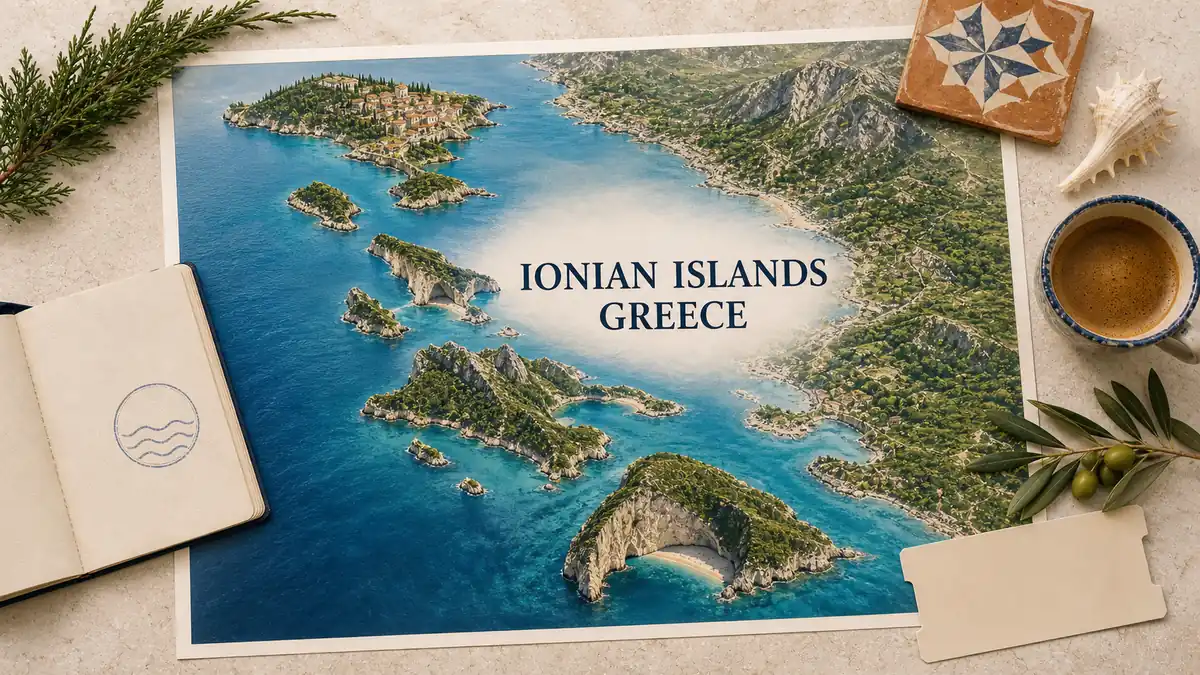
You have settled on Greece and you are looking west instead of at the Cyclades. That single decision changes the trip. The Ionian Islands are green where the Cyclades are bare, roofed in Venetian terracotta where the Aegean is whitewashed and blue-domed, and generally calmer and cheaper than the islands on every postcard.
Four of them are developed enough to carry a first visit: Corfu, Zakynthos, Kefalonia and Lefkada. But there is one practical catch worth knowing before you plan anything else. You cannot ferry across from the Aegean side — the Ionian is entered by air or overland, and nothing sails over from the Cyclades or Athens’ Aegean ports.
This guide answers the four questions that follow from that: which island suits your kind of traveler, how you physically arrive, when to go, and how long the region actually needs.
Quick Answer
The Ionian Islands are Greece’s green, Venetian-flavoured group off the west coast, calmer and cheaper than the Cyclades. Choose by traveler type: Corfu for towns and first-timers, Zakynthos for big beaches, Kefalonia and Lefkada for quieter coast. Fly into Corfu, Zakynthos or Kefalonia, base on one island, and day-trip from there.
Trust Layer
Tripstou region guide for travelers planning a regional trip. Covers sub-areas, trip shape, base strategy, timing, and mobility tradeoffs.
Produced with AI assistance and reviewed by Alex Perrut, working in tourism since 2015, for the Tripstou editorial team. See our editorial process for details.
Last factual review: August 29, 2026.
Official sources consulted: Visit Greece, Greek Ministry of Tourism.
Key Takeaways
- The Ionians are Greece’s green, Venetian-flavoured islands, calmer and generally cheaper than the Cyclades, and greener because they are wetter.
- Pick your island by travel style: Corfu for towns, Zakynthos for beaches, Kefalonia and Lefkada for quieter, wider coast.
- Access is by air or overland only — nothing sails to the Ionian from the Cyclades or Athens’ Aegean ports.
- Pair north with north and south with south; base on one island and day-trip instead of chaining accommodation.
- Late spring and early autumn give the best value, with real rain risk; much of the group winds down off-season.
- A car matters more here than in the Cyclades, because the best coastline sits far from the main towns.
Table of Contents
Where the Ionian Islands Are and Which Islands Are in the Group
The Ionian Islands sit off Greece’s west coast, in the Ionian Sea, facing Italy. That places them on the opposite side of the country from the Cyclades. Seven main islands make up the group: Corfu, Paxos, Lefkada, Kefalonia, Ithaca, Zakynthos and Kythira, the last of which lies south of the Peloponnese.
The seven split cleanly into two working categories, and that split is the vocabulary this page uses throughout. Four islands — Corfu, Zakynthos, Kefalonia and Lefkada — are developed for tourism, with the airports, road networks and accommodation range a first visit needs. The remaining three — Paxos, Ithaca and Kythira — are the calm end of the group, smaller and thinner on services, better as a second island or a deliberate retreat. Kythira is the geographic oddity: it is grouped with the Ionians by history and administration, but it floats off the southern tip of the Peloponnese, a long way from its siblings.
If you are still weighing the Ionian against Greece’s other archipelagos, that comparison belongs one level up — the Greek islands overview handles group selection across the Cyclades, the Dodecanese, the Sporades and Crete. For how the islands fit into a wider national trip, start from the Greece travel guide. This page assumes the group is already chosen and takes it from there.
How the Ionian Islands Differ from the Cyclades
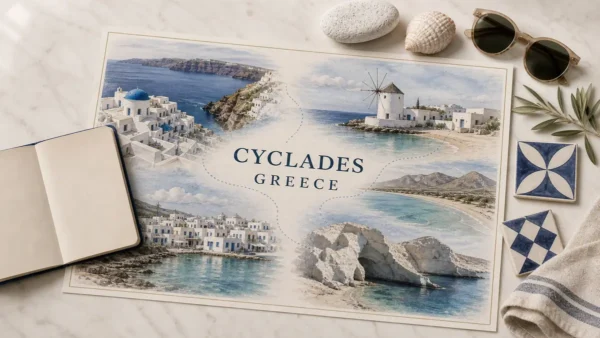
The Ionians are green, Venetian and comparatively calm where the Cyclades are bare, whitewashed and busy. The contrast runs three ways: dense olive and cypress cover instead of arid rock, terracotta roofs and arcaded lanes instead of blue domes, and generally lower prices instead of peak-season premiums. Each difference has a cause.
The greenness is a rainfall story. The Ionian side of Greece catches markedly more rain than the Aegean, and the landscape answers with olive groves, cypress and thick hillside cover that stays green well into the season. That is the honest trade: the same weather that gives you the scenery gives you a real chance of wet days outside high summer, which is the timing question further down this page.
The architecture is a Venetian story. These islands spent centuries under Venetian rule instead of Ottoman, and the towns still show it in terracotta roofs, shuttered facades, arcaded streets and Italianate squares — Corfu Town carries the strongest imprint of the lot. The influence reached the kitchen too, where you will meet dishes and cooking habits with more Italian in them than the Aegean standard; the Greek food guide covers what to order. If you want the other side of the contrast in full, the Cyclades travel guide describes what you are trading away.
On cost, the Ionian is generally cheaper than the Cyclades for a comparable trip — a relative band, not a fixed discount, and it narrows on Corfu and Zakynthos in peak weeks. Actual figures live in how much a Greece trip costs. The saving is less about headline room rates and more about what an ordinary day costs once you have arrived, because the Ionian has far fewer businesses engineered to sell you a view.
Who each group suits comes down to one line each. The Cyclades suit travelers who want the iconic Greek image and accept the crowds and prices that come with it. The Ionian suits travelers who want green landscapes, walkable old towns with a European accent, and a slower, cheaper trip.
Which Ionian Island Should You Visit?
The right Ionian island follows your travel style, not a ranking. Four islands are developed enough to work as a first-visit base: Corfu for Venetian towns and easy arrivals, Zakynthos for big beaches, Kefalonia for space and mountains, Lefkada for west-coast coastline. The other three suit travelers who want quiet above convenience.
| Island | Known for | Who it suits | How you arrive |
|---|---|---|---|
| Corfu | Venetian old town, wooded hills, the widest range of resorts | Best for: first-timers who want a proper town alongside the beaches | Own international airport; mainland ferries from Igoumenitsa |
| Zakynthos | Dramatic west coast and Greece’s most photographed cove | Best for: travelers building the whole trip around big beach days | Own international airport; mainland ferries from Kyllini |
| Kefalonia | Mountains, long drives and widely spaced coastal villages | Best for: drivers happy to trade convenience for space and quiet | Own international airport; mainland ferries from Kyllini |
| Lefkada | White cliffs above a run of exceptional west-coast bays | Best for: beach-focused travelers already arriving by road | Overland from the mainland; no airport of its own |
Pick the island that matches how far you are willing to drive each day. That one question separates Corfu from Kefalonia far more sharply than any beach comparison does — Corfu puts a town, a harbour and a dozen beaches within easy reach of each other, while Kefalonia spreads the same amount of interest across an hour or more of mountain road.
Beach character varies enough across the four to be a real deciding factor, and Greece’s best beaches puts the Ionian coastline in national context. The three calm islands — Paxos, Ithaca and Kythira — work best as a second stop or a deliberate escape, and the hidden gems of the Ionian Islands covers those quieter corners properly. If you are still not sure the Ionian is where your trip belongs at all, the wider shortlist of places to visit in Greece is the better starting point.
Corfu: The Venetian All-Rounder
Corfu is the easiest first pick in the Ionian and the island with the strongest Venetian imprint. Its old town is a working centre with arcaded lanes, fortresses and squares that feel closer to Italy than to the Aegean, and it stays lively outside the beach season. Beyond the town, the island holds wooded hills, a long coastline and the widest spread of accommodation in the group, from family resorts to quiet north-coast villages. It suits travelers who want a real place to walk in the evening as well as sand during the day. Full depth lives in the Corfu guide.
Zakynthos: Big Beaches and the Famous Postcard
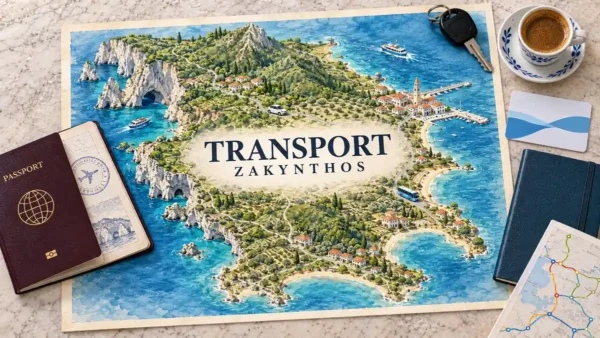
Zakynthos is the island to choose if the coastline is the point of the trip. Its west side drops in sheer cliffs to a run of coves, including Navagio — the shipwreck cove behind most images of Greece’s Ionian coast, taken in from the clifftop viewpoint above or from a boat offshore, not from the sand. The east and south are gentler, with long sandy stretches and the bulk of the island’s resorts and nightlife. It suits travelers whose days are built around swimming, boats and beach time, with a town visit as a sideline. The Zakynthos guide handles how to see it.
Kefalonia: Space, Mountains and a Slower Pace
Kefalonia is the largest Ionian island and the one that feels least resort-shaped. A mountainous spine runs through it, villages sit far apart, and the good coastline is scattered around the edges instead of concentrated in one strip. That geography is the appeal and the cost: you get space, quiet and dramatic driving, and you spend real time on the road to reach it. It suits travelers who want an island that does not funnel everyone into the same three bays.
Lefkada: The West-Coast Beach Alternative
Lefkada is the Ionian island for travelers who want the coastline without the flight. It has no airport of its own and is reached overland from the mainland, which keeps its arrivals quieter than Corfu’s or Zakynthos’. Its west coast is the draw — a sequence of bays under pale cliffs that rank among the best in the country — while the east side is calmer water and small harbour towns. It suits road-trippers and anyone already driving down Greece’s western side.
Hotels and places to stay
Compare hotels, apartments and stays for your dates in one search.
Search hotels and stays on hotels.com →
Tripstou may earn a commission if you book through this link, at no extra cost to you.
How to Get to the Ionian Islands
You reach the Ionian Islands by air or overland, and there is no ferry from the Aegean side. Corfu, Zakynthos and Kefalonia each have an international airport. The alternative is an overland trip to a western mainland port and a ferry from there. Nothing sails across from the Cyclades or Athens’ Aegean ports.
The mainland ports face the islands directly. Igoumenitsa serves Corfu in the north, Kyllini serves Zakynthos and Kefalonia in the south, and Patras is the other western hub on the same coast. That is the practical shape of the decision: fly straight in if the island has an airport and the fare works, or drive or bus to a western port and cross. Both doors are worth pricing before you commit, because a cheap direct flight and a cheap mainland approach rarely land on the same island.
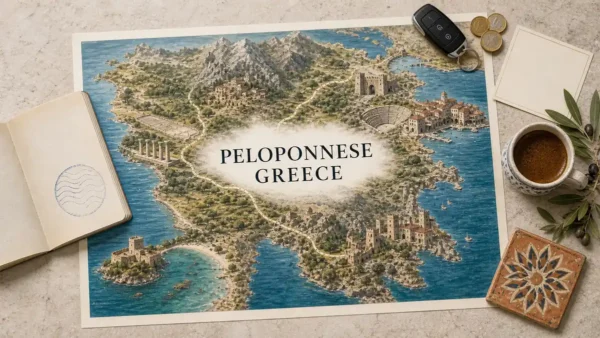
Do not assume you can hop between Ionian islands by plane — direct inter-island air links are not something to build a plan around. Routes, sequencing and the full answer to whether you can ferry over from the Aegean belong to Greek island hopping routes, which sets the same framing this page does. If you are coming overland, the drive down Greece’s western side is a trip in itself; the Greece road trip guide covers the approach, and the Peloponnese guide covers the region you cross on the way to the southern ports.
When to Visit the Ionian Islands
Late spring and early autumn are the best times to visit the Ionian Islands. Both windows deliver warm sea, open businesses and lighter crowds than midsummer. The catch is straightforward: this group is green because it is wet, and rain is a genuine possibility on either shoulder. Summer stays reliably dry.
The shoulder-season trade is the honest one. You get better value, easier accommodation and islands that still function, and you accept that a couple of days may be washed out — the same rainfall that produced the olive groves and cypress cover described earlier. High summer removes the rain risk and adds heat, crowds and peak pricing. Travelers who need guaranteed beach weather should take the peak; travelers who want the islands at their most pleasant should take the edges and pack for weather. Bring a light rain layer for shoulder trips — the Greece packing list covers the rest.
From late autumn through early spring, much of the group winds down. Tavernas, hotels and seasonal services close, unevenly and more completely on the smaller islands than on Corfu, which keeps a year-round town life the others do not. Ferry and flight schedules thin out over the same stretch. Corfu is the one island that stays genuinely visitable off-season; the rest reward flexibility and low expectations. If you want month-by-month detail across the country, the best time to visit Greece handles national timing. Book accommodation early for the shoulder weeks — the good, small properties on these islands fill faster than the resort stock does.
How Many Days You Need in the Ionian Islands
Most travelers need seven to ten days to do the Ionian properly. That buys one island in depth or two neighbouring islands at a sensible pace. Shorter trips still work, provided you pick a single island and stay put. The group is spread out enough that every extra base costs you most of a travel day.
- 3–4 days: one island, one base, beaches and a town. Enough for a first taste of Corfu or Zakynthos; not enough to add a second island. Fits travelers bolting the Ionian onto a wider Greece trip.
- 5–7 days: one island explored properly, including its far end and a boat day trip to a neighbour. The sweet spot for a standalone Ionian holiday.
- 8–10 days: two islands from the same end of the group, at a pace that leaves room to do nothing. Fits travelers who want variety without turning the trip into logistics.
- 12–14 days: two islands in depth, or one island plus a mainland leg on the way in or out. Fits road-trippers and returning visitors.
The second island only pays for itself when it shares the same end of the group. Otherwise it costs you a transfer day and hands back an afternoon, which is a poor exchange on any trip under two weeks. Turning these tiers into an actual plan is the job of the Greece itinerary guide, with worked routes at 7 days in Greece, 10 days in Greece and 14 days in Greece.
Which Ionian Islands Can You Combine in One Trip?
Pair north with north and south with south: Corfu with Paxos, Zakynthos with Kefalonia. Those neighbours sit close enough to combine without eating the trip. Crossing between the northern and southern ends of the group means a flight or a long mainland transfer, which is rarely worth it on a trip under two weeks.
Base-and-day-trip beats chaining islands here, and that is the model the whole region rewards. You take one island as your base for the trip, and you see its neighbour on a boat day trip — the standard way visitors reach Paxos from Corfu, or Ithaca from Kefalonia, without moving accommodation. A day trip gives you the neighbouring island’s coastline while your bed stays where it is, which is why the Ionian pays off for travelers who stay still and punishes the ones who keep packing. What those day trips actually hold — the coastlines, caves and villages worth the crossing — sits in things to do in the Ionian Islands.
The three quiet islands work best in this model. Paxos pairs naturally with Corfu, Ithaca with Kefalonia, and both are more rewarding as a day out or a short second stay than as the anchor of a first Ionian trip. Kythira is the exception nobody should force: it sits far south of the rest and belongs to a Peloponnese trip more than an Ionian one.
Tours and activities
Book skip-the-line tickets, day trips and local tours with free cancellation on most activities.
You can also browse everything on getyourguide.com.
Tripstou may earn a commission if you book through this link, at no extra cost to you.
How to Get Around the Ionian Islands
A car changes the trip more in the Ionian than in the Cyclades. These islands are green, mountainous and spread out, and the best stretches of coast sit well away from the main towns. Bus networks link the larger settlements but thin out fast beyond them. Without wheels, your range shrinks to one bay and one town.
- Rented car: the default for Kefalonia, Lefkada and anyone staying outside a main resort. It opens the whole island. The tradeoff is mountain roads that are slower than the map suggests, and parking that gets tight in old towns.
- Local buses: workable on Corfu and Zakynthos, where routes connect the main town with the busier resorts. They suit travelers on a tight budget with a flexible schedule. Services to remote beaches are sparse to non-existent.
- Boat day trips: the best way to see coastline that roads do not reach, and the standard route to a neighbouring island. They suit anyone based near a harbour town. You travel on someone else’s timetable.
- Staying walkable: choosing a base where the town, the beach and the tavernas are all on foot removes the transport question entirely. It suits short trips and non-drivers, and it costs you the rest of the island.
The car earns its place through beach access, not distance covered. Ionian roads climb and wind, so a realistic day covers one coast, not three, and travelers who plan around that get far more out of the island than the ones who try to circle it.
Frequently Asked Questions
Does it rain in the Ionian Islands?
Yes — the Ionian Islands get markedly more rain than the Aegean, which is exactly why they are green. Most of it falls outside high summer, so spring and autumn trips carry a genuine chance of wet days. Midsummer is reliably dry and hot. Pack a light rain layer for either shoulder.
Corfu or Kefalonia — which is better?
Corfu is better for first-timers and anyone who wants a real town; Kefalonia is better for drivers who want space. Corfu concentrates a Venetian old town, harbour and beaches within short hops, while Kefalonia scatters its coastline across mountain roads that take real time to cover.
Kefalonia or Zakynthos?
Choose Zakynthos for big beach days and a livelier resort scene, Kefalonia for quiet, scale and mountain driving. They sit at the same southern end of the group and share the Kyllini mainland link, so pairing them across one trip is realistic without a long transfer.
Are the Ionian Islands good for families?
Yes — calm water, green landscapes and a less party-driven atmosphere than the busiest Aegean resorts make the group an easy family choice. Corfu is the simplest base: a direct international airport, the widest accommodation range, and beaches, town and food within short driving distance.
Do you need a car in the Ionian Islands?
You need one for Kefalonia, Lefkada or any base outside a main resort. You can skip it on Corfu or Zakynthos if you stay in a walkable town or a resort on a bus route, and take boat trips for the coastline roads never reach.
Related Guides
These guides take the Ionian decision forward — into experiences, quieter corners, routes, trip shape and on-the-ground safety.
- Things to do in the Ionian Islands — the experiences and day trips behind the base-and-day-trip model.
- Hidden gems in the Ionian Islands — the quiet corners and the escape-the-crowds angle.
- Greek island hopping routes — how the ferry network works and where the Ionian fits.
- Greece itinerary guide — turning island choice and trip length into a working plan.
- Common scams in Greece — what to watch for in tourist towns and harbours.
- Solo female travel safety in Greece — practical guidance for travelers going alone.
Did this guide save you time or money? Tripstou is independent and reader-funded — if you'd like to give something back, you can support the site with a crypto contribution of any size.