You have seen the photos of Sarakiniko — pale volcanic rock falling into impossibly clear water — and Milos is on your shortlist. Now you need confirmation and a plan.
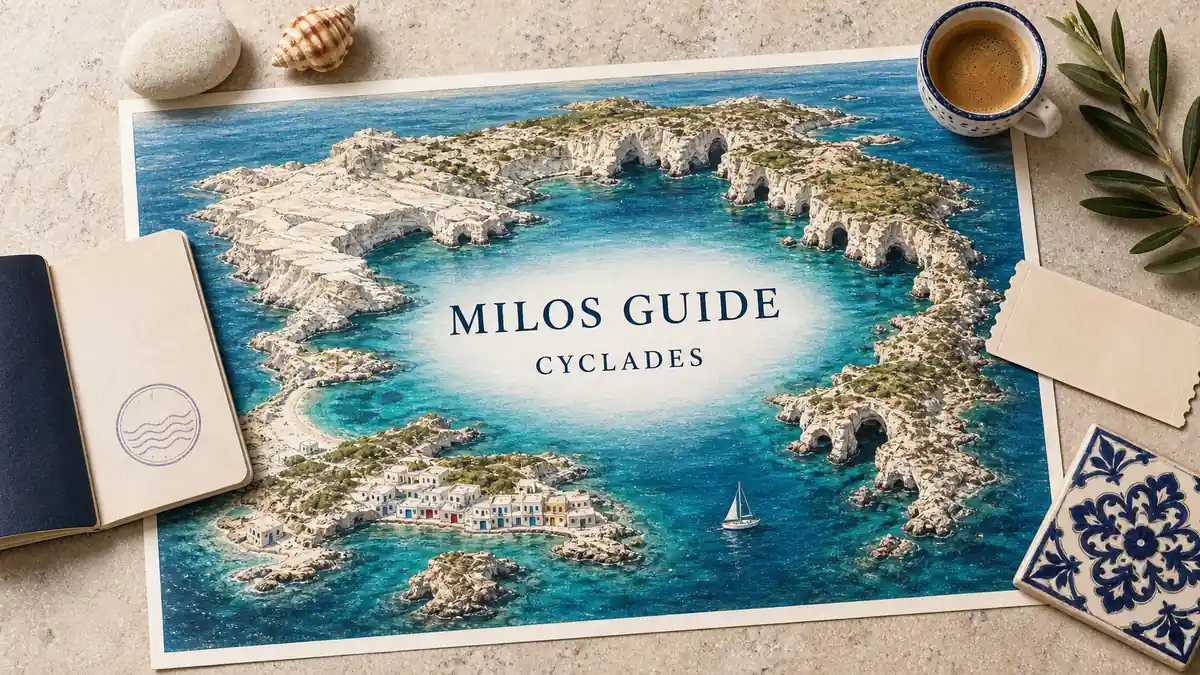
Milos is the coastal-scenery specialist of the Cyclades. It is a volcanic island of white rock, sea caves and coloured cliffs, with dozens of coves ringing one wide central bay, several reachable only by boat or unsurfaced track. Evenings are quieter here than on Naxos or Paros. This is not a nightlife island, and pretending otherwise is how travelers end up disappointed by a place that is doing exactly what it does best.
This guide resolves the decisions that come before the details: whether Milos is worth committing to and who it suits, how to arrive from Athens, when to go and whether the boats are running, how many nights to give it, how the island is laid out, whether you need a car, and how it compares with the other Cycladic candidates. Depth topics — stays, costs, transport, itineraries, things to do — live on dedicated pages this guide routes you to.
Quick Answer
Milos is worth visiting: it is the Cyclades’ coastal-scenery specialist, all volcanic white rock, sea caves and quiet coves. Give it three to four nights and plan on a car, because the best coastline sits spread around a wide bay. Arrive by ferry, or a short flight from Athens, inside the roughly May–October season.
Trust Layer
Tripstou city guide for travelers planning a city trip. Covers trip length, stay style, season, cost, and mobility tradeoffs.
Produced with AI assistance and reviewed by Alex Perrut, working in tourism since 2015, for the Tripstou editorial team. See our editorial process for details.
Last factual review: August 29, 2026.
Official sources consulted: Visit Greece, Greek Ministry of Tourism.
Key Takeaways
- Milos is the Cyclades’ coastal-scenery specialist: volcanic white rock, sea caves and quiet coves, not an island for nightlife.
- Take the ferry from Piraeus or Lavrio first; the Athens flight wins on comfort more often than on door-to-door time.
- Travel inside the roughly May–October season: the boat trips that define Milos run within that window and stop outside it.
- Give Milos three to four nights — one for the boat day, one as insurance against wind cancelling it.
- Picture one wide bay: Adamas at its head, Plaka on the hill above, Pollonia on the north-east tip.
- Plan on driving: Milos is the clearest car “yes” among the small Cyclades, its best coastline spread wide around the bay.
Table of Contents
Is Milos Worth Visiting — and Who Is It For?
Yes — Milos is worth visiting for one clear reason: it has the most dramatic coastline in the Cyclades. Volcanic white rock, sea caves and dozens of coves ring a wide central bay. It suits scenery-first travelers, couples wanting quiet evenings, photographers, returning Cyclades visitors and anyone happy to drive.
What Milos is known for is landscape, not scene. This is an island you look at and swim off, not one you go out on at night. Bars close early, the towns stay small, and the day is organised around water and light. Anyone unwilling to drive or to spend a day on a boat will see a fraction of what makes the island famous — and that fraction is not enough to justify the trip.
The non-fit list is short and worth taking seriously. Families who want shallow, soft-sand beaches and easy evenings are better served on Naxos. Nightlife travelers should look elsewhere entirely. Milos rewards curiosity about a coastline more than it rewards a checklist, which is also why it works so well as a second or third Cycladic island once the obvious ones are done. If you are still choosing your Greek region, the overview of where to go in Greece frames the wider decision.
On value, Milos sits between Naxos and Paros, with a small room supply that tightens noticeably in peak weeks — book earlier than you would on a bigger island. The numbers themselves belong elsewhere: see what a Milos trip costs for the island breakdown and Greece trip costs for country-level context.
The island’s best hours are the two either side of the light changing on white rock. Anyone booking Milos for its evenings has bought the wrong island.
How to Get to Milos from Athens: Ferry or Flight
Take the ferry first. Piraeus and Lavrio both serve Milos, roughly 2.5–3.5 hours by high-speed vessel and roughly 4–8 hours conventional. The short Athens flight is a genuine option here, but its door-to-door advantage shrinks once you add the airport transfer and check-in.
Your three realistic arrival routes:
- High-speed ferry from Piraeus — the default. Roughly 2.5–3.5 hours, central Athens departure, lands you in Adamas harbour.
- Conventional ferry from Piraeus or Lavrio — roughly 4–8 hours depending on vessel and route, steadier in wind, and the option that carries a vehicle.
- Flight from Athens — a short domestic hop into a small island airport, best when the ferry timings do not fit your day.
The ferry-versus-flight choice is about the whole journey, not the crossing. A high-speed ferry leaves from Piraeus, which most Athens visitors can reach directly, and it deposits you in the middle of town. The flight leaves from an airport you have to get to, with the usual buffer either side, and it lands you outside town. Count both ends and the gap narrows fast — the flight wins on comfort and on bad-timing days more often than it wins on clock time. The airport itself is small and sits close to Adamas; the Milos airport transfer guide covers the mechanics.
Many travelers arrive from another island instead. Milos connects across the Cycladic chain by ferry, which is how it usually enters a longer route — the Greek island hopping guide covers building those legs. Frequency follows the season rather than the calendar: sailings are dense in high summer, noticeably thinner in the shoulder, and reduced to a skeleton service in winter. Do not assume summer density outside summer.
Train and bus tickets
Compare routes, schedules and prices across rail and bus operators in one search, with mobile tickets on your phone.
New to Omio? Code NEW10 takes 10% off your first booking — or APPNEW10 if you book inside the Omio app. Both apply to bookings up to €80.
Search routes and compare prices on Omio →
Tripstou may earn a commission if you book through this link, at no extra cost to you.
When to Visit Milos — and When the Boats Run
The shoulder months are the sweet spot inside a season running roughly early May to late October. Early summer and the back half of September bring warm sea, open tavernas and thinner crowds. Crucially, the boat trips that define Milos run inside that window and stop outside it.
That single fact reorders the usual season logic. On most islands the season question is about heat and crowds; on Milos it is also about access, because the coastline that makes the island famous is only reachable while the boats are operating. Travel at the very edges of the window and you meet a slow closing-down: tavernas shut, some hotels stop taking guests, tours wind up, and ferry links thin out. Nothing dramatic happens on a fixed date — it simply tapers.
Inside the season, the trade-off is straightforward. High summer gives you maximum certainty that everything is open and running, plus the strongest crowds, the highest heat and the Meltemi, the strong north wind that blows hardest in July and August. The shoulder gives you calmer towns, gentler temperatures and better light, at the cost of a slightly thinner set of open businesses and fewer sailings.
Wind matters more than heat here. A calm week in late September buys you more of Milos than a hot, blowing week in August, because a blowing week can cost you the boat day entirely.
| Period | Crowds | Heat and wind | What is open | Boat trips running |
|---|---|---|---|---|
| Early season, from around May | Light, easy to find space | Warm days, cool sea, mild wind | Most places open, some still waking up | Yes, as the season starts up |
| Early summer | Building but still comfortable | Hot days, wind picking up | Effectively everything open | Yes, weather permitting |
| High summer | Peak, small island feels full | Hottest, strongest Meltemi spells | Everything open, everything booked | Yes, but departures sell out |
| September into early autumn | Thinning steadily, calm towns | Warm sea, softer heat, easing wind | Almost everything still open | Yes, one of the better stretches |
| Late season, toward end of October | Very quiet, few visitors around | Mild, more unsettled weather | Closures begin, choice narrows | Winding down, then stopping |
Country-level timing sits one level up, in the best time to visit Greece. If you are travelling in the shoulder or expect wind, a light windproof layer earns its place — the Greece packing list handles the rest.
How Many Days You Need in Milos
Three to four nights is the honest answer for Milos. Two nights under-serves this island specifically, because the good coastline is spread around a wide bay and the headline boat trip eats a full day on its own. A fourth night buys a wind buffer.
The arithmetic is simple once you see the shape of the island. One day goes to the boat. Another goes to the drivable coastline, which is scattered around the rim and takes real time to move between. A third absorbs the towns, a long swim and the arrival or departure half-day that ferries always steal. Compress that into two nights and you are choosing between the boat and everything else.
The fourth night is not extra sightseeing time. It is insurance against a cancelled boat day, and on an island whose signature experience is weather-dependent, that is the one night worth adding.
For the day-level shape, the two-day Milos itinerary shows what a short trip can realistically hold, and the three-day Milos itinerary covers the standard stay. If Milos is one stop in a longer Greek route, start with the Greece itinerary planner, then the seven-day Greece route or the ten-day version. Milos works best as the fourth node on a two-week Cycladic chain, once the bigger islands have set the baseline — the 14-day Greece itinerary shows where it slots in.
How Milos Is Laid Out: Adamas, Plaka and Pollonia
Milos reads as one wide central bay with a rim around it. Adamas sits at the head of the bay, Plaka on the hill above, Pollonia on the north-east tip. The best coastline is scattered around the rim, and the south-west is reachable only by sea.
The three settlements that anchor the map:
- Adamas — the port town at the head of the bay, where ferries arrive and most services sit. Central for driving in any direction.
- Plaka — the hilltop main town above the bay, with the old lanes, the views and the sunset crowd. Compact and steep.
- Pollonia — the small fishing village on the north-east tip, quieter and more waterside, further from the western coastline.
Around that rim sit the beaches Milos is known for — more than seventy are commonly counted, which is remarkable for an island this size. Some are a short drive from a paved road. Others sit at the end of an unsurfaced track. A handful, including Kleftiko on the south-west coast, have no land access at all. The distinction is geography, not ranking: what changes between coves is how you reach them.
Sarakiniko is the island’s signature landscape — pale volcanic rock scoured smooth, closer to a moonscape than a beach, with no sand to speak of. It appears in the wider guide to Greek beaches for exactly that reason. The other recurring image is the syrmata: the tiny fishing villages of Klima, Mandrakia, Firopotamos and Emborios, where brightly painted boathouse doors line the water’s edge.
Do you need a car in Milos?
Yes — Milos is the clearest car “yes” among the small Cyclades. The good coastline is spread wide around the bay, the distances between coves are real, and some of the best of it sits at the end of an unsurfaced track that no scheduled service reaches. Without wheels, your Milos shrinks to the towns, the boat day and a couple of easy beaches.
This is a fact about the island’s geography, not a nudge. On Naxos you can have a good week without driving; on Milos you cannot. The mobility question is settled the moment you look at the map, and it also settles the base question — where you stay matters much less when you can drive. For how the options actually work on the ground, see getting around Milos, and for driving in Greece generally, the Greek road trip guide.
The Milos Boat Trip: What It Is and When It Runs
The island’s headline activity is a day by boat along the coastline no road reaches, Kleftiko included. It runs roughly May to October, weather permitting. Everything the boats show you — the sea caves, the sculpted white cliffs of the south-west — sits beyond the end of the last track.
The reason the trip exists is geological, not commercial. Milos’s south-west coast has no road, and the rock formations that made the island famous face the open sea. A boat is the only way to see them, which is why a day on the water functions as a planning variable here rather than an optional excursion.
The season tracks the island’s tourist season: roughly May through October, tapering at both ends and stopping outside it. Inside the season, weather still governs the day. The Meltemi can force a route change or cancel a departure outright, sometimes on the morning itself — which is precisely why the trip-length buffer above exists. In peak summer, departures also sell out.
Choosing an operator, comparing formats and understanding what a day on the water costs belong to things to do in Milos. The quiet, boat-only coves themselves are covered in Milos hidden gems.
Tours and activities
Book skip-the-line tickets, day trips and local tours with free cancellation on most activities.
You can also browse everything on getyourguide.com.
Tripstou may earn a commission if you book through this link, at no extra cost to you.
Milos or Naxos, Paros and Santorini: How to Choose
Choose Milos for coastal scenery and quiet evenings. Naxos wins for families, soft sand and the well-rounded week; Paros is smaller and more scene-led; Santorini delivers the caldera moment and the crowds that come with it. The four islands solve different problems, and Milos solves the scenery one best.
The useful way to run this decision is to name what your trip is actually for. If it is a relaxed family week with beaches children can walk into, Naxos is the stronger answer and Milos will feel like work. If it is a first Greek island and you want the postcard, Santorini is the honest choice, crowds included. If you want bars, restaurants and a bit of scene inside a small island, Paros is built for it. If your trip is organised around water, rock and light — and you accept early evenings as part of the deal — Milos is the specialist.
Milos also earns its place late in a longer chain, once the headline islands have been seen and you want something with a different texture. The full selection job lives with the Cyclades guide, and the wider set is covered in the Greek islands overview.
Planning the Rest of Your Milos Trip: Stays, Costs and Practicalities
The depth topics all have dedicated pages, and this section points you at the right one. Where to stay, what a Milos trip costs, how to get around, day-by-day plans, the boat-tour choice, safety and practical gotchas each live on their own guide.
Where to stay
- Three bases exist and they genuinely differ, but the choice follows the car decision — where to stay in Milos resolves it.
- For design-led and small-property stays, see boutique hotels in Milos.
- Travelling with a specific brief? Start from the matching guide: first-time visitors, families.
Money and practicalities
- Milos sits between Naxos and Paros on cost, with peak weeks tightening a small room supply — the figures are in Milos trip costs.
- The small stuff that catches people out is collected in Milos travel tips.
- Eating on the island follows Greek patterns generally, covered in the Greek food guide.
Safety and country-level planning
- Milos is a low-risk island for visitors; the specifics are in Milos safety.
- For the wider picture, see common scams in Greece and the solo female travel guide to Greece.
- Everything above the island level — visas, seasons, regions, budgets — starts at the Greece travel guide.
Frequently Asked Questions
How long is the ferry from Athens to Milos?
Roughly 2.5 to 3.5 hours on a high-speed vessel from Piraeus, and roughly four to eight hours on a conventional ferry. The spread is wide because it depends on the boat and on how many islands the route calls at before Milos. Lavrio sailings vary similarly.
Does Milos have an airport?
Yes. Milos has a small domestic airport with short flights from Athens — no international service. It sits close to Adamas, so the transfer at the island end is brief. Door-to-door, though, the high-speed ferry often competes once you count getting out to Athens airport.
Is Milos still open in October?
Mostly, at the start of the month. The island’s season runs roughly early May to late October, and the back end tapers instead of closing on a fixed date. Expect tavernas and hotels to begin shutting, ferry links to thin, and choice to narrow the later you go.
When do boat tours in Milos start and stop?
Roughly May through October, tracking the island’s tourist season. There is no fixed opening or closing date: operators start and finish according to demand and weather, so the window shifts slightly year to year. Outside that stretch the trips stop, and the boat-only coastline becomes unreachable.
Can boat tours in Milos be cancelled by wind?
Yes. The Meltemi, the strong north wind of Aegean summer, can force a shortened route or cancel a departure outright, sometimes on the morning itself. It is the main argument for keeping a spare day in your stay so a lost boat day is not a lost trip.
Is Milos good for families?
It can work, but it is not the obvious pick. Milos suits families comfortable with driving, rocky shorelines and a long day on a boat. Those wanting shallow, soft-sand beaches within walking distance and livelier evenings will have an easier week on Naxos.
Related Guides
- Cyclades guide — choosing between the islands and building a route.
- Things to do in Milos — the boat trip, the beaches and the rest of the activity depth.
- Where to stay in Milos — Adamas, Plaka and Pollonia compared as bases.
- Getting around Milos — how the car verdict works in practice.
- Milos trip costs — what a stay actually adds up to.
- Greek island hopping — fitting Milos into a multi-island trip.
Did this guide save you time or money? Tripstou is independent and reader-funded — if you'd like to give something back, you can support the site with a crypto contribution of any size.