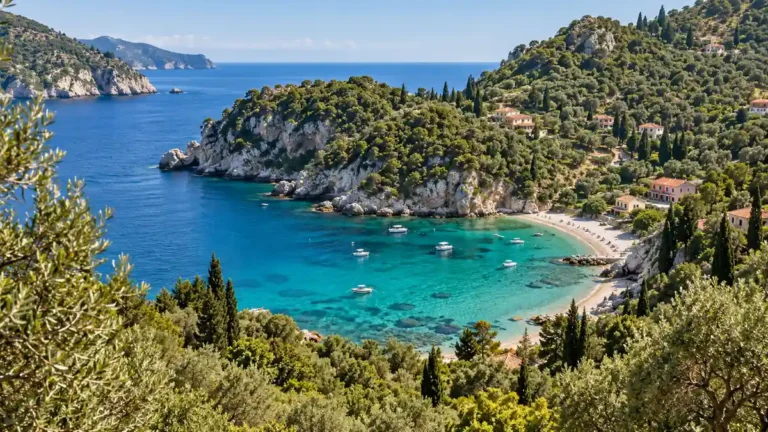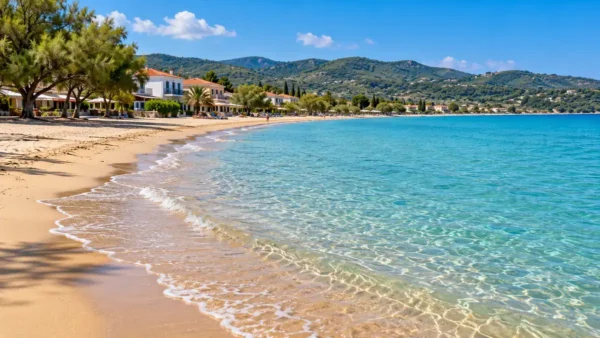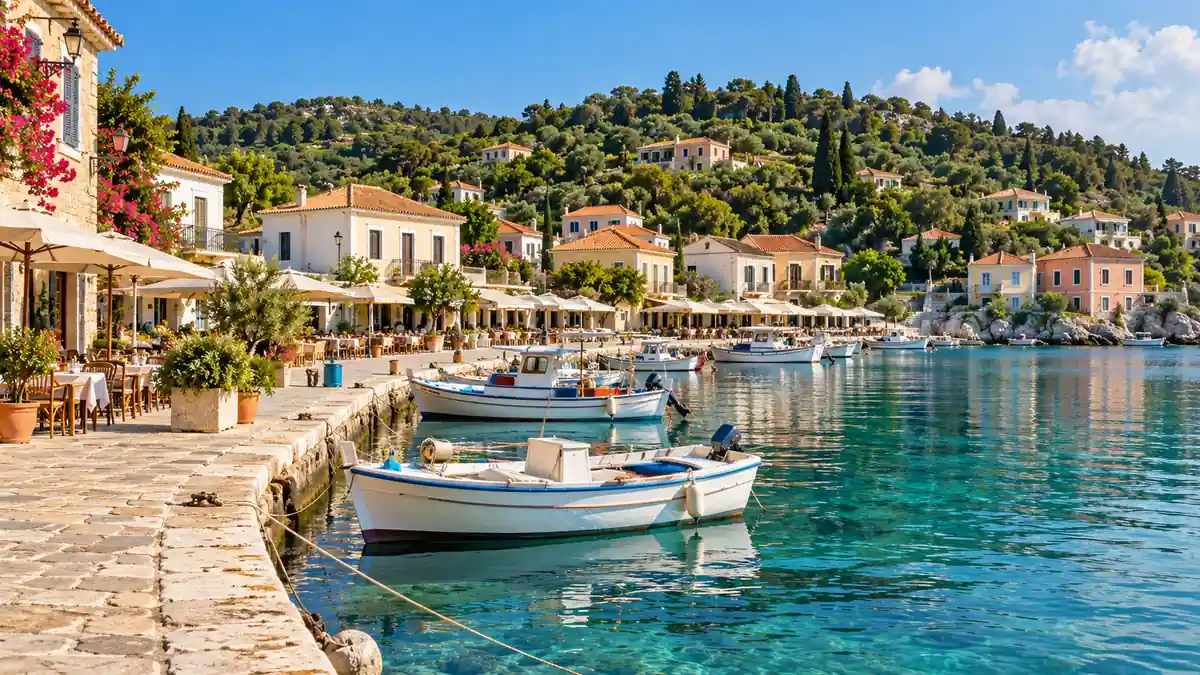
Travel to Corfu, Greece, pays off for anyone who wants a Venetian-era old town and green, cove-lined coasts on one island, and two choices shape the trip: where you base yourself and whether you drive. The island splits into four broad zones — Corfu Town on the east coast, the sheltered north-east coast around Kassiopi, Dassia and Ipsos, the cliff-backed west coast around Paleokastritsa, Glyfada and Pelekas, and the resort-heavy south around Kavos. Mountain roads link them slowly, so your base decides what you can reach in a day.
The season matters just as much. Beach resorts run roughly from May to September or October, while Corfu Town works closer to year-round. This guide settles the planning decisions for a first trip: whether Corfu suits you, how many days to give it, when to go, where to base, how to arrive and get around, what drives the cost, and which day trips are worth the crossing. Sight-by-sight detail, hotel picks and day-by-day plans live in the linked guides.
Quick Answer
Corfu is worth visiting for travelers who want a historic old town and beach coves on one green island. Three to four days covers Corfu Town plus one coast; five or more, or a car, opens the whole island. Base in Corfu Town for history and buses, or on the north-east or west coast for beaches.
Coverage, Credits and Sources
A planning guide to a first trip to Corfu: season, base, arrival and getting around, trip length, day trips and broad cost. It is not a list of things to do in Corfu, a resort-by-resort stay guide, a day-by-day itinerary or a bus timetable.
For the Tripstou editorial team, Alex Perrut, working in tourism since 2015, reviewed this Corfu guide, whose first draft was written with AI assistance; the editorial process page explains what that review covers.
Official sources consulted: Visit Greece, Greek Ministry of Tourism, Ionian Seaways.
Jump to a Section
Is Corfu Worth Visiting, and Who It Suits
Corfu is worth visiting if you want a Venetian old town and beach coves without choosing between them. It is greener than the Cyclades, and it suits families, couples and first-time Greece visitors. The one condition: the island rewards a car or a well-chosen base, because mountain roads make distances slow.
Corfu suits travelers who want variety within a short radius. Families do well on the sheltered north-east coast, where the water is calmer and Corfu Town stays within easy reach. Couples and road-trippers get the most from the west coast, with its cliffs, coves and sunsets. First-time visitors who find the Cyclades too bare often prefer Corfu’s cypress and olive landscape. To see where the island sits among the country’s other island groups, start with the guide to the Greek islands.
Corfu disappoints in a few situations. Car-free travelers hoping to hop between beaches in May or October will find buses thin and resort services winding down. Winter is not a beach trip. Resorts close, and only Corfu Town keeps a full rhythm. Anyone after quiet should avoid basing in Kavos, a party resort in the south built around nightlife.
Corfu is a low-stress island for most visitors, and standard precautions cover busy resorts and the port. The Corfu safety guide covers where to take care, the guide to common scams in Greece explains the tricks to recognise, and women travelling alone can plan with the Greece solo female safety guide.
Corfu’s greenness is also its logistics problem: the mountains that make the west coast beautiful are the same ones that make it slow to reach from town.
What Is Corfu Known For?
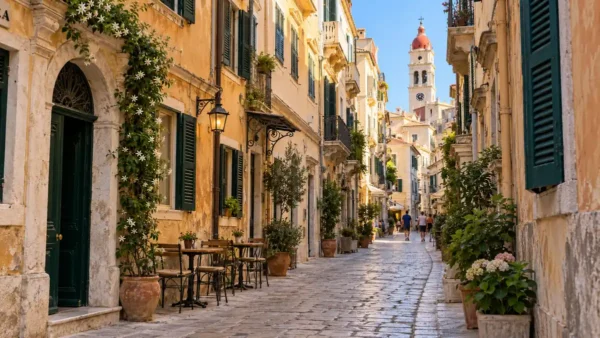
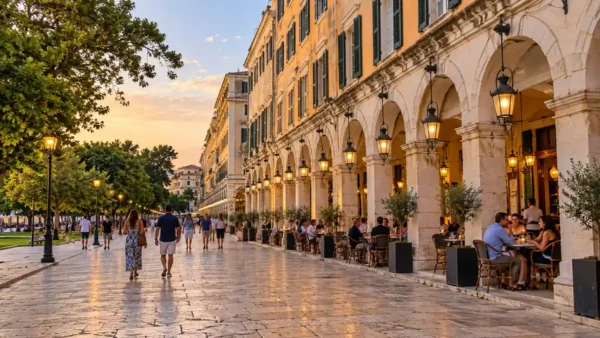
Corfu is known for its UNESCO-listed Old Town, its Venetian fortresses, and green coves on the west coast. The Old Town packs the Old and New Fortresses, the Liston arcade and the Spianada square into a walkable core. Beyond town, the Achilleion palace and the cliffs at Paleokastritsa define the island’s image.
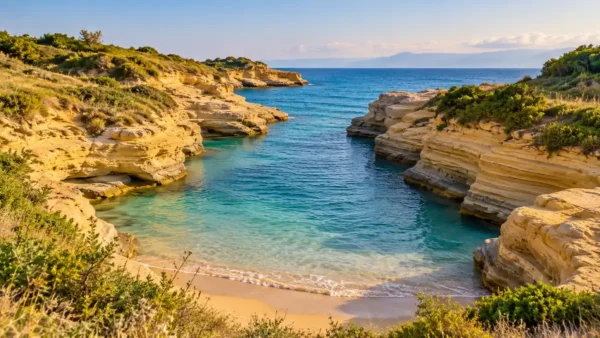
Inside the Old Town, the Church of Saint Spyridon holds the relics of the island’s patron saint and anchors the lanes behind the Liston. The Achilleion, built for Empress Elisabeth of Austria, stands in the hills south of town near Gastouri. On the west coast, the bays of Paleokastritsa lie below the ruined Byzantine castle of Angelokastro. The north-east has Kassiopi, a harbour village with a castle ruin. The north coast adds the sandstone channels of the Canal d’Amour at Sidari and the twin coves of Porto Timoni near Afionas.
The Old Town is the one landmark you can see without transport; every other name here needs a bus or a car. The things to do in Corfu guide resolves how to see each one, and the best beaches in Greece guide places Corfu’s coves among the country’s strongest beach options.
Best Time to Visit Corfu, and When the Resorts Close
Visit Corfu between May and early October for beaches; Corfu Town alone works most of the year. Resorts and most international flights run roughly from May to September or October. Outside that window, many coastal hotels and tavernas close, buses thin out, and the trip becomes a Corfu Town stay.
- Late spring (May to June): green hills, open beaches and lighter crowds, a good match for walkers and couples; the sea is still cool early in the window.
- Peak summer (July to August): every resort and route running at full capacity. Families tied to school holidays travel now, with beaches and prices at their busiest.
- Early autumn (September to early October): warm sea and thinning crowds. It suits beach trips without the peak, though some resorts wind down as October goes on.
- Winter (November to April): resorts closed and fewer buses, which leaves a Corfu Town city break, never a beach trip.
Shoulder season on Corfu favours drivers. Beaches stay open while bus service thins, so a car matters more in October than in August. For how Corfu’s calendar fits the rest of the country, see the best time to visit Greece, and match your bag to the month with the Greece packing list.
Choosing a Base: Corfu Town, the North-East, the West or Kavos
Base in Corfu Town for history and transport, or on the north-east or west coast for beaches. Corfu Town has the food, sights and bus hub but no real beach. The north-east gives sheltered beaches close to town, the west coast gives scenery and sunsets, and the south means Kavos nightlife.
| Zone | Main places | What it gives | Best for |
|---|---|---|---|
| Corfu Town | Old Town, Liston, the port and both bus hubs | History, tavernas and the island’s best bus connections | Car-free travelers and short stays putting culture first |
| North-east coast | Kassiopi, Dassia and Ipsos along the coast road | Sheltered beaches and calm water within reach of town | Families wanting beach days with easy town access |
| West coast | Paleokastritsa, Glyfada and Pelekas above dramatic bays | Cliffs, sandy coves and sunsets, with slower connections | Couples and drivers who prioritise scenery over convenience |
| South | Kavos at the island’s southern tip | Party-resort nightlife built around bars and clubs | Groups chasing nightlife, not travelers seeking quiet |
A beach base far from town costs you the buses, and a town base costs you the beach. The north-east coast half-solves both. Resort-level choices sit in the Corfu where-to-stay guide, first-timers can narrow the zones with the guide to where to stay in Corfu for a first visit, and parents can start with the best areas in Corfu for families. For hotels on the sand, see the best beach hotels in Corfu.
Hotels and places to stay
Compare hotels, apartments and stays for your dates in one search.
Search hotels and stays on hotels.com →
Tripstou may earn a commission if you book through this link, at no extra cost to you.
How to Get to Corfu by Air or Ferry
Most travelers fly into Corfu Airport; the alternative is a short ferry from Igoumenitsa on the mainland. The airport, Ioannis Kapodistrias (CFU), sits just south of Corfu Town and has year-round flights from Athens and Thessaloniki, with international routes mostly seasonal. Ferries from Italy suit travelers driving their own car.
Flying is the default for a first trip, especially in summer, when international routes land directly. Off-season, a connection through Athens or Thessaloniki is the usual route in. The Igoumenitsa ferry suits travelers already on the mainland, such as those driving the north-west. Longer ferries from Ancona, Bari and Venice suit a road trip starting in Italy. Corfu is also a ferry-linked island, and the Greece island-hopping guide shows how it connects to a wider route. For the country-level picture, start with the Greece travel guide.
How do you get from Corfu Airport to Corfu Town?
City bus line 15, one of the blue buses, links Corfu Airport with Corfu Town. It stops at the green intercity bus station, San Rocco Square and the port, so it also works for a same-day ferry connection. It is a cheap city bus, and tickets are bought before boarding at kiosks or machines. Taxis and pre-booked transfers are the alternative. The Corfu airport transport guide compares every option, and the Corfu transport guide covers onward buses.
Getting Around Corfu: Blue Buses, Green Buses or a Car
Blue buses cover Corfu Town and its suburbs, green KTEL buses the rest; a car unlocks everything else. Buses reach the main resorts and villages, but their routes are built around Corfu Town. Travelers who want to hop between coves on different coasts or explore the quieter north should plan on a car or scooter.
- Blue city buses: lines such as 2 to Kanoni, 7 to Dassia and Ipsos, 10 to the Achilleion and 11 to Pelekas. They work for town-based stays but stop where the suburbs end.
- Green KTEL intercity buses: routes to Paleokastritsa, Sidari, Kavos, Acharavi and Roda. They suit resort trips from town; linking two coasts usually means changing in Corfu Town.
- Car or scooter: the only way to reach the west coast, the north and the south on your own schedule. This is the road-trippers’ option; mountain roads are narrow and slow, and scooters suit confident riders only.
Bus service is thinner out of season and on Sundays. You do not need a car for Corfu Town plus the north-east coast. You do need one for a west-coast base, or to cover the whole island in under a week. Routes and ticket logic are in the Corfu transport guide, the Greece road trip guide covers driving and rental practicalities, and the practical advice for Corfu covers the on-the-ground habits that save time.
The bus network is shaped like a star around Corfu Town, so a town base gets the most from it and a coastal base the least.
How Many Days Do You Need in Corfu?
Three to four days covers Corfu Town and one coast; five or more lets you see the whole island. A short stay works from a single base with buses. A longer one pays off with a car or a split between Corfu Town and a coastal resort, because mountain roads slow every cross-island move.
- Two days: Corfu Town, the fortresses and one short excursion by blue bus. It fits a stopover or a ferry connection, not a beach holiday.
- Three to four days: Corfu Town plus one coast, reached by bus or a short car hire. It suits first-timers who want both history and beach time.
- Five to seven days: the west coast, the north and a day trip to Saranda or Paxos, from a split base or with a car. Road-trippers and families on a beach week get the most from this length.
Day count and base interact on Corfu. A town base with buses covers less ground per day than a coastal base with a car, so a longer trip without a car still sees less than you expect. Ready-made pacing sits in the 2-day Corfu itinerary and the 3-day Corfu itinerary. If Corfu is one stop in a wider trip, the 7-day Greece itinerary and the 10-day Greece itinerary show how to pace the rest of the route around it.
A fifth day spent in the wrong base buys less on Corfu than a third day spent in the right one.
Day Trips From Corfu, Ranked by Travel Time
Saranda in Albania is Corfu’s best day trip: 30–45 minutes by hydrofoil from Corfu Town port. It is the easiest trip off the island, with a slower car ferry on the same route. Paxos works as a day out by excursion boat or via Lefkimmi, and the rest of the island’s highlights are on-island drives.
- Saranda, Albania: the Ionian Seaways hydrofoil takes 30–45 minutes, and the passenger and car ferry 55–70 minutes. Saranda is the gateway to the ancient site of Butrint. Albania is outside the EU, so carry your passport. Check the entry rules that apply to your passport before booking.
- Paxos: boats to Gaios leave from the port of Lefkimmi in the south, run by Kamelia Lines, and excursion boats also sail from Corfu Town. It suits travelers who want a second, smaller island in one day.
- On-island trips: Paleokastritsa, the Achilleion, Kassiopi and Pelekas need no crossing. They fill a quieter day by bus or car.
Paxos looks closer on the map than it is in practice. The fast route leaves from Lefkimmi in the far south, so the day starts with a long run down the island. If Corfu opens a longer journey, the Greece island-hopping guide covers onward ferries, the guide to the best places in Greece helps choose the next stop, and the Greece itinerary planner and 14-day Greece itinerary show how the pieces fit together.
Tours and activities
Book skip-the-line tickets, day trips and local tours with free cancellation on most activities.
You can also browse everything on getyourguide.com.
Tripstou may earn a commission if you book through this link, at no extra cost to you.
Is Corfu Expensive? Cost by Season, Base and Car
Corfu is a mid-priced Greek island: resort beach fronts in August cost most, Corfu Town in shoulder season least. It is cheaper than Mykonos or Santorini and pricier than the mainland in high summer. Season, base and whether you rent a car move the total more than anything else.
- Budget: simple rooms in Corfu Town or an inland village, bakery and gyros lunches, taverna dinners away from the beach strips, and blue and green buses. Corfu rewards this style in town and punishes it in August resorts, where cheap rooms are scarce.
- Mid-range: a family-run hotel or apartment on the north-east coast, sit-down taverna meals, and a car for the days you explore. This is where Corfu gives the best value for a beach week.
- High-end: a boutique hotel in the Old Town or a villa or beach resort on the coast, with private transfers and boat hire. Peak-season demand for villas makes early planning the main lever here.
Hiring a car only for the days you head to the far coasts, and taking the bus the rest of the time, is the cheapest way to see the whole island. Daily bands by spend style are in the Corfu trip cost guide. For the national picture, see the Greece trip cost guide, and the Greece food guide explains what to order in a taverna.
Did this guide save you time or money? Tripstou is independent and reader-funded — if you'd like to give something back, you can support the site with a crypto contribution of any size.