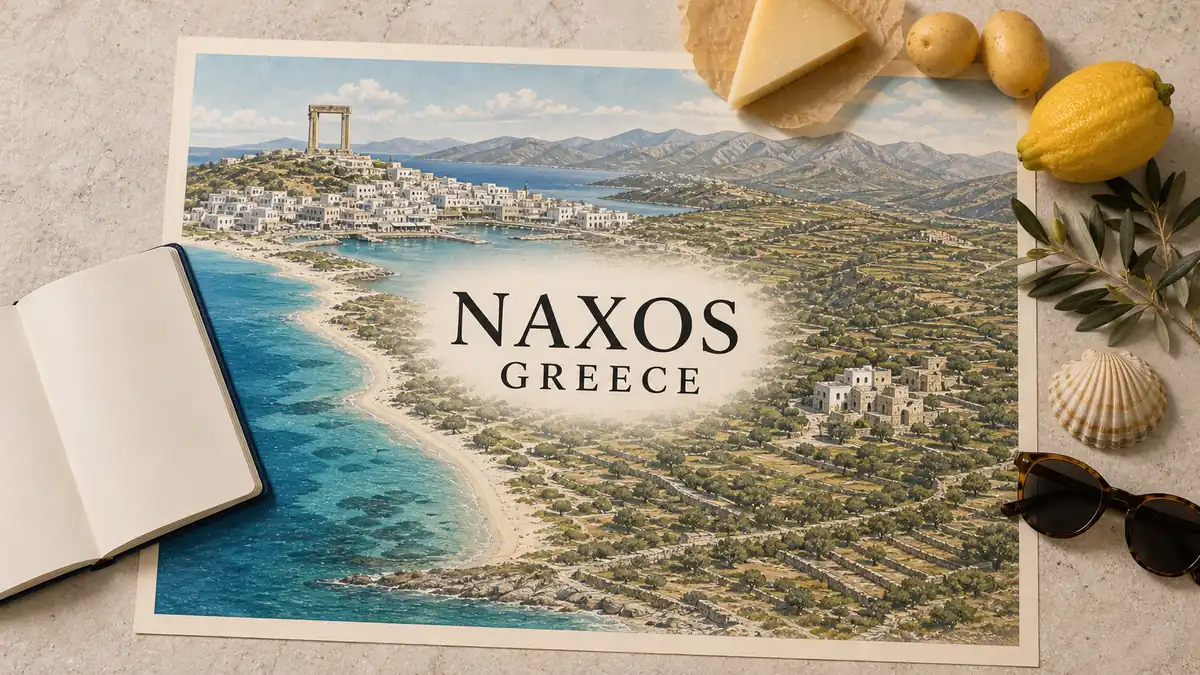
You have narrowed Greece down to Naxos and now need to know whether to commit. Naxos is the largest island in the Cyclades and the most self-sufficient — a place with farms, cheese, potatoes and citrus groves, working mountain villages, and a west coast lined with long, shallow, sandy beaches. That combination makes it the group’s all-rounder: the strongest family pick in the Cyclades, easier on the budget than Santorini or Mykonos, and the slow middle of the classic ferry chain that most first island-hopping routes follow.
This guide resolves the six decisions that come before booking: whether Naxos is worth it and who it suits, how you actually get there, when to go, how long to stay, how the island is laid out, and how it compares with the islands next to it. The depth topics — where to stay, what things cost, getting around, day plans — each live on their own page, linked where they belong.
Quick Answer
Yes — Naxos is the Cyclades’ best all-rounder: real working villages, long shallow beaches, and the group’s strongest family pick. Trip length is the main variable: four to five nights is comfortable, three the working minimum. Arrive by ferry. It suits families, first-timers and one-week travelers wanting value Santorini and Mykonos cannot match.
Trust Layer
Tripstou city guide for travelers planning a city trip. Covers trip length, stay style, season, cost, and mobility tradeoffs.
Produced with AI assistance and reviewed by Alex Perrut, working in tourism since 2015, for the Tripstou editorial team. See our editorial process for details.
Last factual review: August 29, 2026.
Official sources consulted: Visit Greece, Greek Ministry of Tourism.
Key Takeaways
- Naxos is the Cyclades’ all-rounder: the largest island in the group, self-sufficient, and its strongest family pick.
- Arrive by ferry from Piraeus, Rafina or Lavrio; the crossing runs roughly four to nine hours depending on the vessel.
- Book four or five nights for comfort, three as the working minimum, and a full week if the mountain interior interests you.
- June and September balance a warm sea, open facilities and manageable crowds better than the heat and crush of high summer.
- Think in three zones — west-coast beach strip, mountain interior, quiet south and north — and every other decision gets easier.
- Naxos costs less than Santorini or Mykonos without feeling like a compromise, which is why it rewards a longer stay.
Table of Contents
Is Naxos Worth Visiting — and Who Is It For?
Naxos is worth visiting, and it is the most complete all-round island in the Cyclades. It is the largest in the group, self-sufficient, ringed by long shallow sandy beaches and backed by working mountain villages. It suits families, first-timers, one-week travelers and couples who want substance without caldera prices.
The fit is clearest by contrast. Travelers who want a caldera-view honeymoon or a hard-partying week will be happier on Santorini or Mykonos, and they should choose accordingly. Naxos gives you a place to live in for a week: a port town with a real centre, farmland behind it, and a coast you can walk into rather than climb down to.
The authenticity here is agricultural, not curated. Naxos grows its own potatoes, presses its own citrus, and makes cheese that leaves the island by ferry — the villages had a reason to exist long before the first traveler arrived, and they still do. That is the difference you feel walking through Halki at nine in the morning.
Naxos is one of the few Cycladic islands that would still function if tourism stopped tomorrow, and that is precisely why it stays cheaper than its neighbours — the local economy is not organised around extracting a season’s income from visitors.
On money, the short version is that Naxos is gentler on the budget than Santorini or Mykonos across stays, eating and transport, without feeling like a compromise. The detail belongs elsewhere: see what a Naxos trip costs for the island-level picture, and Greece trip costs for the country-level baseline. If Naxos is still competing with mainland options on your shortlist, the best places to visit in Greece frames the wider choice.
Is Naxos good for families?
Naxos is the strongest family island in the Cyclades. The west-coast beaches shelve gently into shallow water, distances are short, and there is enough space that nothing feels squeezed. Family-sized rooms and apartments are common here in a way they are not on the glamour islands. For the stay decision, go to where to stay in Naxos with family and the best family hotels in Naxos.
How to Get to Naxos from Athens
Ferries are the way to reach Naxos from Athens, sailing from Piraeus, Rafina or Lavrio. The crossing runs roughly four to nine hours depending on the vessel and the route it takes. Naxos also has a small national airport, but that is the exception, not the plan.
Your arrival options come down to three:
- Ferry from Athens — Piraeus is the main port, with Rafina and Lavrio as alternatives depending on the operator and where you are staying in Athens.
- Ferry from another island — Naxos sits on the busiest routes in the Cyclades, with connections to Paros, Mykonos, Santorini, Tinos, Amorgos and the Small Cyclades.
- Flying in — the airport is small and close to town, with limited service; treat it as a bonus, never as the backbone of the plan.
Ferry-first arrival changes how you plan day one. A long crossing eats a morning or an afternoon, so the sensible move is to treat arrival day as a half day: port, base, a first swim, dinner. Book the return leg with the same honesty — an early sailing back to Athens costs you the last morning. The seasonal shape matters too: sailings are dense through high summer, thinner in the shoulder months, and reduced to a skeleton service in winter.
Naxos being on the main chain is its quiet advantage — it is one of the easiest islands in the group to slot into a multi-island route without backtracking, which is why island hopping in Greece so often runs through it. For the transfer between the airstrip and your base, see Naxos airport transport.
Train and bus tickets
Compare routes, schedules and prices across rail and bus operators in one search, with mobile tickets on your phone.
New to Omio? Code NEW10 takes 10% off your first booking — or APPNEW10 if you book inside the Omio app. Both apply to bookings up to €80.
Search routes and compare prices on Omio →
Tripstou may earn a commission if you book through this link, at no extra cost to you.
When to Visit Naxos
June and September are the sweet spot for Naxos, inside a season that runs roughly April to October. High summer brings the fullest facilities and the busiest beaches, plus the strongest heat and the thickest crowds. Shoulder months are calmer and cooler, with thinner ferry links and fewer places open.
The trade-off has three moving parts, and they pull against each other. Heat and crowds peak in July and August. Facilities also peak then — most seasonal tavernas, beach setups and boat trips are running, and most hotels stay open to about the end of October. Ferry links follow the same curve, densest in mid-summer and progressively thinner either side of it. Pick the month that balances the two things you care about most.
| Period | Crowds | Heat | What is open | Ferry links |
|---|---|---|---|---|
| April to May | Very quiet, mostly local rhythm | Mild, warm days and cool nights | Opening up gradually through spring | Building, fewer routes than summer |
| June | Busy but still comfortable | Hot without being punishing | Effectively everything is running | Strong, close to full summer service |
| July to August | Peak, beaches and town both full | Hottest, with strong summer winds | Fullest facilities of the whole year | Densest connections across the Cyclades |
| September | Easing off week by week | Warm, with the sea at its warmest | Almost everything still open | Still strong, tapering late in month |
| October | Quiet, an island winding down | Mild, swimming becomes a gamble | Most hotels open to about month end | Thinning noticeably as season closes |
| Winter | Local life only, no visitor season | Cool, wet and often very windy | Skeleton, mainly year-round businesses | Reduced to a basic lifeline service |
September is the underrated half of the sweet spot. The Aegean has had all summer to warm up by then, while June water still carries a chill that surprises people who booked for the weather forecast alone. If you are choosing between Naxos and a mainland leg by season, the best time to visit Greece sets the national pattern. Shoulder-season visitors should pack for wind and cool evenings as well as sun — the Greece packing list covers it.
How Many Days You Need in Naxos
Three nights is the working minimum on Naxos, four or five is comfortable, and a full week is genuinely justified. The island is large enough that beaches, mountain villages and quiet corners are separate outings, not a single loop. Shorter trips work, but they force a choice between coast and interior.
Here is the reasoning. Three nights gets you the beach strip and Chora properly, with one day inland — enough if Naxos is one stop on a hopping route. Four or five nights adds the interior without rushing it and leaves room for a weather day, which is the right answer for most first visits. A week is where Naxos separates itself from the smaller islands: the mountain villages are a genuinely different holiday from the west coast, and the far south and north still have something left after that. Families and one-base travelers are the ones who should book it — a week here does not run dry.
Length is the decision this page makes; the sequence belongs elsewhere. For short stays, follow the 2-day Naxos itinerary or the 3-day Naxos itinerary. If Naxos is one leg of a bigger trip, Greece itinerary planning shows how it fits, with worked routes at 7 days in Greece, 10 days in Greece and 14 days in Greece.
How Naxos Is Laid Out: Beach Coast, Chora and the Villages
Naxos divides into three zones: Chora and the west-coast beach strip, the mountain interior, and the quiet south and north. Almost everything a first visit needs sits on the west coast, within a short run of the port town. The interior and the far ends reward the travelers who go looking for them.
- Chora and the west coast — the port town, its old quarter and the Portara headland, with the sandy strip running south: Agios Georgios, Agios Prokopios, Agia Anna, Plaka, Mikri Vigla and Alyko. This is the shallow, sandy, wind-exposed side of the island, and it is where most visitors base themselves.
- The mountain interior — a working landscape of terraces, olive groves and stone villages, with Halki and Apiranthos as the two you will hear named most often. Higher, greener and cooler than the coast, and a genuinely different day out from anything on the beach strip.
- The quiet south and north — thinner development, longer drives, and Apollonas at the northern tip as the natural end point of the coastal road. This is where the island empties out, and where the extra nights of a longer stay finally earn their keep.
The headline draws are easy to name and belong on their own page: the Portara at sunset, the hill villages, and the beach strip itself. For the full list, see things to do in Naxos, and for the corners most visitors miss, hidden gems in Naxos. The west-coast beaches read differently once you see them in national context — the best beaches in Greece places them.
One practical consequence of this geography: how far beyond Chora you intend to go is what decides your getting-around question. Stay on the west-coast strip and you barely need to think about it. Push into the interior or up to Apollonas and you are on mountain roads. Both cases are covered in getting around Naxos, and the wider driving picture sits in the Greece road trip guide.
Naxos or Paros, Santorini and Mykonos: How to Choose
Choose Naxos for the all-round week, families and value for money. Paros is smaller and more scene-led, Santorini sells the caldera moment at caldera prices, and Mykonos is priced around its nightlife. The right island depends on whether you want a place to stay or a place to see.
If your shortlist is Naxos against Santorini, you are usually comparing two different holidays: one you live in, one you look at. Santorini earns its reputation on a view and a two-or-three-night stay; Naxos earns its on breadth, and it repays a longer booking. Mykonos is a straightforward fit test — if the nightlife is the reason, go; if it is not, you are paying for it anyway. Paros is the closest genuine rival, smaller and busier in feel, and travelers often pair the two by ferry instead of picking one. If Naxos still sounds too developed for what you want, Milos is the quieter direction to look.
This page caps the comparison there on purpose. The full selection job — every island in the group, side by side — lives at the Cyclades guide, and the wider national choice at the Greek islands guide.
Planning the Rest of Your Naxos Trip: Stays, Costs and Practicalities
The depth topics on Naxos each have a dedicated page, and this section points you to the right one. Stays, costs, transport, day plans and practical gotchas are resolved elsewhere in detail. Use whichever matches the decision in front of you right now, and skip the rest.
- Where to base yourself — the areas genuinely differ, and the choice turns on whether you will have a car; start at where to stay in Naxos.
- Stay by travel style — resolved separately for , first-time visitors.
- Practical gotchas — the small things that catch first-timers out are gathered in Naxos travel tips.
- Safety — Naxos is a low-risk, low-crime island; for the reassurance in detail see is Naxos safe, plus common scams in Greece and solo female travel safety in Greece.
- Eating — the island’s own produce is the point here, and the national context sits in the Greek food guide.
- Wider planning — for everything above island level, go to the Greece travel guide.
Frequently Asked Questions
How long is the ferry from Athens to Naxos?
The crossing takes roughly four to nine hours, depending on the vessel and the route it follows. High-speed boats sit at the fast end, conventional ferries at the slow end, and sailings that call at other islands on the way add time. Departures leave from Piraeus, Rafina or Lavrio.
Does Naxos have an airport?
Yes. Naxos has a small national airport a short distance from Chora, served by domestic flights only, so there is no direct international arrival. Service is limited, which is why almost everyone reaches the island by ferry. Treat a flight as a useful bonus, not the backbone of your plan.
How big is Naxos compared with the other Cyclades islands?
Naxos is the largest island in the Cyclades, and the scale shows on the ground. Crossing from the west-coast beaches to the mountain villages, or up to the northern tip at Apollonas, is a proper outing, not a quick hop — which is exactly why the island absorbs a longer stay.
Is Naxos still open in October?
Mostly yes, though the island is winding down. The season runs roughly April to October, and most hotels stay open to about the end of October before the winter shutdown. Expect thinner ferry links, fewer seasonal tavernas and beach setups, milder days and swimming that becomes a gamble.
Is Naxos a good first Greek island?
It is one of the best. Naxos gives first-timers a real, self-sufficient island — working villages, farmland, a port town with its own life — plus easy shallow beaches and simple ferry connections from Athens. Nothing about it demands experience, and it sets a fair benchmark for every island after it.
Can you visit Naxos and Santorini on the same trip?
Yes, and it is a common pairing. Both sit on the same ferry chain through the Cyclades, with direct connections running through the summer season. The usual shape is a short Santorini stay for the caldera and a longer Naxos base for beaches, villages and everything else.
Related Guides
- The Cyclades guide — choose between all the islands in the group.
- Where to stay in Naxos — the area and base decision resolved in full.
- Things to do in Naxos — the complete list of draws across the island.
- 3 days in Naxos — a worked day-by-day plan for a short stay.
- Naxos trip cost — what a trip here actually adds up to.
- Greece island hopping — fitting Naxos into a multi-island route.
- Greece travel guide — the country-level planning hub.
Did this guide save you time or money? Tripstou is independent and reader-funded — if you'd like to give something back, you can support the site with a crypto contribution of any size.