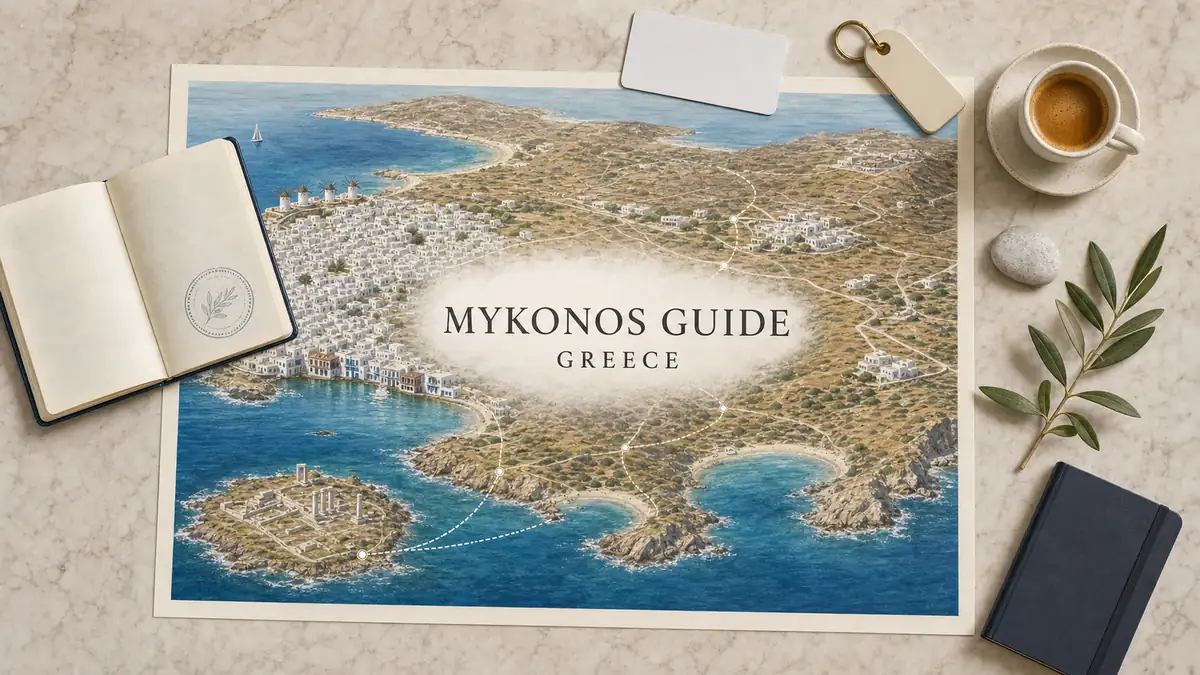
Mykonos has a party reputation, and it is real — but it is only part of the island. Beach clubs on the south coast and Chora’s late-night bars run at full volume through the summer, while a few kilometres inland Ano Mera goes about its ordinary business and Agios Sostis sits undeveloped on the north shore with no sunbeds at all. Both versions are the same island. This guide resolves the decisions that actually shape a trip here: whether Mykonos is worth it for the kind of traveler you are, what the island is known for, how many days it needs, when to go, where to base yourself, how to move around, and what it costs in broad terms. One thing matters more than the rest. The Mykonos you have seen in photographs exists roughly from May to September, and the calendar decides most of what follows.
Quick Answer
Mykonos is worth visiting for its beaches, beach-club nightlife and the whitewashed maze of Chora, if the price fits. Season is the decision that makes or breaks the trip: the island most travelers picture runs roughly May to September. Base in Chora for walkability or a south-coast beach area; 2–3 days suits most.
Trust Layer
Tripstou city guide for travelers planning a city trip. Covers trip length, stay style, season, cost, and mobility tradeoffs.
Produced with AI assistance and reviewed by Alex Perrut, working in tourism since 2015, for the Tripstou editorial team. See our editorial process for details.
Last factual review: September 1, 2026.
Official sources consulted: Visit Greece, Greek Ministry of Tourism.
Key Takeaways
- Mykonos rewards travelers who want beaches with a scene attached; budget-first and crowd-averse visitors get more elsewhere in the Aegean.
- The island most people book runs roughly May to September; from mid-October much of the hotel and beach-club stock closes.
- Two to three days covers Chora, one beach base and Delos; extra days here cost more than anywhere else in the Cyclades.
- Sleep in Chora and travel out to the beaches; nightly taxis from a beach base are where Mykonos budgets break.
- The Meltemi blows from the north, so a windy forecast moves your beach day south instead of cancelling it.
- The party scene is concentrated in a few named beaches and months, so avoiding it is a matter of where you sleep.
Table of Contents
Is Mykonos Worth Visiting?
Mykonos is worth it for beach-club energy, Cycladic-town beauty and easy beaches — if the price fits. The island delivers on its reputation: sandy south-coast bays, a genuinely beautiful main town, and nightlife with international pull. The honest counter is crowds and cost, both of which peak exactly when the weather does.
Mykonos suits travelers who want beach days with something attached to them — a bar, a scene, a town worth walking after dinner. It also suits people travelling short: everything sits close enough that a two-night stop still feels complete. Photographers and first-time Cyclades visitors get an unusually high return per hour here, because Chora is compact and consistently beautiful at every time of day.
Three types of traveler should book a different island. Budget-first travelers will find their money goes further almost anywhere else in the Aegean; crowd-averse travelers will struggle with Chora’s high-summer lanes; and anyone whose trip is built around archaeology and ruins will exhaust Mykonos quickly, since Delos is the depth and it sits offshore. If any of those is you, compare the options in our overview of the Greek islands and who each one suits, or widen the search with the best places to visit in Greece. Picking the wrong island here is more expensive than any booking mistake you can make later, because Mykonos charges peak rates for the error.
Mykonos is a low-risk destination for most visitors, with the usual island caveats around scooters, late nights and drink prices — the detail lives in our Mykonos safety guide and, for women travelling alone in Greece, in our guide to solo female safety in Greece.
Is Mykonos just a party island?
No — the party scene is concentrated, not universal. It clusters in a few named places and a narrow window: Paradise and Super Paradise on the south coast, Chora’s bar streets after dark, and roughly mid-June to mid-September at full tilt. Step outside that geography and that calendar and Mykonos changes character completely. Ano Mera is a working inland village around the Panagia Tourliani monastery. Agios Sostis on the north coast has no sunbeds and no music. Shoulder-month mornings in Chora belong to shopkeepers and cats.
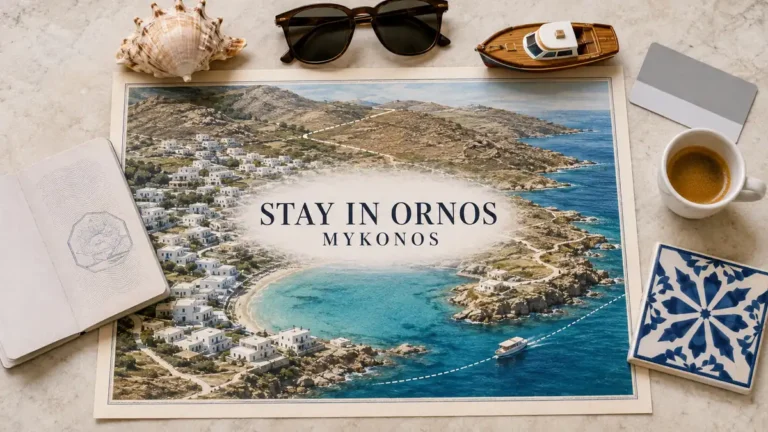
The practical consequence is that avoiding the party scene on Mykonos is a matter of where you sleep, not whether you come. A traveler based in Ornos — a sheltered family bay a short bus ride from town — in late May and a traveler based at Paradise in late July are describing two different islands, and both are describing them accurately.
What Mykonos Is Known For
Mykonos is known for Chora’s whitewashed maze, Little Venice sunsets, the Kato Mili windmills, and beach-club culture. Those four things account for most of what visitors photograph and book. Offshore, the archaeological site of Delos adds the island’s historical weight, and inland Ano Mera keeps a quieter village core.
Chora, the main town, is a deliberate labyrinth of low white houses and painted doors that motor vehicles cannot enter — you walk it, and getting lost is the intended experience. Little Venice is the row of old merchant houses built with their balconies out over the water, which is why it fills at sunset. The Kato Mili windmills are the sixteenth-century grain mills on the hill above the harbour, and they are the island’s signature silhouette. The beach clubs at Paradise and Super Paradise are what turned Mykonos into an international nightlife name, while Psarou built the polished, see-and-be-seen version of the same idea.
Two more names balance the picture. Ano Mera, in the island’s interior, is built around the Panagia Tourliani monastery and a village square with tavernas — the counterweight to Chora’s intensity. Delos, a short boat trip away, is the ancient sacred island and one of the most significant archaeological sites in Greece; it is the reason many visitors add a half-day that has nothing to do with beaches. For the full selection of sights, boat trips and how to prioritise them, use our guide to things to do in Mykonos.
Tours and activities
Book skip-the-line tickets, day trips and local tours with free cancellation on most activities.
You can also browse everything on getyourguide.com.
Tripstou may earn a commission if you book through this link, at no extra cost to you.
How Many Days You Need in Mykonos
Two to three days covers Chora, a beach base and a Delos trip for most travelers. Mykonos is small, and its core attractions sit within a short drive of each other. Add a fourth or fifth day only if you want beach time as the point of the trip instead of a bonus.
- Two days — Chora plus one south-coast beach. Enough for a Cyclades stopover, but Delos will not fit comfortably.
- Three days — the same, with room for Delos or a second beach at an unhurried pace. This is the pacing most first-time visitors should book.
- Four to five days — a beach-led trip: slow mornings, a different bay each day, an evening inland in Ano Mera for dinner away from the coast. Suits travelers who came to swim, not to sightsee.
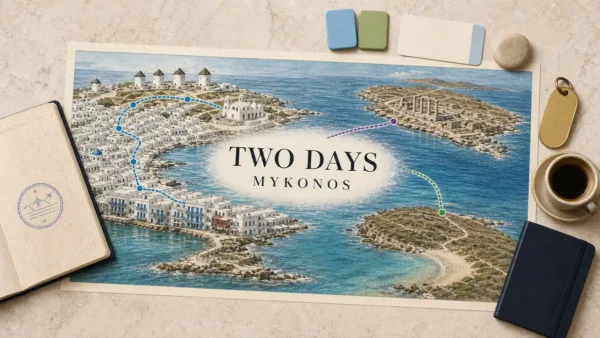
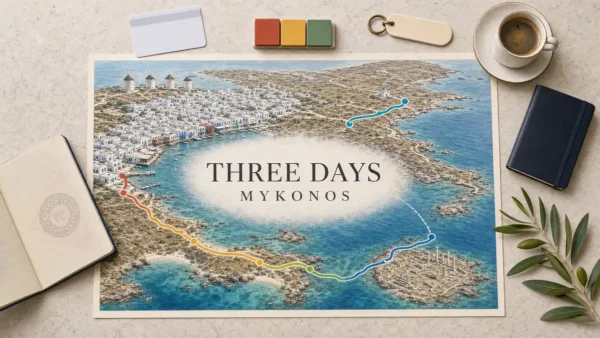
Because Mykonos is expensive, extra days here cost more than extra days almost anywhere else in the Cyclades — which is why the island works better as an intense short stop than as a long slow base. For day-by-day execution, follow our 2-day Mykonos itinerary or the 3-day Mykonos itinerary. If Mykonos is one leg of a larger route, our Greece itinerary planner shows where it fits without eating the whole budget.
When to Visit Mykonos — and What Closes Off Season
The Mykonos most people book — beach clubs, dining, nightlife — runs roughly May to September. From mid-October much of the hotel, restaurant and beach-club stock closes for the winter. What remains is a quieter, legitimate island: open lanes, sea views, far fewer places to eat, drink or sleep.
June through September is peak. The sea is warm, everything is operating, and crowds and prices are at their highest. May and early October are the shoulder: warm enough for beach days, noticeably calmer in Chora, with most of the island still open but the nightlife scene either not yet started or already winding down. From mid-October to April, Mykonos becomes an off-season island — beautiful, cheap and largely shut.
| Season band | Crowds and prices | What is operating | Best for |
|---|---|---|---|
| Peak (June to September) | Busiest lanes, highest rates of the year | Full island: hotels, beach clubs, nightlife | Travelers who came for the scene and the sea |
| Shoulder (May, early October) | Calmer town, softer accommodation pricing | Most hotels and tavernas; limited club scene | Beach days without the high-summer crush |
| Off season (mid-October to April) | Very few visitors, lowest prices of the year | A limited core of town and village businesses | Photographers and travelers wanting empty streets |
Late September is the quiet arbitrage on Mykonos: the sea is at its warmest after a full summer of heating, the clubs are winding down without being closed, and Chora has stopped queueing. For how the island calendar sits inside the country’s wider weather and crowd pattern, see our guide to the best time to visit Greece.
What’s actually open in the off season?
A limited core stays open: a handful of tavernas and cafes in Chora and Ano Mera, the shops and services the island’s residents use year-round, flights from Athens, a reduced ferry schedule and a thinner bus network. That is the honest inventory. Beach clubs, seasonal restaurants and most of the hotel stock are simply not trading.
Treat that as a tradeoff, not a warning. Off-season Mykonos gives you empty lanes, low prices and a town that behaves like a place rather than a venue — at the cost of most of the reasons the island is famous. It rewards travelers who want the architecture and the light. It disappoints anyone who came for the summer product. Do not plan an off-season trip around a specific restaurant or club; plan it around walking, weather and the town itself.
Where to Stay in Mykonos
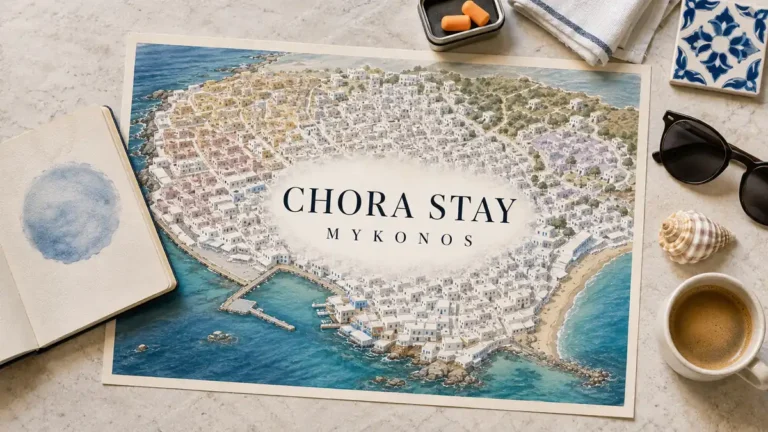
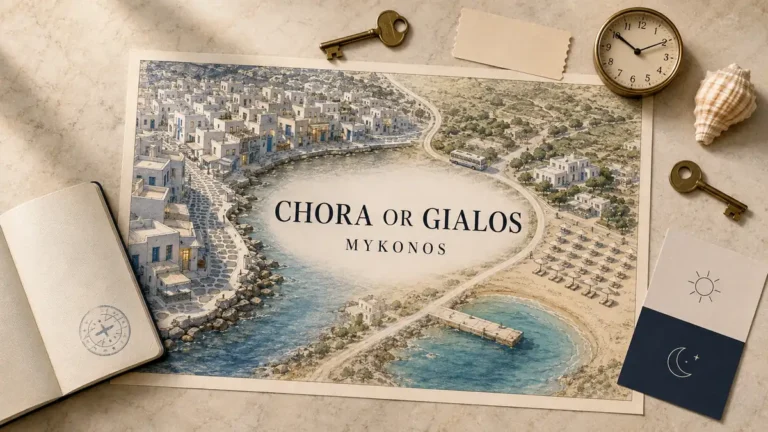
Base in Chora for walkability and nightlife, or on the south coast for a beach-first trip. Chora puts the restaurants, bars and ferry connections at your door but has no beach of its own. Ornos, Platis Gialos and Psarou trade that walkability for sand, calmer water and a bus ride into town.
- Chora (Mykonos Town) — Best for: first-time visitors who want to walk everywhere and come home on foot after dinner.
- Ornos — Best for: families who want sheltered, shallow water and a short bus ride into town.
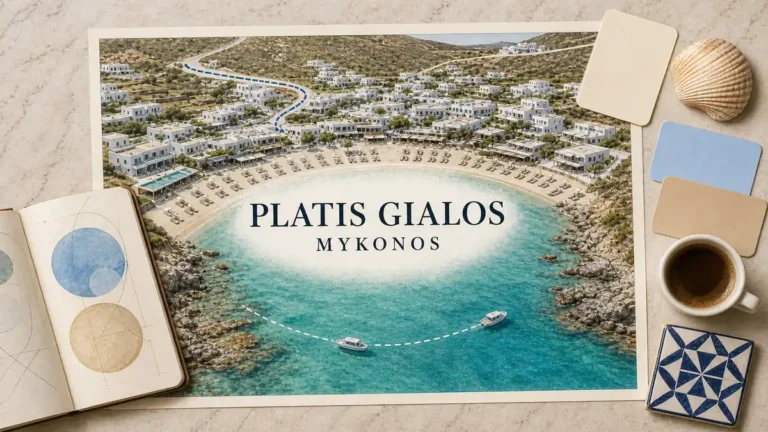
- Platis Gialos — Best for: travelers who want a long sandy beach as an all-day, low-effort base.
- Psarou — Best for: couples spending upward on a polished, upscale beach stay.
- Paradise — Best for: party-first travelers who want the club within walking distance of the bed.
Anyone splitting the trip between nightlife and beach days should sleep in Chora and travel out. The reverse — a beach base with taxis into town every night — is where Mykonos budgets quietly break.
Resolve the area choice properly with our full guide on where to stay in Mykonos, then narrow by trip type: Mykonos for first-time visitors, budget stays on Mykonos, Mykonos for couples, Mykonos for families, luxury stays on Mykonos and where to stay for Mykonos nightlife. If the beach itself is the deciding factor, our roundup of the best beach hotels in Mykonos handles the hotel-level selection this page deliberately leaves out.
Hotels and places to stay
Compare hotels, apartments and stays for your dates in one search.
Search hotels and stays on hotels.com →
Tripstou may earn a commission if you book through this link, at no extra cost to you.
Mykonos Beaches and the Meltemi Wind Rule
Mykonos’s best-known beaches line the sheltered south coast — Platis Gialos, Ornos, Psarou, Paradise and Elia. The Meltemi wind is the rule that decides your beach day: it blows from the north, so south-coast bays stay calm while north-coast beaches like Agios Sostis take the full force. Check the forecast before committing.
The south coast is where the character map matters. Platis Gialos is long, sandy and relaxed, with boats leaving for the neighbouring bays. Ornos is the most sheltered and the easiest with children. Psarou is the upscale one. Paradise and Super Paradise are the party beaches, running at full volume roughly mid-June to mid-September. Elia and Kalo Livadi are the quieter south-coast options for travelers who want sand without a soundtrack. Agios Ioannis is small and west-facing, which makes it a sunset beach.
Agios Sostis, on the north coast, is the counter-example: undeveloped, no sunbeds, no facilities, and unusable when the Meltemi is up. That is precisely the point — a windy forecast does not cancel a Mykonos beach day, it moves it south. Ornos and Psarou stay swimmable on afternoons when the north coast is being sandblasted. For how these bays compare with the rest of the country, see our selection of the best beaches in Greece.
Getting to Mykonos: Fly or Ferry
Fly from Athens or take a ferry from Piraeus or Rafina — roughly 3.5 hours by high-speed. Conventional ferries take around five hours and are the cheaper option. Flying wins on time and runs year-round from Athens; the ferry wins when Mykonos is one stop in a wider island route.
The choice is mostly about what the rest of your trip looks like. If Mykonos is a standalone short break, fly: the island has an airport with domestic connections from Athens and seasonal international routes, and the time saved is a meaningful share of a two-night stay. If Mykonos is one node in a Cyclades chain, the ferry is the right tool, because the same port that brings you from the mainland also connects onward to the neighbouring islands.
Mykonos sits in the northern Cyclades, which is what makes it such an easy first or last stop — see how it connects within the archipelago in our Cyclades guide, and plan multi-island routing with our guide to island hopping in Greece. For the airport-to-hotel leg once you land, our Mykonos airport transport guide covers the mechanics.
How to Get Around Mykonos
You walk Chora; vehicles are restricted there. Beaches are reached by bus, boat, taxi or rented wheels. Buses run from Chora to the main south-coast beaches, boats link those beaches to each other in summer, and a scooter, quad or car buys freedom at the price of finding somewhere to park it.
Each mode suits a different trip. Buses are the default for travelers based in town who want two or three beach days and nothing complicated. Beach boats are the pleasant option once you are already on the south coast, hopping between Platis Gialos, Paradise and Elia without returning to Chora. Taxis are limited in number and best treated as a backup. Rented wheels make sense for travelers staying outside town or chasing quieter bays like Agios Sostis, where public transport thins out fast. The full decision — including whether to rent at all — is resolved in our Mykonos transport guide.
How Much a Mykonos Trip Costs
Mykonos is one of Greece’s most expensive islands, and peak-season beach-club life is what drives the bill. Accommodation, sunbeds and restaurant dining all price higher here than on most Cycladic neighbours. Your travel style, your month and your base move the total far more than luck or last-minute deals do.
- Budget — hostel or simple room away from the beachfront, taverna and bakery eating, buses everywhere, public stretches of sand instead of organised clubs. Mykonos is harsh on this style in peak months, when even modest beds price up sharply.
- Mid-range — a small hotel in Chora or Ornos, a mix of tavernas and one or two bigger dinners, buses plus occasional taxis, sunbeds a few times. This is where the island is most reasonable relative to what it delivers.
- High-end — a design hotel or villa on the south coast, beach-club days at Psarou or Paradise, private transfers, boat trips on demand. Mykonos is built for this style and prices accordingly.
Timing moves the budget more than anything else you control. The same room, the same sunbed and the same dinner shift band between August and late May without the experience changing much. The other real lever is the sunbed itself: skipping organised beach clubs for open sand changes the daily total more than downgrading the hotel does.
For the actual numbers this page deliberately withholds, use our Mykonos trip cost breakdown, and set expectations against the country baseline with our guide to how much a trip to Greece costs. Eating well without eating expensively is largely a matter of ordering like a local — our Greek food guide explains the pattern.
Frequently Asked Questions
Can you swim in Mykonos in May or October?
Yes, in most cases. May and October sit at the warm edges of the swimming season: the sea is still cool early in May after winter, and it holds its summer heat into early October. October swimming is generally the more comfortable of the two. Wind, not water temperature, is usually what shortens a shoulder-month beach day.
What is the cheapest time to visit Mykonos?
Shoulder months are the cheapest time worth booking: May and early October. Accommodation prices soften while the island still functions. Genuine off-season, from mid-October to April, is cheaper again, though most hotels, beach clubs and seasonal restaurants are closed and the summer product simply is not there.
Is Mykonos good for families?
Yes, with the right base. Ornos and Platis Gialos give sheltered, shallow water on the south coast and short bus rides into town, which is what makes the island workable with children. The party scene is concentrated at Paradise and Super Paradise and in Chora after dark, so it is easy to avoid.
Do you need to book Mykonos accommodation in advance?
For peak months, yes. Mykonos has finite accommodation stock and heavy summer demand, so booking late from June through September mostly means paying more for less choice. Shoulder months are looser and can absorb a late decision. Off season the constraint flips: the question is what is open, not what is available.
Can you visit Mykonos as a day trip from Athens?
Not comfortably. The ferry from Piraeus or Rafina runs roughly 3.5 hours each way by high-speed, which leaves almost no usable time on the island once you account for the return. Flying makes a same-day return technically possible, but Mykonos rewards at least one overnight.
How busy does Chora get in high summer?
Chora’s lanes are most congested in the evening from June through September, when dinner and the Little Venice sunset draw everyone into the same few streets. Mornings are much quieter. If crowds are your main worry, walk the town early and save the beach for the afternoon.
Related Guides
Keep planning with the guides that surround this one:
- Greece travel guide — the country hub, and the starting point if Mykonos is one part of a bigger trip.
- 7 days in Greece — a short route where Mykonos works as a two-night island stop.
- 10 days in Greece — enough time to pair Mykonos with a second Cycladic island.
- 14 days in Greece — the fuller route, mainland plus islands.
- Greece packing list — what the Meltemi, the sun and the beach days actually require.
- Greece road trip guide — the mainland alternative if the islands are not the priority.
- Common scams in Greece — tourist-price awareness for an island where prices are high anyway.
- Mykonos travel tips — the on-the-ground know-how for once you are there.
Did this guide save you time or money? Tripstou is independent and reader-funded — if you'd like to give something back, you can support the site with a crypto contribution of any size.