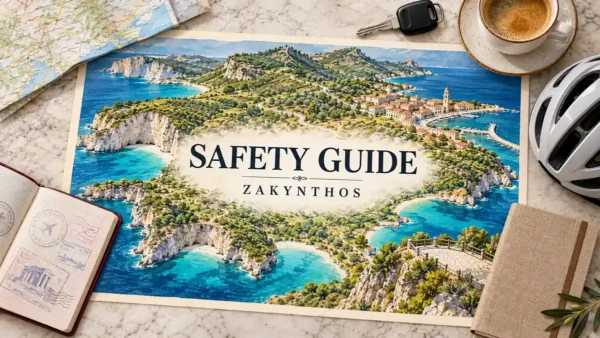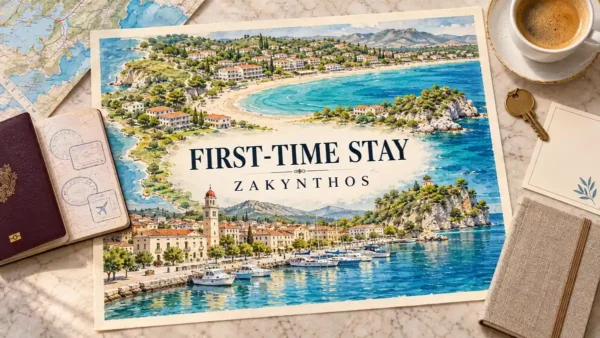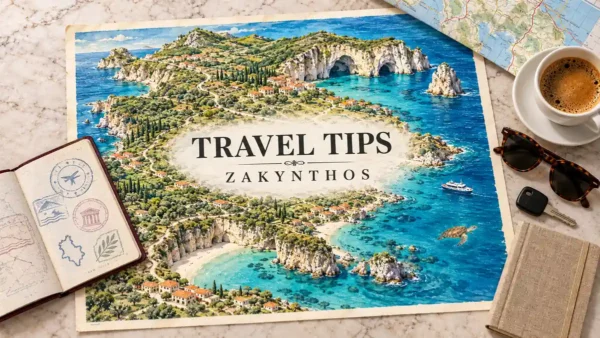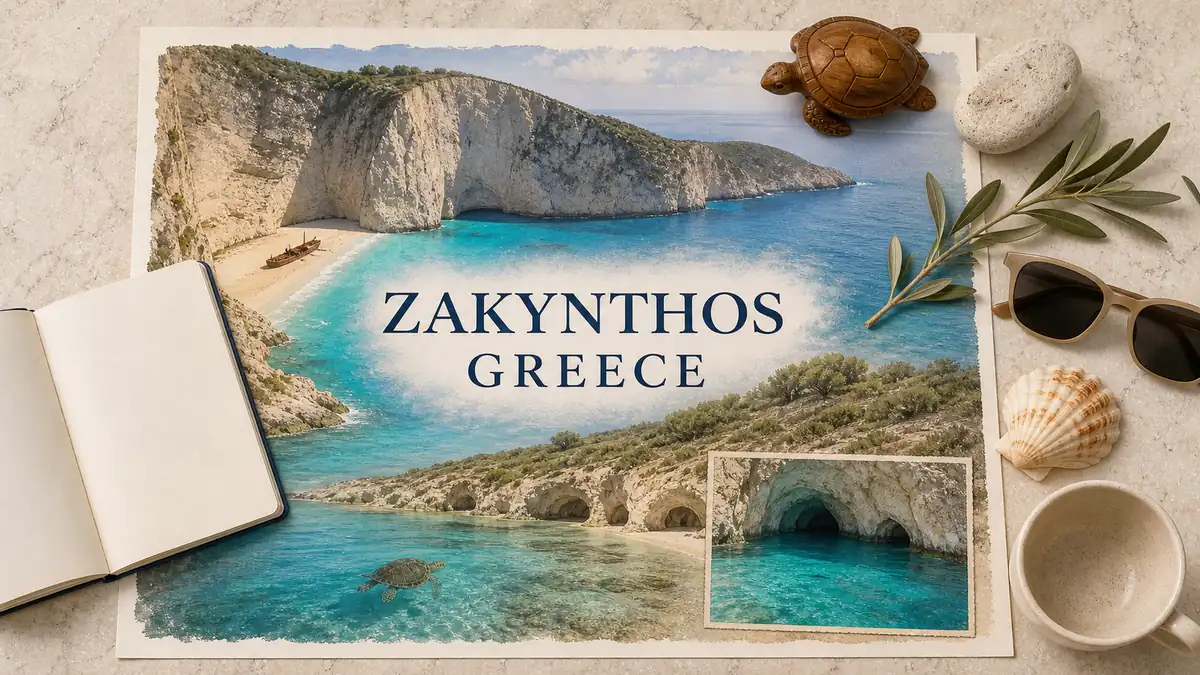
Zakynthos is usually chosen from a photograph — a rusted shipwreck on white sand between two vertical cliffs — and then, almost immediately, needs explaining. It is the Ionian’s beach-resort headliner: the southernmost major island in the group, with a wild cliff-and-cove west coast you look at, mostly from the water, and a low, sandy east and south holding the resorts, the family hotels and the nightlife. Very few Greek islands make a straightforward beach week this easy to organise.
This guide resolves the decisions that come first: whether the island is worth committing to and who it suits, what has actually happened to Navagio and how you see it now, which coast to base yourself on, how to arrive, when to go, which of the two boat trips to pick, and the rules that govern the turtle waters. Depth topics — stays, costs, transport, itineraries, things to do — live on dedicated pages this guide routes you to.
Quick Answer
Zakynthos is worth it: the Ionian’s beach-resort headliner, a cliff-and-cove west coast, a sandy resort-lined east and south. Base on the sandy side and see the west — Navagio included — by boat; landing on the shipwreck beach is banned. Its own airport and resort infrastructure make it the easiest Ionian beach week, especially for families.
Trust Layer
Tripstou city guide for travelers planning a city trip. Covers trip length, stay style, season, cost, and mobility tradeoffs.
Produced with AI assistance and reviewed by Alex Perrut, working in tourism since 2015, for the Tripstou editorial team. See our editorial process for details.
Last factual review: August 29, 2026.
Official sources consulted: Visit Greece, Greek Ministry of Tourism.
Key Takeaways
- Zakynthos is the Ionian’s beach-resort headliner: a cliff-and-cove west coast to look at, a sandy east and south to stay on.
- Landing and swimming at Navagio are banned; the free clifftop viewpoint and an offshore boat stop are the legal views.
- Base yourself on the sandy east or south coast, then treat the cliff-bound west as a boat day.
- The boat trip is the island’s real booking decision: the northwest run for the shipwreck, the southern run for turtles.
- Its own international airport and the short Kyllini ferry make Zakynthos the easiest Ionian island to organise a beach week on.
- Laganas Bay is a national marine park, so pick boats that keep their distance and never promise a turtle sighting.
Table of Contents
Is Zakynthos Worth Visiting — and Who Is It For?
Yes — Zakynthos is the Ionian’s beach-resort headliner and the easiest island in the group for a straightforward beach week. The southernmost major Ionian island splits between a spectacular cliff coast and a sandy resort coast. It suits beach-week travelers, families and anyone who enjoys a day on the water.
The island sits off the western Peloponnese, roughly 40 km by 20 km, close enough to the mainland to be reached by a short ferry crossing and large enough that you do not see it all on foot. Zakynthos is known for three things: the shipwreck cove on the northwest coast, the loggerhead turtles nesting in the bay to the south, and long sandy beaches with hotels built along them. That combination is unusual. Most Greek islands give you scenery or infrastructure; this one gives you both, on opposite sides of the same short drive.
The fit is clearest for travelers who want a base and a beach, not a project. Families land here for the shallow sandy shore and the short transfers, couples for the boat days and the sunsets off the west, and groups for the nightlife concentrated in the southern resorts. It is not the island for a traveler seeking somewhere quiet and unresorted, or a chain to hop through week by week — those travelers are better served by the wider Greek islands selector or by looking at the Cyclades, a different group with a different rhythm entirely. Where Zakynthos sits among the country’s headline destinations is covered in our guide to the best places to visit in Greece.
Zakynthos also has neighbours, and the choice between them is a real one. Kefalonia and Corfu answer different briefs, and the head-to-head belongs on the Ionian Islands guide, which weighs the group as a set. On value, expect a mainstream resort island: the package infrastructure keeps the everyday costs mild by Greek-island standards, while the marquee experiences sit at the top of the local range.
Is Navagio Beach Open? How to See the Shipwreck Now
No — landing and swimming at Navagio are banned, and the beach cannot be visited. You still get the famous view two legal ways: from the free clifftop viewpoint above the cove, or from a boat holding offshore. The ban rests on landslide risk from the unstable cliffs above.
The closure came through a joint ministerial decision on landslide-risk grounds, after a geological assessment found the limestone slopes surrounding the cove unstable. Both the beach itself and the bay’s swimming zone are covered. It is a restriction that has been renewed season after season, with no confirmed reopening. Enforcement is real: the Hellenic Police police the cove, and violators face fines. A restoration and stabilisation plan has been discussed publicly, without a confirmed timetable attached to it.
Boat trips to the cove still run, and they remain the closest legal approach. Boats stop offshore, outside a marked exclusion zone, for a photo stop — not a beach landing. That is enough for the picture and for the scale of the thing, which does not really register until you are underneath the cliffs. Which of the island’s two boat runs takes you there is a separate decision, covered further down.
The clifftop viewpoint is open, and you must stay behind the railings. It sits a short walk from a parking area above the cove, with a reinforced safety barrier at the edge, and it costs nothing to visit. Treat the barrier as absolute — the cliff edge has its own record of fatal falls, entirely separate from the beach closure, and the full island safety picture is set out in our Zakynthos safety guide. The photograph nearly everyone has seen was taken from the clifftop, not from the sand, which is why the closure costs the average visitor far less than it sounds. Where the cove ranks nationally is handled in our roundup of the best beaches in Greece.
The Two Sides of Zakynthos: Cliff West, Sandy East and South
Zakynthos has two coasts with two different jobs: you stay east or south, and you visit the west. The west and northwest are sheer limestone cliff and cove, mostly seen from the water. The east and south are low, sandy, swimmable and resort-developed, which is where the island’s holiday infrastructure sits.
- West and northwest: vertical cliffs, sea caves and coves reached by boat or steep track — spectacular to look at, thin on places to swim from or sleep in.
- East and south: long shallow sand, hotels, tavernas, water sports and nightlife, with the airport and the ferry port both on this side.
Each coast charges you something. The sandy side trades drama for convenience: you get beaches you can walk onto with a toddler and a hotel behind them, and you give up the scenery that put the island on your list. The west repays boat days, not beach days. Understanding that saves a lot of disappointment, because the coast decision is settled before you ever look at hotels — the cliff coast has almost nothing you can swim from, so the west stays a day trip even for the travelers who came specifically for it.
This is also why the island is so simple to organise. One base on the sandy side puts you within an easy drive of everything, so families in particular avoid the packing-and-moving that a multi-island trip forces. Coast level is where this page stops. Which resort within that coast suits you, and how the areas differ in noise, price and character, is resolved on our Zakynthos where to stay guide; the properties themselves sit on our list of the best beach hotels in Zakynthos.
How to Get to Zakynthos: Flights and the Kyllini Ferry
Zakynthos has two clean arrival routes: its own international airport, or the ferry from Kyllini. The airport takes year-round domestic flights from Athens plus seasonal direct European services. The ferry crosses from Kyllini in the western Peloponnese to Zakynthos Town in roughly 1h15, which suits travelers already driving the mainland.
- Fly: the island’s own international airport takes year-round flights from Athens and seasonal direct services from across Europe — the standard route for a resort week.
- Ferry: Kyllini to Zakynthos Town, a crossing of roughly 1h15 — the route for anyone arriving overland or travelling with their own vehicle.
Choose by what the rest of the trip looks like. A direct seasonal flight into the island is unbeatable for a week in one hotel, and it keeps the transfer short. The ferry earns its place when Zakynthos is one stop in a longer mainland route: Kyllini sits within reach of the ancient sites and coastline covered in our Peloponnese guide, and folding the crossing into a driving loop is a well-trodden move set out in our Greece road trip guide. Combining the island with others in the Ionian or beyond is a route-planning question answered in our Greek island hopping guide.
On the ground, most people cover the island with a rental car or an ATV, simply because the sights are spread and the good coves are not on a bus line. The mechanics — hire, roads, buses, taxis and ferry practicalities — belong to our Zakynthos transport guide, and getting from the airport to your resort is covered in our Zakynthos airport transport guide.
Train and bus tickets
Compare routes, schedules and prices across rail and bus operators in one search, with mobile tickets on your phone.
New to Omio? Code NEW10 takes 10% off your first booking — or APPNEW10 if you book inside the Omio app. Both apply to bookings up to €80.
Search routes and compare prices on Omio →
Tripstou may earn a commission if you book through this link, at no extra cost to you.
The Best Time to Visit Zakynthos
The shoulder ends of the season beat peak summer on Zakynthos for crowds and heat. Peak delivers the full resort machine — every hotel, bar and boat running — at its busiest and hottest. Outside the season the resort infrastructure that defines the island winds down, and the boat trips thin out.
| Period | Crowds | Heat | Resorts and services | Boat trips |
|---|---|---|---|---|
| Early shoulder | Beaches quiet, no queues at the sights | Warm days, cool sea, comfortable for walking | Larger resorts open, smaller places still waking up | Running, but cancelled more often by wind |
| Peak summer | Busiest by a wide margin, book well ahead | Hot and dry, midday shade genuinely necessary | Everything open, full nightlife and family programmes | Full schedule, frequent departures every day |
| Late shoulder | Thinning fast, beaches feel spacious again | Warm days with the sea at its warmest | Most resorts open, closures begin near the end | Still running, winding down towards the close |
| Winter off-season | Almost no visitors beyond the island’s own life | Mild and wet, not remotely beach weather | Resort infrastructure largely shut, few options open | Tourist runs stopped, west coast effectively unreachable |
The trade-off is straightforward once you know what you are buying. Peak buys certainty — every hotel open, every excursion running, the island at full volume — and charges for it in crowds, heat and queues at the viewpoint. The shoulder ends buy space and comfort, and ask you to accept that a windy day can cancel the boat you came for. On Zakynthos the season is set by the boats more than by the thermometer: a warm week when the west-coast runs are not operating leaves you with the sandy coast and little else.
Summer is also loggerhead nesting season in the bay to the south, which is exactly when the marine park’s rules bite hardest — the detail sits in the turtle section below. For the country-level picture, see our guide to the best time to visit Greece, and if you are travelling at either shoulder end, our Greece packing list covers the layer most people forget.
Which Zakynthos Boat Trip Should You Book?
The genuine choice is between two runs. The northwest run takes in the Blue Caves and views Navagio from the water; the southern run circles the Keri caves, the Mizithres sea stacks and the turtle waters off Marathonisi. Pick by what you most want to see, not by what is cheapest.
A boat is not optional here. The west coast’s signature sights sit at the foot of cliffs with no road access, so the island genuinely reads best from the water — that is the structural fact shaping a Zakynthos trip. Everything else can be driven to.
- North or south: the shipwreck cove and the Blue Caves lie north; the sea stacks, the caves at Keri and the turtle bay lie south. Few trips do both properly.
- Full day or half day: a half day delivers the headline stop and little swimming time; a full day adds swim stops and a slower pace.
- Big boat or small: larger boats are steadier and cheaper per head; small and private boats reach tighter coves and can wait out the crowds at the popular stops.
The southern run carries an extra constraint: it operates inside a protected bay, under park rules that govern speed, distance and where boats may go at all. Operator behaviour, not the itinerary, is what separates a good southern trip from a bad one — the rules themselves are set out in the next section. If Navagio is the reason you chose Zakynthos, take the northwest run early in your stay; the southern run is the better outing on a calm sea, and calm seas are not something you can book in advance.
Beyond the boats, the full activity depth — which operators run what, the land-based sights, the tour selection — sits in our guide to things to do in Zakynthos. The quieter coves and corners most trips skip are collected in our hidden gems in Zakynthos guide.
Turtles, Laganas Bay and the Marine Park Rules
Laganas Bay is Greece’s first national marine park, protecting loggerhead turtle nesting beaches. It is also where you see turtles, from southern-run boats that follow the park’s rules. Those rules close the most sensitive zone to boats through the nesting season and cap speed and approach distance elsewhere.
The regulations themselves are fixed and worth knowing before you board. Navigation is prohibited in Zone A from 1 May to 31 October, the core of the nesting season. A 6-knot speed limit applies in Zones B and C. Boats and swimmers must keep 15 m from a turtle, and there is no feeding, no touching and no swimming with them. The nesting beaches are daytime access only, with restrictions on umbrellas and loungers near the water’s edge.
Enforcement is a separate question from the rule text. ARCHELON, the Greek sea turtle protection society, has documented that the observation code applied to tour boats functions as advisory in practice, that boat strikes on turtles continue, and that recorded violations frequently go unfined. That is the NGO’s position on the record, not a verdict on every operator in the bay — but it is the reason your choice of boat matters more here than anywhere else on the island. The rules bind the boat; the only variable you actually control is which boat you get on.
Judge an operator by behaviour, not by claims:
- Keeps a real distance from turtles and does not manoeuvre to close it.
- Cuts or idles the engine near animals instead of holding position under power.
- Does not chase, circle or herd a turtle for a better photograph.
- Does not promise a sighting — nobody can, and the promise is the warning sign.
- Briefs passengers on the rules before entering the bay, not after a complaint.
Broader on-the-ground etiquette, including what to do and avoid on the nesting beaches themselves, is collected in our Zakynthos travel tips.
Planning the Rest of Your Zakynthos Trip: Stays, Costs and Day Plans
The depth topics on Zakynthos live on dedicated pages, and this section points you to the right one. Where you sleep, what the trip costs, how you fill each day and how the island fits a wider Greece route are all resolved elsewhere. Use the routing below by whichever decision is next.
- Where to stay, by traveler type: the coast-level logic above becomes a resort-level answer on our guides for , families, first-time visitors.
- How long, and how to fill it: a short break covers the icons — a boat day, the viewpoint, a beach day — while a week is the island’s natural resort shape. See our 2-day Zakynthos itinerary and 3-day Zakynthos itinerary.
- Fitting Zakynthos into a wider Greece route: start from our Greece itinerary hub, or go straight to the 7-day, 10-day and 14-day routes.
- What it costs: a resort island with mainstream package infrastructure and a few premium experiences on top — the numbers are in our Zakynthos trip cost guide and the country picture in our Greece trip cost guide.
- Staying comfortable: Zakynthos is a low-stress destination beyond the cliff edge, but the usual tourist-area caution applies — see our guides to common scams in Greece and solo female travel safety in Greece.
- Eating and wider planning: what to order and why in our Greek food guide, and everything else about the country in our Greece travel guide.
Frequently Asked Questions
Can you swim at Navagio Beach?
No. Swimming in the bay is banned under the same decision that closed the beach, on landslide-risk grounds, and boats hold offshore instead of dropping swimmers. For swimming, the sandy east and south coasts are where the island’s shallow, easy water sits, a short drive from any resort.
Is there a fine for going on Navagio Beach?
Yes. The closure is enforced by the Hellenic Police and violators face fines. The restriction covers the water as well as the sand, so swimming in from a boat or landing privately counts as a breach. The legal alternatives are the clifftop viewpoint and an offshore photo stop.
Can you see Navagio without a boat?
Yes. The clifftop viewpoint above the cove is open, free and reached on a short walk from a parking area, and you must stay behind the railings — the cliff edge has its own record of fatal falls. It gives the photograph; the boat gives the scale.
Are Zante and Zakynthos the same place?
Yes, they are two names for the same island. Zakynthos is the Greek name; Zante is the long-standing Italian-derived form, still used widely by airlines, tour operators and holiday listings. Both refer to the same Ionian island, so a Zante package and a Zakynthos package are identical.
How many days do you need in Zakynthos?
A long weekend covers the icons: one boat day, the clifftop viewpoint and a beach day. A full week is the island’s natural shape, because the resort infrastructure is built for it and a weather-cancelled boat trip still leaves you room to reschedule.
Is Zakynthos good for families?
Yes, it is the strongest family-logistics pick in the Ionian. The east and south coasts are sandy, shallow and lined with resorts, so the beach is usually a walk from the room. Its own international airport keeps the transfer short at both ends of the trip.
Related Guides
- Ionian Islands guide — how Zakynthos compares with Kefalonia, Corfu and the rest of the group.
- Things to do in Zakynthos — the boat trips, the beaches and the full activity depth.
- Where to stay in Zakynthos — turning the coast decision into a resort decision.
- Getting around Zakynthos — cars, ATVs, buses and the ferry mechanics.
- Zakynthos trip costs — what a beach week on the island actually adds up to.
- Best beaches in Greece — where Navagio and the island’s sandy coasts rank nationally.
Did this guide save you time or money? Tripstou is independent and reader-funded — if you'd like to give something back, you can support the site with a crypto contribution of any size.