Ten days in Greece is enough for Athens plus two Cycladic islands, and the route that works best is Athens, Naxos and Santorini, three nights each, moving south in one direction. Two ferries carry you through the Cyclades, and you fly home from Santorini, so the trip never doubles back to the capital. It suits a first visit wanting the classical core and two contrasting islands without rushing.
This page is the day-by-day version of the ten-day shape the Greece itinerary planner recommends. It sets out where each night goes, what each day is for, and how the two ferry legs and the final flight fit between the stops. It also covers the one real choice inside the route — Naxos or Paros for the middle island — and what to cut or add if your trip runs shorter or longer. Ferry booking, island selection and budgets each have their own guide, linked where they matter.
The Recommended Route for 10 Days in Greece: Athens, Naxos and Santorini
The strongest ten-day route is Athens, Naxos and Santorini, three nights each, travelling south in one direction. The shape works because each stop has one job: Athens is the gateway and the classical core, Naxos is the slow middle island, and Santorini is the finale with its own airport for the flight home.
Route at a glance
- Days 1–3: Athens — the gateway and classical core
- Days 4–6: Naxos — the slow middle of the Cyclades
- Days 7–10: Santorini — the finale, then fly out
Nine nights split three ways is the whole pacing rule. Each stop gets two full days plus an arrival or travel day, which is enough to see the anchors without living out of a suitcase. The first night in Athens doubles as a buffer against a late or delayed flight.
| Stop | Nights | How you leave | Rough journey time |
|---|---|---|---|
| Athens (Days 1–3) | Three nights, the first a buffer | Ferry from Piraeus to Naxos | Three to five hours, depending on the boat |
| Naxos (Days 4–6) | Three nights, the slowest stretch | Ferry south from Naxos to Santorini | One to two hours by ferry |
| Santorini (Days 7–10) | Three nights on the caldera side | Flight home from Santorini airport | Domestic and seasonal international flights |
Naxos is the stop that makes three nights non-negotiable. It opens with a morning ferry and ends with another, so two nights would leave a single full day on the island.
The route runs best from late spring to early autumn; winter sailings are sparse, so check the best time to visit Greece before fixing dates. For what nine nights across three stops add up to, the Greece trip cost guide breaks down the budget. This page covers one trip length in detail; the Greece itinerary planner sets the shape for every length.
Days 1–3: Athens, the Gateway and the Classical Core
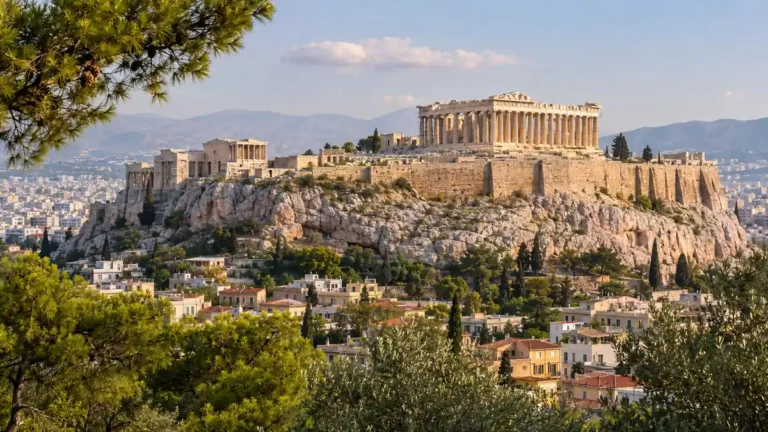
Athens gets three nights: land, settle, then two full days for the Acropolis and the old centre. The first night works as a buffer against late flights, so nothing important is scheduled on Day 1. On the morning of Day 4 you leave from Piraeus, Athens’ main ferry port for the Cyclades.
Day 1: Arrive in Athens and settle in
Day 1 is for landing and getting your bearings. The metro runs from the airport into the centre, and it is the simplest way in; the Athens guide covers the transfer and which neighbourhood suits a first stay. Keep the evening loose. A walk through Plaka below the Acropolis and an early dinner are plenty for an arrival day.
Day 2: The Acropolis and the historic centre
Day 2 is the Acropolis and the historic centre around it. Book the Acropolis slot ahead and take the earliest entry you can get, when the hill is cooler and quieter. Walk down afterwards through the Ancient Agora into Monastiraki. Then stop. Two anchors fill a day in the Athens heat, and the rest of the afternoon is for recovering.
Day 3: A second Athens day, then pack for the port
Day 3 is a second Athens day at a gentler pace. The Acropolis Museum makes more sense the morning after the hill, and the afternoon suits a neighbourhood such as Koukaki or Psyrri. Pack in the evening, because Day 4 starts at the port. The Greece travel guide covers the country basics, and the best places to visit in Greece show where this route sits on the wider map.
Tours and activities
Book skip-the-line tickets, day trips and local tours with free cancellation on most activities.
You can also browse everything on getyourguide.com.
Tripstou may earn a commission if you book through this link, at no extra cost to you.
Days 4–6: Naxos, the Slow Middle of the Cyclades
Day 4 is the long ferry from Piraeus to Naxos; the next two days are the slowest of the trip. The crossing takes three to five hours depending on the boat, then Naxos gets three nights of beaches, villages and room to breathe. You leave on Day 7 by a short ferry south.
Naxos is the largest island in the Cyclades and one of the greenest, which is why it works as the pause between a capital and the busiest stop on the route. The Cyclades guide shows how it sits within the island group.
Day 4: Ferry from Piraeus to Naxos
Day 4 is travel day: a three-to-five-hour ferry from Piraeus to Naxos, depending on the boat. Blue Star Ferries runs conventional ships on this line and Seajets runs high-speed ones; the Greek island hopping guide explains how to choose between them. Arrive, check in, and walk out to the Portara — the marble gateway by the harbour — for the evening.
Day 5: Beaches and the Chora
Day 5 belongs to the beaches and the Chora. The long sandy stretches south of town — Agios Prokopios and Plaka — are the easy first choice, close enough for a relaxed day. The guide to the best beaches in Greece places them against the rest of the country. Spend the evening in the Kastro, the old Venetian quarter at the top of the Chora.
Day 6: The interior villages, then an early night for the crossing
Day 6 goes inland to the mountain villages. Halki and Apiranthos are the anchors, and the unfinished kouros statues in the hills make a natural third stop. This is the one day of the trip where a hire car pays off, since these villages sit far from the ferry-served coast. The Naxos guide covers getting around. Have an early night.
Days 7–10: Santorini, the Finale and the Flight Home
Day 7 is a short ferry to Santorini; the last three nights belong to the caldera. The crossing from Naxos takes one to two hours, which leaves most of the day on the island. On Day 10 you fly out of Santorini, which has domestic and seasonal international flights, so the route never goes back by sea.
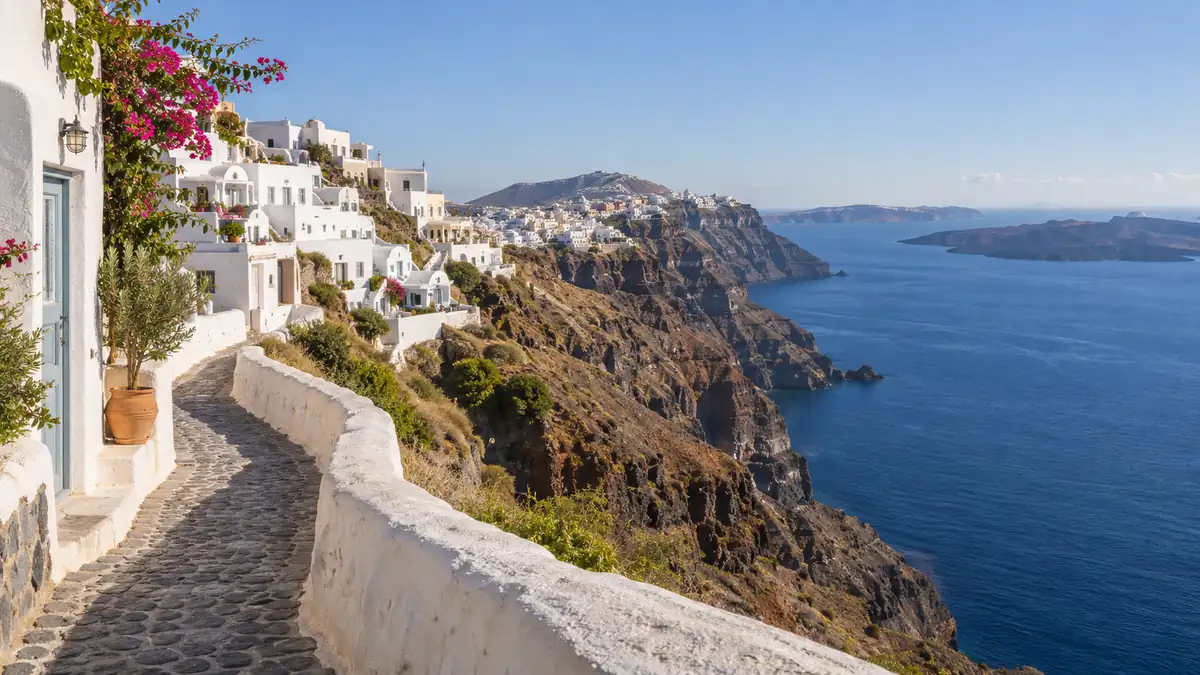
Base yourself on the caldera side for these three nights. The caldera view is the reason Santorini closes the route, and a beach-side base turns every sunset into a trip across the island.
Day 7: Ferry from Naxos to Santorini
Day 7 is the short hop south. The ferry from Naxos to Santorini takes one to two hours, and the same island hopping guide covers this leg. Arrive, settle in, and give the first evening to Fira, the main town on the caldera edge. Save the long walks for tomorrow. The first sunset is enough.
Day 8: The caldera villages
Day 8 is the caldera villages. Walk the clifftop path from Fira through Imerovigli towards Oia, turning back or taking the bus whenever the heat demands it. Oia is the anchor at the far end. Its lanes fill up in the late afternoon, so arrive earlier and leave before the evening crowd builds around the viewpoints.
Day 9: The rest of the island, then the sunset
Day 9 covers the rest of the island. The Akrotiri excavations — a Bronze Age town preserved under volcanic ash — make the morning anchor, and a black-sand beach at Perissa or Kamari fills the afternoon. Return to the caldera side for the last sunset. The Santorini guide covers where to base yourself and how to get around.
Day 10: Fly out of Santorini
Day 10 is the flight out of Santorini. The island’s airport (JTR) has domestic and seasonal international flights, so in season you may be able to fly home directly. With no direct option, connect through Athens on a domestic flight. Either way, the last morning is a transfer across the island. No ferry back to Piraeus is needed.
Hotels and places to stay
Compare hotels, apartments and stays for your dates in one search.
Search hotels and stays on hotels.com →
Tripstou may earn a commission if you book through this link, at no extra cost to you.
Why Start in Athens and End in Santorini
Start in Athens, where you land and the ferries leave; end in Santorini, where you can fly home. That order sends the whole trip south in one line. No leg repeats, the highlight comes last, and the final morning is a transfer to the island airport, not a ferry back to Piraeus.
The open-jaw shape saves a day. A route that returns to Athens needs a ferry back to Piraeus near the end, which turns a beach or caldera day into a day at sea. Ending on an island with its own airport removes that leg entirely.
Reversing the order looks symmetrical and rarely is. Direct flights into Santorini are seasonal, so most reverse trips still land in Athens first and then travel out to the island before the route even starts. The capital also absorbs jet lag better than a ferry schedule does.
Ferries handle both island legs because Naxos and Santorini are neighbouring Cyclades on the same line south. Flights make sense for long or cross-group legs, such as reaching Crete or Rhodes, and the Greek island hopping guide sets out that trade-off in full.
How many islands can you visit in 10 days in Greece?
Two islands is the right number for ten days in Greece, alongside three nights in Athens. A fourth stop breaks the pace. Every extra island adds another check-in and another half-day lost to a port, and in ten days that cost lands on the stops you came for.
A third island is possible only if you cut Athens to two nights; four islands turns the trip into a string of ferry days. Ten days will not cover the mainland and the islands together without one-night stops either, so choose one focus. The guide to choosing Greek islands is the place to weigh other islands against these two.
Naxos or Paros for the middle island?
Naxos is the better middle island for this route; Paros is a straight swap if you want a livelier base. Naxos gives more beach space and a slower pace after Athens. Paros sits on the same ferry corridor between Piraeus and Santorini, so choosing it changes nothing else in the ten days.
The difference is character. Naxos is bigger, greener and quieter in the evenings, with long beaches that rarely feel full and inland villages worth a full day. Paros is more compact, with a busy harbour town in Parikia and a lively evening scene in Naoussa. The ferry days stay the same either way: swap Naxos for Paros on Days 4–6 and keep everything else.
Choose Paros if nightlife and a buzzier base matter more than space. Choose Naxos if the middle of the trip is meant to slow down. Mykonos can take the same middle slot as a swap for Naxos, keeping the ten-day pace but trading a quiet middle island for the nightlife one; adding it without extra days forces two-night stops. The Paros guide and the Naxos guide cover each island in depth, and the Cyclades island guide shows the rest of the group.
How to Adapt This Route with More or Fewer Days
With fewer days, cut Naxos before anything else; with more days, add one island, never two. Athens and Santorini hold the route together because one is the arrival gateway and the other ends it with a flight. The middle slot is the flexible part, so it absorbs every change first.
- Fewer days, cut Naxos first: the route becomes Athens and Santorini, which suits a shorter trip at the cost of the slow middle. If you want to keep both islands, trim Athens to two nights instead and accept a single full day in the capital.
- More days, one more Cycladic stop: add Paros, Milos or Mykonos to the middle and keep moving south. The Paros guide suits a livelier second base, the Milos guide covers the most unusual coastline in the group, and the Mykonos guide covers the nightlife island. Each adds one more ferry leg.
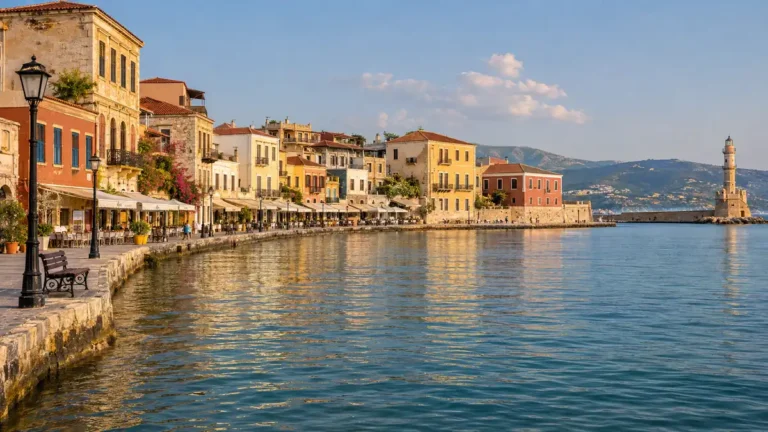
- More days, swap in Crete: replace the island block with one large island of mountains, gorges and Minoan sites; start with the Crete guide and the Chania guide for its best-known base.
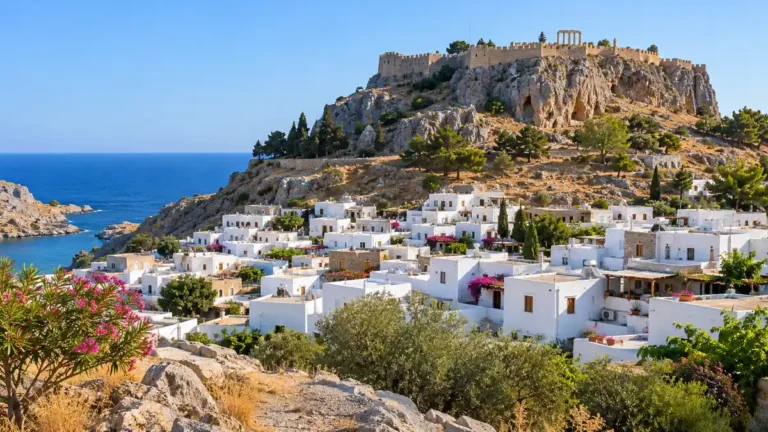
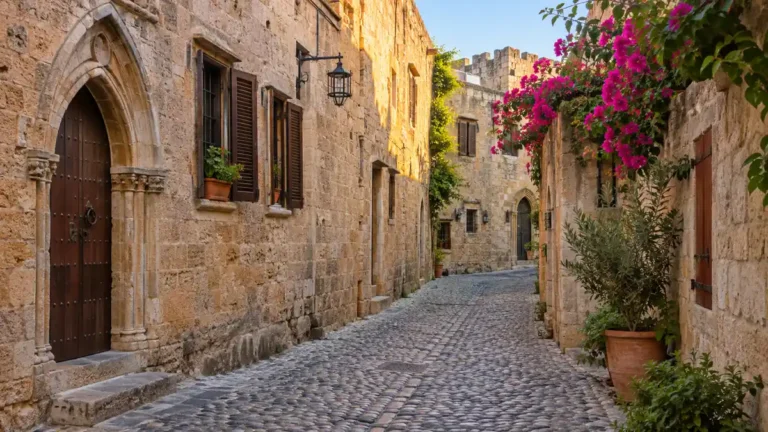
- More days, swap in Rhodes: trade the Cyclades for a medieval walled town and a long beach coast, covered in the Rhodes guide; it sits far from the Cyclades line, so plan to fly.
- More days, swap in the Ionian: choose green coast and sheltered water on the other side of the mainland with the Ionian islands guide, the Corfu guide and the Zakynthos guide.
- Mainland version: swap the islands for Delphi, Meteora and the Peloponnese by car, which suits history-first travelers who can trade beach days for driving days; see the Greece road trip guide and the Peloponnese guide.
- Other trip lengths: the Greece itinerary planner decides the shape for each length, and the guide to choosing Greek islands helps pick the islands that fill it.
This Route’s Scope and Sources
This page plans a single ten-day route through Greece, from Athens to Naxos to Santorini: the order, the nights at each stop, the two ferry legs and the flight out. It is not a broad Greece guide, a things-to-do list for the three stops, a hotel roundup or a general trip planner.
Each of these ten days was read through by Alex Perrut, working in tourism since 2015, for the Tripstou editorial team, after the route was produced with AI assistance. Our editorial process describes what that read-through covers.
Official sources consulted: Visit Greece, Greek Ministry of Tourism.
Did this guide save you time or money? Tripstou is independent and reader-funded — if you'd like to give something back, you can support the site with a crypto contribution of any size.