France punishes travelers who guess. Turn up at the wrong hour and the kitchen is shut; pick the wrong room and you pay restaurant prices for reheated food; order from the wrong line on the menu and you spend double for the same cooking. None of that is bad luck. French dining runs on a system — fixed service windows, a clear hierarchy of venues, and a menu structure that tells you exactly where the value sits — and the system is easy to learn in an afternoon.
This guide covers what to eat, where each thing is actually eaten, how the meal day works, and how to get the best food for your money without a list of restaurant names. Regions and cities get their depth in their own guides; here you get the map and the operating instructions.
Quick Answer
Eat where and when the French eat: the venue and the hour matter more than the address. France runs on two fixed meal windows and a clear venue hierarchy, and matching them decides whether you eat well. Make lunch your big restaurant meal, ordering the set formule, and fill the rest from markets and boulangeries.
Trust Layer
Tripstou planning guide for travelers resolving one travel decision. Covers the main variable, traveler context, and practical tradeoffs.
Produced with AI assistance and reviewed by Alex Perrut, working in tourism since 2015, for the Tripstou editorial team. See our editorial process for details.
Last factual review: August 22, 2026.
Official sources consulted: France.fr, Atout France.
Key Takeaways
- Make lunch the day’s big restaurant meal: the set formule serves the same kitchen’s cooking at a fraction of dinner prices.
- French kitchens serve two windows only — midday into early afternoon, then early evening — and close completely between them.
- Pick the venue first: bistro for a proper meal, brasserie off-hours, café for drinks, boulangerie for a fast lunch.
- On a menu, entrée means starter and plat is the main course — the mistake that shrinks most first dinners.
- Service is included by French law, so round up loose change if you like and skip percentage tipping entirely.
- Most French icons are regional, so choosing where you go decides far more about your meals than choosing where you sit.
Table of Contents
What Food Is France Famous For?
France is famous for bread, pastry and cheese, plus regional classics like steak-frites, coq au vin and bouillabaisse. Almost every icon belongs to a region before it belongs to the country. Recognise the dish, then learn where it is cooked properly. That pairing is the whole logic of eating here.
Two categories are worth separating. National staples travel everywhere: the baguette and the morning viennoiserie, cheese in every form, charcuterie, steak-frites, omelettes, gratins, and a pastry counter of éclairs, fruit tarts and mille-feuille. You will find all of these done well in almost any French town, and they can carry a trip on their own without a single reservation.
Regional icons do not travel. Cassoulet belongs to the Southwest, bouillabaisse to Marseille, choucroute to Alsace, galettes to Brittany, quenelles to Lyon. Ordering one of them far from home usually buys a worse and more expensive version of the same idea, because the ingredients and the muscle memory are both somewhere else. Where each icon lives is mapped further down this page; for how eating fits into the wider trip, start with our France travel guide.
The pattern worth internalising is that French food is dish-plus-place. A traveler who learns ten dishes and their home regions makes better ordering decisions than one who memorises fifty dish names.
Bistro, Brasserie or Café: Where Should You Eat?
Choose a bistro for the proper meal, a brasserie when you are hungry off-hours, a café for drinks. Bistros cook a short seasonal menu at the best price-to-quality ratio in France. Brasseries serve longer hours with a wider, safer menu. Cafés are for coffee, wine and a sandwich, not dinner.
The venue decides more about your meal than the neighbourhood does. Each type exists for a different moment in the day, and picking the wrong one is the most common way travelers end up disappointed by French food.
| Venue | What it is | What you eat there | When to choose it |
|---|---|---|---|
| Bistro | Small owner-run restaurant with a short menu | Seasonal French cooking, daily plats and classics | The main sit-down meal of the day |
| Brasserie | Large all-day room that serves continuously | Steak-frites, seafood platters, choucroute, reliable staples | Late lunches and meals outside kitchen hours |
| Café | Drinks-led counter and pavement terrace | Coffee, wine, croque-monsieur and simple sandwiches | Breakfast, an afternoon pause, or an apéritif |
| Boulangerie and pâtisserie | Bakery counter, either bread-led or pastry-led | Baguettes, viennoiserie, tarts, sandwiches to take away | Breakfast and a fast, cheap lunch |
| Marché | Covered or street produce market, usually mornings | Cheese, charcuterie, fruit, prepared dishes to carry | Building a picnic or a self-catered meal |
| Crêperie and bouchon | Regional specialist rooms, Breton and Lyonnais respectively | Galettes and crêpes; Lyonnais charcuterie, offal, quenelles | Eating a local specialty in its home region |
Two venue types sit outside the table. A salon de thé serves tea, cake and a light plate through the afternoon gap when restaurant kitchens are closed, which makes it more useful than it sounds. Fine dining is a separate decision entirely: a booked, multi-hour event rather than a meal you walk into, and it competes with a week of good bistro lunches for the same money.
A bistro with six dishes on the board is a better bet than a brasserie with sixty. A short menu means a kitchen that cooked today; a long one usually means a kitchen that reheats.
How Do You Spot a Good Restaurant — and Avoid Tourist Traps?
Judge a French restaurant from the pavement before you sit down, using the menu, the crowd and the clock. The signals are consistent enough that you rarely need a recommendation.
- A short menu. Six to ten dishes means the kitchen cooks. Forty dishes means a freezer and a microwave.
- A handwritten daily board. Chalk changes daily; laminated photographs do not.
- A local crowd at lunch. Rooms full of people who look like they work nearby are the strongest single signal available.
- Kitchen hours respected. A place that serves full meals continuously from morning to night is a brasserie or a trap, not a bistro.
- Distance from the monument. Two or three streets back from a major sight changes both the price and the cooking.
- Nobody outside selling. A host on the pavement working the passing crowd in several languages is filling seats the food cannot fill.
What Time Do the French Eat?
French kitchens serve lunch from around midday into the early afternoon, and dinner from early evening onward. Between those two windows most restaurant kitchens close entirely. Arriving mid-afternoon hungry usually means a café sandwich or a bakery, not a meal. Plan around the rhythm and you eat well anywhere.
The windows exist because most kitchens run a single service. One team cooks lunch, cleans down, shops or rests, then comes back for dinner. That is why a bistro that looks open in the middle of the afternoon will pour you a drink and offer nothing else — the kitchen is genuinely cold, and no amount of politeness restarts it.
Three kinds of place stay open between services. Cafés serve drinks and simple plates all day, brasseries keep cooking continuously, and boulangeries sell sandwiches, quiches and pastries until they run out. Breakfast is small and often taken standing at a counter, which is why the eating day tilts so heavily toward lunch. Learn the rhythm once and the rest of the trip stops fighting it.
How Do You Read a French Menu?
A French menu splits two ways: the fixed-price menu or formule, and the à la carte carte. The menu bundles two or three courses at one price and is almost always the better value. The carte lists every dish individually and costs more. The plat du jour is the kitchen’s daily dish.
Order the formule the way it is written: one option per course from a short list, and expect that list to be short, because it is what the kitchen actually cooked that morning. Entrée plus plat, or plat plus dessert, is the standard two-course shape. Three courses cost a little more and are the better deal whenever you are properly hungry.
The word to watch is entrée. In France it means the starter, and the main course is the plat or plat principal — English speakers order a small plate and wonder where dinner went more often than any other menu mistake. Formule usually means the lighter, faster set at lunch; menu means the fuller set. Prix fixe describes both.
The plat du jour is the one item the kitchen shopped for this morning. Most of the carte was shopped for the week, which is why the daily dish is so often the best thing in the room and so rarely the most expensive.
Do You Tip in France?
No — service is included in every French bill by law, so percentage tipping is not expected. Service compris means the staff are paid without your arithmetic. Rounding up the change, or leaving a couple of coins after a good meal, is a gesture and nothing more. Nobody will chase you for it.
The rest of the table runs on defaults you never have to ask for. Bread arrives free, sits directly on the tablecloth without a side plate, and is refilled if you finish it. Tap water is free too: ask for une carafe d’eau and a jug appears, while asking simply for water usually produces a bottle you pay for. Coffee comes after dessert, never alongside the meal, and it means an espresso unless you specify otherwise.
Two things do need asking. Substitutions are treated as a rewrite of the dish and generally get a polite refusal, so choose a different plate instead of editing one. The bill will never arrive uninvited, because bringing it would mean hurrying you out — catch the waiter’s eye and ask for l’addition when you are ready. Etiquette beyond the table, from greetings to shop-door manners, is covered in our France travel tips.
How Do You Eat Well in France on a Budget?
Eat your main restaurant meal at lunch, when the same kitchen sells a set formule far cheaper. Dinner buys the same cooking at evening prices. Lunch formules are the value engine of French dining. Fill the remaining meals from boulangeries, markets and traiteurs, and the food budget stops being the problem.
The lunch formule is the same kitchen at a lower price, not a lesser kitchen. Most bistros run a two- or three-course set at midday and withdraw it in the evening, when the carte takes over and the bill grows. Order the formule, take the plat du jour inside it, and you eat the day’s best cooking at the day’s lowest price — in the same room, from the same brigade, off the same delivery.
The other half is simpler. A boulangerie sandwich or quiche, a market picnic, or a traiteur’s prepared dish covers a second meal for a fraction of a sit-down bill, and in France none of those reads as a downgrade — the bakery lunch is what half the country eats. Actual daily food costs by travel style and city belong in our France travel budget guide; this page handles the strategy, that one handles the arithmetic.
The hour does more for your food budget than the choice of restaurant ever will. A good bistro at midday beats a cheap one at night on both price and cooking.
How Do You Shop a French Market for a Picnic?
Shop a French market in the morning: most run from early and are packing up by early afternoon. Build the picnic in four stops — bread from the boulangerie, cheese from a fromagerie or market stall, charcuterie or a roast chicken from the traiteur, and fruit from whoever has the shortest queue. Ask for a quantity by weight instead of a number of slices; stallholders cut to order and will usually let you taste before you commit.
What sits on the stalls changes with the calendar, which is one more reason the season shapes the trip — see our guide to the best time to visit France for how that plays out. Market mornings and locations vary by town and are not worth guessing, so check the town’s own listing on your phone the evening before; a working French SIM or eSIM turns that into a ten-second job.
How Does the French Cheese Course Work?
The cheese course comes after the main and before dessert, and you take two or three cheeses. A board is served in an order: work from the mildest to the strongest so nothing gets flattened. Cut each wedge in the shape it arrived, keeping the rind’s share fair. Bread accompanies it; butter does not.
Order the cheese course when you want to slow the meal down, not when you want more food. In a set menu you often choose between cheese and dessert instead of taking both, and cheese is the more interesting choice in any region with a serious dairy tradition. On a shared board, cutting the tip off a wedge of brie is the one move that instantly marks a table as foreign.
The labels do the quality work for you. France’s official quality signs are administered by INAO and cover AOP/AOC, IGP, Label Rouge, STG and Agriculture Biologique. The system covers several hundred AOP/AOC wines and over a hundred agri-food AOP, around half of them dairy — which is why the AOP tags on a cheese counter are a reliable shortcut to the serious end of the case. Wine has its own map entirely, covered in our France wine regions guide.
French Food by Region: What to Eat Where
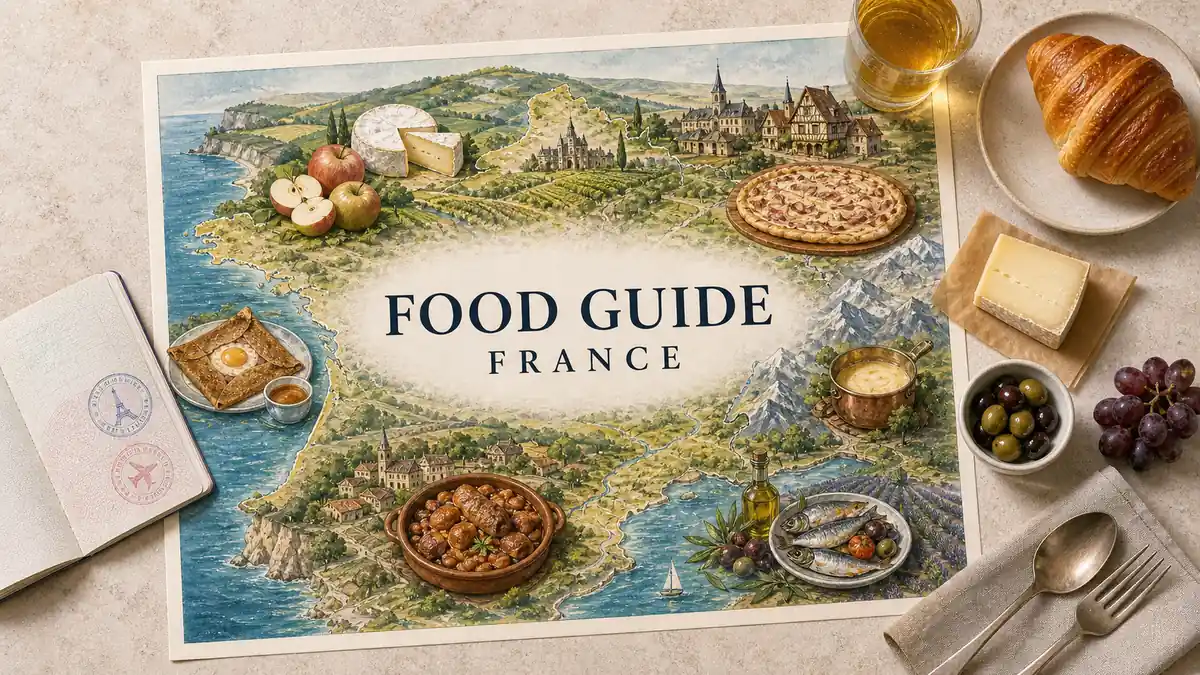
Most famous French dishes belong to a region: bouillabaisse to Marseille, choucroute to Alsace, galettes to Brittany. France eats regionally, and the map rewards travelers who follow it. Butter and cream in the north and west, olive oil in the south, duck and confit in the southwest. Build the route around the plate.
Six macro-zones cover the country well enough to plan with. The table orients; the routing runs underneath it.
| Zone | Signature dishes | Drink in passing | Character of the cooking |
|---|---|---|---|
| Paris and the North | Steak-frites, jambon-beurre, moules-frites, pâtisserie | Beer in the far north | Every regional kitchen plus international range |
| Normandy and Brittany, the northwest | Oysters, mussels, galettes, crêpes, camembert | Cider, poured into bowls | Butter, cream and cold-water seafood |
| Alsace and the East | Choucroute garnie, tarte flambée, baeckeoffe, munster | Alsatian beer with the plate | German-influenced, hearty and generously portioned |
| Lyon and the Alps | Quenelles, charcuterie, tartiflette, fondue, raclette | Local beer after the slopes | Bistro tradition below, melted cheese above |
| Provence, Riviera and Corsica | Bouillabaisse, ratatouille, socca, pissaladière, brocciu | Pastis before the meal | Olive oil, herbs and sun-grown vegetables |
| The Southwest and the Loire | Cassoulet, duck confit, foie gras, rillettes | Armagnac poured after dinner | Duck, goose and slow-cooked richness |
Normandy is butter, cream and apples — camembert, sole in cream sauce, and cider and calvados where other regions pour wine. Our Normandy guide covers how that fits a route. Brittany is the galette and crêpe heartland and one of Europe’s great oyster coasts, mapped in the Brittany guide. Both seafood coasts sit alongside the country’s best beaches in France, which makes a coastal food trip an easy sell.
Alsace eats German-influenced and generously: choucroute garnie, tarte flambée, baeckeoffe and munster, with beer as the everyday drink — see the Alsace guide. Paris is the exception to the whole regional logic. The capital and its surroundings are the wrong place to hunt a single local cuisine and the right place to eat any of them, with the geography set out in our Paris region guide.
The Lyon area is the bistro tradition in concentrated form — charcuterie, quenelles, pralines and offal cooked without apology — placed in its wider corridor by the Lyon region guide. Climb east and the food changes to fondue, raclette and tartiflette, mountain cooking built for cold work, with the seasons covered in the French Alps guide.
Provence is olive oil, herbs and vegetables: ratatouille, tapenade, daube and goat cheese, detailed in the Provence guide. The Riviera runs its own kitchen, closer to Liguria than to Paris, with socca, pissaladière and fish off the boat — see the French Riviera guide. Corsica eats mountain and sea in the same week, from brocciu and chestnut-fed charcuterie to grilled fish, and the Corsica guide explains how the island divides.
The Bordeaux region and the wider Southwest run on duck, confit, foie gras and cannelés, with the territory covered in our Bordeaux region guide. The Loire Valley is river fish, rillettes, goat cheese and tarte Tatin eaten between châteaux, routed in the Loire Valley guide. Stringing three or four zones into a single drive is the natural way to eat across the country, and our France road trip guide handles the sequencing.
Cross a regional border and the cooking fat changes with it — butter in the north and west, olive oil in the south, duck fat in the southwest. Order whatever the region cooks in and you will rarely eat badly, even in a town you know nothing about.
Which French Cities Are Best for Food?
Lyon is the classic answer for a food-first city break, with Paris the best choice for range. Lyon concentrates the country’s bistro tradition in a walkable centre. Paris carries every regional kitchen plus the international ones. After those two, choose the city whose regional cooking you actually want to eat.
Lyon earns the reputation. Its bouchons serve a charcuterie-heavy, offal-friendly city tradition that exists nowhere else at that density, and the historic centre is compact enough to eat across on foot — our Lyon guide covers what to plan around. Paris wins on range. Every French region and most world cuisines are represented, along with the country’s deepest bread and pastry scene, and the practical side is handled in the Paris guide.
Bordeaux pairs southwestern cooking with a compact riverside centre, detailed in our Bordeaux guide. Marseille is the home of bouillabaisse and of North African cooking in equal measure, with the context set out in the Marseille guide. Strasbourg is the Alsatian table at its most complete, winstubs included, and the Strasbourg guide covers the rest of the city.
Nice is the outlier: a Ligurian-leaning kitchen of socca, pissaladière and pan bagnat that has no equivalent elsewhere in France, described in the Nice guide. If the destination is still open, our guide to the best places to visit in France widens the shortlist beyond food alone. Linking two or three food cities into one trip is easiest by rail, and the France train itinerary shows how the connections fit together.
Tours and activities
Book skip-the-line tickets, day trips and local tours with free cancellation on most activities.
You can also browse everything on getyourguide.com.
Tripstou may earn a commission if you book through this link, at no extra cost to you.
Frequently Asked Questions
What is the difference between a boulangerie and a pâtisserie?
A boulangerie bakes bread on the premises and sells viennoiserie and sandwiches alongside it. A pâtisserie is a pastry shop, run by a trained pâtissier, selling tarts, éclairs and cakes made to order. Many shops do both, but the sign tells you which craft leads. Go to the boulangerie for breakfast and lunch, the pâtisserie for dessert.
Is water free in French restaurants?
Yes — ask for une carafe d’eau and the table gets free tap water, poured from a jug. Ask simply for water and you will usually be brought a bottle you pay for, because bottled is the default. The same phrase works in cafés and brasseries, and nobody treats the request as cheap.
How much does a meal cost in a French restaurant?
The venue tier sets the price far more than the dish does. A bakery or market lunch sits at the bottom, a café plate or brasserie staple in the middle, a bistro set lunch above that, and an à la carte dinner at the top. Big cities run dearer than small towns throughout.
What do the French eat for breakfast?
Breakfast in France is small and sweet: bread and jam, or a croissant, with coffee. A tartine — sliced baguette with butter and jam — is the everyday version, and viennoiserie is the treat. Savoury cooked breakfasts are a hotel offering for foreign guests, not a domestic habit. A boulangerie counter serves it faster and better than most hotels.
What is the difference between a Michelin star and a Bib Gourmand?
Stars rate cooking quality at the top of the scale; the Bib Gourmand rates value. Michelin awards one to three stars, with each additional star signalling a bigger reason to travel for the meal. The Bib Gourmand marks good cooking at moderate prices, which makes it the more useful list for most travelers.
What is the gastronomic meal of the French?
It is the French festive meal ritual, inscribed by UNESCO as intangible cultural heritage. UNESCO’s Representative List describes it as an apéritif followed by at least four successive courses — starter, fish and/or meat with vegetables, cheese and dessert — closing with liqueurs. It is a celebration format, not a daily habit.
Related Guides
These guides pick up where the food decisions stop.
- France travel guide — the country hub, and the place to start if the trip shape is still open.
- France travel budget — daily costs by travel style, including what food realistically adds up to.
- France wine regions — the drinking map this page deliberately leaves alone.
- Best time to visit France — season by season, including what is in the markets when.
- France road trip — how to string regions, and their kitchens, into one route.
- France safety — the practical safety picture for travelers, covered separately from anything on this page.
Did this guide save you time or money? Tripstou is independent and reader-funded — if you'd like to give something back, you can support the site with a crypto contribution of any size.