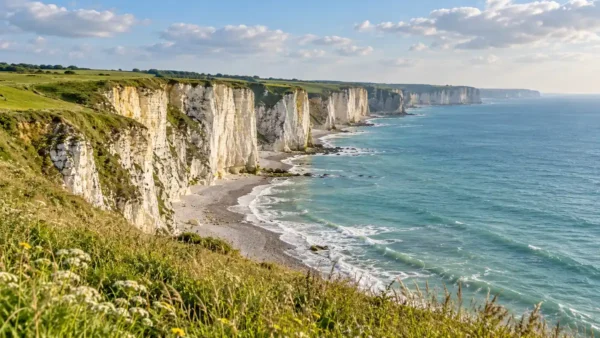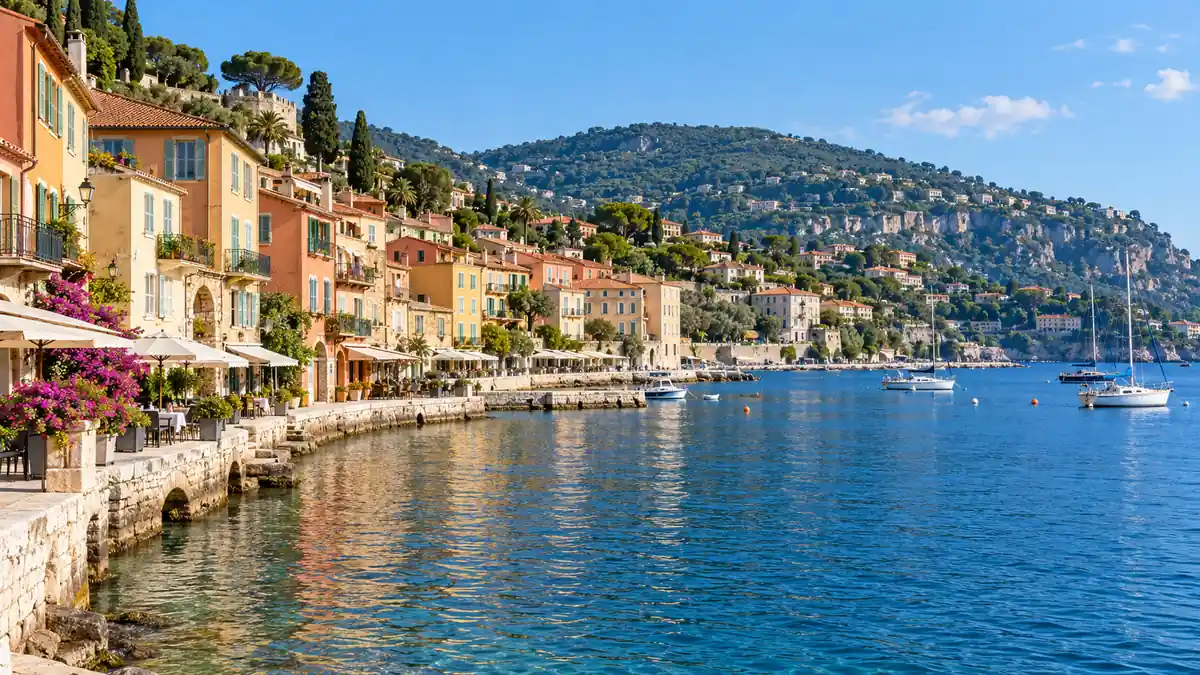
The French Riviera is the Mediterranean coast of southeast France, running west from Menton on the Italian border with no fixed western end. To travel to the French Riviera in France, fly into Nice, base yourself in Nice or Antibes, and you will not need a car. Three to five days covers a first look; about a week is comfortable. Go in June or September. It is a coast of distinct towns strung along one railway, and it suits first-timers who want sea and towns without driving.
One variable changes the plan: the coast splits in two. Regional trains link the towns from Cannes to Menton, while Saint-Tropez and the western Var coast need a boat, a bus or a car. The sections below follow that split through getting in, getting around, the stops, the bases, trip length, season and cost.
The Short Version
- The coast splits in two: regional trains link the towns from Cannes to Menton, while Saint-Tropez and the Var coast need a boat, a bus or a car.
- Nice is the easiest car-free base because it pairs the airport with a central spot on the coastal line, and Antibes is the smaller mid-coast alternative.
- Three to five days covers the eastern core from one base, and about a week adds Cannes, the Lérins islands and the hill towns without changing hotels.
- Hire a car only for the days you head west or into the hills, since on the eastern coast it mostly sits in paid parking.
- June and September give the summer sea without the July–August holiday crush on trains, roads and beaches.
- Summer is when the Riviera costs most, and accommodation is where most of the extra goes.
On This Page
Where is the French Riviera, and how long is the coast?
The French Riviera sits in the far southeast of France, on the Mediterranean, and starts at Menton on the Italian border. How long it is depends on where you stop it, because it has no official boundary. The core is the Alpes-Maritimes coast from Menton to Cannes; broader definitions push west to the Esterel, Saint-Tropez, Toulon or even Cassis.
For planning, think of two halves and a hinterland. The eastern half, Cannes to Menton, is compact and rail-served. The western half, the Var coast from the red cliffs of the Esterel to Saint-Tropez, is looser and leans on roads and boats. Behind both rise the hill towns, Grasse and Saint-Paul-de-Vence among them. Monaco is part of the same coastline but is a separate principality, not French territory.
The French name, Côte d’Azur, was coined by the 19th-century writer Stéphen Liégeard and is the one you will see on signs and tourist boards. For how the coast fits into the rest of the country, start with our France travel guide.
Nice is the gateway, whether you fly in or come by train
Fly into Nice Côte d’Azur airport, the region’s main gateway. By rail, the TGV runs from Paris to the coast, and the coastal line continues east to Ventimiglia, the rail link for travelers coming in from Italy.
Nice works as the hinge of the trip because it combines both: the airport and a station on the coastal line that serves the rest of the eastern Riviera. Whichever base you choose, you will probably pass through Nice on the way in and out. Arriving from Paris by high-speed train is a sound option if you are already in France and want to skip a domestic flight; planning France by train shows how the Riviera fits into a rail route.
Check the entry rules that apply to your passport before booking.
Do you need a car on the French Riviera?
You do not need a car for the eastern coast. Coastal regional (TER) trains link Cannes, Antibes, Nice, Villefranche-sur-Mer, Monaco and Menton, and most coastal towns have a station. A car, or a boat, earns its place only for Saint-Tropez, the Var coast and the inland hill villages, and summer traffic and parking are the price you pay for it.
- Coastal train: the backbone of a car-free trip and the easiest way between the eastern towns. A TER ticket is valid for the journey you chose on any TER that day, so you are not tied to one departure. The catch is crowding on summer trains and platforms, which is also where pickpockets work; common scams and pickpocket tricks in France covers what to watch for.
- Regional buses: they fill the gaps the railway leaves, including the hilltop villages. Use them for Èze, Saint-Paul-de-Vence and Grasse if you are not driving; expect slower, twistier rides than the train.
- Seasonal boats: boats from Nice and Cannes reach Saint-Tropez, Monaco and the Lérins islands, running from late winter to autumn. They are the way to see Saint-Tropez without a drive, and they do not help in the depth of winter.
- Car: worth it for the Var coast, the Esterel and the hills, or if you are continuing across the country on a France road trip. Summer congestion on the coast roads and scarce parking in the towns make it a burden for the eastern stretch.
A car rented for the whole trip mostly sits in paid parking on this coast. Hire one for the days you head west or into the hills, and stay car-free for the rest.
The main stops along the coast, from Menton to Saint-Tropez
Read east to west, the coast is a run of towns with distinct jobs: the rail-served stretch from Menton to Nice, Antibes and Cannes in the middle, the perfume and art villages in the hills behind, and Saint-Tropez on its own beyond the railway. This is an orientation map, not a ranking.
Menton to Nice: the rail-served eastern coast
This is the densest stretch of the Riviera and the one to see first, with the coastal train stopping in almost every town. Menton, the last French town before Italy, is quiet and known for its gardens and lemons, and it makes a calm eastern base. Monaco comes next: a separate principality with its own casino-and-harbour glamour, served by the coastal train and, in season, by boat.
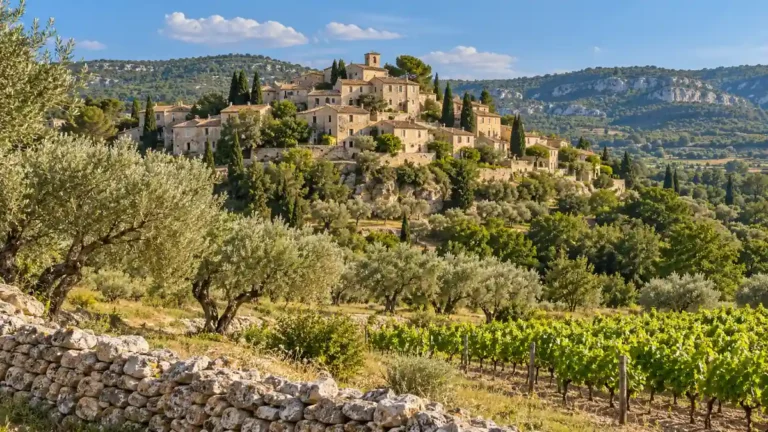
Above the coast, Èze is a hilltop village perched high over the sea, reached by regional bus and prized for one of the classic Riviera views. Lower down, Villefranche-sur-Mer wraps around a sheltered bay just east of Nice, with the Saint-Jean-Cap-Ferrat peninsula and its villas on the far side. The bay and the peninsula are at their best seen from the water, on a short boat trip out of Nice.
Nice itself is the region’s city: the biggest choice of stays, food and transport, and the natural base for most first trips. Our Nice guide covers the city in depth. This whole eastern stretch is the one built for car-free first-timers.
Antibes and Cannes: the middle of the coast
Antibes pairs a walled old town and harbour with the resort strip of Juan-les-Pins, and its mid-coast position makes it the easiest base for reaching both Nice and Cannes. It is the pick for a smaller town that still keeps the train on the doorstep.
Cannes is the polished west end of the rail-served coast, all promenade and festival gloss. Its real advantage for a visitor is offshore: regular boats from Cannes cross to the Lérins islands, where Sainte-Marguerite offers pine woods and quiet coves, and you can reserve the island ferry ahead of a summer visit.
Beaches change character along the way: pebbles dominate around Nice, and sand becomes more common as you head west. For where to swim, see the best beaches in France.
Grasse and Saint-Paul-de-Vence: the hills behind the coast
The hill towns are the Riviera’s other face, reached by regional bus or by car. Grasse is the perfume town, where you can book a perfume class in one of its historic houses. Saint-Paul-de-Vence is a walled hill village long linked with painters, compact enough for an unhurried half-day.
Both work as outings from a coastal base; few visitors need to sleep up here. For workshops, gardens, museums and other experiences, see things to do on the French Riviera, and for villages away from the coach routes, quieter French Riviera villages. The hills reward travelers who have already seen the coast and want its slower, inland side.
Saint-Tropez and the Var coast: beyond the railway
Saint-Tropez is not on the rail line, so getting there from Nice means a seasonal boat, a bus or a car. In season, the boat is the most direct way without driving, and you can book the boat crossing from Nice; boats also run from Saint-Raphaël and Fréjus, closer by.
The Var coast is the Riviera at its most spread out: the red rock of the Esterel, beach towns and the Saint-Tropez peninsula. Squeezed into a day from Nice, it is mostly transit. Travelers who want Saint-Tropez for more than a look should sleep in the west for a few nights.
Tours and activities
Book skip-the-line tickets, day trips and local tours with free cancellation on most activities.
You can also browse everything on getyourguide.com.
Tripstou may earn a commission if you book through this link, at no extra cost to you.
Where to base yourself, by the trip you’re planning
Nice is the base for a first, car-free trip: it is the transport hub, it has the most choice and it brings city energy. Pick Antibes if you want something smaller in the middle of the coast, Cannes for the polished west end and the Lérins boats, and Menton or Villefranche-sur-Mer for quiet. On a week or more that takes in Saint-Tropez, split the trip between two bases.
| Base | Suits | On the coastal line | Trade-off |
|---|---|---|---|
| Nice | First trips, no car, city life | Central hub, with the airport | Busier and more urban than the towns |
| Antibes | A smaller town, mid-coast | Between Nice and Cannes | Less choice of stays and evenings |
| Cannes | The west end, the Lérins islands | Western end of the rail-served coast | Longer trips east to Monaco and Menton |
| Menton | A quiet stay, Italy close by | Last stop before the border | Far from Cannes and the west |
| Villefranche-sur-Mer | A small bay village near Nice | Between Nice and Monaco | Few services after dark |
On this coast, choosing a base is really choosing a position on the railway: every hop you take starts from it, so a mid-coast town like Antibes evens out trips that a Menton base would make lopsided. For where to stay inside the city, see where to stay in Nice.
One base covers the eastern coast comfortably, from Cannes to Menton. If the plan includes Saint-Tropez and the Var, add a second, western base such as Saint-Raphaël or the Saint-Tropez area for the last nights. The cost of splitting is one packing day; the gain is not spending whole days in transit.
Hotels and places to stay
Compare hotels, apartments and stays for your dates in one search.
Search hotels and stays on hotels.com →
Tripstou may earn a commission if you book through this link, at no extra cost to you.
How many days do you need on the French Riviera?
Three to five days covers the eastern core from one base, about a week makes the trip comfortable, and longer stays make sense once you add Saint-Tropez and the Var or inland Provence. Length on the Riviera is decided by how far west you go, not by how many towns you tick off.
A short trip of three to five days fits a city break with sea attached. From Nice or Antibes you can see Nice, Monaco, Èze and Villefranche, plus Antibes or Menton, by train and bus without rushing. It suits first-timers with limited leave or a Riviera stop inside a longer France trip.
About a week is the strongest first-trip shape. It adds Cannes and the Lérins islands and a day in the hills for Grasse or Saint-Paul-de-Vence, still from one base, with slack for beach time. Aim here if you want the full eastern coast without changing hotels.
Ten days or more justifies a second base in the west for Saint-Tropez and the Esterel, or a move inland into Provence. It suits return visitors and anyone with a car. For a day-by-day plan, see a day-by-day France itinerary; this page stops at the trip’s shape.
June and September beat high summer on the Riviera
June and September are the best months for the Riviera: the sea is warm, the days are long, and you miss the July–August peak in crowds and prices. Those two summer months coincide with the French summer holidays, when trains, coast roads and beaches are at their fullest and stays cost the most.
Spring and autumn are good shoulder options for towns, gardens and walking, with cooler water. Winter is quieter and mild by northern standards, but some seasonal services stop; the boats run from late winter to autumn. In summer, a one-day unlimited regional train pass is offered, which suits a day of hopping between towns. Month-by-month detail lives on the best time to visit France.
Weather is not what makes July and August hard here: the national holiday calendar is. A late-June or mid-September trip gets much the same summer feel with noticeably more room.
Is the French Riviera expensive?
Yes in summer: the Riviera is among France’s pricier regions, and most of the extra goes on accommodation. It is kinder off-season and to travelers who base themselves in Nice and use trains.
A tight budget works best from Nice, which has the widest spread of stays, with trains and buses for every outing and picnics from markets and bakeries instead of restaurant lunches. A comfortable mid-range trip bases itself in Antibes or Nice, adds a boat trip and perhaps a single car day for the hills, and eats out most evenings. The high end lives in Cannes, Cap Ferrat and Saint-Tropez, with private boats and a hire car, and here the Riviera has almost no ceiling.
For euro figures by spend style, see what a France trip costs.
The Riviera works alone or as the warm end of a France trip
A week on the Riviera alone makes a complete first trip for anyone after the sea and a string of towns with no car to manage. On a 10–14-day France trip, it pairs best with Paris by TGV, with Lyon, or with the Alps.
The coast is a weaker fit for travelers after wide sandy beaches, for anyone whose picture of the south is lavender fields and rural Provence, and for low budgets in August. Those trips are better built elsewhere, or outside high summer.
As part of a longer route, the classic pairing is the Paris region at one end and the coast at the other, linked by high-speed train. Lyon and its region sit naturally on the way south, and the French Alps add mountains to a summer trip. Food and wine travelers can fold in a stop from France’s wine regions.
Route length shapes how much Riviera fits: a 7-day France itinerary leaves room for a short coastal stay, 10 days in France allows a proper few days, and two weeks in France can carry the full eastern coast. If you are still choosing regions, compare them on the best places to visit in France.
Riviera Questions, Answered Briefly
Is it better to stay in Nice or Cannes?
Nice is the better choice for most first trips: it has the airport, the widest choice of stays and a central spot on the coastal line, so every outing is shorter. Cannes suits a smaller, more polished stay at the west end of the railway with easy boats to the Lérins islands, at the cost of longer rides east to Monaco and Menton.
Is Monaco part of the French Riviera?
Geographically yes, politically no: Monaco sits on the Riviera coastline between Nice and Menton, but it is a separate principality, not part of France. The coastal regional train stops there, so it slots into a trip from any base on the eastern coast.
Is the French Riviera part of Provence?
Administratively, yes: the French Riviera lies within the region officially named Provence-Alpes-Côte d’Azur.
Is there a train pass for the French Riviera?
Yes. In summer, a one-day pass gives unlimited travel on the regional TER trains, which suits a day of hopping between coastal towns. For longer stays, the multi-day Pass Sud Azur Explore combines train, tram and bus across the Alpes-Maritimes and Monaco.
How We Put This Guide Together
This page is a broad planning guide to the French Riviera coast: where it runs, how to get in and around, where to base yourself, how long to stay, when to go and which stops matter. It is not a Nice city guide, a day-by-day itinerary, a transport timetable or a hotel roundup.
Alex Perrut, working in tourism since 2015, went over this Riviera planner for the Tripstou editorial team after it was written with AI assistance; our editorial process sets out the steps.
Official sources consulted: Côte d’Azur France, Explore Nice Côte d’Azur (regional trains), Explore Nice Côte d’Azur (Trans Côte d’Azur boats).
Keep Planning Your France Trip
- The best beaches in France — where the Riviera’s swimming spots sit against the rest of the French coast.
- Alsace travel guide — a wine-village region in the northeast, the Riviera’s opposite in mood.
- Bordeaux region guide — the Atlantic side of France, with vineyards and a big-city base.
- Normandy travel guide — cliffs, war history and a cooler coast in the north.
- France food guide — what to order, from Niçoise specialities to the rest of the country.
- France packing list — what to bring for a beach-and-towns trip.
- Solo female travel safety in France — practical safety for women travelling alone.
Did this guide save you time or money? Tripstou is independent and reader-funded — if you'd like to give something back, you can support the site with a crypto contribution of any size.