
Nice is the French Riviera’s most useful city, and the trip works best when you decide its shape before you arrive. This guide answers the planning questions in order: how many days Nice needs, when to go, what stay style suits you, how the city moves, roughly what it costs, and whether Nice should be the base for the whole coast. One honest expectation up front — Nice rewards planning more than improvising. The city is small enough that a loose trip drifts into repeating the same seafront walk, and structured enough that a planned one covers the old town, the market, the beaches and half the Riviera without a car. Beach mornings and old-town evenings are the default rhythm here, and the day trips are the part most packaged trips skip. Everything below stays at planning level and routes you to the deeper pages when you need them.
Quick Answer
Nice is worth visiting and works as the French Riviera’s most practical base, with real city depth of its own. Plan 2–3 days for the city itself, or 4–7 days to use Nice as a base for coastal day trips. It suits car-free travelers who want beach mornings, old-town evenings, and easy coastal day trips.
Trust Layer
Tripstou city guide for travelers planning a city trip. Covers trip length, stay style, season, cost, and mobility tradeoffs.
Produced with AI assistance and reviewed by Alex Perrut, working in tourism since 2015, for the Tripstou editorial team. See our editorial process for details.
Last factual review: August 5, 2026.
Official sources consulted: France.fr, Atout France.
Key Takeaways
- Plan 2–3 days for Nice itself and 4–7 days if you intend to use it as a coastal base.
- Nice earns the Riviera base role on airport proximity, the coastal rail corridor, and city depth — no rental car needed.
- Early autumn gives up the least: warm sea, thinner beaches, lower prices, and a city back on its own rhythm.
- Pick your stay by style — seafront, old-town character, or quieter residential — then resolve the exact area separately.
- Every beach in Nice is pebble, so pack water shoes and expect clear water instead of soft sand.
- The seafront premium buys a view, not access — two streets inland resets Nice to ordinary French city pricing.
Table of Contents
Is Nice Worth Visiting?
Nice is worth visiting because it is a real city with beach access, not a resort. The old town, the market culture, and a distinct local cuisine give it depth that most Riviera towns cannot match. Travelers who want more than a beach week get it here.
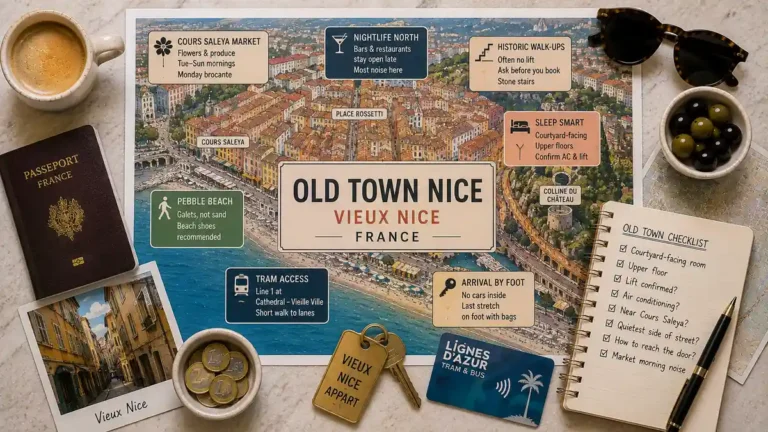
The city is best for travelers who want a coastline and an urban base in the same trip. Its historic core sits behind the seafront as a dense grid of narrow streets. Castle Hill rises above it with the view most people picture before arriving, the Promenade des Anglais runs the length of the Baie des Anges, and Cours Saleya anchors the market life. Those are orientation points, not a plan — the curated shortlist lives in our guide to things to do in Nice. Among French destinations, Nice is the one that pairs a Mediterranean coastline with a working city; the alternatives are set out in our roundup of the best places to visit in France.
Nice has its own cuisine, and that is the clearest proof the city has depth beyond the shoreline. Niçoise cooking is regional and specific — socca, chickpea-flour street food, and the produce culture around Cours Saleya — and it reads as its own tradition, closer to the Ligurian coast than to Paris. Eating well here is easy. The national picture, from regional dishes to what to order where, sits in our France food guide, and the drinking side is covered in our overview of French wine regions.
Why Nice Works as a French Riviera Base
Nice works as the Riviera base because everything else on the coast is easier from here. The airport sits on the city’s western edge, the coastal rail corridor runs through town, and the city itself has enough substance that base days are not wasted days. Car-free travelers gain most.
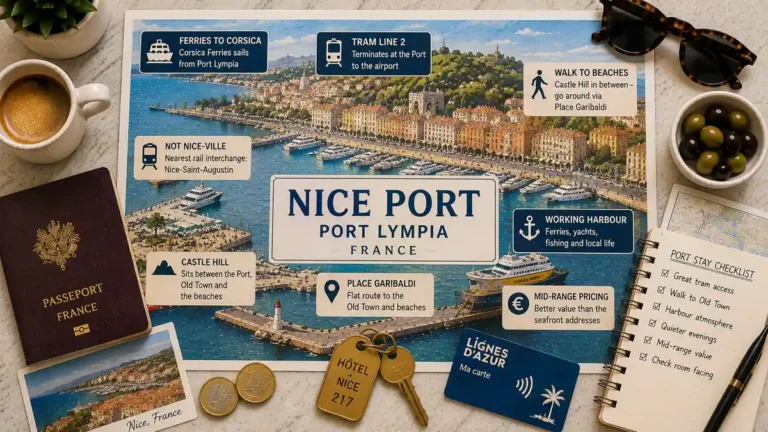
Nice Côte d’Azur airport sits on the western edge of the city and connects directly to the centre by tram. It is the shortest airport-to-centre hop of any major arrival point on the French Riviera, which matters more than it sounds on a trip of four or five days. Nice is also reachable by rail from elsewhere in France, which is how many travelers arrive without flying. Transfer options and how they compare are resolved in our Nice airport transport guide.
The coastal rail corridor is the second pillar, and it is what makes a base-and-explore trip shape possible. Regional trains link the Riviera towns along the shore, so you sleep in one place and reach the rest of the coast on day trips. Unpacking once is the whole point. Town-by-town comparison — which coastal base suits which traveler — belongs to the parent, in our French Riviera guide.
The third pillar is the one most base arguments skip: Nice has enough city depth that base days are not filler. A base only pays off if the base itself is worth a day of its own, and most Riviera towns run out in an afternoon while Nice does not. That one fact decides whether a week on the coast feels balanced or repetitive.
How Many Days You Need in Nice
2–3 days covers the city itself; 4–7 days makes Nice a base worth keeping. The tier you need depends on one question: whether the rest of the coast belongs in this trip. Anything under two days reduces Nice to a stopover, which the city does not reward.
Tiers assume a car-free trip with the coast reached by train.
| Trip length | What it realistically covers | Who it suits | Main trade-off |
|---|---|---|---|
| 2 days | Old town, seafront, market, one viewpoint | Stopovers inside a wider France trip | No day trips, no slow mornings |
| 3 days | The city at a comfortable pace, plus beach time | First visits focused on Nice itself | One day trip at most, chosen carefully |
| 4–5 days | The full city plus two coastal day trips | Travelers using Nice as a Riviera base | Sampling the coast; each town stays brief |
| 6–7 days | City depth, several day trips, genuine rest days | Beach-and-explore weeks without a car | Repetition if you skip the day trips |
The two tiers answer different questions, which is why competing guides disagree so loudly about the number. Pages that say two days are answering how long the city takes; pages that say a week are answering how long you should stay on the Riviera. Both are right about their own question. Decide which one you are asking before you book the nights.
Adding a day to Nice mostly buys a day trip, not more Nice. By the third day the city is largely seen, and every further day converts into coastline — which is exactly the trade the base argument is built on. Day-by-day sequencing for the short tier sits in our 2-day Nice itinerary, and the fuller city version in our 3-day Nice itinerary.
When to Visit Nice: Season Trade-Offs
Shoulder seasons — early autumn and mid-spring — beat peak summer in Nice for crowds, price, and comfort. The sea stays warm well past the summer rush, which makes early autumn the strongest all-round window. Peak summer wins only if school holidays decide your dates.
Early autumn is the window that gives up the least. The sea is at its warmest after a summer of heating, the beaches thin out, and the city returns to something closer to its own rhythm. Mid-spring trades warm water for lower prices and emptier streets, with everything open and the light already Mediterranean. You swim less and see more.
July and August are peak on every axis that matters here — the beaches, the trams, the old town at dinner, and what accommodation asks for a room. Nothing is closed and the atmosphere is real, so peak summer is a legitimate choice for anyone locked into school holidays. It is a poor choice for anyone free to move a few weeks either side.
Winter is where Nice’s calendar contains its own contradiction. February is the quietest stretch of the year by visitor volume, and it is also when Nice Carnival fills the city in its late-winter window — so the year’s quietest month is not uniformly quiet, and accommodation during the carnival window behaves like a high season inside a low one. Book that window early or avoid it deliberately. Timing at national level, including how the Riviera fits the rest of the country’s calendar, is covered in our guide to the best time to visit France.
Where to Stay in Nice: Style Over Street
Choose your Nice stay by style — seafront, old-town character, or quieter residential — before choosing a street. The three trade against each other on the same three things: noise, walking distance to the sea, and how much the area empties out at night. Settle style first; the exact street follows easily.
- Seafront: you wake up to the Baie des Anges and reach the water in minutes. You pay for it in price, and in boulevard noise on the road-facing side.
- Old-town character: you get the market, the evening life and the shortest walk to dinner. You give up quiet — the historic core stays loud late, every night of the week.
- Quieter residential: you get space, calmer streets and better value for the same room class. You trade a few extra minutes of walking, or a tram ride, to reach the sea and the old town.
The honest variable in Nice is atmosphere, not distance. The city is compact enough that a few streets inland costs you minutes instead of access, so what actually separates the three styles is how loud the area sounds at midnight and how alive it feels at breakfast.
Which actual area delivers your chosen style is a map question, and it is resolved in our Nice where to stay guide. The traveler-type versions of the question have their own answers — best areas for first-time visitors, where couples should stay, family-friendly bases, budget stays, luxury stays, and nightlife-focused areas. If you want named properties on the water, see our shortlist of the best beach hotels in Nice.
Hotels and places to stay
Compare hotels, apartments and stays for your dates in one search.
Search hotels and stays on hotels.com →
Tripstou may earn a commission if you book through this link, at no extra cost to you.
Do You Need a Car in Nice?
No — you do not need a car in Nice, and one is closer to a liability. The historic core, the seafront and the main squares sit within walking distance of each other, and the tram covers the rest. Parking and traffic cancel any benefit.
Most visitors barely use transport at all inside the city. The tram is the spine for the longer hops, including out toward the airport edge of town, and it runs where the walking distances stop being pleasant. Fares work on a simple structure: a flat single fare valid for transfers within a time window, cheaper from a machine than from a driver, with multi-day options for heavier users. Tickets, passes, lines and validation mechanics are all resolved in our Nice transport guide.
A car earns its place only if your trip pushes inland to the hill villages. In the city it buys you one-way streets, paid parking and a permanent search for a space.
Is Nice Expensive to Visit?
Nice charges Riviera prices at the seafront and normal French city prices a few streets back. That gap is the whole cost story here, and it is almost entirely under your control. Where you sleep and where you eat decide the total more than the trip’s length does.
- Budget: hostels or simple rooms a few streets inland, market food and bakery lunches, everything on foot or by tram. Nice is unusually kind to this style — the public beach, the Promenade and the old town cost nothing to enjoy.
- Mid-range: a comfortable hotel or apartment within walking distance of the sea, one sit-down meal a day, the occasional taxi. This is the style the seafront premium bites hardest, and the style that gains most by moving inland a block or two.
- High-end: a seafront address, beach club days, restaurant dinners and private transfers. Nice supports all of it, and the coast charges a genuine Riviera premium for the view that inland Provence never asks for.
The seafront charges for the view, and the view is the only thing that changes. Two streets inland, the same room class and the same plate of food reset to ordinary French city pricing — which makes address, not appetite, the lever that moves a Nice budget.
Actual figures — per-day totals and what to allow for stays, food and transport — live in our Nice trip cost guide. For how the Riviera sits against the rest of the country, see our France travel budget guide.
What to Expect from Nice’s Beaches and Seafront
Nice’s beaches are pebble (galets), not sand — the most common surprise for first-time visitors. The stones run the length of the city shoreline, so no beach in Nice is an exception. Free public stretches sit alongside paid beach clubs along the Promenade des Anglais.
The pebbles change what you pack more than where you go. Water shoes make entering and leaving the sea painless, and a mat or thick towel makes lying down comfortable; the payoff is water that stays clear all summer because there is no sand to stir up. Nobody warns first-timers about the walk in. Everybody notices the clarity.
French beaches are public maritime domain, which is the principle worth knowing before you plan a beach day. Free public stretches always exist, and private clubs operate as time-limited concessions that cannot occupy an entire beach. In practice you never have to pay to reach the water in Nice, and paying buys comfort — a lounger, shade, table service — instead of access.
The Promenade des Anglais is the seafront boulevard, running several kilometres along the Baie des Anges and working as the city’s main axis for walking, running and simply looking at the sea. It is the one piece of Nice that everyone uses daily. If you want ranked beach picks across the country, see our guide to the best beaches in France.
A memorial to the victims of the attack on the Promenade des Anglais stands in the Jardin de la Légion d’Honneur at Villa Masséna. It is reached from the Promenade or from rue de France and is open to individual visitors daily. A commemorative sculpture, L’Ange de la baie, stands on the Promenade itself. Commemoration takes place on Bastille Day.
Day Trips from Nice: What the Base Unlocks
From Nice, the coastal rail corridor puts Monaco, the Riviera towns and the Italian border within day-trip reach. That reach is the payoff of basing here, and it is what turns a city break into a coast trip. No car is required for any of it.
Monaco is the obvious first pick, and it asks no more planning than turning up at the station. The Riviera towns strung along the same corridor are equally accessible from the same station, and the Italian border is near enough that crossing for the day is routine. Which of them deserves your limited day trips, and how they measure up against each other, is the regional guide’s job — the parent linked above profiles them properly. This page names them and stops there.
Nice also works as one leg of a longer French trip, usually the coastal one. Where it fits depends on the route you build:
- Country-level orientation in our France travel guide
- Route planning in our France itinerary hub, with 7-day, 10-day and 14-day versions
- Rail-led France trips and road-trip routes for the two ways of stitching the coast to the rest of the country
Tours and activities
Book skip-the-line tickets, day trips and local tours with free cancellation on most activities.
You can also browse everything on getyourguide.com.
Tripstou may earn a commission if you book through this link, at no extra cost to you.
Who Nice Is For — and Who Should Skip It
Nice suits car-free travelers who want a city and a coastline in one base. It disappoints anyone expecting a sand-beach resort, a quiet village, or a short trip with no city in it. The fit is clearer than most destinations make it.
- Nice fits car-free travelers, first-time Riviera visitors, couples, families who want beach and city in the same place, and anyone building day trips out of a single hotel room.
- Nice disappoints travelers set on sand, anyone looking for a small quiet village, party travelers expecting a club capital, and drivers who plan to keep a car in town.
The traveler Nice consistently lets down is the one who booked it for the beach alone. The pebbles and the city both reward people who came for more than sand, and the trip that fails here is almost always the one built on a single expectation.
On safety, Nice behaves like any large French city — ordinary urban care applies, with the usual pickpocket attention in crowded tourist zones — and the full verdict is in our Nice safety guide. First-timer practicalities are collected in our Nice tips guide, common approaches to watch for in our France scams guide, solo travel considerations in our solo female safety guide for France, and what to bring in our France packing list.
Frequently Asked Questions
Can you swim in Nice outside the summer months?
Yes — the sea stays swimmable well past the summer rush, and early autumn is the warmest water of the year. Spring swimming suits the hardy, since the Mediterranean warms slowly after winter. By late autumn the water cools quickly, and winter swimming becomes a determined local habit, not a holiday activity.
Is Nice worth visiting in winter?
Yes, if you want the city itself instead of a beach holiday. Winter is the quietest stretch of the year, the coast stays mild by northern European standards, and the old town, the market and the seafront work as well as ever. Shorter days trim what a single day trip covers.
What is the Nice Carnival, and when does it happen?
Nice Carnival is the city’s biggest annual event, a late-winter run of parades and public celebrations. It is worth planning a trip around if street festivals appeal, and worth planning away from if you came for a quiet coastal city. Either way, dates move each year, so check the current programme first.
How far is Monaco from Nice?
Monaco is close enough to be an easy half-day trip from Nice, reached along the coastal rail corridor. Regional trains follow the shore, so the trip needs no car, no tour booking and no advance planning. Whether it earns one of your limited days depends on interest, not on distance.
Do people speak English in Nice?
Yes — English is widely spoken across Nice’s tourism, hotel and restaurant scene, and you can plan and travel here without French. A greeting in French still changes the tone of an exchange, and it is worth the effort in the old town and at the market, where the crowd is more local than international.
Is Nice good for families?
Yes — Nice suits families because the beach, the old town and the tram sit within one compact area, so days need little logistics. The pebbles are the main caveat: young children find them harder underfoot than sand. Evenings in the historic core stay loud, which matters if early bedtimes shape your day.
Is Nice a good place to travel solo?
Yes — Nice works unusually well solo because the city is compact, walkable and easy to move through without a car. Eating alone is straightforward in a market and street-food culture, and the day trips need no group booking. The one real drawback is that a room near the water costs the same solo as it does for two.
Related Guides
- Where to stay in Nice — the area-by-area resolver once you have picked a style.
- 2 days in Nice — the short-tier day plan for a stopover visit.
- 3 days in Nice — the fuller city plan with beach time built in.
- Things to do in Nice — the curated shortlist behind the orientation points above.
- Getting around Nice — tram lines, tickets, passes and validation.
- Nice trip cost — per-day figures and what to budget for each spend style.
- Nice airport to city centre — transfer options compared.
- French Riviera guide — the regional trip shape and town-by-town base comparison.
Did this guide save you time or money? Tripstou is independent and reader-funded — if you'd like to give something back, you can support the site with a crypto contribution of any size.