
Paris is booked. What sits around it is a full French region — Île-de-France — and it is where most Paris trips find their extra days. Eight departments ring the city, and inside them are the palace at Versailles, the château and forest at Fontainebleau, the walled medieval streets of Provins, the theme parks at Marne-la-Vallée, and the village where Van Gogh painted his last canvases.
This guide answers the regional questions rather than the city ones: what is actually out there, how many days the region deserves, whether to base in Paris or move out, and how the radial rail network shapes every decision. It also settles a boundary problem most guides skip — several of the most-marketed “Paris region” day trips are not in Île-de-France at all.
Quick Answer
The Paris region rewards 1–3 extra days beyond the city itself. Versailles, Fontainebleau, and Provins all sit within roughly an hour and a half by rail, and the network runs radially from Paris. The real choice is day-tripping from a Paris base or moving out; most first-timers should stay in Paris and radiate by RER.
Trust Layer
Tripstou region guide for travelers planning a regional trip. Covers sub-areas, trip shape, base strategy, timing, and mobility tradeoffs.
Produced with AI assistance and reviewed by Alex Perrut, working in tourism since 2015, for the Tripstou editorial team. See our editorial process for details.
Last factual review: August 5, 2026.
Official sources consulted: France.fr, Atout France.
Key Takeaways
- Île-de-France earns 1–3 extra days beyond Paris; past that, returns drop unless you deliberately slow down.
- One flat fare covers Metro, train, and RER anywhere in the region, so distance never changes the ticket price.
- Base in Paris and radiate outward; staying in the region only pays off when one anchor dominates the trip.
- The rail map is radial, so plan one direction per day — crossing the region means backtracking through Paris.
- Chantilly, Giverny, and Chartres sit outside Île-de-France, which changes how their tickets price even though the day trip works.
- Versailles requires a booked timed-entry slot, and a Paris Museum Pass covers admission without exempting you from reserving it.
Table of Contents
Why the Paris Region Is Worth Extra Days
Île-de-France surrounds Paris with royal estates, forest châteaux, and walled medieval towns within an hour of the city. That proximity is what makes the region worth extra days — it extends a Paris trip instead of replacing it. One to three added days cover the main anchors without changing hotels.
The region is an add-on, not a standalone destination on a first visit. Almost nobody flies in to see Île-de-France and skip Paris, and the surrounding sights were built as satellites of the capital in the first place. Repeat visitors flip this. On a second or third Paris trip, the region can carry most of the itinerary while the city becomes the place you sleep and eat.
Paris is the region’s hub and its default base. Every rail line that reaches the region’s sights runs through the city, which makes city planning and regional planning the same exercise here. Sights, neighborhoods, city day counts, and ticket mechanics all belong to the city layer — our Paris travel guide resolves those, and this page starts where the city stops.
Where the region sits against the rest of France is a separate question, and one worth settling before you allocate the days. If you are weighing French regions against each other, the comparison lives in our guide to the best places to visit in France.
The region’s quiet advantage is that it needs almost no logistics: you can decide over breakfast to go to Versailles and be walking the gardens before midday. Few other French regions let you improvise a full day out with that little planning cost.
How Île-de-France Is Laid Out for Travelers
Île-de-France is eight departments arranged in two rings around Paris. The Petite Couronne is the dense urban belt directly around the city; the Grande Couronne is the outer ring where nearly every travel target sits. The rings matter more than the department names.
Translated into travel terms, the split is simple:
- Petite Couronne (75, 92, 93, 94) — Paris, Hauts-de-Seine, Seine-Saint-Denis, and Val-de-Marne. This is continuous city and suburb, reached on the Metro and short RER hops. Saint-Denis, with its royal basilica, is the one Petite Couronne stop most travelers actually plan for.
- Grande Couronne (77, 78, 91, 95) — Seine-et-Marne, Yvelines, Essonne, and Val-d’Oise. This is where the palaces, forests, medieval towns, and theme parks are, and where a day trip actually feels like leaving the city.
The anchors map onto the outer ring cleanly. Versailles sits in the Yvelines, west of Paris. Fontainebleau, Provins, and Marne-la-Vallée — the site of Disneyland Paris — are all in Seine-et-Marne, the large department east and southeast of the city. Auvers-sur-Oise is in the Val-d’Oise to the northwest.
Think east and west. Seine-et-Marne alone holds three of the region’s four main draws, which is why splitting the map into an eastern side and a western side is more useful for planning than memorising eight department names.
The Sub-Areas Worth Your Time Outside Paris
Four sub-areas justify trip time outside Paris: Versailles, the Seine-et-Marne east, Marne-la-Vallée, and the Val-d’Oise. Each has a distinct character and a clear base town, and each works as a day trip from the city. Choose by the kind of day you want.
| Sub-area | Character | Anchor experience | Base town | Best for |
|---|---|---|---|---|
| Versailles & the Yvelines | Formal, monumental, heavily visited | The palace and its gardens | Versailles, walkable from the station | First-timers wanting one royal set piece |
| Seine-et-Marne east | Wooded, provincial, slower paced | Fontainebleau château and forest | Fontainebleau, or Provins for walls | Repeat visitors avoiding palace queues |
| Marne-la-Vallée | Purpose-built, busy, family-focused | The Disneyland Paris resort | Marne-la-Vallée–Chessy resort area | Families building the trip around parks |
| Auvers-sur-Oise & Val-d’Oise | Rural, quiet, art-led villages | Van Gogh’s final landscapes on foot | Auvers-sur-Oise, covered on foot | Art travelers wanting a low-effort half day |
Versailles and the Yvelines
Versailles is the region’s set piece and the trip most itineraries include. The palace and gardens fill a half to full day, roughly 30–40 minutes from central Paris by rail, which is close enough that most people go and return without touching their luggage. Book a timed-entry slot before you travel — the palace requires one. A Paris Museum Pass is accepted for admission, but it does not exempt you from reserving that free slot, and it does not cover transport. Best for: first-timers who want one unmissable royal set piece.
Fontainebleau and Provins
Fontainebleau and Provins are the eastern answer to Versailles crowds. Fontainebleau pairs a lived-in royal château with a forest that draws hikers and boulderers year-round, and the town itself is pleasant enough to sit in. Provins is a walled medieval town about 1h20 from Paris by rail, with ramparts you can walk and a compact old centre. Both reward a slower day than Versailles does, and neither runs on booked slots in the same way. Best for: repeat visitors who want a château without the queue.
Marne-la-Vallée and Disneyland Paris
Marne-la-Vallée is the region’s theme-park anchor, in Seine-et-Marne roughly 40 minutes east of central Paris on RER A. Disneyland Paris uses dynamic pricing, so admission changes by date and demand; check the official site rather than any figure quoted elsewhere. Practically, this is a destination in its own right instead of a sight to fold into a general sightseeing day — families routinely give it one to two full days. Best for: families building the trip around the parks.
Auvers-sur-Oise and the Val-d’Oise
Auvers-sur-Oise is the quiet, art-led half day of the four. The village is where Van Gogh spent his final months, and the walkable circuit of the church, the wheatfields, and the cemetery is essentially the whole visit. It suits a slow morning far better than a packed schedule, and the Val-d’Oise around it stays genuinely rural. Nothing here needs booking, which is exactly the point after a Versailles day. Best for: art travelers wanting a low-effort half day.
These are character profiles, not a ranking. If you want the picks weighed against each other and ordered, that is a separate job — our guide to day trips from Paris handles the pick-list.
Pick the pace first. The four sub-areas differ more by tempo than by quality: Versailles and Marne-la-Vallée run on booked slots and queue management, while Provins and Auvers reward turning up without a plan. Deciding which of those two days you want narrows the choice faster than comparing the sights themselves.
Tours and activities
Book skip-the-line tickets, day trips and local tours with free cancellation on most activities.
You can also browse everything on getyourguide.com.
Tripstou may earn a commission if you book through this link, at no extra cost to you.
Chantilly, Giverny, and Chartres Are Not in Île-de-France
Chantilly, Giverny, and Chartres sit outside Île-de-France, despite being sold as Paris region day trips. Chantilly is in the Oise, Giverny in Normandy, and Chartres in the Eure-et-Loir. The distinction matters because the region’s ticketing and planning rules stop at the boundary, even when the trip does not.
The radius is wider than the region. All three are reachable from Paris and back within a day, which is why marketing folds them into the Paris region without much resistance. The difference shows up when you buy the ticket: a journey that leaves Île-de-France leaves the regional fare structure behind and prices as ordinary national rail, and it falls outside anything sold as a regional pass.
Giverny belongs to a Normandy trip more than a Paris one. Monet’s garden is the best-known stop in a region that also holds a coastline, cathedral towns, and the D-Day beaches, and it is worth checking whether the pull is strong enough to extend the trip properly — our Normandy travel guide covers what that would involve.
Chantilly and Chartres work the same way on a smaller scale: both are legitimate days out from Paris, and neither is part of the region this page describes. Treat the boundary as a booking and budgeting line, not a travel restriction — it changes how you buy the ticket, never whether the trip is worth making.
How Many Days the Paris Region Deserves
Most Paris trips should add 1–3 days for the region. A single day covers one anchor properly; 3 days cover the range without repetition. Past 3 days, returns fall off quickly unless you are deliberately slowing down in the forests and villages.
The tiers break down cleanly:
- 1 extra day — one anchor at full depth, almost always Versailles or Disneyland Paris. Buys the region’s headline experience and nothing else. Right for a first Paris trip where the city still owns most of the schedule.
- 2–3 extra days — the set piece plus a genuine contrast: a medieval town or a forest château, and a half day in a village. Buys variety in landscape and pace. Right for repeat visitors, or any trip spending a week or more in and around Paris.
- 4+ days, region-led — forest walks, small towns, and a park-centred family stay, with the city reduced to arrival and departure. Buys depth and quiet. Right for travelers who have already done Paris properly.
The ceiling is 3 days for most trips. On a wider France trip the region’s share shrinks fast: a 7-day France itinerary rarely allows more than a single day outside Paris, a 10-day France itinerary supports two, and only a 14-day France itinerary leaves room for the region and the rest of the country.
For repeat visitors, days two and three in the region usually beat days six and seven in the city. A marginal Paris museum is competing against an entire château you have never seen, and that is not a close contest.
Should You Base in Paris or Stay Out in the Region?
Paris is the right base for nearly every trip into the region. The rail network runs radially from the city, so every outward journey is shorter and simpler from a central base. Staying out earns its keep in two cases: a Disneyland-centred family trip, or a slow Fontainebleau stay.
Move out only for one anchor. Sleeping in the region buys quieter evenings, more space, and a shorter morning to one specific sight. It costs you the ability to reach anything else without backtracking through Paris, which turns every second excursion into a long day. That trade is worth it when the trip is built around a single place and pointless when it is not.
Where to sleep inside Paris — which neighborhoods, how they compare, how far they sit from the RER stations — is city-level planning, and the Paris travel guide linked earlier is the place to resolve it. This page stops at the in-or-out decision.
On positioning: accommodation outside the city generally costs less than central Paris, though the gap narrows sharply around the parks and in Versailles itself. Our France travel budget guide sets the national context.
The base question is really a question about how many anchors you plan to visit. One anchor tolerates a regional base comfortably; two or more force you back through Paris anyway, and at that point the central base wins on every single leg.
Hotels and places to stay
Compare hotels, apartments and stays for your dates in one search.
Search hotels and stays on hotels.com →
Tripstou may earn a commission if you book through this link, at no extra cost to you.
How to Get Around the Paris Region
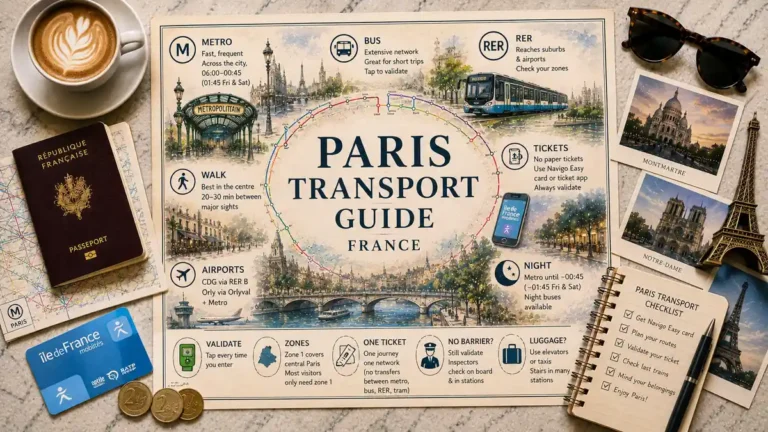
The Paris region is rail-shaped: RER and Transilien lines radiate outward from the city. A single flat fare covers Metro, train, and RER journeys anywhere in Île-de-France, regardless of zone; airport rail journeys are priced separately. Zones do not decide the price.
That radial shape sets the practical day-trip radius. Most anchors sit between roughly 30 and 90 minutes from central Paris — Versailles around 30–40 minutes, Marne-la-Vallée around 40 on RER A, Provins closer to 1h20 — which is why almost everything works as a day trip and almost nothing works as a chain of stops.
Cross-region moves are the weak point. There is no useful orbital line, so travelling from Versailles in the west to Fontainebleau in the southeast means going back through Paris to do it. Plan one direction per day.
A car only changes the answer beyond the anchors. Forest trailheads around Fontainebleau, the villages of the Vexin, and clustered small towns are where driving genuinely beats the train; for the palaces and the parks it does not, and parking makes it worse. If a wider drive is already on the table, our France road trip guide covers the national picture.
Ticket mechanics — which pass to buy, how to validate, how airport transfers price out — are city-level questions, and the Paris travel guide is where they get resolved.
The flat fare removes the region’s oldest planning question. Distance does not change the ticket, so choose a day trip by what you want to see and how long the ride takes, never by how far out it sits on the map.
When to Visit the Paris Region
The Paris region works year-round, and autumn is the strongest window for the two mass-draw anchors. Versailles and Disneyland Paris both thin out once the summer holidays end, while the gardens and forests keep their colour. Winter is quiet and short on daylight.
Crowds track school calendars. Versailles is heaviest through late morning in summer and on weekends all year, and arriving at opening or in the final hours of the afternoon changes the experience more than the month does. Disneyland Paris peaks with French and UK school holidays, which is a different calendar from the general tourist season.
Spring and autumn are the two shoulder windows, and they behave differently. Spring brings the gardens into flower and the crowds back along with them. Autumn keeps the light and the forest colour with noticeably fewer people, which is why it edges spring for this particular region. Summer is the outlier: long days, the fullest opening hours, and the longest queues of the year.
Winter suits the indoor half of the region — château interiors, museums, and the Provins ramparts on a clear cold day — and cuts the usable daylight for everything else. For national timing depth, see our guide to the best time to visit France.
The region rewards the opposite weather logic to the city. Paris absorbs a rainy day easily; the region does not, because half of what you came for is outdoors. If your trip contains one settled forecast day, spend it outside the city and keep the museums for the grey one.
Where the Paris Region Fits in a Wider France Trip
Île-de-France is France’s natural first act: nearly every national route starts or ends here. The country’s rail network radiates from Paris, so the region is where most French trips are assembled and broken up. Give it the front of the itinerary, while jet lag still limits ambition.
Start here. International flights land in the region, the TGV network fans out from its stations, and the first jet-lagged days cost you the least when the sights are short rides away and the days are self-contained. Our France travel guide covers the national picture, and our France itinerary guide covers how the pieces fit into an actual route.
The same rail structure makes the region an efficient bookend. Because long-distance lines radiate from Paris, ending a trip here is as easy as starting one, which is useful when a late departure leaves room for a final regional day out. Our France train itinerary shows how the national routes connect.
One practical note before your first day out: the crowds at Paris rail stations and at Versailles attract pickpockets and street scams. Our guides to common scams in France and solo female travel safety in France cover what actually happens and how to sidestep it.
Frequently Asked Questions
Is Chantilly in Île-de-France?
No. Chantilly sits in the Oise department, part of Hauts-de-France, just north of the Île-de-France boundary. It still works as a day trip from Paris — roughly half an hour from Gare du Nord plus a short onward hop — but the journey prices as national rail, not regional.
Is Disneyland Paris in the Paris region, and how do you get there?
Yes. Disneyland Paris sits at Marne-la-Vallée in Seine-et-Marne, inside Île-de-France, and RER A runs there from central Paris in roughly 40 minutes with trains every 10 to 15 minutes. The station opens directly onto the resort, and the regional flat fare applies, so distance adds nothing to the ticket.
Can you visit Versailles and Fontainebleau in one day?
Technically yes, realistically no. They sit on opposite radials from Paris, so combining them means crossing the city between two crowd-heavy châteaux. Versailles also runs on a mandatory timed-entry slot, which pins your schedule. Give each one its own day and you will actually see them.
Do you need a car in Île-de-France?
No — every anchor in Île-de-France has a station, and a car parked in Paris costs you money for days you will not drive. If a forest or village stretch is on the plan, rent for those days only and collect the car on your way out of the city, not on arrival.
Is Provins worth visiting?
Yes, for travelers who want a slow, low-planning day. Nothing in Provins runs on booked slots, so a single walk of the ramparts and the old centre fills a morning without a schedule. It reads as a change of pace from a palace day, not a smaller version of one.
Related Guides
These guides continue the trip beyond Île-de-France and cover the preparation the region does not. Each one either extends the route into another part of France or handles a practical layer — food, packing, and the wider country’s regions — that a single regional hub cannot resolve on its own.
- French Riviera travel guide — the Mediterranean south, and the most common second region after Paris.
- Alsace travel guide — half-timbered towns and vineyards on the German border, reachable by direct TGV.
- Lyon region travel guide — France’s food capital and the natural midpoint between Paris and the south.
- French Alps travel guide — mountain valleys for both summer hiking and winter snow.
- France’s wine regions — how the wine map is organised and which regions accept visitors easily.
- Best beaches in France — the coastlines worth planning a leg around, Atlantic and Mediterranean.
- French food guide — what to eat where, and how meal timing works across the country.
- France packing list — what to bring for a trip that mixes city days with château gardens and forest walks.
Did this guide save you time or money? Tripstou is independent and reader-funded — if you'd like to give something back, you can support the site with a crypto contribution of any size.