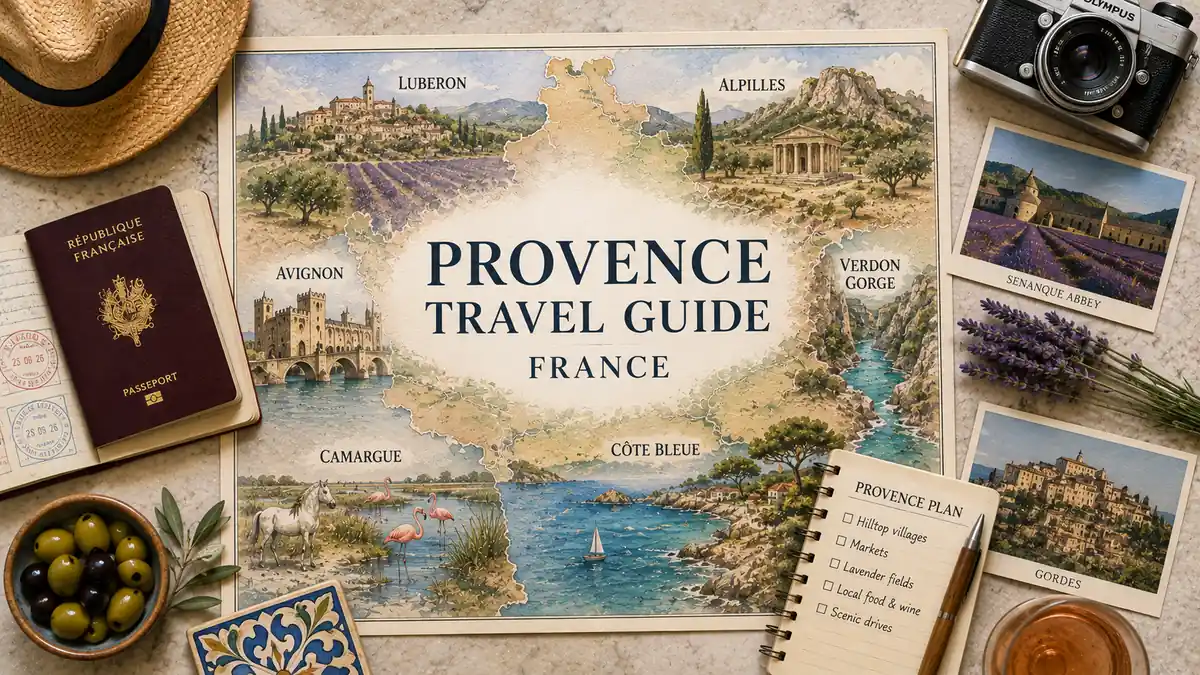
Provence is inland southern France — hilltop villages, Roman towns, and lavender plateaus spread across a region with no single centre. That missing centre is the planning problem. There is no one city you fly into, sleep in, and walk out of every morning.
Trips here succeed or fail on structure. Travelers who love Provence choose one or two sub-areas, base in a town that reaches them, and match their mobility to the villages they actually want. Travelers who leave disappointed spread themselves across the whole map and spend the week behind the wheel.
This guide resolves the four decisions that shape the trip: which area to anchor on, how many days it needs, where to base, and whether you need a car. Everything else follows from those four.
Quick Answer
Provence works best as a 5–7 day trip built around 1–2 base towns in different sub-areas. Whether you drive decides everything else: a car opens the hilltop villages, while going car-free narrows you to the rail towns. First-timers should base in Avignon or Aix-en-Provence and add a Luberon base only with a car.
Trust Layer
Tripstou region guide for travelers planning a regional trip. Covers sub-areas, trip shape, base strategy, timing, and mobility tradeoffs.
Produced with AI assistance and reviewed by Alex Perrut, working in tourism since 2015, for the Tripstou editorial team. See our editorial process for details.
Last factual review: August 5, 2026.
Official sources consulted: France.fr, Atout France.
Key Takeaways
- Provence has five travel-distinct sub-areas, and the one you anchor on decides the whole trip’s shape.
- Budget 5–7 days for a first trip; 3 days covers one sub-area, 10+ days earns a second base.
- A car is effectively required for the Luberon hilltop villages; Avignon, Arles and Marseille work fine car-free.
- Base in Avignon or Aix-en-Provence for a first visit — both sit on the rail network and reach several sub-areas.
- Late spring and early autumn beat summer; August brings the heaviest crowds and the highest accommodation costs.
- Plan every driving day around market mornings and hilltop parking — arrive before mid-morning or come late afternoon.
Table of Contents
Is Provence Worth Visiting — and What Exactly Is It?
Provence is worth visiting for anyone who wants slow, scenic, rural France with real depth. It combines hilltop villages, Roman monuments, weekly markets, and a produce-and-rosé food culture inside a compact inland region. It rewards travelers who settle into one base and explore outward at an unhurried pace.
Provence is inland southern France — the Rhône valley, the Luberon and Alpilles hill country, the Valensole plateau, and the port city of Marseille with its stretch of coast. The Riviera coast further east is a different region and a different trip. Inside those boundaries the appeal stays consistent: stone villages built into hillsides, Roman monuments still standing in Arles and Orange, weekly markets that work as the region’s social calendar, and a landscape of vines, olives, and lavender.
The food culture follows the market. Produce, olive oil, herbs, seafood on the coast, and the pale rosé that made Provence one of France’s defining wine regions set the tone of almost every meal. Lunch is the event, and it is rarely quick.
Provence suits slow travelers, first-timers to rural France, and anyone adding a southern leg to a longer trip. It suits sight-tickers least, because the good parts are dispersed and the driving between them is the trip. If you want everything walkable from one hotel door, weigh Provence against the other regions of France before committing — this region asks you to move to reach it.
The Main Areas of Provence, Compared
Provence splits into five travel-distinct sub-areas, and the one you anchor on defines the whole trip. The Luberon, the Alpilles, Avignon and the Vaucluse, Valensole and Verdon, and Marseille with its coast each deliver a different kind of day. Choose the area before you book anything else.
| Sub-area | Character | Natural base | Best for | Car needed |
|---|---|---|---|---|
| Luberon hill villages | Ochre and stone villages above vineyards | Bonnieux, or Gordes for shorter stays | Village-hopping days at a slow pace | Yes — no rail reaches the villages |
| Alpilles and Saint-Rémy | Limestone ridge, olive groves, painters’ light | Saint-Rémy-de-Provence, small and walkable | Art, landscapes, and short driving days | Helpful, though the base stays walkable |
| Avignon and the Vaucluse | Roman and papal heritage on the Rhône | Avignon, the region’s main rail hub | First trips arriving by train | No — the rail spine covers it |
| Valensole and Verdon | High plateau farmland above a deep gorge | Moustiers-Sainte-Marie, near the gorge | Big-landscape drives and lavender plateaus | Yes — distances here are rural |
| Marseille and the coast | Working port city beside limestone creeks | Marseille, the region’s largest city | City energy and coastline in one base | No — city transport and boats suffice |
The Luberon is the Provence of the postcards: ochre and pale-stone villages stacked on hillsides above vineyards, orchards, and cherry country. The anchor experience is the village circuit — Gordes, Roussillon, Bonnieux, Ménerbes — driven slowly over a day or two. Bonnieux makes the most balanced base, central to the circuit and still a living village. Best for: travelers with a car who want village-hopping days.
The Alpilles is a low limestone ridge running through olive groves and cypress rows, smaller and gentler than the Luberon. The anchor experience is the hilltop citadel of Les Baux and the light that pulled painters here. Saint-Rémy-de-Provence is the natural base: walkable, well fed, and close to everything in the range. Best for: art, landscape, and short driving days.
Avignon and the Vaucluse is the region’s heritage and transport core, built around a walled papal city on the Rhône. The anchor experience is the Palais des Papes, with canal-side L’Isle-sur-la-Sorgue and the spring at Fontaine de Vaucluse close by. Avignon is the base, and the only one that functions fully without a car. Best for: first trips and car-free travelers arriving by train.
Valensole and Verdon is high, open plateau country that ends at the Verdon gorge, one of Europe’s deepest river canyons. The anchor experience is the Valensole lavender plateau, a landscape of long purple rows against wide sky. Moustiers-Sainte-Marie, wedged into a cliff above the gorge, is the base. Best for: big-landscape drives and photography-led days.
Marseille and the coast is the region’s urban counterweight — a large, unpolished port city with layered neighbourhoods and the limestone calanques on its doorstep. The anchor experience is the Vieux-Port and the coastline south of it. Marseille itself is the base, and city-level planning lives in the Marseille city guide. Best for: city energy and coastline inside a Provence trip.
Mobility should decide the area before scenery does. The Luberon photographs best and punishes car-free travelers hardest; Avignon and Marseille do the opposite. Once the area is fixed, the village-level choices open up — the well-known stops are covered in things to do in Provence, and the quieter alternatives in Provence’s hidden gems.
How Many Days Do You Need in Provence?
Most first trips to Provence need 5–7 days; 3 days covers one sub-area well. The region has no single centre, so every extra day buys either a deeper sub-area or a second one. Under 3 days, Provence works better as one stop on a wider France route.
- 3 days — one base, one sub-area, highlight pace. Enough for Avignon plus a Luberon or Alpilles loop. Fits travelers adding Provence to a longer France trip.
- 5 days — one base plus day loops in two directions. The shortest length that stops feeling like a checklist, and the sweet spot for a first visit.
- 7 days — two sub-areas properly, or one explored deeply with market mornings, a long lunch, and an unplanned day built in.
- 10+ days — two bases, unhurried, with room for Valensole and the Verdon gorge or the coast around Marseille. Best for repeat visitors and slow travelers.
The fifth day is where a Provence trip stops feeling rushed. It is the first day you can give a market morning and a hilltop village to the same afternoon without cutting either short.
Trip shape matters more than the raw count. One base with day loops beats a moving itinerary at almost every length here, because the driving is the same either way and the packing is not. Provence also rarely travels alone: if it is one leg of a longer route, the sequencing belongs on the route pages — the France itinerary overview for how regions connect, and the 7-day France itinerary, 10-day France route, and two-week France route for where Provence realistically fits.
Where Should You Base Yourself — One Base or Two?
One base serves most Provence trips up to about 5 days, and Avignon or Aix-en-Provence is the safest choice. Both sit on the rail network, both reach several sub-areas in a day, and both have real evening life. Trips of 7 days or more earn a second base.
Avignon is the default first base. It is a walled city with genuine urban life, the region’s main rail hub, and the shortest reach to the Luberon, the Alpilles, and the Rhône towns. It works with a car and, unusually for Provence, works without one. Choose it for a first trip, a train arrival, or a short stay.
Aix-en-Provence is the elegant option: fountains, plane trees, a university crowd, and the strongest café and dinner scene of the bases. It sits closest to Marseille’s airport and the coast, and slightly further from the Luberon villages. Choose it if evenings matter as much as days.
Arles is smaller, quieter, and more atmospheric, with Roman monuments in the middle of town and the Alpilles and Camargue on its edges. Evenings are subdued compared with Aix. Choose it for a second visit, or if Roman and artistic Provence is the reason you came.
A Luberon village or L’Isle-sur-la-Sorgue is the with-car option. Village bases put you inside the scenery, ahead of the day-trippers each morning and behind them each evening. The tradeoff is real: fewer dinner options, early-closing shops, and a car needed for everything, including groceries.
Two bases only make sense when the second one removes daily driving instead of adding a transfer. A second base costs a half-day of packing, checkout, and check-in, so it pays when you are moving between genuinely distant sub-areas — Avignon or Aix for the west, then Moustiers or the coast for the east. Below 7 days, the transfer eats the gain.
Hotels and places to stay
Compare hotels, apartments and stays for your dates in one search.
Search hotels and stays on hotels.com →
Tripstou may earn a commission if you book through this link, at no extra cost to you.
Do You Need a Car in Provence?
For the hilltop villages, yes — a car is effectively required. A rewarding car-free Provence trip exists, but it follows the rail spine and the towns on it. Decide this before you choose a base, because the answer changes which sub-areas are realistically open to you.
Car-free Provence is a real trip, but it is a town trip: Roman Arles, the ramparts and palace at Avignon, the canals and antique dealers of L’Isle-sur-la-Sorgue. The postcard villages are the part that does not survive the decision.
What a car-free trip can actually reach
A car-free trip reaches the towns on the regional rail network, using Avignon as the hub. The TER lines fan out from there and cover a genuinely rewarding set of destinations without a rental car:
- Arles — Roman arena, theatre, and a walkable old town.
- Orange — one of the best-preserved Roman theatres in France.
- L’Isle-sur-la-Sorgue — canals, waterwheels, and the antiques trade.
- Cavaillon — the closest rail edge to the Luberon, and a bus interchange.
- Marseille and Aix-en-Provence — the region’s two cities, both well connected.
The honest limit is the Luberon. Its hilltop villages have no rail station at all — Cavaillon and Avignon are the rail edges, and beyond them you depend on infrequent regional buses, a day tour, or a taxi. Gordes, Roussillon, Bonnieux, and Ménerbes are the villages most travelers picture when they think of Provence, and they are the ones a car-free trip mostly loses. The Alpilles and the Valensole plateau thin out the same way. If trains are the plan from the start, build the trip around the towns and accept the villages you give up; the wider rail logic sits in the France train itinerary guide.
How to get around with a car
With a car, driving is the default mode and the region opens completely. The practical pattern is a loop: leave your base early, take the villages in a circuit, and return in the evening rather than relocating. Roads are good and distances are modest, though mountain and gorge roads run slower than a map suggests. Parking, not driving, is the real constraint — the pattern is covered in the market-morning section below. For routing a car trip across the country, the France road trip guide carries the wider plan.
Tours and activities
Book skip-the-line tickets, day trips and local tours with free cancellation on most activities.
You can also browse everything on getyourguide.com.
Tripstou may earn a commission if you book through this link, at no extra cost to you.
Getting to Provence: Fly to Marseille or TGV to Avignon
Fly into Marseille, the region’s largest international airport, or take the TGV from Paris to Avignon in under three hours. Marseille suits trips that start with a rental car or the coast; Avignon suits car-free trips and anyone continuing from Paris by rail. Both put you inside the region on arrival day.
Marseille’s airport is the region’s main air gateway, with the widest choice of rental desks and onward rail connections into the rest of Provence. It is the sensible door for a driving trip, for a coastal start, and for anyone flying in from outside France.
The TGV is the better door from Paris. Paris to Avignon runs under three hours, and Paris to Aix-en-Provence a little over three — fast enough that the train beats flying door to door. Two details shape the arrival: Avignon’s TGV station sits outside the walls and connects to the centre by a short shuttle, and the Aix TGV station is well outside town, needing a bus or taxi transfer. Arriving in Avignon and collecting a rental car the next morning is the cleanest hybrid. It removes the airport transfer entirely. For how Provence connects to the country’s wider arrival points, see the France travel guide.
Best Time to Visit Provence — and When the Mistral Blows
Late spring and early autumn are the sweet spots, and August is the month to avoid. Those shoulder months bring warm days, open villages, and manageable crowds. Summer delivers the fullest landscape and the heaviest crowds at once; winter is quiet, cold in the wind, and thinner on open businesses.
Spring arrives early here and builds through warm, green weeks before the peak season starts. Summer is hot, busy, and at its most extreme in August, when French holidays overlap with international visitors and the villages, roads, and parking all strain at once. Early autumn keeps the warmth, adds the harvest, and empties the lanes. Winter strips the region back to markets, olive oil, and light — beautiful, but many rural restaurants and small hotels close.
Lavender follows altitude, not the calendar: the lower Luberon colours first, the Valensole plateau sits mid-window, and the high Pays de Sault comes last, with harvest cutting fields early and the whole window shifting a week or two with the year’s weather. Field-level timing and where to actually go live in the Provence lavender fields guide. For how the region’s seasons compare with the rest of the country, see the best time to visit France.
The lavender window and the crowd window are the same window. That is the timing tradeoff nobody solves in Provence — you either accept the crowds for the colour, or accept a quieter region with the fields already cut.
What the mistral means for your trip
The mistral is a cold, dry north to north-west wind that funnels down the Rhône valley and across western Provence. It is most common and strongest from winter into spring, and it can blow for several consecutive days once it starts. The upside is famous: it scours the sky and produces the hard, clear light the region’s painters chased.
The downside is practical. A mistral day feels genuinely cold even when the forecast temperature is mild, terraces close, exposed hilltop villages turn unpleasant, and hiking or photography plans get rearranged. Pack a windproof layer whatever the season — the wider seasonal packing logic is in the France packing list.
Market Mornings and Village Parking Shape Every Provence Day
Most Provence villages hold one market morning a week, and those mornings overwhelm hilltop parking. Markets run morning-only and wind down around midday, so a late start misses them entirely. Plan the driving day around the market first and fit everything else after it.
The pattern is consistent across the region. Each town or village has its own weekly market day, stalls fill the centre from early morning, and traders begin packing up around lunchtime. Markets are not a side attraction here — for many villages they are the one morning a week the place is fully alive.
Parking is where the two constraints collide. Hilltop village cores are pedestrian-only, with paid lots on the approach roads below, and those lots fill early on any sunny day and much earlier on a market morning. Arrive before mid-morning, or invert the day entirely and come late in the afternoon, once the day-trippers and the coaches have gone.
Check the market day of the village you are aiming for before you set the day’s route, then decide whether you want the market or the village — on a market morning you rarely get both.
Is Provence Expensive?
Provence is not a budget corner of France. It prices closer to the country’s popular regions than to its quiet interior. Season drives it more than anything else you control: summer, and August above all, moves accommodation the most. Car hire and a second base add the next largest share.
For what a French trip actually costs by category, the France travel budget guide carries the detail this page deliberately leaves out.
Standalone Provence Trip vs Add-On to a Wider France Route
Provence works both ways: a self-contained week, or the southern leg of a longer France route. The standalone version wants a car, two sub-areas, and time for slow days. The add-on version wants Avignon, the train, and a tight 2–3 days. Choose the shape before you book the first train.
The standalone trip earns its own arrival door. Fly into Marseille, pick up a car, base once or twice, and let market mornings and long lunches set the pace. It is the version that reaches the Luberon villages, the Verdon gorge, and the plateau country — the parts of Provence that need mobility and unhurried days.
The add-on trip is a rail trip. Arrive in Avignon from Paris, stay inside the walled city, and take one sub-area at highlight pace before continuing onward. It fails when it keeps the standalone version’s ambitions: 3 days out of Paris buys Avignon and one loop, and adding the Verdon to that plan turns the visit into a drive.
If Provence’s pace is the appeal more than its specific landscape, the Loire Valley offers a similar slow-region trip further north — villages, food, and a river valley in place of hill country, with easier rail access from Paris.
Frequently Asked Questions
Is August a good time to visit Provence?
August is the month most travelers should avoid, though not everyone. French holidays overlap with international visitors, so villages, roads and parking strain simultaneously and accommodation costs peak. It still works if you are locked to school holidays and base in a larger town like Avignon or Aix, where the crowding is absorbed better.
Can you visit Provence as a day trip from Paris?
Technically yes, but it is not worth doing. The TGV reaches Avignon from Paris in under three hours, which leaves a few hours on the ground before the return journey. That buys the walled centre of Avignon and nothing else. Provence rewards bases and slow days, so give it at least 3.
Which airport is best for Provence?
Marseille Provence is the best airport for most trips. It is the region’s largest international airport, with the widest choice of rental desks and onward rail connections into the rest of Provence. If you are coming from Paris, skip flying entirely — the TGV to Avignon is faster door to door.
What food is Provence known for?
Provençal cooking is built on produce, olive oil and herbs, not on heavy sauces. Expect market vegetables, tapenade, ratatouille, goat cheese, seafood on the coast, and pale rosé at almost every lunch. It is a lighter, garden-led style than the butter-and-cream cooking of northern France — the France food guide covers the regional map.
Can you drive into the hilltop villages of Provence?
Mostly no — the historic cores are pedestrian-only. You park in paid lots on the approach roads below and walk up, which means steep, cobbled lanes and steps once you are inside. The lots fill early on sunny days and much earlier on market mornings, so arrive before mid-morning or late in the afternoon.
Do you need to book ahead for the Calanques near Marseille?
Yes — the busiest calanques require a free advance booking in summer. The reservation is made online before you go and shown on arrival, and it applies to the most visited creeks, not the whole park. Quieter calanques stay open without one. The best beaches in France guide covers the access rules.
Related Guides
- Marseille travel guide — city-level planning for the region’s largest base and airport.
- Things to do in Provence — the villages, sights, and experiences behind each sub-area.
- Hidden gems in Provence — quieter alternatives when the well-known villages are full.
- Provence lavender fields — where the fields are and how the season works.
- Best beaches in France — the calanques near Marseille and the wider French coast.
- France food guide — regional dishes, including what Provençal cooking is built on.
- Common scams in France — the tourist-area patterns worth recognising early.
- Solo female travel safety in France — practical guidance for solo trips.
Did this guide save you time or money? Tripstou is independent and reader-funded — if you'd like to give something back, you can support the site with a crypto contribution of any size.