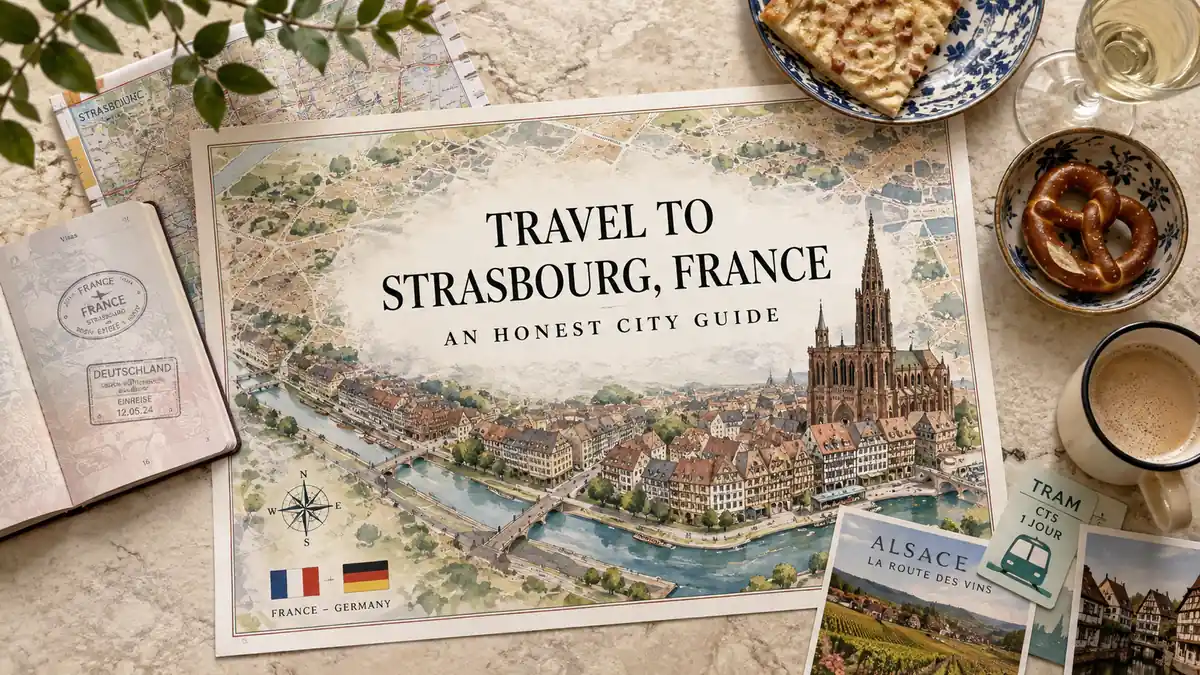
Most travelers meet Strasbourg as an open question. It lands on a France shortlist beside Colmar, or gets squeezed into a day trip from Paris, and the decision stalls on two doubts. The first is seasonal: the Christmas markets dominate everything written about the city, which leaves the rest of the year unexplained. The second is identity — a French city with Germanic architecture, German-sounding food and bilingual street signs makes people unsure what kind of trip they are booking.
This guide answers the hub questions and routes the rest: whether Strasbourg is worth visiting and for whom, what makes it different from the rest of France, how many days it takes, when to go, where to base yourself broadly, how to move around, what it costs in plain terms, whether it is safe, and how far one Strasbourg base reaches into Alsace and across the Rhine. Details that move — fares, market logistics, hotel picks — live in the linked city pages.
Quick Answer
Strasbourg is worth two to three days for its UNESCO centre, cathedral and Alsatian food culture. The real decision is season: Christmas-market weeks transform crowds and prices, while the rest of the year is calmer and cheaper. It suits couples, families and first-timers wanting a walkable base near Germany.
Trust Layer
Tripstou city guide for travelers planning a city trip. Covers trip length, stay style, season, cost, and mobility tradeoffs.
Produced with AI assistance and reviewed by Alex Perrut, working in tourism since 2015, for the Tripstou editorial team. See our editorial process for details.
Last factual review: August 15, 2026.
Official sources consulted: France.fr, Atout France.
Key Takeaways
- Strasbourg earns two to three days on its own merit, not only during the weeks when the Christmas markets run.
- The Franco-German fabric is the real differentiator: Germanic architecture, an Alsatian food repertoire and bilingual signage in a French city.
- Choose your season before your hotel — market weeks bring atmosphere and scarcity, while spring and early autumn bring space and value.
- Skip the car in Strasbourg: the pedestrianised centre, the tram network and mainstream cycling cover every trip you will make.
- One Strasbourg base reaches Colmar, the smaller Alsatian towns and a German city across the Rhine, all by train.
- Strasbourg suits couples, families and first-timers who want walkable culture; it disappoints anyone needing coast, scale or nightlife.
Table of Contents
Is Strasbourg Worth Visiting?
Yes — Strasbourg is worth visiting, and not only in market season. The historic Grande Île is UNESCO-listed as a whole city centre, the pink-sandstone cathedral anchors it, and Petite France’s half-timbered canal quarter sits inside the same walkable island. Alsatian food culture carries the rest.
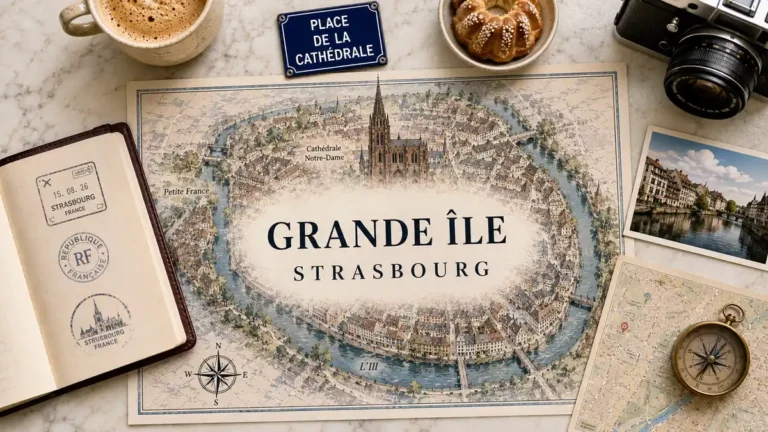
The case for Strasbourg is concentration. The Grande Île — the river-ringed historic core — was the first entire city centre to receive that UNESCO listing, and almost everything a first visit wants sits on it or beside it: the Gothic cathedral in pink Vosges sandstone with its single asymmetric spire, the half-timbered lanes and covered bridges of Petite France, the Barrage Vauban looking back across the water. You are never walking far. That density is what lets a two-day trip feel finished.
The cathedral’s astronomical clock is the one sight with a schedule attached. Its figures move on a fixed daily display, and the cathedral closes the clock at least one day a week. Confirm the time and the closed day with the cathedral before you build a morning around it.
The reason two days is enough here is geographic: the historic centre is an actual island, so almost none of your visiting time gets spent in transit.
What Strasbourg does not offer is scale. There is no week-long museum circuit and no landmark that carries a whole trip by itself, which is why it works best as a two-to-three-day stop inside a wider plan. It is one of the more rewarding mid-size stops on that circuit — the France travel guide shows how it fits a national route, and the best places to visit in France sets it against the alternatives competing for the same slot.
What Makes Strasbourg Different: France’s Franco-German City
Strasbourg is French with a Germanic fabric, and the border shapes what you see, eat and hear. Half-timbering and pink sandstone stand where Haussmann stone would be in most French cities. The food is Alsatian before it is French, and signage in the old quarters runs bilingual.
Start with what your eyes register. The centre is built from timber frames, steep tiled roofs and warm sandstone, so it reads closer to the Rhineland than to Lyon or Bordeaux. The cathedral is Gothic in the German tradition, and the domestic architecture of the old lanes would look at home across the river. Centuries of the city changing hands left that fabric in place, and it is the first thing visitors register.
The food repertoire is the clearest tell. Choucroute garnie, flammekueche, baeckeoffe and winstub cooking are Alsatian first, and the drinks follow: dry Riesling, Pinot Gris and Gewurztraminer from the region’s vineyards, alongside a beer culture that is native here. The French food guide covers the national picture, and France’s wine regions explain where Alsace sits inside it.
The quickest way to feel the difference is to order. A winstub wine list runs to Riesling and Pinot Gris, beer arrives as a local product, and the classic French bistro template barely shows up.
Two further layers appear in daily life. Street signs run in French and Alsatian in the old quarters, a visible marker of the dialect’s survival in the city. And the European Parliament sits in Strasbourg, giving it a diplomatic, multilingual working population you notice in its restaurants and bars far more than in its skyline. The border itself is close enough to use: Germany begins across the Rhine, and train range makes a cross-river day out a genuine option.
How Many Days You Need in Strasbourg
Two to three days is the sweet spot in Strasbourg. One day covers the cathedral, the Grande Île and Petite France at a rush. A second day adds museums, winstub meals and unhurried canal time. A third opens Alsace day trips without moving your base.
One day is a compromise, and a common one. Arrivals from Paris or Colmar can walk the island, see the cathedral and get through Petite France, but it is a highlight sprint with no room for a museum or a long lunch. Two days is where the rush stops. Three is where the trip stops being a city break and becomes a regional one.
| Trip length | What it buys | Who it fits |
|---|---|---|
| One day | Cathedral, Grande Île and Petite France at speed | Day-trippers arriving from Paris or elsewhere in Alsace |
| Two days | The centre unhurried, plus a museum and a proper winstub dinner | First-timers on a short city break |
| Three days | Everything above plus one day trip from the same base | Couples and families wanting range without repacking |
| Four or more days | A second day trip, including one across the Rhine | Slow travelers treating Strasbourg as a regional base |
The third day is worth more spent on a train out of Strasbourg than on a second pass through the centre — the city runs out of new ground before the region does.
Day-by-day sequencing belongs to the itinerary pages. The Strasbourg 2-day itinerary and the 3-day itinerary both build routes around the same walking core, and things to do in Strasbourg ranks what fills them.
When to Visit Strasbourg
Strasbourg’s season question is really one choice: market season or everything else. Peak weeks bring the Christkindelsmärik, among the oldest markets in Europe, along with dense crowds and scarce accommodation. Spring and early autumn deliver the same city with space to move, mild weather and far easier booking.
Market season is the loudest version of Strasbourg and the hardest to book. The market takes over the city centre completely, with stalls filling the squares, lights strung over the streets and visitor numbers that change how the whole island feels. The season’s dates shift, so confirm them with official sources before you commit to travel. Accommodation tightens first and hardest.
Spring and early autumn are the strongest all-round windows. The weather suits canal walks and terrace meals, the centre is busy without being congested, and rooms are both available and sensibly priced. Summer is warm and lively, with long evenings on the water and the year’s heaviest general tourist volume outside the markets. Deep winter beyond the market weeks is cold, quiet and cheap, which suits some travelers exactly.
Season logistics live elsewhere. France’s Christmas markets covers the market circuit and its practicalities, and the best time to visit France sets Strasbourg’s seasons against the rest of the country.
Is Strasbourg Worth Visiting Outside Christmas?
Yes — Strasbourg is worth visiting outside Christmas, and for many travelers it is the better trip. The cathedral, the UNESCO island, Petite France and the food culture are permanent. What the markets add is atmosphere and scale; what they take away is space, availability and calm. The city is the attraction in every month.
Off-season you get the centre at walking pace, restaurant tables without a fight, and photographs of the canals with nobody else in them. You give up the illuminated squares, the mulled-wine ritual and a particular kind of postcard. That is the whole trade. Plenty of visitors take the quiet side of it happily.
Choose peak weeks if the market is the reason you are going and you have booked well ahead. Choose any other time if the city itself is the point.
Where to Base Yourself in Strasbourg
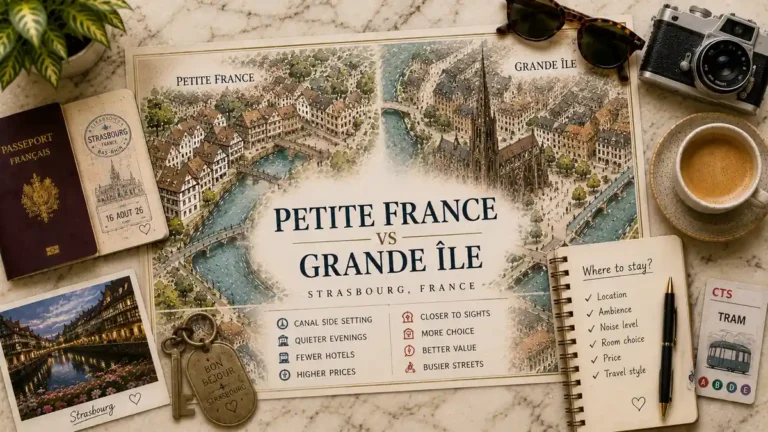
Base inside or beside the historic centre and the whole city works on foot. Strasbourg is small enough that the centre-versus-periphery decision is about atmosphere and price, not commute length. Central streets put you inside the walkable core; outer areas trade that for quiet and better value.
The practical rule is proximity to the island. Staying in or immediately around the historic centre means everything is on foot with the tram covering whatever is not, which is why booking early beats hunting for a clever location here. Streets a little further out swap evening atmosphere for lower prices and more space — a real option in a city this walkable, and a weak one only if you want to step straight out into the old quarters at night.
In a centre this compact, your calendar decides your stay more than your address does: market weeks empty the good central rooms long before the season opens.
Full area resolution belongs to where to stay in Strasbourg, which compares the quarters properly. If you already know your travel style, go straight to the matching guide:
- Watching the budget: budget stays in Strasbourg — value that keeps the centre walkable.
- Couples: romantic stays in Strasbourg — canal atmosphere and quiet streets.
- Families: family-friendly stays in Strasbourg, with specific properties in the best family hotels in Strasbourg.
- First visit: where to stay in Strasbourg for the first time — central, simple, hard to get wrong.
- Higher budget: luxury stays in Strasbourg — the heritage and design end of the market.
- Nights out: nightlife stays in Strasbourg — bars and late food within walking distance.
Hotels and places to stay
Compare hotels, apartments and stays for your dates in one search.
Search hotels and stays on hotels.com →
Tripstou may earn a commission if you book through this link, at no extra cost to you.
How to Get Around Strasbourg
You will not need a car in Strasbourg. The historic centre is pedestrianised, the tram network covers everything beyond walking distance, and cycling here is genuinely mainstream. Driving into the core is a liability: restricted access, awkward parking and streets laid out long before cars existed.
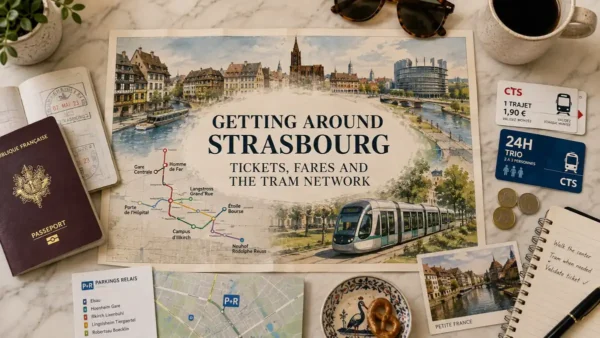
Walk by default. The historic core is closed to through traffic and small enough to cross comfortably, so many visits never use transport at all. The tram handles anything past the island — the European quarter, outer neighbourhoods, the station approach — and it is how locals move. Bikes are treated as real transport here, with protected lanes running across the city.
Arrival by air needs its own answer, and the options and timings change, so check the current picture in Strasbourg airport transport. Fares, passes, ticket types and the full network map sit in the Strasbourg transport guide. If you are driving into Alsace, park once and leave the car parked — inside a pedestrianised centre it buys you nothing.
How Much a Strasbourg Trip Costs
Strasbourg costs less than Paris and behaves like a mid-priced French city. Food, transport and sightseeing all sit in ordinary regional territory. One exception drives the whole budget: accommodation during market season, when demand across the centre outruns supply and rooms are priced accordingly.
What each spend style buys here:
- Budget: hostels and simple guesthouses, bakery breakfasts, tarte flambée and market food, everything on foot. Strasbourg is kind to this style because walking removes the transport line entirely.
- Mid-range: a central small hotel, one winstub dinner a day, the occasional museum. This is the style the city is priced for and the one most visits default to.
- High-end: heritage and design hotels, tasting menus and Grand Cru wine lists. The ceiling sits lower than in Paris, so the same spend goes noticeably further.
Market season breaks the pattern, and it hits accommodation hardest — booking months ahead does more for a peak-season budget than any other decision you make. Current bands and per-day estimates live in the Strasbourg trip cost guide, with national context in the France travel budget guide.
Is Strasbourg Safe for Tourists?
Yes, Strasbourg is a safe city for visitors. It reads as calm and walkable by big-city standards, and ordinary urban precautions cover it: watch your bag in crowded market and station areas, and keep normal night-time awareness. No visitor-specific safety problem defines this city.
The detail sits with the specialists: Strasbourg safety for the city-level read, common scams in France for the tricks that travel nationwide, and solo female travel safety in France for that specific perspective.
Strasbourg as a Base for Alsace and the Rhine
One Strasbourg base covers most of Alsace and a slice of Germany by train. Colmar is roughly half an hour away. Sélestat, Obernai and Wissembourg all sit under an hour. Freiburg, across the Rhine in Germany, is around an hour and a half from the city.
The train does the work. Colmar is close enough to be a half-day, so you can see it and still be back for dinner in Strasbourg. Sélestat, Obernai and Wissembourg deliver smaller, quieter Alsatian towns inside the same hour of travel. Freiburg puts a German city on the table without an overnight, and that is the cross-Rhine range worth planning around.
What makes Strasbourg work as a base is that its best day trips are short enough to be half-days, so adding one does not cost you a day in the city.
The Strasbourg-or-Colmar base question belongs to the region guide. Strasbourg’s side of it is scale, rail connections and a bigger evening city, and the full verdict sits in the Alsace travel guide. For fitting the city into a longer rail plan, see the France train itinerary.
Tours and activities
Book skip-the-line tickets, day trips and local tours with free cancellation on most activities.
You can also browse everything on getyourguide.com.
Tripstou may earn a commission if you book through this link, at no extra cost to you.
Who Strasbourg Suits — and Who Should Skip It
Strasbourg suits travelers who want a compact, walkable, culture-first city break. Couples, families, first-timers in France and short-break travelers all get full value from it. It disappoints anyone chasing beaches, big-city scale or a serious nightlife scene, because the city is landlocked and deliberately compact.
Right for you if:
- You want a historic centre you can cover on foot without using transport.
- You are travelling as a couple or with children and want low-friction days.
- Food and wine are a reason to travel, and a regional repertoire with its own rules appeals.
- The Franco-German border culture interests you as lived daily reality.
- You have two or three days and want them to feel complete.
Wrong for you if:
- You need a coast — Strasbourg is landlocked, and the Rhine is a working river.
- You want big-city scale, major-museum depth or a large nightlife scene.
- You have a single day in the area and a stronger candidate already on the list.
- You are travelling in peak market weeks with no booking and a tight budget.
The coast point is a pairing question, not a disqualification. Strasbourg slots naturally into a wider France trip that picks up sea time somewhere else — the best beaches in France shows where that leg belongs on the map, and the France itinerary guide covers how the country’s regions string together into one route.
Frequently Asked Questions
Is Strasbourg in France or Germany?
Strasbourg is in France. It sits in Alsace on the Rhine, directly across the water from Germany, and French is the official everyday language. Sovereignty over the city moved back and forth in earlier centuries, which is why the architecture, the food and the local dialect all lean German.
Do you need to speak French in Strasbourg?
No, but a few words help. French is the everyday language, and English is widely understood in hotels, museums and restaurants across the historic centre. Alsatian, the local Germanic dialect, survives mainly on bilingual street signs rather than in conversation. Opening in French before switching to English is always welcome.
What is a winstub?
A winstub is a traditional Alsatian wine tavern — wood-panelled, informal, and built around regional cooking and local white wine. It is where choucroute, baeckeoffe and tarte flambée belong, poured alongside Riesling or Pinot Gris. Eating in one is the fastest way to understand why Alsace tastes unlike the rest of France.
Can you visit Strasbourg as a day trip from Paris?
Yes — direct high-speed trains reach Strasbourg from Paris in under two hours, so a day trip is genuinely possible. It is also a compromise. You get the cathedral, the Grande Île and Petite France, and little else: no unhurried winstub evening, and no Alsace day trip attached.
Is Strasbourg good for solo travelers?
Yes — Strasbourg suits solo travelers well. The centre is compact and walkable, so you never depend on transport or company to get around, and casual winstub dining makes eating alone unremarkable. The day-trip range keeps a longer stay varied. The limit is scale and late-night options.
Is Strasbourg a good stop between France and Germany?
Yes — Strasbourg slots naturally into a two-country rail plan. It sits on the Rhine with fast lines running west into France and direct services crossing east into Germany, putting Freiburg around ninety minutes away. Give it two days and the stop justifies itself instead of interrupting the route.
Related Guides
Next steps for turning a Strasbourg decision into a booked trip:
- Strasbourg travel tips — the practical habits that make a first visit smoother.
- France packing list — what to bring for Alsace’s swing between seasons.
- 7-day France itinerary — where a short France trip can afford a Strasbourg stop.
- 10-day France itinerary — the length at which Alsace stops being a detour.
- 14-day France itinerary — room for Strasbourg plus the wider east.
- France road trip guide — how Alsace connects by car once you leave the city.
Did this guide save you time or money? Tripstou is independent and reader-funded — if you'd like to give something back, you can support the site with a crypto contribution of any size.