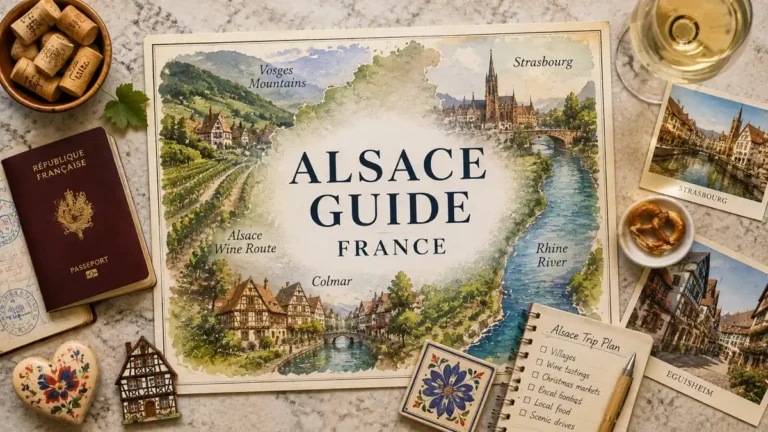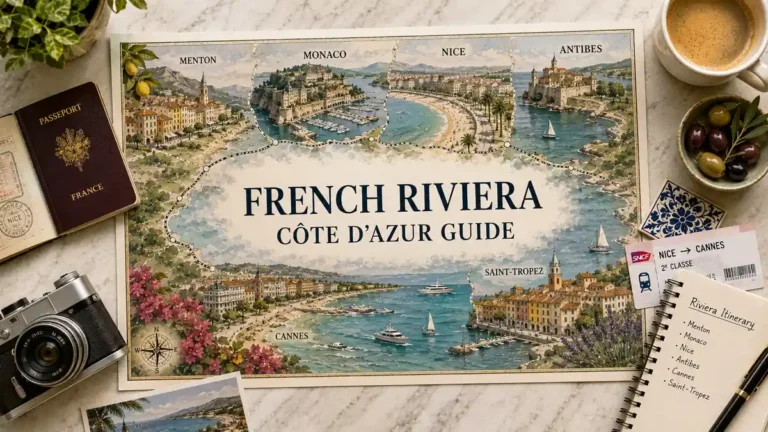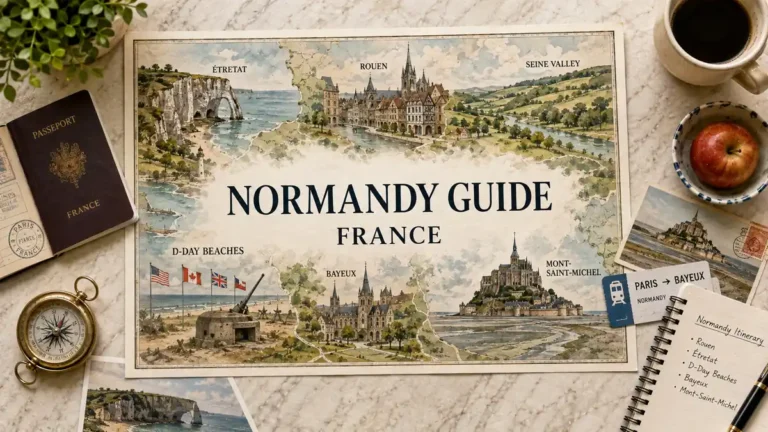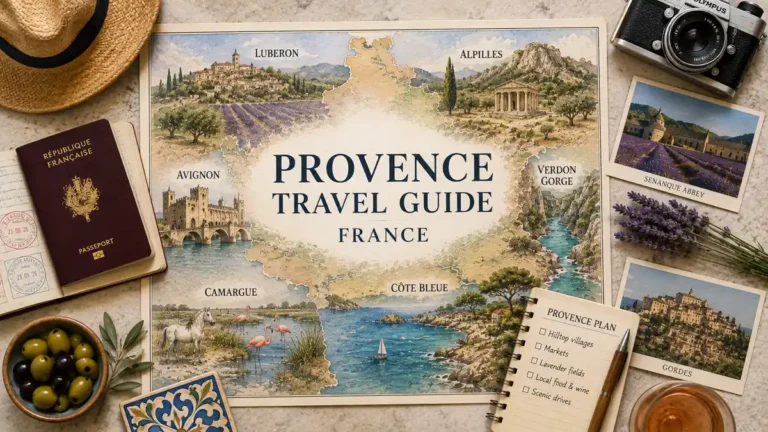
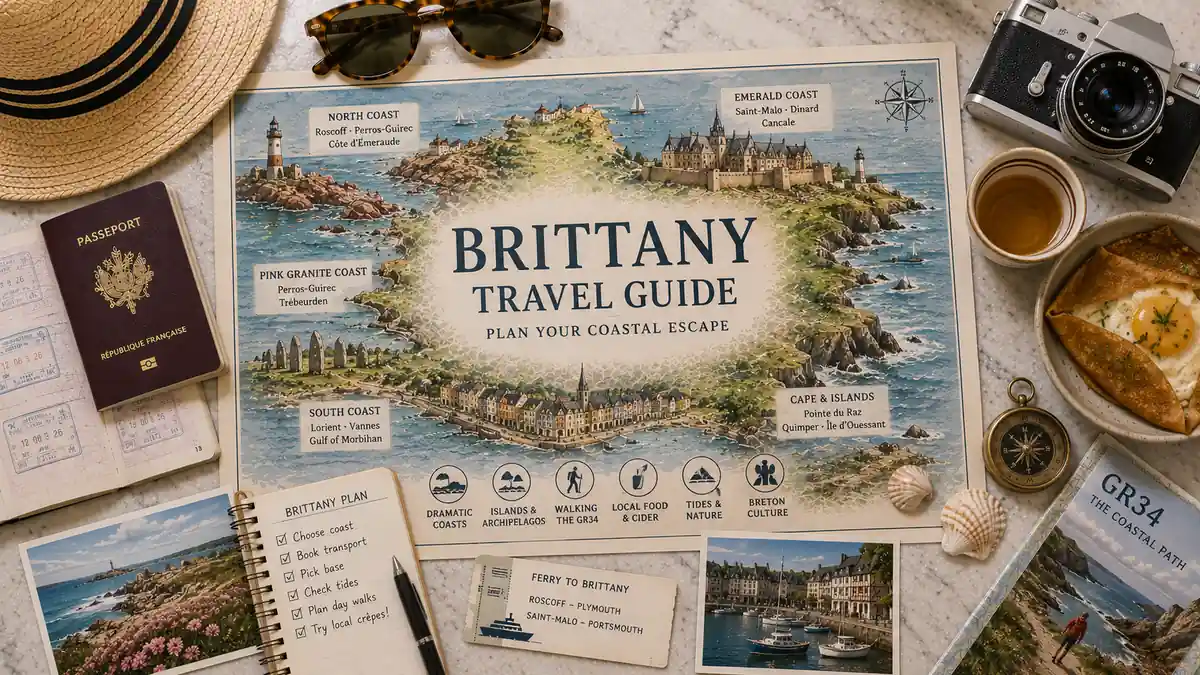
Brittany is the part of France that behaves least like France. It pushes into the Atlantic as a granite peninsula with its own Celtic language traces, its own flag, and a food culture built on galettes, seafood and cider instead of wine. It is also not one destination. Brittany is a run of distinct coasts — walled ports and estuaries in the north, rose-coloured rock further west, cliff-torn capes at the tip, and a sheltered island-scattered gulf in the south — and each one asks for different days.
That is what makes the region easy to under-plan. Travelers arrive expecting a single stop and find a coastline that takes a week to cross properly. This guide resolves the practical shape of a Breton trip: which coasts deserve your time, how many days each tier of trip realistically buys, whether you need a car, when to come, and why the tide table belongs in your planning.
Quick Answer
Brittany rewards a dedicated trip: it is France’s Celtic Atlantic west, split into four distinct coastal areas. Trip length decides the shape — 2–3 days covers one coast, 7+ days covers the loop. A car unlocks the coastline; rail alone suits travelers happy to base in the main towns.
Trust Layer
Tripstou region guide for travelers planning a regional trip. Covers sub-areas, trip shape, base strategy, timing, and mobility tradeoffs.
Produced with AI assistance and reviewed by Alex Perrut, working in tourism since 2015, for the Tripstou editorial team. See our editorial process for details.
Last factual review: August 5, 2026.
Official sources consulted: France.fr, Atout France.
Key Takeaways
- Brittany splits into four coastal areas — pick one or two and go deep instead of touring all four.
- Choose north for drama and walking, south for shelter — a southern base rescues more days from a bad forecast.
- Give one coast 2–3 days, two neighbouring coasts 4–5 days, and the full coastal arc 7+ days.
- Rail reaches Rennes, Saint-Malo, Vannes and Quimper; the capes, coves and footpath trailheads between them need a car.
- One base plus day trips beats nightly repacking; add a second base only when it sits on a different coast.
- Check the official tide table for your port and date before any coastal walk, foreshore crossing or beach day.
Table of Contents
What Makes Brittany Different from the Rest of France?
Brittany is France’s Celtic west, and it plans differently from the rest of the country. Its identity is Breton before it is French: granite coast, Atlantic weather, its own language traces on the road signs, and a table built on galettes and cider. The region rewards coastal planning, not city-hopping.
The practical difference is that Brittany’s geography is edge-first. The interior is quiet farmland, forest and market towns, while almost everything a visitor comes for sits on or near the shoreline. That has a direct planning consequence: two places that look close on a map can be a long drive apart, because the road follows every estuary and inlet between them.
The second difference is weather. Brittany’s climate is Atlantic and changeable, with more in common with Cornwall than with Provence, which is why Breton itineraries are built with alternatives instead of fixed hours. The third is cultural. This is cider country. Wine is an import here, and that single fact tells you how far the region sits from the French default.
None of this makes Brittany hard to visit — it makes it a region you choose deliberately. If you are still deciding where in the country to spend your time, the national picture sits in our France travel guide, and the regional shortlist in our guide to the best places to visit in France.
Where to Go in Brittany: The Four Coasts That Matter
Brittany splits into four coastal areas, each a separate decision: Emerald Coast, Pink Granite Coast, Finistère, Morbihan. Each has its own character, its own weather feel and a natural base town. First-timers should pick one or two and go deep; touring all four turns the trip into driving.
Emerald Coast (Saint-Malo and Dinan)
The Emerald Coast is Brittany’s most theatrical north-facing shore, named for the green cast of its water. The anchor experience is walking the ramparts of Saint-Malo’s walled town while the tide moves across the sand below. Saint-Malo is the natural base: a rail-served walled port with the medieval river town of Dinan a short hop inland.
Best for: first-timers who want a walled port, dramatic tides and easy rail access.
Pink Granite Coast
The Pink Granite Coast is the strangest-looking stretch in Brittany, where rose-coloured boulders pile into sculpted shapes along the shore. The anchor experience is the coastal footpath at Ploumanac’h, where the GR34 threads between the rocks and the sea. Perros-Guirec is the natural base — small, seaside and easy to settle into for a few nights.
Best for: walkers and photographers who want landscape over townscape.
Finistère and the Crozon Peninsula
Finistère — land’s end — is the wildest quarter of Brittany, all exposed capes and open Atlantic swell. The anchor experience is standing on the cliffs of the Crozon Peninsula, where the land breaks apart into headlands and the weather arrives without warning. Quimper is the natural base for culture and rail access; Crozon itself suits travelers already driving.
Best for: travelers chasing raw coastline who accept the longest drives.
Gulf of Morbihan and Carnac
The Gulf of Morbihan is the sheltered south, a near-enclosed bay scattered with islands and noticeably calmer than the Atlantic-facing coasts. The anchor experience is the alignments at Carnac, where rows of prehistoric standing stones run through the land just behind the shore. Vannes is the natural base: a walled town with a working port and fast rail service.
Best for: families and slow travelers who want calm water and prehistory.
Access below is orientation-level; the coastline itself is car territory almost everywhere.
| Coastal area | Character | Who it suits | Getting there |
|---|---|---|---|
| Emerald Coast (Saint-Malo) | Walled port, estuaries, powerful tidal range | First-timers wanting history plus coastline | Rail from Rennes to Saint-Malo |
| Pink Granite Coast | Rose-coloured rock formations along the footpath | Walkers and photographers after landscape | Car recommended along the shore road |
| Finistère and Crozon | Exposed Atlantic capes and cliff paths | Travelers chasing wild, empty coastline | Rail to Quimper or Brest, then car |
| Gulf of Morbihan | Sheltered bay, islands, prehistoric standing stones | Families and slower, calmer-water trips | Fast rail to Vannes, car for the gulf |
The four coasts are not evenly spaced as decisions. The Emerald and Pink Granite coasts sit close enough along the north to combine on one trip, while Finistère and the Morbihan each pull a trip in their own direction — which is why the realistic choice for a short visit is a pair of neighbours, never one of each.
Rennes is the arrival point, not a fifth destination. It is the gateway station, the place most car rentals start, and a workable landing pad for a first night. The reason you came, though, lies north and west of it. These four areas are decision units, not sight lists: the individual highlights sit in our guide to things to do in Brittany, the quieter corners in Brittany’s hidden gems, and the question of how Breton sand compares nationally is answered in our guide to the best beaches in France.
Tours and activities
Book skip-the-line tickets, day trips and local tours with free cancellation on most activities.
You can also browse everything on getyourguide.com.
Tripstou may earn a commission if you book through this link, at no extra cost to you.
North Coast or South Coast: Which Side of Brittany Suits You?
The north coast is wilder and more dramatic; the south is gentler and more sheltered. First-timers rarely need both. North Brittany delivers walled ports, big tides and cliff walking. South Brittany trades drama for calmer water, islands and prehistoric sites. Pick by what you want your days to feel like.
The north suits travelers who came for the sea as spectacle. Its shoreline is granite, its tidal movement is enormous, and its towns face the Channel with fortifications to prove it. Days there are active by default — ramparts, footpaths, headlands, weather. The trade-off is exposure: the north takes wind and rain first, and swimming is a bracing proposition even at the height of summer.
The south suits travelers who want the coast to be comfortable. The Gulf of Morbihan is sheltered water, the light is softer, the swimming is easier, and the sights lean archaeological instead of military. The trade-off is drama: the south is lovely, but it will not stop you in your tracks the way a Finistère cape does.
Choosing a side is really choosing a weather exposure. The north and west face the open Atlantic and meet each front as it lands, while the Morbihan sits in their lee — which is why a south-coast base rescues more days from a bad forecast than a north-coast one, and why walkers still choose the north anyway.
How Many Days Do You Need in Brittany?
2–3 days covers one Breton coast well; a full loop of the region needs about a week. Coastline shape decides the pace: the road follows every inlet, so days disappear into driving when a trip is spread too thin. Most standalone first visits work best at 4–5 days.
- 2–3 days — one coast at highlight pace, from a single base, with no repacking. Right as an add-on to a wider France trip.
- 4–5 days — two neighbouring coasts, or one coast plus an island day. The sweet spot for a standalone first visit.
- 7+ days — the coastal arc from the Emerald Coast round to the Morbihan without rushing, with slack for weather. Right for walkers and returning visitors.
The tier travelers misjudge is 4–5 days. It gets used to attempt all four coasts when it comfortably holds two, and the third coast costs a full driving day to buy a thinner version of what you have already seen. If your days are limited, spend them on depth along one shoreline.
Brittany also works as a leg inside a longer French trip. It fits tightly into a 7-day France itinerary, sits comfortably in a 10-day version, and leaves room for the far west in a 14-day route.
How to Get to Brittany from Paris and the UK
The TGV from Paris Montparnasse reaches Rennes in about an hour and a half. Rennes is Brittany’s gateway station and the practical starting point for most trips, whether you continue by train or collect a car there. Ferries from the UK land directly in Brittany’s northern ports.
- Paris to Rennes — about an hour and a half by TGV from Montparnasse; the fastest way into the region and the usual handover point to a rental car.
- Paris to the far west — roughly four hours by rail to Brest, the western terminus of the line, for trips built around Finistère.
- UK to Brittany — ferry services run to Roscoff and Saint-Malo, landing you on the north coast without crossing France by road.
Arriving by sea quietly reorders the trip. A ferry passenger starts on the north coast and works west or south from there, while a rail passenger lands mid-region at Rennes and chooses a direction — which is why UK travelers often end up with a more coherent north-coast trip without planning one. If the rest of your journey runs on rails, our France train itinerary guide shows how Brittany connects to the wider network.
Do You Need a Car in Brittany?
You can reach Brittany’s main towns by rail, but the coast itself mostly needs a car. Rennes, Saint-Malo, Vannes and Quimper are all rail-served and walkable once you arrive. The capes, coves, footpath trailheads and small harbours between them are where public transport thins out.
A car-free Brittany trip is genuinely viable if you accept its shape. You get walled towns, ports, markets, museums, crêperies and whatever coastline sits within walking distance of a station. What you forfeit is the in-between: the headlands, the small beaches, the harbour villages, and most of the access points to the coastal footpath. That in-between is the reason a lot of people come.
The car question here is really a question about the GR34. If your trip is built around walking the coastal path, you need transport to trailheads and pick-up points that town-to-town rail cannot provide. If your trip is built around towns, food and a slower pace, the car spends most of its time parked and paid for. Choose by the activity, not the region.
Driving in Brittany is straightforward in itself — roads are good and distances are moderate — but parking in Saint-Malo, Vannes and the honeypot coastal villages tightens sharply in high season. Our France road trip guide covers the wider driving logic if Brittany is one leg of a longer route.
Belle-Île and Bréhat — What the Islands Mean for a Car Trip
Brittany’s islands change the calculation, because both of the best-known ones are visited on foot. Belle-Île, off the south coast, is under an hour away by ferry, with frequent sailings in summer and only a handful in winter. Taking a vehicle across is possible, but the car ferry is expensive and capacity-constrained, and most visitors leave the car on the mainland.
Bréhat, off the north coast, removes the question entirely: it is car-free. Foot passengers and cyclists cross from the Pointe de l’Arcouest on a short crossing of about ten minutes, with only service and emergency vehicles and tractors excepted. For a driving trip, islands are effectively parking days — you leave the car at the terminal and travel the rest on foot.
Where to Stay in Brittany: Picking Your Base
For most first trips, one coastal base plus day trips beats moving every night. Brittany’s towns sit close enough along each coast that a single base covers an area comfortably, and packing up daily costs more time than the driving it saves. Match the base to the coast you chose.
- Saint-Malo — the Emerald Coast base: rail-served, walkable, and within easy reach of Dinan and the estuary shore.
- Perros-Guirec — the Pink Granite Coast base: small and seaside, with the footpath and the rock formations on the doorstep.
- Quimper — the Finistère base: the cultural anchor of the west, with Crozon and the capes within driving range.
- Vannes — the Morbihan base: a walled town on sheltered water, positioned for the gulf, the islands and Carnac.
A two-base split earns its packing cost only when the second base sits on a different coast — north to south, or east to west. Two bases on the same shoreline duplicate what a day trip already covers, and you pay for the duplication in check-ins and lost mornings.
The trade-off of a single base is honest to name: the far ends of the region stay out of reach. From Saint-Malo, Finistère is a long day out and back, and it is not a day anyone enjoys repeating. If the wild west is what drew you to Brittany, base there instead of visiting it.
Hotels and places to stay
Compare hotels, apartments and stays for your dates in one search.
Search hotels and stays on hotels.com →
Tripstou may earn a commission if you book through this link, at no extra cost to you.
When to Visit Brittany: Season Logic for a Changeable Coast
Late spring to early autumn is Brittany’s core season, but its maritime weather changes fast year-round. The coast is at its best when days are long and ferries, beaches and crêperies are all running; the trade-off is a busier shoreline. Shoulder periods stay viable and noticeably quieter.
High summer is when the region is fully open and fully attended: island ferries run at their most frequent, coastal towns fill, and popular parking areas reach capacity early. Shoulder periods swap that energy for space — the footpath is emptier, the towns are relaxed, and some seasonal services run on reduced patterns. Winter is for a different trip entirely, built around towns, weather-watching and long lunches.
Brittany punishes rigid sightseeing schedules more than most French regions. The sensible planning move is to hold two options for each day, one indoors and one on the coast, and let the morning sky pick between them. Travelers who plan this way rarely report bad weather; travelers who lock in a beach day three days ahead often do.
For how Brittany’s timing fits the national picture, see our guide to the best time to visit France. For what a changeable Atlantic coast actually demands from your bag — layers, waterproofs and proper walking shoes in any season — our France packing list covers it.
Why Tides Rule the Breton Coast
Brittany has some of Europe’s biggest tidal ranges, and they decide when beaches, bays and coastal paths are usable. The water does not creep here — it redraws the shoreline between low and high. Treat the tide table for your port as part of the plan.
Official Breton tourism information describes tides on a coefficient scale, the upper end of which marks a grande marée, the largest tides of the cycle. The planning consequence is simpler than the scale itself: the same stretch of shore can be walkable ground at one hour and open water at another, and the change is neither slow nor negotiable.
Tide awareness changes three practical things — which coastal walks are passable, whether a foreshore or bay area can be reached at all, and how a harbour looks when you arrive, since many Breton ports sit on mud at low water. It is normal planning here, not caution for its own sake.
Check the official tide tables for your specific port and date before any coastal walk, foreshore crossing or beach day. Tide tables are published per port and posted locally at the sites themselves. A general weather forecast is not a substitute, and neither is a table for a neighbouring port.
What to Eat and Drink in Brittany
Brittany’s table is galettes, crêpes and seafood, washed down with cider rather than wine. The savoury buckwheat galette is the regional staple, the sweet crêpe its dessert counterpart, and the Atlantic supplies the rest. This is cider country, and the distinction runs deeper than a local quirk.
Crêperies are the region’s everyday restaurant. Most Breton towns have several, they serve at normal meal times, and a galette followed by a crêpe with a bowl of cider is a full meal in itself. Seafood is the other pillar — oysters, mussels, langoustines and whatever the day’s boats landed — and it is at its best in the port towns rather than inland.
Brittany grows apples, and cider is the regional drink because of it. France’s celebrated vineyards are elsewhere in the country, mapped in our guide to France’s wine regions, and the national eating picture — what to order, where and when — sits in our France food guide. Ordering wine with a galette is not a crime here. It is simply not what the region does.
Frequently Asked Questions
Is Brittany worth visiting?
Yes, for travelers who want coastline, walking and regional food culture. Brittany delivers walled ports, cliff paths, islands and crêperies across four distinct shores. The honest trade-offs are changeable Atlantic weather and a coast that mostly rewards drivers. Travelers set on guaranteed sun and easy swimming are better served elsewhere in France.
Is Mont-Saint-Michel in Brittany or Normandy?
Mont-Saint-Michel is in Normandy, not Brittany — the mount stands in the Manche department, on the Normandy side of the Couesnon river that marks the boundary, though the bay around it is shared with Brittany, which is why Breton tourism markets Mont-Saint-Michel Bay and the confusion persists.
Can you walk among the Carnac stones?
Yes, but the season decides how. A free footpath runs around the alignments year-round, and the main enclosures are freely walkable through the winter half of the year. In high season, roughly April to September, entering the enclosures needs a ticketed guided visit with a reduced child rate — book ahead in summer.
Can you take a car to Belle-Île?
Technically yes, though the real question is whether you should. Vehicle space on the ferry is limited and priced accordingly, and it needs reserving well before a summer crossing. Most visitors leave the car at the mainland terminal and cross as foot passengers, treating the island as a day off from driving.
What is the GR34 coastal path?
The GR34 is the long-distance footpath that runs the length of Brittany’s coastline. It links headlands, coves, beaches and harbour villages, and it is the main reason walkers come to the region. Nobody needs to walk it end to end — most visitors take day sections from whichever coastal base they chose.
Related Guides
Brittany is one region inside a much larger country, and these guides handle the decisions this page deliberately routes onward.
- France itinerary guide — how to sequence a national trip and where a Breton leg fits within it.
- Corsica travel guide — the planning picture for France’s Mediterranean island region.
- France travel budget — what a French trip costs across accommodation, food and transport.
- Common scams in France — the tourist-facing tricks worth recognising before you travel.
- Solo female travel safety in France — practical guidance for travelling alone in the country.
Did this guide save you time or money? Tripstou is independent and reader-funded — if you'd like to give something back, you can support the site with a crypto contribution of any size.