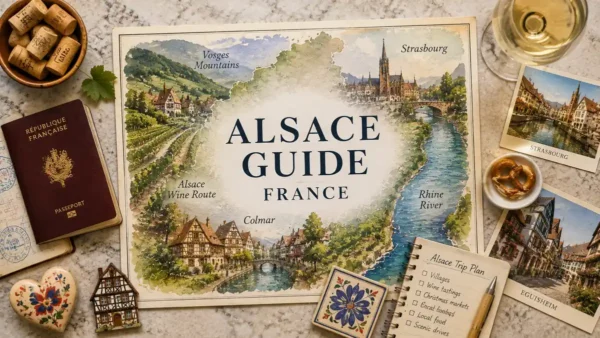
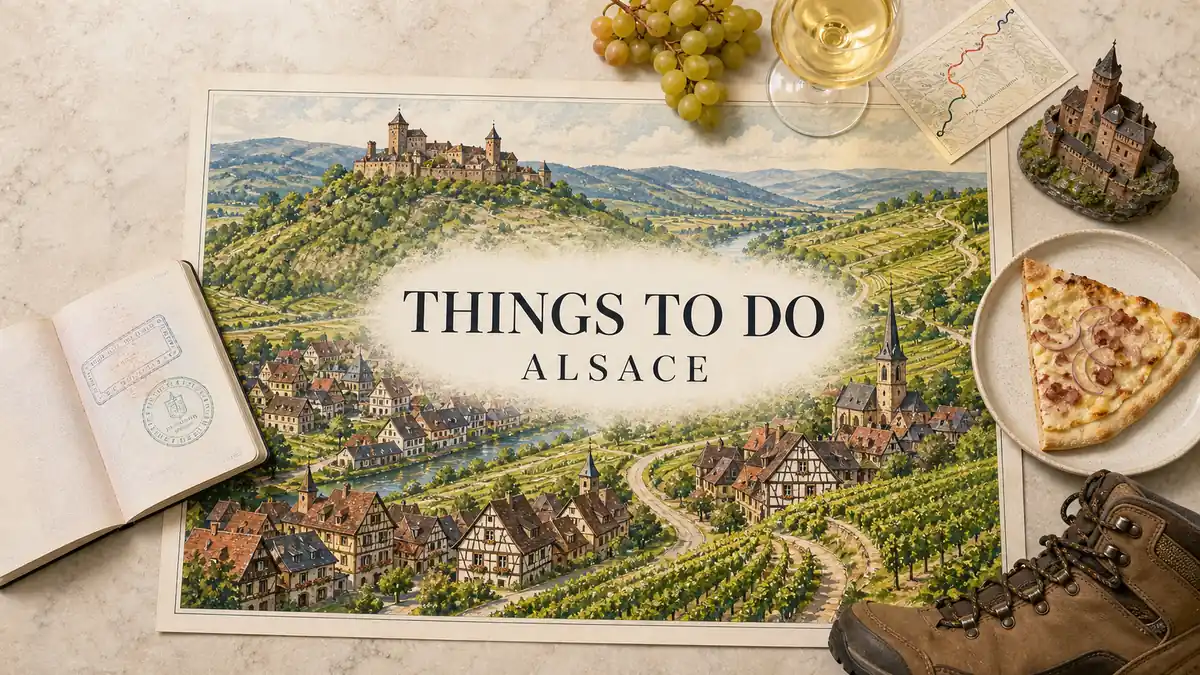
Alsace photographs as one continuous postcard — half-timbered houses, geraniums at every window, vineyards climbing towards a castle — which makes it oddly hard to work out what you actually do there once the photo is taken. The problem compounds because the famous villages sit close together, close enough that a day can dissolve into car parks and the same street seen four times in slightly different light. This page assumes the region is already on your list and that you have two to four days to fill. It works through a small set of experiences: what each one is actually like, who it suits, where it disappoints, and which version of it to book. How you travel the vineyard and what time you arrive do most of the work here. Both are settled below.
Quick Answer
Alsace rewards four experiences: the Wine Route driven slowly, a grower’s cellar tasting, one hilltop castle and one winstub meal. How you travel the vineyard — car, bike, guided tour or train — decides how much of that set fits. Timing beats adding villages: arrive early or in the early afternoon and the famous streets change completely.
Trust Layer
Tripstou attraction guide for travelers deciding whether an experience is worth doing and how to do it well. Covers value, booking versions, timing, access, and traveler fit.
Produced with AI assistance and reviewed by Alex Perrut, working in tourism since 2015, for the Tripstou editorial team. See our editorial process for details.
Last factual review: August 21, 2026.
Official sources consulted: France.fr, Atout France.
Key Takeaways
- The Wine Route rewards depth over distance: three villages with real time in each beat seven quick photo stops.
- How you travel the vineyard — car, bike, guided tour or train — decides which experiences fit your days.
- Car-free travelers should book one guided vineyard day, which converts the hardest part of Alsace into the easiest.
- Re-time your day instead of re-routing it: take the famous villages early, and give mid-morning hours to a cellar.
- Haut-Koenigsbourg earns a half day only on a clear one; cloud on the ridge removes the panorama entirely.
- Anchor each day on one committed experience — cellar, castle, ridge or long table — so no two days repeat.
Table of Contents
Drive the Wine Route for Depth, Not Village Count
The Alsace Wine Route rewards depth over distance: fewer villages, longer in each. Its 170 kilometres run from Marlenheim to Thann, and the good part always happens after you park — a cellar door, a vineyard path, a two-hour lunch. Driving the whole thing in a day produces identical photographs.
It is one of the oldest wine routes in France, and the infrastructure reflects that head start: cellar doors, marked vineyard walks and village squares are all built around people who stop. Fifty-one Grands Crus sit along its length, and almost none of them get tasted properly by a traveler working through a checklist.
Villages sit roughly 10–15 minutes apart by car. That spacing is the trap. The next one is always close enough to justify one more stop, and a day built on that logic ends as a sequence of car parks. Three villages with real time in each is a fuller day than seven.
Two or three stops fills a comfortable day and four is the ceiling before the experience flattens. For the wider regional picture — bases, transport, how the Alsace plain fits together, and where Strasbourg sits in it — the alsace travel guide covers that ground.
Most of what makes the Wine Route memorable happens between the villages: the vineyard tracks, the cellar you had no plan to enter, the ridge appearing at a bend. That is exactly the part a crowded itinerary deletes first.
Taste in a Grower’s Cellar, Not Just a Tasting Room
Alsace cellar tastings run informally: you walk into the courtyard, find the door marked dégustation, and someone pours. Many are working family estates where the person pouring made the wine. Expect a short guided flight, a conversation, and the quiet expectation that you leave with a bottle if something landed.
The sequence is consistent enough to plan around. You are usually poured dry whites in ascending weight and finish sweeter; you spit or you do not, and nobody minds either way; you ask what the grower drinks at home, and the visit changes character entirely. There is no ticket, no timed slot and no script.
This suits travelers who want one long stop over five short ones, and anyone travelling with a designated driver. Families get less out of it — a cellar visit is an adult hour with nothing for a child to do.
The tradeoff is commitment. A grower’s cellar takes the better part of an hour and cannot be hurried politely, and English is common without being guaranteed at the smallest estates. A tasting room in a village centre is faster, more predictable, and entirely fine when the day is tight.
Ask for the estate’s Riesling before anything else. It is the variety Alsatian growers are judged on among their own neighbours, and their answer tells you within two minutes whether this cellar is worth an hour of your day.
Car, Bike, Guided Tour, or Train: How to Do the Wine Route
A car is the default for the Alsace Wine Route, because the best stops are the unscheduled ones. Everything else on this ladder trades that freedom for something specific: a bike buys the landscape, a guided tour buys tasting without a driver, the train buys simplicity at the cost of reach.
- Self-drive — suits travelers with two or more days and a nominated non-drinking driver. The defining tradeoff: village car parks fill early in high season, and the person driving tastes least.
- Bike — suits reasonably fit travelers who want the vineyard itself as the experience. The Véloroute du Vignoble is signed the length of the route from Marlenheim to Thann, running on former railway lines, sections of Roman road and vineyard tracks. The defining tradeoff: gradients are real once you leave the valley floor, and you carry whatever you buy.
- Guided day tour — worth it for travelers without a car, on a short stay, who came here to taste. A driver-guide reaches small villages that public transport does not and removes the sober-driver problem entirely. Skip it if you already have a car and more than one day; the fixed stops and fixed clock will cost you more than they add.
- Train and bus — suits car-free travelers based in Colmar or Strasbourg who want low effort. The defining tradeoff: rail reaches the larger wine towns comfortably and the small villages awkwardly, and the timetable, not you, decides when the day ends.
The mode question is really a question about who tastes. Every rung below self-drive exists because somebody has to stay sober on a day designed around wine, and that is the single problem this decision solves.
Can You Do Alsace Without a Car?
Yes — Alsace works without a car, as long as you accept a smaller map. Strasbourg and Colmar sit about half an hour apart by rail and both function as bases. What you give up is the back-road vineyard, where the smallest villages and the majority of grower cellars are.
Colmar is the more useful car-free base of the two, because it sits inside the vineyard rather than at its northern edge. From there, regional trains and buses reach the larger wine towns, and one booked guided day covers the villages that public transport handles badly.
A realistic car-free day is one town reached by rail, one guided or cycled excursion, and one long meal. That is a good day. It is a different day from a driver’s, and expecting them to match is where the disappointment comes from.
The honest limitation is frequency and finish time. Rural services thin out in the evening, which quietly rules out lingering over a late dinner in a village you are not sleeping in.
Car-free travelers usually do better booking one guided vineyard day and then relaxing about everything else, because a single tour converts the hardest part of Alsace — the small villages — into the easy part.
Tours and activities
Book skip-the-line tickets, day trips and local tours with free cancellation on most activities.
You can also browse everything on getyourguide.com.
Tripstou may earn a commission if you book through this link, at no extra cost to you.
Is Haut-Koenigsbourg Worth Visiting?
Haut-Koenigsbourg is worth visiting if you want one large set-piece in an otherwise village-scale trip. It is a fully reconstructed mountain castle above the plain, managed by the Collectivité européenne d’Alsace, and the view from the ramparts is what most people remember. Go on a clear day.
It suits travelers with children, anyone who reads castles as architecture, and drivers who want a reason to climb out of the vineyard for an afternoon. The interiors present some 900 years of history in heavily restored form, which is also the point of contention: this is a vivid reconstruction, and a purist will notice within the first room.
The skip case is straightforward. If two days are already committed to wine and villages, or if cloud has settled on the ridge, leave it out. The castle’s strongest asset is the panorama across the Alsace plain, and without that you are spending an afternoon on corridors.
Three versions, separated mainly by time:
- Self-guided — suits confident visitors and families with restless children; the quickest circuit through the castle and the one with the least context.
- Audio guide — suits most first-time visitors; it supplies the reconstruction story while leaving you in control of your own pace.
- Guided tour — suits history-minded travelers; the richest version, and the one that takes the largest share of the day.
Getting up the hill and back down again takes longer than almost anyone budgets for, so treat Haut-Koenigsbourg as a half-day commitment whichever version you pick.
Sit Down at a Winstub for the Meal Alsace Does Best
A winstub is Alsace’s own restaurant format: a wood-panelled wine room serving the region’s food to locals. Eating in one is a genuine regional experience in its own right; the room, the shared tables and the wine list do as much work as the plate. Book one proper dinner.
Flammekueche is the entry point — a paper-thin tart of cream, onion and bacon, cooked fast and eaten with your hands while the next one arrives. It is a sharing dish ordered in rounds, which is why a winstub works better for two or more people than for a solo diner in a hurry.
The rest of the menu is unapologetically heavy: baeckeoffe, choucroute, pork in several forms. This is cold-weather cooking served all year, and a winstub on a hot evening can feel like an endurance event. Lunch is the easier slot in summer.
The winstub suits travelers who treat one long meal as the anchor of a day, and it rewards choosing somewhere locals still use, which is rarely the terrace on the main square. Among the best experiences in france, a winstub table is one of the few regional dining formats that has never been flattened into a national style.
The wine list is the underused part. A winstub pours Alsace by the glass across several growers in one sitting, which makes it the fastest way to work out which bottle you actually want to carry home.
Hike the Vosges Above the Vineyards
Trade one village morning for the Vosges if you want the trip’s only non-village day. The wooded ridge behind the vineyard changes the register completely: forest, high pasture, long views west, and the Route des Crêtes running along the top of it. Most travelers skip it. That is the opportunity.
You do not need to be a serious hiker to use it. The vineyard alone carries around 50 waymarked walking circuits plus roughly 10 intercommunal routes, so a short vine-and-forest loop from a village counts as fully as a ridge day. The Route des Crêtes is drivable, with walks starting straight from the passes, which makes the Vosges the easiest big-landscape day to bolt onto a wine trip.
It suits travelers already tiring of village centres, families who need somewhere for children to run, and anyone visiting in high summer, when the villages are at their most crowded and the heights are not.
Weather does most of the deciding here, and effort the rest. The ridge makes its own cloud, and a view day and a white-out day look identical from the plain first thing. Check the sky before committing.
The Vosges is the release valve of an Alsace trip. Half a day up there resets a group that has started to find the villages repetitive, which is the standard failure mode of a two-day wine itinerary.
How Do You Avoid the Crowds in the Alsace Villages?
Adjust the hours you visit and the famous Alsace villages empty and refill on a predictable rhythm. Coach groups and day-trippers move through in a wave, and because villages sit roughly 10–15 minutes apart, you can re-sequence a day around that wave without dropping a single destination.
The pattern travelers consistently report is a mid-morning peak in the biggest names. Riquewihr is at its most overwhelmed mid-morning, when tour groups and independent visitors arrive on top of each other; Kaysersberg tends to read calm again in the early afternoon, once the same wave has moved on. Neither is a measured rule, but both are consistent enough to plan around.
Re-sequencing works because the distances are small. Take the most famous village first, ahead of the coaches, then give the mid-morning hours to something with no queue attached — a cellar visit, a vineyard walk, a longer lunch. Drop back into the villages once the day-trip window has closed.
Early evening is the other under-used slot. The street that was unwalkable at eleven belongs to whoever is still standing in it at seven, and the light is better.
If the real question underneath this one is whether Alsace deserves the slot at all against other French regions, that is a separate comparison, and the guide to the best places to visit in france handles it.
Two travelers can visit exactly the same four villages on the same day and come home with opposite opinions of Alsace. The only variable that separates them is what time they arrived.
When Each Experience Is at Its Best
Late spring and early autumn carry every experience on this page at once. Cellars are open, the vineyard is green or turning, the Vosges are walkable, and the villages have not yet reached their summer density. Season changes the character of these experiences more than it changes access to them.
Availability patterns, not a calendar — treat each constraint as the thing most likely to change the day.
| Experience | When it works best | The constraint that decides it |
|---|---|---|
| Driving the Wine Route | Late spring through to the grape harvest | Village car parks fill fastest in high summer |
| Tasting in a grower’s cellar | Reliable across most of the year | Growers are busiest and least available at harvest |
| Visiting Haut-Koenigsbourg | Any clear day, ideally outside high summer | Cloud on the ridge removes the panorama entirely |
| Eating at a winstub | Genuinely better in cold weather | Heavy regional cooking sits badly on hot evenings |
| Hiking the Vosges | Late spring to mid-autumn on the heights | Snow and low cloud close the ridge experience down |
Harvest is the one moving target. The vendanges run for a few intense weeks in autumn, and the region is at its most alive and its least available at the same moment: the vineyards are full of pickers, the cellars smell of fermentation, and the grower who would have given you an hour in June has ten minutes.
December moves the region’s centre of gravity somewhere else entirely. The Christmas markets take over the village and town squares, a wine trip turns into a market trip by default, and the villages that felt quiet in November are emphatically not quiet in December. It works far better as a deliberate choice than as a surprise.
Choosing between May and October matters less here than choosing between October and December. The first is a change of light. The second is a change of trip.
How to Choose With Two or Three Days in Alsace
Choose your mode first, then let each day carry one anchor experience. How you travel the vineyard removes most of the options before you have chosen anything, and one committed experience per day — a cellar, a castle, a ridge, a long table — is what two or three days actually hold.
Mode comes first because it is the only decision you cannot reverse on the road. With a car, the anchor set can include back-road villages, a grower’s cellar and the Vosges. Without one, the anchors shift towards the rail towns and one guided vineyard day, and the trip gets simpler instead of worse.
Then pick anchors that do not repeat each other. Two village days feel like one. A village day, a cellar-and-vineyard day and a castle-or-ridge day feel like three, and that contrast is what makes a short Alsace trip feel long.
Crowd timing is the sequencer. Slot the famous villages into the quiet windows described above and let each day’s anchor fill the hours in between.
With two days, the realistic set is the Wine Route taken slowly, one cellar and one winstub table. A third day buys exactly one more anchor: Haut-Koenigsbourg or the Vosges, depending on whether you would rather stand inside something or look out over it.
The Alsace trip that disappoints treats the region as a village collection to be completed. The one that works treats it as three or four different kinds of day that happen to share a vineyard.
Once the experiences are chosen, fitting them into a wider route is a separate job — our france itinerary planning handles sequencing across regions.
Frequently Asked Questions
How many days do you need in Alsace?
Two days covers the essentials: the Wine Route taken slowly, one cellar and one winstub meal. Three days adds a second kind of day — a castle or the Vosges — which is what stops the trip feeling repetitive. Four days is comfortable, not necessary. Beyond four, you are adding rest, not new experiences.
Is Riquewihr worth visiting?
Yes, and the only real question is what time you arrive. Riquewihr is a walled wine village carrying the Plus Beaux Villages de France designation, which is also why it fills so heavily mid-morning. Come at opening or in the early evening and it reads completely differently. The crowd, not the village, is what disappoints people.
Can you do the Alsace Wine Route as a day trip from Strasbourg?
Yes, though a single day buys the larger wine towns and very little of the back-road vineyard. Colmar sits about half an hour away by rail and makes a workable base for the day. A booked vineyard tour reaches more villages than trains do, at the cost of choosing your own stops.
What can you do in Alsace with kids?
Haut-Koenigsbourg is the easiest win: a real castle with ramparts to run along and a long view at the top. The Vosges works for the same reason, giving children space that village streets do not. Grower cellar visits are the one experience to leave out — they are an adult hour.
Is the Écomusée d’Alsace worth it?
It is worth a slot of its own for families, or for anyone wanting Alsace’s rural past. It is the clearest alternative on offer to another vineyard morning. On a two-day trip it competes directly with the Wine Route and usually loses; on a longer stay it is a genuine change of register.
Where can you see storks in Alsace?
Storks nest in the open across the vineyard villages, and are most visible in spring and summer. You will see them on rooftops, poles and church towers, not behind a fence. A walk through almost any wine village at that time of year usually produces a nest overhead.
Related Guides
- alsace travel guide — regional orientation, bases, transport and everything this page deliberately leaves out.
- things to do in france — the national experience set, and where Alsace sits inside it.
- best places to visit in france — how the regions compare when you are still deciding which one earns the slot.
- france itinerary ideas — turning chosen experiences into a route across the country.
Did this guide save you time or money? Tripstou is independent and reader-funded — if you'd like to give something back, you can support the site with a crypto contribution of any size.