Alsace photographs as a single street: half-timbered façades in sweet-shop colours, geraniums at every window, a coach idling just outside the frame. Search for hidden gems in Alsace and the lists hand back Riquewihr and Kaysersberg — two of the busiest villages on the Wine Route. This page takes the opposite approach. It states an inclusion bar first, names only what clears it, and fails the famous villages in public when they fail the bar.
That bar behaves strangely in Alsace, which is why most lists get it wrong. Official designation and heavy visitation land in the same places here: two of the five Plus Beaux Villages on the Wine Route are exactly where the coaches park. So this page asks a different question. Is the village a scheduled stop on the standard Colmar–Ribeauvillé–Riquewihr day? Zellenberg, about two kilometres from Riquewihr, is not — and that two-kilometre gap is the whole method.
Quick Answer
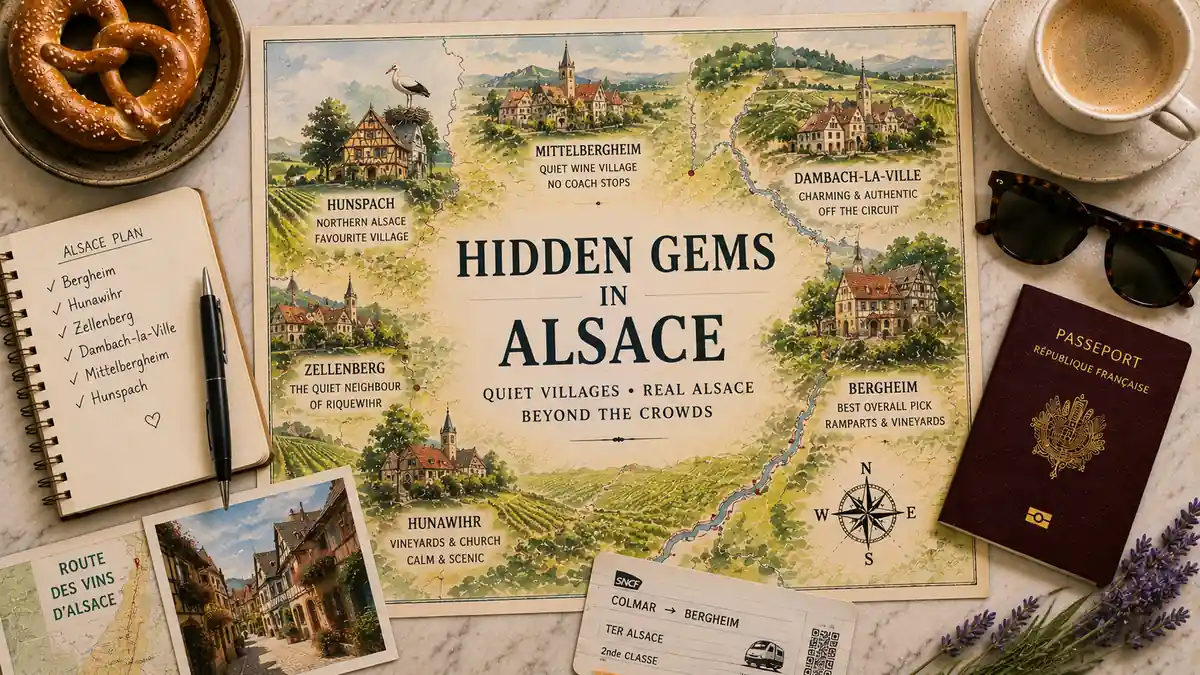
Bergheim is the strongest quiet pick in Alsace, followed by Hunawihr, Zellenberg, Dambach-la-Ville and Mittelbergheim, with Hunspach in the north. What qualifies a village is not its label but whether it is a scheduled stop on the standard Colmar–Ribeauvillé–Riquewihr day. Bergheim is the first swap: ramparts and vineyards minutes from the circuit, without the coaches.
Trust Layer
Tripstou selection guide for travelers choosing between multiple places. Covers selection criteria, traveler fit, and trip value. Every designation named here was checked against the awarding body’s current listing, and villages holding none are identified as such.
Produced with AI assistance and reviewed by Alex Perrut, working in tourism since 2015, for the Tripstou editorial team. See our editorial process for details.
Last factual review: August 22, 2026.
Official sources consulted: France.fr, Atout France.
Key Takeaways
- Bergheim is the strongest single pick: a designated village with walkable ramparts that the standard coach day still skips.
- Judge any Alsace village by whether it appears on the standard Colmar day, not by the label it carries.
- Designation and crowds correlate here: Riquewihr and Eguisheim are both Plus Beaux Villages and both scheduled coach stops.
- Zellenberg holds no designation at all and still qualifies, proving that the itinerary decides the crowd, not the distance.
- Head north for the least photographed version: Hunspach and Wissembourg sit well beyond any Colmar-based day trip.
- The swap costs open cellar doors and restaurant choice, so keep meals and tastings where the crowds already are.
Table of Contents
In Alsace, the Famous Labels Point Straight at the Crowds
In Alsace, the official designations and the crowds sit in the same villages, so the label test fails here. The test that works is narrower: it asks whether a village is a scheduled stop on the standard coach day between Colmar, Ribeauvillé and Riquewihr. Everything on this page cleared that bar.
The national version of this test runs in two tiers, and the full explainer sits in our guide to hidden gems in france: Tier 1 asks whether an official body has vouched for the place, Tier 2 asks whether it has stayed off the mass circuit. Alsace narrows the first tier and forces a rewrite of the second. Both amendments matter more than the picks themselves, because they are what lets you judge any village name someone hands you.
Tier 1 is narrower here: no Grand Site de France in all of Grand Est
Alsace has no Grand Site de France, and neither does anywhere else in Grand Est. The closest thing is the Ballon d’Alsace, which runs an Opération Grand Site — a candidacy process, not an award already held. Naming it as a label would be an upgrade the site has not received.
Tier 1 in Alsace therefore rests on two signals only: membership of Les Plus Beaux Villages de France, and Monument Historique protection on a specific building. That is a thinner filter than the national test assumes. Both are also live statuses: the Plus Beaux Villages roster is reviewed and membership can lapse, so read every designation on this page as current standing.
Which Alsace villages are Plus Beaux Villages — and why two of the five are the problem
Five Wine Route villages currently hold Plus Beaux Villages de France membership: Eguisheim, Riquewihr, Hunawihr, Bergheim and Mittelbergheim. Two of them are the busiest stops in the region. Riquewihr and Eguisheim are where the coach itineraries stop, and Eguisheim also holds a Village Préféré des Français title — an annual television award that reliably pulls visitors towards whichever village wins it.
In Alsace, official designation and crowding correlate positively. That is the opposite of how the label is usually read. A designation tells you a place is worth seeing; it does not tell you anyone has overlooked it, and in a region this compact the two signals collapse into one.
Two of the five labelled villages are the exact two most travelers are trying to avoid, which makes the roster more useful as a list of what to skip than as a list of where to go.
The real Tier 2: is it a scheduled stop on the standard Colmar–Ribeauvillé–Riquewihr day?
At regional scale, the corridor is the region. The Wine Route runs roughly 170 km along the foot of the Vosges, with villages ten to fifteen minutes apart, so the usual advice to “get off the corridor” returns nothing in Alsace. There is no elsewhere within reach. Leaving the road means leaving the wine villages entirely.
The workable Tier 2 test asks something else: does this village appear as a scheduled stop on the standard day trip? Two proxies answer it quickly — how far the village sits from Colmar, and whether a coach can park and turn around near the centre. Villages on a ridge, behind a narrow gate, or with no bus-sized parking simply never enter the itinerary.
Zellenberg proves the axis. It sits about two kilometres from Riquewihr, in plain sight of it, and is consistently reported as quiet. Proximity is not the variable. Being on the itinerary is.
The Quieter Wine Route Villages: Five Swaps That Clear the Bar
Five Wine Route villages clear the bar: Bergheim, Hunawihr, Zellenberg, Dambach-la-Ville and Mittelbergheim. None appears as a scheduled stop on the standard Colmar day, and each sits within minutes of a village that does. Bergheim is the strongest of the five, because it also holds a designation.
Distance from Colmar does more work here than any label. The villages clustered tightest around Colmar and Riquewihr have to fight hardest to stay quiet; the ones further north, like Mittelbergheim and Dambach-la-Ville, stay quiet almost by default because the standard day never reaches that far.
Bergheim: the flagship, because it clears both tiers
Bergheim holds Plus Beaux Villages de France membership and still sits off the standard stop list, which makes it the only pick here that satisfies both tiers at once. Its ramparts are among the best preserved in Alsace: a fourteenth-century circuit of walls, a high fortified gate, flanking towers and the line of the old moats — walkable in roughly an hour.
What separates Bergheim from the other picks is that the walls, not the street of houses, are the reason to come. Everywhere else on this list you look at façades or landscape; here you walk a defensive perimeter and read the village from outside it.
Pick this if: you want a labelled village with a genuine monument to walk, and you still expect to hear your own footsteps on it.
Hunawihr: the labelled village the coaches still miss
Hunawihr holds Plus Beaux Villages de France membership and sits between Ribeauvillé and Riquewihr, close enough to both that the coaches pass it and keep going. Its fortified church stands apart from the houses on a low rise in the vineyards, ringed by a defensive wall — a silhouette visible from most of the surrounding vines.
It is the only pick on this page whose landmark stands out in the vines, away from the houses, which changes what the visit is. You spend it in the vineyards looking back at the church, not on a main street looking up at windows.
Pick this if: you photograph landscape more than architecture and want the Plus Beaux Villages standard without a main street to share.
Zellenberg: no designation at all, and that is the point
Zellenberg holds no designation this page could confirm. No Plus Beaux Villages membership, no Grand Site, nothing — and inventing a label to make it look stronger would break the test the page just set. It qualifies on Tier 2 alone, and saying so plainly is the test working in public.
The village is a single ridge above the vines, a few hundred residents, with open views across the plain towards Ribeauvillé and Riquewihr. It sits about two kilometres from Riquewihr and appears on no standard itinerary, which is precisely why it is worth the detour: it is the cheapest possible demonstration that the itinerary, not the distance, is what makes a village busy.
Pick this if: you are already in Riquewihr with an hour to spare and want to see what two kilometres of separation actually buys.
Dambach-la-Ville: Monument Historique, not Plus Beaux Villages
Dambach-la-Ville carries Monument Historique protection and no village designation, and this page will not upgrade it. The Chapelle Saint-Sébastien, with its Romanesque bell tower, is classée; the ruined Château de Bernstein on the hill above the vines is inscrit. Those are the exact statuses, and they are worth more than a borrowed label.
It is the only pick here that pairs a walled wine village with a hill castle above it, which makes it the one that turns into a half-day if you let it. The climb to Bernstein is the substance of the visit; the village below is the reward on the way down.
Pick this if: you would trade a second village stop for a climb to a ruined castle above the vineyards.
Mittelbergheim: the Bas-Rhin member below Mont Sainte-Odile
Mittelbergheim holds Plus Beaux Villages de France membership and sits at the foot of Mont Sainte-Odile, near the northern end of the Wine Route. Its slopes carry the Grand Cru Zotzenberg, and the village itself is built in a heavier, stonier style than the painted timber further south.
Its distinguishing feature is simply where it is. Mittelbergheim is the furthest of the five from the Colmar cluster, which is most of the reason it stays quiet, and it pairs naturally with Andlau a few minutes away if you want a second stop in this corner.
Pick this if: you are approaching Alsace from Strasbourg and want a labelled village well clear of the Colmar traffic.
Famous Name, Quieter Counterpart: What Each Swap Costs
Every famous Alsace stop has a working counterpart within about fifteen minutes, and every swap costs something. You give up open cellar doors, restaurant choice and the density of photogenic streets that made the famous village famous. The table below pairs each name with its substitute and the specific loss.
| Famous name | Quieter counterpart | What the swap costs |
|---|---|---|
| Riquewihr | Zellenberg for the view, Bergheim for a full stop | Far fewer open doors along the village street |
| Eguisheim | Hunawihr, a few minutes along the same vineyard slope | No concentric lanes; the landmark stands outside the village |
| Kaysersberg | Dambach-la-Ville, walled and backed by its hill castle | Less to do at street level; the castle needs an extra hour |
| Ribeauvillé | Mittelbergheim, at the northern end of the route | A long drive north and a much smaller village centre |
The Riquewihr row is the one most people need. Riquewihr anchors the standard day and takes the heaviest visitation on the route, which is exactly what makes Zellenberg workable — the coaches are two kilometres away and staying there. Bergheim does the same job for anyone who wants a longer stop with something to walk.
Substitution and re-timing are two different tools, and this page only sells the first. If you still want Riquewihr itself, the lever is arrival timing, which our guide to things to do in alsace resolves.
Fewer doors are open in the quiet villages, so the pattern that works is to take your meals and cellar visits where the crowds already are, and give the quiet village your walking time.
Is the Rest of Alsace Worth Visiting? The Bas-Rhin North and the Sundgau
Yes for the north, and conditionally for the far south. Hunspach and Wissembourg, in the Outre-Forêt north of Strasbourg, qualify outright and sit furthest from the Wine Route circuit. The Sundgau, at the other end of Alsace, is quieter still and genuinely thin on major sights.
Both areas clear Tier 2 for the same reason: they are nowhere near the corridor. The distance is the whole defence. It also explains why the ranking lists leave the most underrated parts of Alsace out entirely — a page built around the Wine Route has no natural slot for a border town or a valley of ponds.
Wissembourg and Hunspach: the Outre-Forêt the ranking lists leave out
Hunspach holds Plus Beaux Villages de France membership and a Village Préféré des Français title. Its houses carry white timbering instead of the painted façades further south, so it looks unlike the Alsace on the postcards. Treat the television title as current standing and expect it to draw more attention than the village’s size suggests; it still sits far off the standard day trip.
Wissembourg is the town-sized option: an old quarter on the Lauter, half-timbered streets, a large Gothic church, and a position tight against the German border that puts it beyond any Colmar-based itinerary.
Pick this if: you want Hunspach’s version of Alsace — white timbering, no colour scheme, no coach park.
Pick this if: Wissembourg fits your route in from Germany or Strasbourg and you want a real town centre with no queues.
The Sundgau: genuinely quiet, honestly thin
The Sundgau, the hilly southern corner between Mulhouse and the Swiss border, is the quietest part of Alsace and the thinnest on things to see. None of the confirmed Plus Beaux Villages sits here, and no single monument justifies the drive on its own. What it has is landscape: ponds, forest, scattered half-timbered farms and roads that carry almost no tour traffic. This page will not oversell it to balance the list.
Pick this if: you are driving between Alsace and Switzerland and want open countryside instead of another village centre.
Do You Need a Car to Reach the Small Villages?
A car is the practical answer for almost every village on this page. Bergheim, Hunawihr, Zellenberg and Mittelbergheim are small, spread along and above the vineyards, and served thinly by public transport. Bus links from Colmar and a seasonal wine-route service exist, but they shape your day around them.
The main railway runs up the plain and serves the larger towns; almost every village on this list sits in the hills to the west of it, reached by road. Cycling is the strongest car-free alternative along the Wine Route, because the villages are close enough together to link several in a day under your own power. For bases, getting around and how the region fits together, the alsace travel guide resolves it properly.
The car matters less for reaching these villages than for leaving them. They are small. Without your own transport, a twenty-minute visit turns into a long wait for whatever comes next, which is the real reason the quiet half of Alsace stays quiet.
Should You Trade the Famous Circuit for the Quiet One?
Swap if crowds change how a place feels to you. Keep Riquewihr, Colmar and Kaysersberg if this is your one day in Alsace and you want the density the photographs promised. None of these villages is a discovery, and this page does not pretend otherwise.
That last point is worth stating flatly. Every village named here has a tourist office, signposted heritage and in most cases a wine festival. They are quieter, better spaced and less photographed — nobody has forgotten they exist. The claim is comparative and nothing more.
Skip the swap if you are a first-time visitor who came for the postcard density, or if your trip allows one drive along the route and you would spend the difference in the car. Photographers chasing the classic Riquewihr street should go to Riquewihr. If that describes you, the famous circuit is the right call, and the wider set of best places to visit in france is a better starting point than this list.
The swap pays off only when you intended to spend real time in the village. For a fifteen-minute walk and one photograph, the famous ones do it better — that is why they became famous.
Frequently Asked Questions
Is Alsace too touristy?
Parts of it are. The standard circuit through Colmar, Riquewihr and Eguisheim is genuinely crowded in season, and it is a small fraction of the region. Five minutes either side of that road the pressure drops sharply, which is why swapping villages works better here than avoiding Alsace.
What is the least touristy village in Alsace?
Zellenberg is the quietest of this page’s Wine Route picks; Hunspach is the quietest option in the region overall. Neither appears as a scheduled coach stop. Treat the superlative as consistently reported, not measured: no visitor counts exist for villages this small, and the season changes the answer.
Is Eguisheim a hidden gem?
No. Eguisheim clears the first test and fails the second: it holds Plus Beaux Villages de France membership and a Village Préféré des Français title, and it is one of the fixed stops on the standard coach day. The label is real; the quiet is not.
Are the small Alsace villages quiet at Christmas?
Less quiet than the rest of the year. The market season partly inverts this page’s logic: small villages draw visitors who would otherwise stay in Colmar and Strasbourg, and the labelled ones fill first. They stay calmer than the cities, but expect the gap to narrow, village by village.
Which Alsace village was voted France’s favourite village?
Hunspach, in the far north, is the Village Préféré des Français winner on this page’s list. Eguisheim and Kaysersberg have taken the title too, and both are scheduled coach stops. The award is an annual television vote, and it reliably pulls more visitors towards whichever village wins.
Which quieter villages sit nearest the standard Colmar circuit?
Zellenberg, Hunawihr and Bergheim are the closest, all inside the Riquewihr and Ribeauvillé cluster, minutes from the road the coaches use. Mittelbergheim and Dambach-la-Ville sit further north, past the point the standard day turns back. Nearer means easier to add; further north means quieter with no effort.
Related Guides
Plan the wider trip and go deeper on the region with these guides:
- alsace travel guide — bases, seasons, how long to stay and how the region fits together.
- things to do in alsace — what to do once you arrive, including arrival timing on the busy circuit.
- hidden gems in france — the national two-tier test and quieter regions beyond Alsace.
- best places to visit in france — the famous set, for travelers who want the headline names.
Did this guide save you time or money? Tripstou is independent and reader-funded — if you'd like to give something back, you can support the site with a crypto contribution of any size.