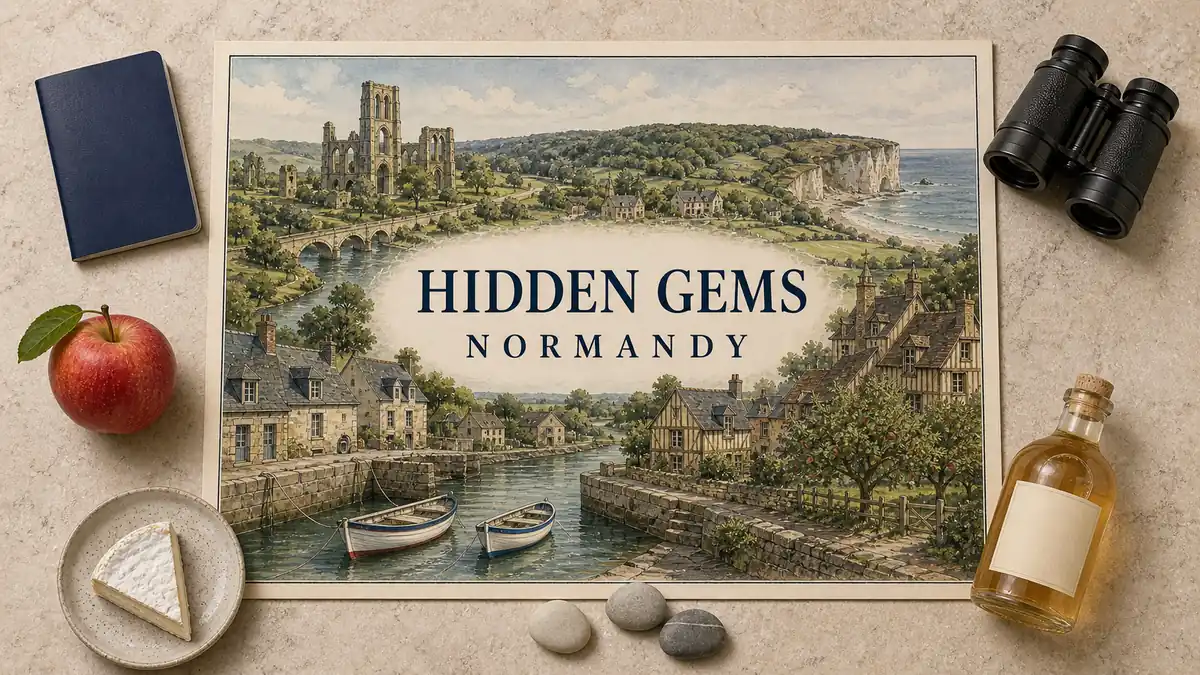
Your Normandy plan probably already has the famous names on it. The trouble starts when you look for what else to add, because nearly every hidden gems list hands the same names straight back — Mont-Saint-Michel, Honfleur, Étretat, Rouen. One widely shared list of Normandy villages even includes Chartres, which sits in Centre-Val de Loire and is not in Normandy at all.
This page runs a stricter test. It names only towns, villages and small harbours the standard English lists leave out, cites France’s own small-town labels where an official listing confirms them, and says plainly when a pick is simply a place travelers keep recommending to each other. Everything is grouped by area, because a gem you cannot attach to a route is trivia.
Quick Answer
Normandy’s strongest overlooked picks are Barfleur, Beuvron-en-Auge, Saint-Céneri-le-Gérei and Bellême. They cluster into five areas — the Perche, the Cotentin, the Pays d’Auge, the Suisse Normande and the quieter coast — so choose by the area your route already touches. Inland picks reward drivers; the quiet coast suits anyone escaping the Honfleur and Étretat crowds.
Trust Layer
Tripstou selection guide for travelers choosing between multiple places. Covers selection criteria, traveler fit, and trip value.
Produced with AI assistance and reviewed by Alex Perrut, working in tourism since 2015, for the Tripstou editorial team. See our editorial process for details.
Last factual review: August 22, 2026.
Official sources consulted: France.fr, Atout France.
Key Takeaways
- Normandy’s underrated picks cluster into five areas, so choose by the area your route already touches, not by prettiness.
- The Perche in southern Orne carries four Petites Cités de Caractère towns and almost no English-language coverage.
- Swap Étretat for Yport and Honfleur’s coast for Villerville: same cliffs and light, a fraction of the summer traffic.
- A car unlocks nearly every pick here; without one, only the coastal picks near larger towns stay realistic.
- Walkers should head to Clécy, food travelers to the Pays d’Auge, and architecture hunters to Jumièges or Le Bec-Hellouin.
- Small places cost you services, not scenery, so plan lunch where the crowds are and keep villages for around it.
Table of Contents
What Counts as a Hidden Gem in Normandy?
A hidden gem here is a Normandy place the big English lists skip — small, quiet, locally loved. Prettiness is not the test; obscurity is. France’s own small-town labels do most of the sorting on this page, and the places travelers keep naming to each other supply the rest.
The English-language lists fail because they relabel famous places as hidden. A widely shared roundup of Normandy villages opens with Bayeux and finishes with Honfleur and Rouen, three of the most visited places in the region, and adds a town that is in a different region entirely. Padding a shortlist with the headline names is the quickest way to break the promise in the title. The famous circuit is worth doing, and our guide to the best places to visit in France covers it. This page is the complement.
Three official French schemes do the credibility work instead. Petites Cités de Caractère covers small historic towns and has an unusually dense cluster in the Orne. Plus Beaux Détours de France covers towns a size up, away from the main tourist flow. Les Plus Beaux Villages de France is the best known of the three nationally. Where a pick holds a confirmed listing, this page names it. Where it does not, it says so — a village can be worth the drive without a certificate.
The same famous-versus-overlooked axis runs at national scale in our guide to hidden gems across France. This page stays region-deep. Every pick below is placed by department and area, because in Normandy the area is what decides whether a village is addable to your route or a two-hour digression you will resent.
A filter that works across the whole region: if a name turns up on a Paris day-trip page or a D-Day tour route, it is not a gem, it is a queue.
| Area | Picks on this page | Best suited to | Access reality |
|---|---|---|---|
| Perche and southern Orne | Bellême, Mortagne-au-Perche, La Perrière, Saint-Céneri-le-Gérei | Slow driving, manor country, market-town mornings | Car country; assume you are driving |
| Cotentin peninsula, in the Manche | Barfleur, Barneville-Carteret and Port Racine | Working harbours and long, empty coastline | Car essential; the tip is remote |
| Pays d’Auge (Calvados and Orne) | Beuvron-en-Auge and Orbec, with Le Sap nearby | Cider country, food stops, half-timbered lanes | Easiest to add to a coastal trip |
| Suisse Normande and the inland valleys | Clécy, Le Bec-Hellouin, Harcourt and Jumièges | Walkers, abbeys and green river valleys | Car-first; confirm site opening before driving |
| The quieter coast (Seine-Maritime and Calvados) | Yport, Villerville and Eu–Le Tréport | Escaping the busiest coastal towns in summer | Closest to workable without a car |
The Perche and Southern Orne Are Normandy’s Best-Kept Inland Secret
The Perche hides Normandy’s most atmospheric small towns, and almost no English-language list mentions any of them. It sits in the Orne, in the south of the region: wooded hills, horse pasture and stone manors. Four of its towns carry the Petites Cités de Caractère label, which is unusual density for one small area.
The Perche stayed off the circuit because it has no headline sight. No cathedral everyone has photographed, no coastline, no landing beach. It was prosperous, then quiet, and it kept its buildings because nothing ever forced it to rebuild. That absence of a must-see is precisely what makes it read as unspoiled now, and it is also why the area deserves a full day instead of a stop — split it across two half-days and most of your time goes on the roads between towns that all improve the slower you take them.
Bellême: the hilltop base for the whole area
Bellême carries the Petites Cités de Caractère label and works as the natural base for the Perche. It stands on high ground in the Orne above wooded, horse-breeding country, and it is a working town — shops, somewhere to eat, people going about their day — which almost none of the other picks in this area are.
That is what separates it here. Most Perche villages give you twenty minutes and a photograph; Bellême gives you an afternoon and lunch afterwards, which is the difference between a detour and a destination.
Pick this if: you want one Perche base with real services attached.
Mortagne-au-Perche: the market town the lists forgot
Mortagne-au-Perche is one of the larger labelled towns in the Perche and the one that comes up most when travelers compare notes about southern Normandy. It holds the Petites Cités de Caractère label, sits high above the surrounding countryside in the Orne, and has the settled feel of a place that never remodelled itself for visitors.
Its distinction on this page is scale. It is a town first and a sight second, which makes it the Perche pick that still works on a grey afternoon when the smaller villages have gone quiet and shuttered.
Pick this if: you are travelling outside high summer and want somewhere that stays open and inhabited.
La Perrière: the ridge village with the view off it
La Perrière is the smallest of the Perche picks and the one that rewards a deliberately short stop. It carries the Petites Cités de Caractère label and sits high on a ridge in the Orne, so half the reason to come is the village and the other half is what you can see from the edge of it.
It is the only Perche pick that is genuinely a village, which changes what you do there. You walk it, you look out, you leave. Nobody needs longer.
Pick this if: you are already driving the Perche and want a twenty-minute stop that earns its place.
Saint-Céneri-le-Gérei: the border village in the Alpes Mancelles
Saint-Céneri-le-Gérei is the prettiest village in this group and the one that needs a geography note. It is administratively in the Orne and therefore in Normandy, but it sits on the border with the Sarthe and the Mayenne, in the Alpes Mancelles — a landscape of river bends and rock that belongs as much to the Maine as to Normandy. It carries the Petites Cités de Caractère label.
That border position is the honest catch, and it decides who should bother. From Rouen or the landing beaches it is a long way south for one village. From Alençon or Le Mans it is a short, obvious detour and one of the best half-hours in the region.
Pick this if: your route already runs through southern Normandy and you want the one village worth going out of your way for.
The Cotentin Peninsula Hides Normandy’s Quietest Harbours
The Cotentin’s far tip holds Normandy’s smallest and calmest harbours, and distance is what keeps them that way. The peninsula pushes north into the Channel in the Manche department, well past the range of a comfortable Paris day trip. That awkwardness is the whole reason it stays quiet.
The Cotentin was skipped for the same reason it survived intact: it is on the way to nothing. Traffic through Normandy runs east to west along the coast, then stops at the landing beaches or turns inland. The peninsula is a long dead end above that line, so it collects residents and sailors and almost no coaches. Inland from the west coast, Bricquebec-en-Cotentin carries the Petites Cités de Caractère label and makes a sensible stop if you are crossing the peninsula anyway.
The Cotentin only rewards you if you sleep there. Treated as a day trip from the landing-beach coast it turns into mostly driving, with two hours of harbour at the far end of it.
Barfleur: the working harbour at the north-east tip
Barfleur is the strongest Cotentin pick and one of the smallest harbour villages in Normandy. It sits at the peninsula’s north-east corner, built low in pale grey stone around a fishing harbour, with none of the pastel prettiness of the resort coast further east.
What makes it distinct here is that it is a fishing village that never converted. The harbour is the town’s job; nobody decorated it for you, and the plainness is exactly the appeal.
Pick this if: you prefer a working harbour with weather in it to a photogenic waterfront.
Barneville-Carteret: the west-coast pick that works as a base
Barneville-Carteret pairs a small harbour with a beach on the Cotentin’s west coast, which makes it the one pick in this group you can realistically stay in. It is a name that keeps surfacing when travelers swap quiet-coast recommendations for Normandy, and it is missing from almost every English listicle.
It is the only Cotentin pick with enough around it to fill a day, and that is what separates it from Barfleur and Port Racine. Those two are visits. This one is a base.
Pick this if: you want a Cotentin base with a beach and a harbour in the same place.
Port Racine: the smallest stop on this page
Port Racine is a very small harbour near the Cotentin’s north-western tip, and it is honest to say the visit is brief. A few boats, a stone quay, the open Channel beyond — that is the whole of it, and the region’s own tourism board lists it among its gems precisely because of the scale.
It earns a place here because it recalibrates everything else. After Port Racine, every other harbour in Normandy looks busy, and the peninsula’s emptiness stops being an abstraction.
Pick this if: you have the peninsula’s northern coast on your route and want the extreme version of small.
The Pays d’Auge: Half-Timbered Villages Deep in Cider Country
The Pays d’Auge’s overlooked villages trade headline sights for half-timbered streets, orchards and a slower pace. This is the orchard country inland of the Calvados coast, running south into the Orne, where cider and cheese are the local economy. It suits travelers who eat well and drive slowly, and disappoints anyone collecting monuments.
The Pays d’Auge stayed half-hidden because its famous edge is the coast. Visitors reach the seaside towns, look inland at farmland, and turn around. The villages start about ten minutes past that turning point, and the ratio of visitors to locals collapses almost immediately. Two more labelled towns sit in the same area if you want to extend the loop: Le Sap and Touques both carry the Petites Cités de Caractère label.
Here the villages are the smaller half of the day. The lanes, orchards and farm gates between them are the actual attraction, so plan the driving as the visit and treat each village as a place to stop the car.
Beuvron-en-Auge: the anchor village of the orchards
Beuvron-en-Auge is the best-known village in the Pays d’Auge and still not a fixture on the standard Normandy circuit. It is essentially one short street of half-timbered houses, flowers and small shops, far enough inland that the coastal crowds rarely make the turn.
Its distinction is completeness. Most Normandy villages have one good corner and a car park spoiling the rest; Beuvron holds up from end to end, which is why it is the one to send someone to if they only stop once.
Pick this if: you have a single afternoon inland and want the most concentrated half-timbered village in the area.
Orbec: the genuinely obscure one
Orbec is the most overlooked town on this page and the reason the Pays d’Auge deserves more than one stop. It is a small medieval town in the Calvados with cobbled streets, half-timbered houses and an old church, and it appears on French regional lists of forgotten villages while staying close to invisible in English.
What keeps it obscure is that it has no hook — no coast, no famous product, no film location — and that is what makes it feel unmanaged. You are not walking through a preserved set. You are walking through a town.
Pick this if: you want a place with nobody performing for you, and you need no reason beyond the streets.
Suisse Normande and the Inland Valleys: Normandy Without the Coast Crowds
Inland Normandy’s river valleys and abbey villages feel nothing like the coast, and they stay far quieter. The Suisse Normande is a stretch of gorge and crag on the Orne river; the abbeys sit east of it, towards the Seine. Together they cover walkers and anyone wanting medieval architecture without coach traffic.
These places are quiet because Normandy sells itself as a coast. Beaches, cliffs, harbours and the landing sites take the marketing, so the interior reads as the part you drive through on the way somewhere. It is greener, hillier and emptier than any brochure suggests. One warning applies to the whole group: the abbeys, châteaux and gardens inland reduce their opening outside the warmer months and some close entirely, so check the site’s own opening before you drive out.
Inland Normandy is where a closed door costs the most, because the site is usually the entire reason for the detour. Build each inland day around one thing you have confirmed is open, and let the rest be a bonus.
Clécy: the walking base in the Suisse Normande
Clécy sits at the centre of the Suisse Normande and is the pick for anyone who wants to be outdoors. It stands on the Orne river in the Calvados, below the rocky crags that earned the area its Alpine nickname, and travelers use its name as shorthand for the whole landscape around it.
It is the only pick on this page where the village is the trailhead and the landscape is the attraction. You come for the river, the viewpoints and the walking. The village is where you park.
Pick this if: you want a day on foot or on the water instead of a day looking at buildings.
Le Bec-Hellouin: the working abbey village
Le Bec-Hellouin is a small village in the Eure built around a working Benedictine abbey, and the monastic community is still in residence. That is what separates it from the region’s ruined abbeys: the place is in use, and its quiet has nothing to do with visitor numbers.
The village itself is half-timbered and very small, so the abbey carries the visit. Access to the abbey buildings is limited and seasonal, which makes this the pick most worth checking before you commit the drive.
Pick this if: you want a functioning religious site with an atmosphere no ruin can give you.
Harcourt: the château with an arboretum attached
Harcourt pairs a medieval château with one of France’s oldest arboretums, an unusual combination and the whole reason it is on this list. The estate sits in the Eure, and the trees are as much of the visit as the walls — mature plantings laid out through the grounds around a fortress.
It is the only pick here that works as a garden visit. That makes it the one to keep in reserve for a good-weather afternoon when nobody in the car wants another village street.
Pick this if: you like a walk under old trees as much as you like stonework.
Jumièges: abbey ruins in a loop of the Seine
Jumièges is the strongest choice for medieval architecture without coach traffic. The abbey stands in ruins inside a bend of the Seine in the Seine-Maritime, roofless towers in pale stone rising over open lawns, on a scale most intact churches never reach.
Its distinction on this page is drama. Everything else in this group is small and intimate; Jumièges is large, broken and theatrical, and it is the one pick that will hold a photographer for an hour without effort.
Pick this if: you want one big historic set piece to break up a run of small villages.
Tours and activities
Book skip-the-line tickets, day trips and local tours with free cancellation on most activities.
You can also browse everything on getyourguide.com.
Tripstou may earn a commission if you book through this link, at no extra cost to you.
Yport and Villerville: Quiet Alternatives to Honfleur and Étretat
Yport gives you Étretat’s chalk-cliff coast without the queues, and Villerville is the estuary village Honfleur’s day trippers drive past. Both sit close to the famous names, on the same coastline, with a fraction of the summer traffic. Eu and Le Tréport add a quieter option at the region’s northern edge.
The crowd problem on this coast is concentrated, and that is the lever. Two or three towns absorb almost all of the visitors, while the villages in between stay ordinary. You do not have to leave the Alabaster Coast to escape its queues; you only have to stop somewhere that was never given a coach park. In July and August the contrast is at its sharpest, and that is the stretch of the year when choosing the smaller name changes the whole day.
These picks work because of their closeness to the famous pair, not despite it. You keep the same cliffs and the same light, and you give up choice at dinner — which matters less than most people expect at lunchtime and rather more at eight in the evening.
Yport: the Alabaster Coast village under the cliffs
Yport is the Étretat alternative: a small village set into a break in the chalk cliffs of the Seine-Maritime, with a pebble beach and the same white walls rising on either side of it. The geology is identical. The crowd is not.
What it gives up is the famous arch. Étretat’s rock formations are the reason that town is busy, and Yport has the cliffs without the silhouette everyone photographs, which is the entire trade you are making.
Pick this if: you want the Alabaster Coast to yourself and can live without the postcard rock.
Villerville: the estuary village between the resorts
Villerville sits on the Calvados coast between the big resort towns and the Seine estuary, and it stays small because nothing about it was built to receive crowds. It is a residential village above its beach, with the water in view and nothing organised happening on the seafront.
Its distinction here is normality. People live in Villerville all year, which is something the resort towns beside it stopped being able to claim decades ago.
Pick this if: you are already based on this coast and want a morning somewhere nobody is performing.
Eu and Le Tréport: the quiet end of the northern coast
Eu–Le Tréport is listed among the Plus Beaux Détours de France and pairs an inland town with a working port at Normandy’s northern edge, in the Seine-Maritime. That label covers towns a size up from villages, chosen for sitting away from the main tourist flow, and it is the clearest official backing any pick on this page carries.
These are the furthest picks from everything else here, which is the point. This corner sits beyond where most Normandy itineraries stop, so it has stayed a French seaside town with a French seaside season attached.
Pick this if: you are entering Normandy from the north and want a coastal stop before the region’s busier half.
Do You Need a Car to Reach Normandy’s Hidden Gems?
Yes — a car unlocks nearly every pick on this page, and most are unrealistic without one. These are inland villages and peninsula harbours, which is exactly the kind of place Normandy’s public transport serves thinly. Plan on driving, or plan on a much shorter list.
Treat the areas as tiers. The Perche and the Suisse Normande are car country: assume you are driving and build each day as a loop. The Cotentin tip is the same with distance added, and it is the one area where a car decides whether you go at all. The Pays d’Auge is the easiest to bolt onto a coastal trip, because its villages sit close to the main east–west corridor. The quieter coast is the closest to workable without a car, since those picks are the ones nearest the region’s larger towns.
The number that matters is how many areas you touch. Two picks in one area cost a single detour; two picks in two areas cost a day, and that arithmetic decides how many of these you actually see.
Basing, timing and how the region connects are resolved in our Normandy travel guide, which is where the driving question properly belongs — including how the Mont-Saint-Michel end of the region fits a wider route. If you are slotting these villages between the landing beaches and the museums, our guide to things to do in Normandy covers what fills the rest of those days.
Small places cost you services, never scenery. Fewer places to eat, shorter opening, and a real chance the one café is shut on the day you arrive — so plan lunch where the crowds already are and keep the villages for the hours around it.
Train and bus tickets
Compare routes, schedules and prices across rail and bus operators in one search, with mobile tickets on your phone.
New to Omio? Code NEW10 takes 10% off your first booking — or APPNEW10 if you book inside the Omio app. Both apply to bookings up to €80.
Search routes and compare prices on Omio →
Tripstou may earn a commission if you book through this link, at no extra cost to you.
Frequently Asked Questions
What are the Petites Cités de Caractère in Normandy?
Petites Cités de Caractère is a French label for small historic towns. In Normandy it covers a dense cluster in the Orne — Bellême, Mortagne-au-Perche, La Perrière and Saint-Céneri-le-Gérei — plus Bricquebec-en-Cotentin on the peninsula and Le Sap and Touques in the Pays d’Auge. More towns hold it regionwide.
Which part of Normandy is the least touristy?
The Cotentin peninsula’s far tip is the emptiest part of Normandy, followed by the Perche in the southern Orne. Both sit off the region’s east–west coastal corridor, so almost no coach traffic reaches them. The Alabaster Coast and the Pays d’Auge stay busier, but empty out quickly once you turn inland.
Is Saint-Céneri-le-Gérei worth visiting?
Yes, if your route already runs through southern Normandy. It is administratively in the Orne but sits on the Sarthe and Mayenne border, in the Alpes Mancelles. Pair it with Bellême and Mortagne-au-Perche for a single southern-Orne day; treat it as a standalone trip from the coast and it disappoints.
How many days do you need to see Normandy’s small towns?
Budget one day per area. Two or three days covers a pair of areas comfortably — say the Pays d’Auge with the quieter coast, or the Perche on its own. A week lets you reach the Cotentin without turning it into a long drive from somewhere else.
Can you reach Normandy’s villages by train?
Mostly no. The coastal picks are the closest to workable, because they sit nearest the region’s larger towns; the Perche, the Cotentin tip and the Suisse Normande are effectively car-only. Without a car, keep to the coastal picks and accept that the inland areas need a rental car to be worth attempting.
Related Guides
Plan the wider trip and go deeper on the region with these guides:
- Normandy travel guide — when to go, where to base yourself, and how the region connects.
- things to do in Normandy — the experiences, landing-beach sites and museums that fill the days between villages.
- hidden gems across France — the same famous-versus-overlooked axis at national scale.
- best places to visit in France — the headline names, for the part of the trip this page deliberately leaves out.
Did this guide save you time or money? Tripstou is independent and reader-funded — if you'd like to give something back, you can support the site with a crypto contribution of any size.