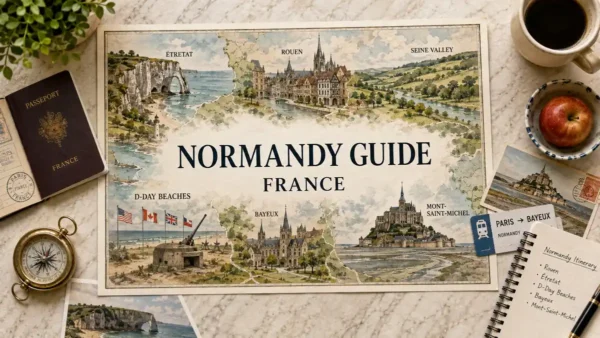
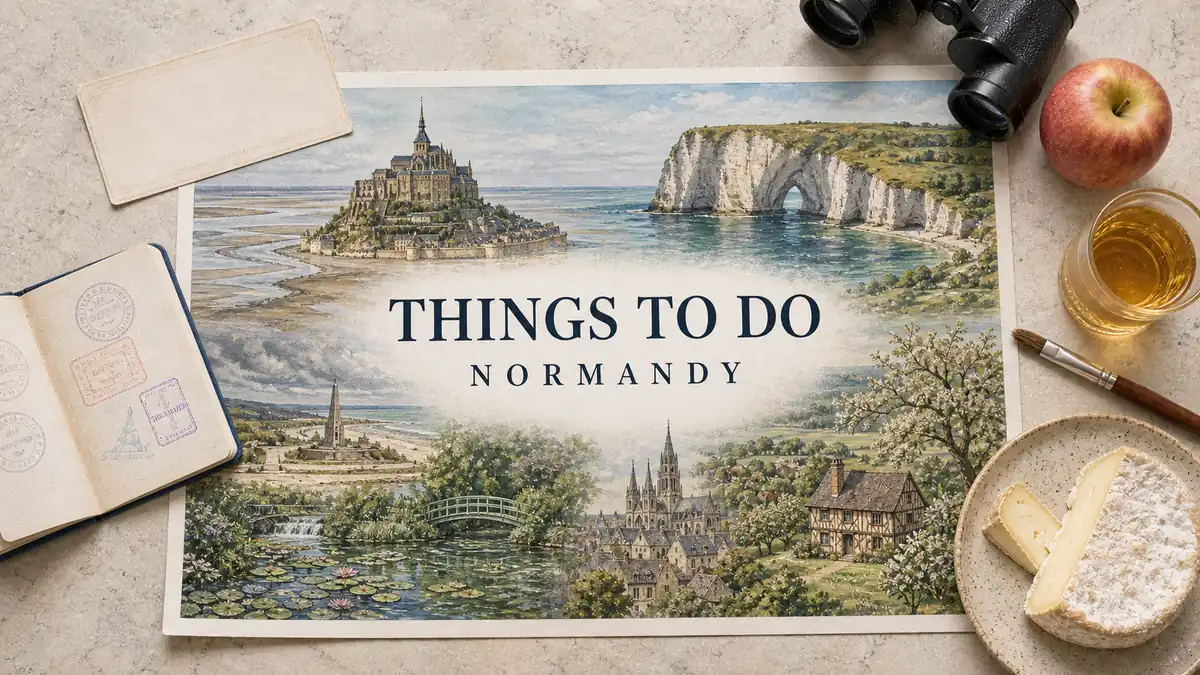
Normandy is decided by experiences, not by how many towns you tick off. The region’s pull comes from a handful of things you actually do: standing on the landing beaches, walking out to a tidal abbey, climbing a chalk clifftop, following painters through gardens and harbours, and tasting cider where it is pressed. Most guides list them. Fewer tell you which ones earn a slot on a short trip, and almost none resolve the choices that decide whether the day works — which of the five beaches to prioritise, whether to book a guided tour or drive yourself, and how to time Mont-Saint-Michel so the tide and the crowds work for you. This page gives a verdict on each experience, says who it suits, names the tradeoff, and then handles the execution on the hard ones. It ends with the booking discipline: the short list of things that genuinely need reserving ahead.
Quick Answer
The D-Day landing beaches, Mont-Saint-Michel and the Étretat cliffs lead any Normandy shortlist. How you do them matters more than how many: tour or self-drive on the beaches, and Mont-Saint-Michel timed around the tide. Book the D-Day tour or abbey entry ahead in high season; the cider route and Impressionist trail reward an extra day.
Trust Layer
Tripstou attraction guide for travelers deciding whether an experience is worth doing and how to do it well. Covers value, booking versions, timing, access, and traveler fit.
Produced with AI assistance and reviewed by Alex Perrut, working in tourism since 2015, for the Tripstou editorial team. See our editorial process for details.
Last factual review: August 22, 2026.
Official sources consulted: France.fr, Atout France.
Key Takeaways
- Six experiences carry a Normandy trip: the D-Day coast, Mont-Saint-Michel, Étretat’s clifftops, the Impressionist trail, cider country and Bayeux.
- Anchor a D-Day day on one or two sectors and their museums and cemeteries; five beaches in one day fails.
- A guided tour buys interpretation and coverage on the landing coast; your own car buys unhurried time at each site.
- Visit Mont-Saint-Michel early or late and plan around the tide; the crowd follows the coach schedule, not the water.
- The Bayeux Tapestry cannot be seen in Bayeux: its museum is closed and the Tapestry travels to London on loan.
- Book only abbey entry, a guided D-Day tour and Giverny ahead; the beaches, clifftops and cider farms need no reservation.
Table of Contents
The Normandy Experiences Worth Your Time
Six experiences earn a place on a Normandy shortlist. They are the D-Day coast, Mont-Saint-Michel, the Étretat cliffs, the Impressionist trail, cider-and-cheese country, and Bayeux beyond its tapestry. Each is a different kind of day, which is why they combine well. The rest of this page resolves how to do each one properly.
- Walk the landing beaches and the sites that explain them. This is the experience that makes Normandy unmissable, and it lands hardest at the cemeteries, batteries and museums, not on the sand. Worth it for history readers and anyone with a family connection to the landings. The tradeoff is distance: the sector is long enough that one day buys you one or two beaches, never all five.
- Cross to Mont-Saint-Michel and climb it early. The abbey and the ramparts justify every superlative attached to them; the mid-afternoon crush on the Grande Rue does not. Worth it for almost everyone, including travelers with only one big day to spend. The tradeoff is timing — arrive at the wrong hour and you queue through the best of it.
- Walk the clifftops at Étretat. The paths above the arches deliver the most dramatic coastal scenery in northern France and cost nothing. Worth it for walkers, photographers and anyone travelling with restless teenagers. The tradeoff is weather: there is no indoor version of this experience when the coast greys over.
- Follow the Impressionist thread from Giverny to Honfleur. Monet’s garden, Rouen’s old town and a working harbour make a gentle day between the heavy ones. Worth it for travelers who want art and atmosphere without a museum marathon. The tradeoff is seasonality — Giverny’s garden runs on a seasonal calendar, and it is busiest exactly when it looks best.
- Taste your way along the cider route. Farm tastings of cider, pommeau and Calvados turn Normandy from scenery into flavour. Worth it for food-led travelers with a car and a willing designated driver. The tradeoff is that producers keep farm hours, so this is a plan-a-little day.
- Spend a half-day in Bayeux beyond the tapestry. The battle museum, the cathedral and the Commonwealth cemetery make Bayeux the natural companion to a beaches day. Worth it for anyone doing the western sector. The tradeoff is the obvious one: the town’s most famous object is currently away.
Normandy runs a long way east to west, and the ground between the Seine valley and the western beaches takes longer to cross than the map suggests, which is why the practical spine — access from Paris, bases, mobility and timing — sits in our Normandy region guide instead of here. Nationally, Normandy competes on history and coastline, not sun, and our roundup of the best places to visit in France shows where it lands against the other regions.
The unusual thing about this set is how little the experiences resemble each other. A war day, a tide day and a tasting day in the same three-day trip feel longer and fuller than five days spent in one register — which is why a shortlist of three beats a checklist of nine here.
How to Visit the D-Day Landing Beaches
A first visit to the D-Day coast works best anchored on one or two sectors. The landing beaches stretch across a long coastline, and the sites that explain them — museums, batteries, cemeteries — take far more time than the sand does. Pick a sector, then build the day around its interpretation sites.
Which D-Day beach should you visit?
Choose the beach that matches the story you came for. Utah and Omaha are the American sectors, Gold and Sword the British, and Juno the Canadian one, and each has kept a different set of sites. Interest matters as much as nationality: airborne history points west, while the artificial harbour and the batteries point to the centre.
| Beach | Who landed there | What is there now | Who it suits |
|---|---|---|---|
| Utah Beach | American forces, on the western flank | Beach museum, plus Sainte-Mère-Église and the airborne sites inland | Readers drawn to the paratrooper story |
| Omaha Beach | American forces, hardest landing of the day | Normandy American Cemetery, Pointe du Hoc, Les Braves sculpture | First-time visitors and American families |
| Gold Beach | British forces, in the central sector | Arromanches and its artificial harbour remains, Longues-sur-Mer battery | Anyone drawn to engineering and logistics |
| Juno Beach | Canadian forces, east of the British centre | Juno Beach Centre, the main Canadian interpretation museum | Canadian visitors and families with older children |
| Sword Beach | British forces, on the eastern flank | Grand Bunker at Ouistreham, Merville Battery a short way inland | Visitors short on time in the eastern sector |
Most first visits settle on the American sector, because Omaha concentrates the strongest sites within a short stretch: the cemetery above the beach, the cratered clifftop at Pointe du Hoc, and the steel sculpture standing on the sand below. The British and Canadian sectors reward the second visit and the returning family. The Caen Memorial works as a starting point for anyone who wants the campaign explained before seeing the ground, and Sainte-Mère-Église carries the airborne story in a single village square.
Set expectations about register before you go. These are quiet, careful places, and the cemeteries in particular affect people more than they expect — children included, which is worth a conversation the night before. Nobody needs to rush. A half-day of two or three sites, done slowly, leaves more behind than a sprint through six.
The beaches themselves give up almost nothing on their own; on a grey morning they look like any other stretch of northern sand. What carries the day is the interpretation — the batteries, the museums, the cemeteries — so build your hours around the sites and treat the shoreline as the view between them.
Should You Book a Guided D-Day Tour or Drive Yourself?
Take a guided tour on a first visit without a car; drive yourself if you already know the history. A guide buys interpretation and coverage in one day. Your own car buys freedom, lower cost, and the ability to stand somewhere as long as it takes. Avoid a fast tour on a day you wanted quiet.
The options separate cleanly once you know what you are optimising for:
- Full-day sector tour. A guided minibus day covering one sector’s main sites with a historian driving and narrating. Suits first-time visitors without a car who want the story assembled for them. The tradeoff is pace — the group moves when the group moves.
- Museum-run guided visit. A half- or full-day guided visit departing from one of the major memorial museums, pairing the exhibition with the ground itself. Suits travelers who want context first and a shorter commitment. The tradeoff is a fixed, standardised route.
- Private guide. A guide booked for your group alone, which allows a family-history route or a deep focus on one unit or one landing. Suits returning visitors and families tracing a relative. The tradeoff is cost, which is materially higher per person.
- Self-drive with your own reading. Your own car, your own order, a book or a good audio series in the background. Suits history readers and anyone who wants unhurried time at the cemeteries. The tradeoff is that you supply the interpretation, and the sites vary in how much they give you.
Access usually settles this before preference does. Travelers who arrive without a car are effectively choosing between a guided day and a much smaller one. Anyone already driving through the region has little reason to buy a seat, and keeps the freedom to sit with one site for an hour if it holds them.
A guide’s real value is not the driving. It is that a good one turns an empty field into a specific morning with names attached, and that is the thing you cannot buy back later. If a tour is sold to you mainly on the number of stops it covers, it is selling the wrong feature.
Tours and activities
Book skip-the-line tickets, day trips and local tours with free cancellation on most activities.
You can also browse everything on getyourguide.com.
Tripstou may earn a commission if you book through this link, at no extra cost to you.
How to Visit Mont-Saint-Michel: Tides, Tickets and Timing
Mont-Saint-Michel succeeds or fails on what time you arrive. Go early in the morning or late in the afternoon, when the coaches have not landed yet or have already gone, and plan the rest around the tide. The Mont itself is free to enter; only the abbey at the top charges admission.
When does Mont-Saint-Michel become an island?
Mont-Saint-Michel becomes a true island only on the strongest high tides, when the sea covers the sands all the way around it. The bay has the highest tidal range in continental Europe, with up to around 15 metres between low and high water, so the difference between the two states is dramatic, not subtle.
French tide tables score every tide with a coefficient, and only the highest-scoring tides — the grandes marées, clustered around the new and full moons — push water right around the base of the rock. The show is worth planning for. Water arrives fast across a very flat bay, and the best viewing window is roughly the couple of hours before high tide, watched from the ramparts or the dam. Tide tables for the bay are published locally; check them for your own dates instead of trusting a list you found online.
The practicalities are simpler than the reputation suggests. Access to the Mont is free year-round, cars park on the mainland, and a free shuttle runs from the car parks towards the bridge. The footbridge is walkable end to end, and plenty of people prefer covering it on foot in at least one direction, because the approach is half the experience. Only the abbey at the summit is ticketed, and in high season timed entry is the sensible way to buy it. Mainland parking is charged, so build that into the day.
The crowd does not arrive with the tide. It arrives with the coach schedule, which peaks in the middle of the day and empties by early evening, so timing the tide gets you the view while timing the coaches gets you the abbey. Only one of those two runs to a published table, and it is the tide.
Where Is the Bayeux Tapestry Right Now?
The Bayeux Tapestry is not on view in Bayeux at the moment. Its museum is closed for a major renovation, and the Tapestry itself travels to the British Museum in London on loan. Plan Bayeux around its other draws, and treat seeing the Tapestry as a separate trip entirely.
Bayeux still earns its half-day, which is convenient given how many travelers pass through it for the western beaches. The Memorial Museum of the Battle of Normandy gives the campaign its clearest single telling in the region, and the Commonwealth war cemetery sits close by. The cathedral is a genuine Norman Gothic set piece, and the town’s art and history museum, the MAHB, occupies the old bishop’s palace beside it. The lanes along the river take about an hour to enjoy properly.
The Étretat Cliffs Are Worth a Full Half-Day
The Étretat clifftops are the best free experience on the Normandy coast, and a half-day is the right dose. Walking both directions from the beach — the Aval arch and the Needle on one side, the Amont cliff on the other — is what makes the visit; the view from the shingle alone does not.
The experience is the walking. Climb the southwest path first for the classic composition of the arch with the Needle standing offshore behind it, then come back down and take the northeast steps for the wider view along the coast and back over the town. Both climbs are steep and short. Above them the paths run on through open grass for as long as you want to keep going, which is what turns a photo stop into an actual outing.
Time it around light and water rather than opening hours, because there are none. Late afternoon gives the chalk its warmest colour, and low water opens up the shingle beneath the Aval arch, where the scale of the cliffs finally registers. Check local tide times before scrambling anywhere below the cliffs, and keep well back from the unfenced edges above them.
Linger if you like walking, photography or big weather; pass through in an hour if you do not. Étretat is also the one Normandy experience where the forecast is effectively the product, so it is the item to keep flexible in a short trip and move to your clearest day.
Follow the Impressionist Trail from Giverny to Honfleur
Treat Giverny, Rouen and Honfleur as one experience instead of three separate stops. The thread is the same: the light and water that Norman painters spent careers chasing. Monet’s garden gives you the source, Rouen’s cathedral and old town the subject, and Honfleur’s old harbour the scene they painted again and again.
At Giverny you walk the house and the gardens, and the gardens are the point — the flower beds by the house, then the water garden with its lily pond and green bridge, which is the image most people arrive already holding in their heads. Go at opening or in the final hour, because the paths are narrow and the middle of the day fills them. Giverny runs on a seasonal calendar, so confirm its opening dates before building a day around it.
Rouen is where the thread turns urban. The cathedral façade Monet painted in series is still the best reason to stand in the square, and the timbered lanes of the old town around it reward an unstructured hour on foot. Between Giverny and Rouen the Seine runs past Château Gaillard, the ruined clifftop fortress above the river, which is an easy addition for anyone who likes a viewpoint with their art.
Honfleur closes the sequence. The tall, narrow houses around the old harbour are the reason painters kept coming back, and the working quaysides still carry the atmosphere they were after. The coastal endpoint of the same thread is Étretat, covered above, whose cliffs Monet returned to repeatedly. Taken as one experience across a day or two, this is the softest and most sociable part of a Normandy trip.
Taste the Cider Route: Calvados, Cider and Normandy’s Cheeses
The Route du Cidre through the Pays d’Auge is the half-day that makes Normandy taste like somewhere specific. It loops past roughly twenty cider and Calvados producers who open their farms for tasting. It suits food-led travelers with a car and a designated driver, and rewards stopping at two or three producers, not eight.
What you actually do is pull into farmyards. The signposted route runs through orchard country between anchor villages such as Cambremer and Beuvron-en-Auge, and the producers along it are working farms where somebody walks you through the presses, the barrels and the difference between what they make and what a supermarket sells. Conversation is most of the value. Buy a bottle where you enjoyed the tasting; nobody minds if you do not.
The cheese runs on the same roads. Normandy holds four AOP cheeses — Camembert, Pont-l’Évêque, Livarot and Neufchâtel — and tasting them where they are made, against a glass of dry cider, beats any cheese board assembled back home. Farm shops, village markets and the small producers on the route all sell them.
Opening is the one thing to handle in advance. Many producers are small operations that welcome visitors seasonally or by appointment, so a couple of calls or a look at the route’s own listings turns a frustrating afternoon into an easy one. The warmer months are the reliable window.
The tasting order matters more than the number of stops: cider first, then pommeau, then Calvados. Once the Calvados comes out the day belongs to whoever is not driving, which is exactly why this works best as a committed afternoon and never as a link between two other plans.
What to Book Ahead in Normandy (and What You Can Wing)
Three things in Normandy reward booking ahead; almost nothing else does. Reserve abbey entry at Mont-Saint-Michel in high season, a guided D-Day tour, and Giverny on a peak day. The beaches, the clifftops, the cider farms and the towns stay open to whatever you decide that morning.
- Book ahead: Mont-Saint-Michel abbey entry in high season, when timed slots go before the day does; a guided D-Day tour at any time of year, and much earlier around the early-June anniversary; Giverny in peak season; and any cider producer who works by appointment.
- Decide on the day: the landing beaches, the cemeteries and the open-air memorial sites; the Étretat clifftop walks; Bayeux’s museums and cathedral; the Route du Cidre itself; Rouen’s old town and Honfleur’s harbour.
Early June is the exception that catches people out. The anniversary period brings ceremonies, heavy crowds around the beaches, strong demand on guides and higher prices, so anything guided wants booking far earlier than you would otherwise bother. The rest of the year, most of this page tolerates a same-morning decision.
If you only have time for two experiences, take the D-Day coast and Mont-Saint-Michel — that pairing is why most people come. If military history is not what brought you, swap the beaches for the Étretat clifftops and an afternoon on the cider route, and you will still leave feeling you saw the real region.
Fitting these experiences into actual days is a routing problem, not a shortlist problem, and our France itinerary guide handles the sequencing across a wider trip. If you are still deciding how much of your time Normandy deserves against the rest of the country, our guide to the best things to do in France sets these experiences beside the national set.
Frequently Asked Questions
Is Normandy worth visiting?
Yes, Normandy is worth visiting for the range of its experiences, not the number of sights. Few regions put a war coast, a tidal abbey, chalk cliffs, Impressionist gardens and farm cider tastings within one compact region. Three well-chosen days already feel full, and each one lands in a different register.
Can you visit Normandy as a day trip from Paris?
You can, but a single day buys one experience, not the region. Giverny works well as a half-day from Paris, and organised coach trips reach the D-Day beaches or Mont-Saint-Michel in a long day. Anything more ambitious turns the day into travel with stops attached.
How much time do the main Normandy experiences take?
Budget one full day for the D-Day coast and half a day for each of the others. Mont-Saint-Michel, the Étretat clifftops, Bayeux, Giverny and the cider route all sit comfortably in a half-day. The abbey alone runs a few hours once you add the approach and the climb.
Is Mont-Saint-Michel in Normandy or Brittany?
Mont-Saint-Michel sits in Normandy, on its western border with Brittany. Both regions claim it in their marketing, but the Mont falls on the Norman side and Normandy’s tourist board lists it among the region’s unmissable sites. For a visitor the label changes nothing about the approach or the abbey itself.
What can you do in Normandy with kids?
Normandy suits children better than its war reputation suggests. The Étretat clifftop walks, the shuttle crossing and ramparts at Mont-Saint-Michel, the harbour at Honfleur and the Canadian museum at Juno Beach all hold attention. Keep the cemeteries short, and talk about what happened there beforehand.
Is early June a good time to visit the D-Day beaches?
Early June is the most atmospheric and the most crowded time on the landing coast. Anniversary ceremonies and commemorative events bring the sites alive, but they also fill the roads, the guides and the museums. Go then for the commemoration; go outside it if you want the beaches quiet.
Related Guides
These guides handle the planning around the experiences above — where Normandy sits nationally, how the region works practically, and how it fits into a wider France route.
- Normandy region guide — access from Paris, how the region divides, where to base yourself and when to go.
- Best things to do in France — the country-wide experience set, for judging how much time Normandy earns.
- Best places to visit in France — where Normandy ranks against the other regions competing for your days.
- France itinerary guide — sequencing Normandy’s experiences into a working route across the country.
Did this guide save you time or money? Tripstou is independent and reader-funded — if you'd like to give something back, you can support the site with a crypto contribution of any size.